AI illustration. Appearance and labels do not verify material compliance.
Quick answer: compare the service, then the metal
For titanium vs stainless steel seawater decisions, Grade 2 titanium deserves serious consideration for continuously wetted equipment where chloride attack, inaccessible joints or a costly shutdown make corrosion resistance valuable. A 316L proposal should demonstrate suitability for the actual exposure and maintenance plan; the word “marine” is not an acceptance criterion. Neither choice can be justified from price per kilogram alone.
Separate material compatibility, mechanical design and ownership cost. The same equipment may include exposed surfaces, stagnant gasket crevices and hot internal walls with different conditions. This guide provides a purchasing framework; the equipment designer must approve the final material, dimensions and joining details.
01 / Exposure conditions
“Seawater service” is not one operating condition
A useful enquiry starts with where the water goes, how long it remains and what happens when the pump stops. A polished component photographed beside the sea tells a buyer almost nothing about its intended duty. The material review needs the operating envelope, including conditions outside normal production.
Exposure
Information to collect
Purchasing implication
Continuous immersion
Water analysis, temperature, flow and inspection access
Assess the actual wetted assembly, including joints
Splash or wet/dry cycling
Salt accumulation, drainage, washing frequency
Specify external surface access and maintenance assumptions
Evaluate local conditions, not only inlet water data
Water with solids or biological growth
Solids, deposits, fouling history and cleaning route
Review obstruction, under-deposit conditions and cleaning access
Mixed process equipment
Both fluid streams and credible leakage scenarios
Do not qualify the material using only the seawater side
For an existing installation, ask operations and maintenance to complete the same sheet. A procurement drawing may describe the original design while the plant now runs warmer, uses a different cleaning product or remains idle for longer periods. Record the source and date of each operating value. Mark unknowns as unknown; do not replace a missing maximum with a convenient normal value.
Application detailProduct form matters
Define the plate or sheet specification and condition before fabrication. AI illustration; not production or inspection evidence.
02 / Corrosion comparison
What the corrosion comparison can establish
Stainless steels can suffer localized pitting and crevice attack in chloride-containing environments. A material that looks sound over most of its surface can still have a critical local defect. Outokumpu identifies environment, surface condition and crevices among the factors affecting corrosion resistance; a stainless grade name does not remove those variables. [1]
Titanium’s protective oxide supports strong resistance in many seawater applications. Nevertheless, hot crevices, unusual chemistry and electrical coupling require attention. TIMET’s technical guidance also discusses galvanic effects and hydrogen-related concerns under some conditions. These are reasons to review the complete installation rather than describe titanium as universally corrosion-proof. [2]
Buyer question
Useful evidence
Weak evidence
Is the proposed material suitable?
Comparable service record with chemistry, temperature and geometry
“Used offshore” without the conditions
Will a joint remain reliable?
Joint design, crevice conditions and qualified assembly route
A corrosion rating for a flat coupon only
What caused the previous leak?
Location map, damaged sample and investigation report
Assuming every leak is uniform corrosion
Is a different alloy necessary?
Written review against the complete duty
A higher alloy number presented as automatic approval
If the evidence does not support either Grade 2 or 316L, expand the engineering review. The choice need not remain binary. A different titanium grade, a different stainless family or a redesigned interface may be appropriate, but each change needs a documented basis and a comparable quote scope.
03 / Operating envelope
Capture temperature, chemistry and the abnormal modes
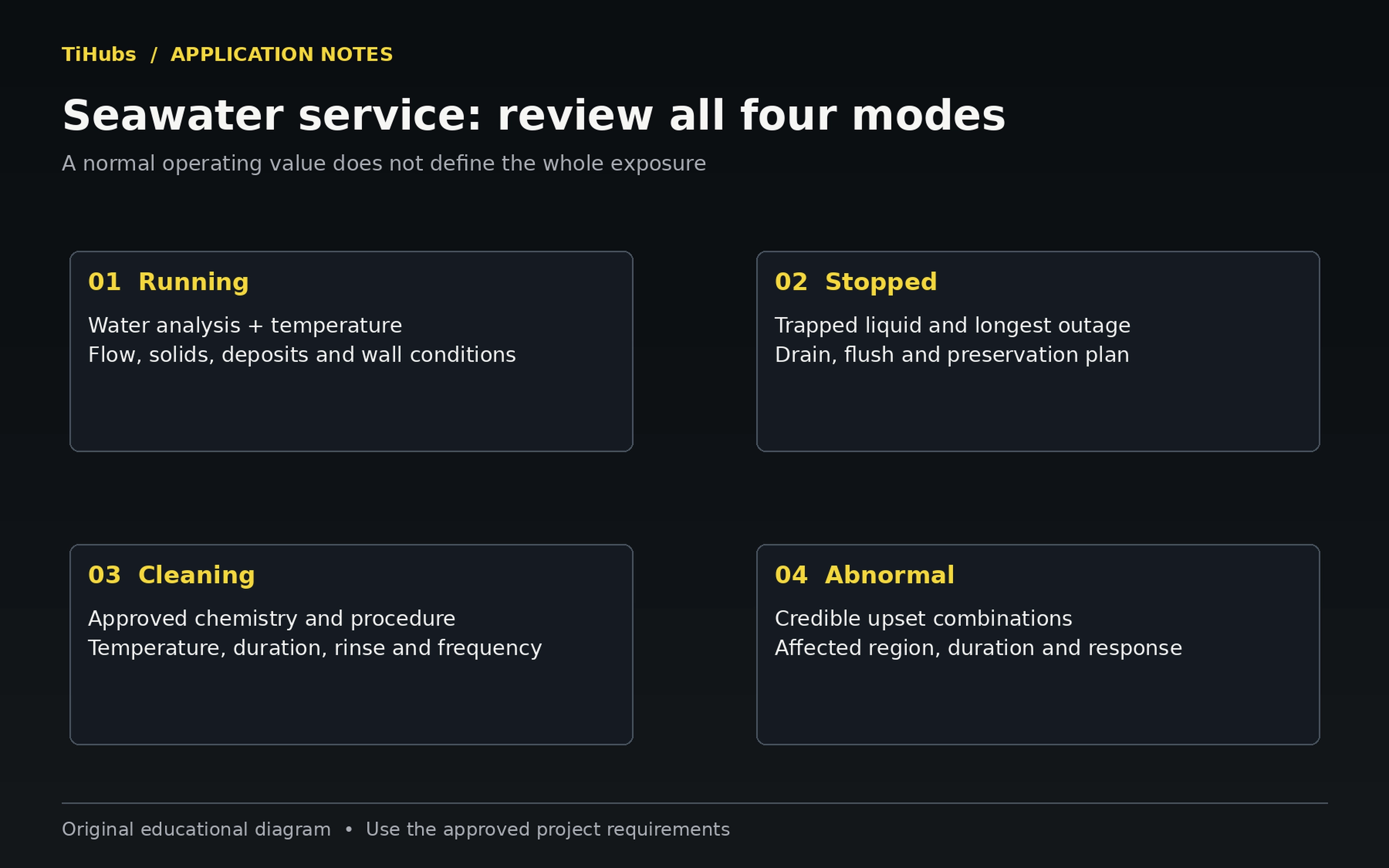
Prepare separate columns for normal, maximum, startup, shutdown, cleaning and upset conditions. Include duration and frequency: a short excursion repeated every shift is a different requirement from a single historical event. Identify where the value applies—bulk liquid, heated wall, inlet, outlet or stagnant pocket.
An equipment supplier should receive the seawater or brine analysis, treatment additions and credible contaminants. “Salt water” does not establish concentration, pH, oxidizing conditions or cleaning compatibility. If the composition changes during evaporation or recirculation, provide the range and the method used to express it.
The cleaning review should identify the product or chemical specification, dilution, temperature, contact time, rinsing and frequency. This is a compatibility review, not an invitation to select an acid cleaning recipe from a generic article. Ask the cleaning supplier and equipment engineer to confirm the approved procedure for the actual assembly, seals and metals.
Technical buying guideFour modes, one material review
Operating, stopped, cleaning and upset conditions belong in the same service envelope.
04 / Metal interfaces
Review the connections around the titanium
Replacing one component changes the installation boundary. Provide a simple connection drawing showing neighboring metals, fasteners, gaskets, supports, electrical bonding and any cathodic protection system. Ask who is responsible for reviewing the resulting assembly.
The same drawing should show inspection and replacement access. A connection hidden behind insulation may carry a very different maintenance cost from an accessible flange. If a nonmetallic isolation detail is proposed, record its pressure, temperature and installation requirements and the means of checking it after assembly. Do not describe isolation as a universal fix without reviewing the complete electrical and mechanical arrangement.
Specify the acceptance boundaries: raw material, fabricated component, joint procedure, assembled leak test and site commissioning. A tube mill certificate does not establish that the installed tubesheet connection is acceptable. Conversely, a successful assembly leak test does not identify the material chemistry.
05 / Design review
Do not make a kilogram-for-kilogram substitution
When comparing quotations, require both options to meet the same equipment duty and approved design basis. A metal change can require review of wall thickness, stiffness, vibration, support spacing, thermal movement, joint details and fabrication method. Equal outside dimensions do not automatically establish equal performance.
For heat transfer equipment, ask for a thermal and hydraulic comparison using the proposed wall, geometry, fouling allowance and operating conditions. A raw thermal-conductivity figure cannot predict the performance of a complete exchanger. The useful deliverable is a design calculation tied to the actual proposed configuration.
Item
Freeze before comparing prices
Duty
Required capacity, fluids, temperatures and allowable pressure drop
Mechanical basis
Governing design requirements and responsible approving party
Geometry
Finished dimensions, wall basis, interfaces and tolerances
Material
Full grade, product standard, edition and delivery condition
Fabrication
Joining route, procedure qualification and inspection scope
Commercial scope
Quantity, spares, installation, packing, freight and exclusions
Where only raw stock is being purchased, keep the scope explicit. TiHubs can coordinate material supply and inspection against an agreed specification; approval of the pressure equipment or complete system remains with the designated engineering authority.
Application detailMeasure against the approved requirement
Record dimensional basis, inspection locations and the identity of the inspected material. AI illustration; not production or inspection evidence.
06 / Maintenance
Maintenance assumptions belong in the comparison
Ask what the operator must do to achieve the service assumptions used in the proposal. Include inspection frequency, cleaning access, spare parts, draining or flushing during shutdown and replacement labor. A material choice that depends on a maintenance action must identify who performs it and how completion is recorded.
Keep corrosion, fouling and mechanical damage separate in maintenance records. A reduction in corrosion repairs does not prove that cleaning can stop. Likewise, changing the alloy may not resolve vibration, poor support, tube-end damage or an unsuitable assembly procedure.
Create a baseline before commissioning: material and joint records, initial inspection results, photographs with location references and the approved operating envelope. At later inspections, compare like-for-like locations and methods. This makes a future replacement RFQ much more informative than a collection of unlabelled photographs.
07 / Cost comparison
Compare ownership cost with visible assumptions
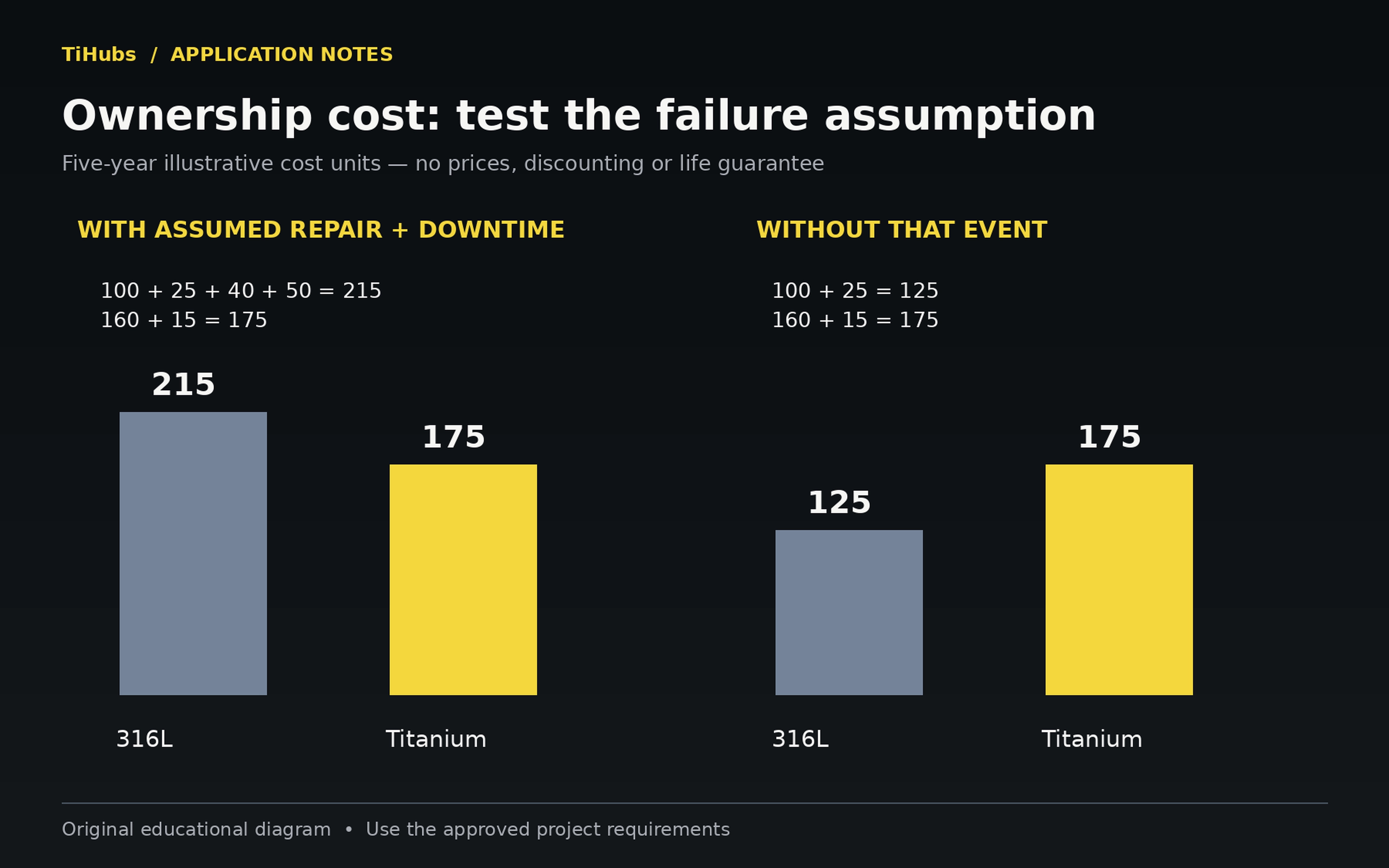
Use a common evaluation period and list each cost category. A simple screening model is initial installed cost + planned maintenance + expected repairs/replacement + downtime cost − residual value. For a formal business case, the buyer’s finance team should apply its chosen timing, discounting and uncertainty method.
The example below uses invented cost units solely to show the arithmetic. It is not a market quotation, a corrosion prediction or a service-life guarantee. Both alternatives are assumed to meet the same approved duty; the maintenance and repair events must be replaced with project evidence.
Five-year scenario
316L option
Titanium option
Initial installed cost
100
160
Planned maintenance, total
25
15
One assumed repair event
40
0
Downtime associated with that event
50
0
Total, undiscounted
215
175
Total if that repair and downtime never occur
125
175
This example deliberately changes the conclusion when the assumed event disappears. Titanium is 40 units lower in the first scenario and 50 units higher in the second. The decision therefore depends on the credibility and consequence of the failure scenario, not on presenting one material as always cheaper over time.
Technical buying guideOwnership cost depends on the assumptions
Illustrative five-year cost units, undiscounted. No market prices or service-life prediction.
In this simplified example, the titanium option needs more than 50 units of avoided repair and downtime costs to recover its remaining premium after planned maintenance. That threshold is an arithmetic result, not a failure probability. Build low, expected and high cases using maintenance records and production exposure. Avoid counting the same outage twice under both lost output and a separate downtime allowance.
08 / Purchasing cases
Three purchasing situations that need different answers
An accessible, intermittently used component
The purchase price may dominate if the component is easy to inspect and replace and the proposed 316L design has a documented record under the actual duty. Request the operating limits and maintenance assumptions in writing. Compare replacement access and spare availability rather than importing the economics of a critical offshore exchanger into a small accessible part.
A continuously operated seawater exchanger
The value of avoiding an unplanned outage may dominate. Request a review of tubes, tubesheet interfaces, neighboring metals, operating chemistry and cleaning. Price the complete replacement scope, including site work and commissioning. A premium tube material with an unresolved joint problem does not deliver a complete reliability solution.
A replacement after repeated leaks
Do not send only the old material designation. Provide leak locations, time in service, repairs, water analysis, cleaning changes and a damaged sample if available. Ask for the failure mechanism to be reviewed before confirming the replacement design. If the cause remains uncertain, separate a temporary supply decision from a long-term corrective action.
09 / Required evidence
What to request with the quotation
Require a compliance table with three statuses: complies, deviates or needs clarification. Each deviation should identify the affected drawing or purchase clause and its consequence. Silence should not mean acceptance of an undefined assumption.
Full material designation, product standard and edition, condition and manufacturing route.
Dimensions, wall basis, tolerances, quantity and any proposed changes to the original design.
Material test certificate, heat/lot identification and agreed inspection documents.
Fabrication and joint responsibilities, assembly testing and site-work exclusions.
Lead time by stage, spares, packaging and handling requirements.
The service conditions and maintenance assumptions on which the proposal depends.
A supplier comparison is much easier when every vendor answers the same schedule. Resolve technical exceptions before negotiating a final commercial ranking; otherwise the lowest quote may simply contain the smallest scope.
10 / Operating checklist
Build your seawater service checklist
Complete the fields below with the information currently available. Add units and distinguish measured data from design values. Where a value is unknown, state what record or sample can be supplied. The generated brief is intended for a material and supply review, not as a completed equipment design.
Build your operating-condition checklist
Choose the product and add the information you have. Copy the resulting brief or send your requirements to TiHubs. Submitting an enquiry does not place an order.
11 / FAQs
Frequently asked questions
Is Grade 2 titanium always better than 316L in seawater?
No. Suitability and value depend on the actual duty, component design, inspection access and cost of failure. Compare an approved technical scope and explicit maintenance assumptions before comparing ownership costs.
Can titanium be described as maintenance-free?
No. Material compatibility does not eliminate fouling, joint inspection, mechanical damage or the need to maintain the surrounding equipment. State what maintenance is included in each cost scenario.
Can I replace a 316L part with titanium at the same dimensions?
Only after the responsible designer reviews the substitution. Material properties, structural behavior, interfaces and fabrication can change; matching a drawing envelope is not complete engineering approval.
Is a seawater inlet temperature enough for an RFQ?
No. Include maximum and upset values, local wall conditions where relevant, outlet conditions, stagnant periods and cleaning. State the location and meaning of every temperature supplied.
Does a mill certificate approve the complete assembly?
No. It documents specified material results and identity within its scope. Fabrication, joining, assembled testing and equipment design require their own records and acceptance.
Should every titanium replacement use Grade 7?
No. The need for a different grade should follow the corrosion review and product requirements. Request evidence for the proposed upgrade and its limits rather than treating it as automatic insurance.
Can TiHubs quote from an old sample?
A sample can help identify geometry and plan measurements. Provide the original drawing and service history where possible; wear, corrosion or previous repairs can make a used sample an unreliable definition of the new part.
What is the fastest way to get comparable quotations?
Send one controlled scope with service conditions, material alternatives, dimensions, tests and commercial boundaries. Ask each supplier to identify deviations and assumptions against that same document.
12 / Key takeaways
The buying decision in five checks
Define continuous, intermittent, stagnant, cleaning and upset exposure separately.
Assess joints and neighboring materials together with the proposed titanium part.
Require the same approved equipment duty and acceptance scope from both options.
Test ownership-cost assumptions with more than one repair and downtime scenario.
Connect the RFQ to drawings, service records and a named engineering approval process.
TIMET — Corrosion Resistance of Titanium. Manufacturer technical background. Historical service examples must not be converted into universal limits or warranties.
The checklists, purchasing scenarios and cost arithmetic are original TiHubs procurement examples. Images illustrate product forms and do not establish material grade, factory capability or inspection results. Technical references checked November 7, 2026; use the editions and acceptance requirements agreed for the order.
Ti
About TiHubs
TiHubs coordinates titanium materials and custom supply from Baoji, China. Our founder’s 20 years in titanium inform a specification-led sourcing approach: clarify the product, manufacturing and acceptance requirements before quotation. Learn about our sourcing role.
Contents
TiHubs
Talk to TiHubs
Ask about titanium materials, grades or custom parts.
Enter your email to start chatting.
We use your email to respond to your enquiry. Your conversation is stored on this website.
Our team is away right now. Leave your enquiry and we will follow up by email.