Baoji High-tech Zone, ChinaTitanium sourcing · One contact



TB17 Titanium Alloy · Metastable beta titanium alloy
TB17 Titanium Alloy. Review strength in every required direction.
Enquire about TB17 bar and forging stock for demanding structural projects, with transverse properties, structure uniformity and the strength–toughness balance built into acceptance.
Start with a specification, drawing or application. We’ll help identify the details still needed.
Material review. Supply coordination.
One contact in Baoji, China.
TB17 Titanium AlloyTi-Al-Mo-Cr-V-Nb-Sn-Zr alloy system
Metastable beta titanium alloyHigh-strength structural stock & directional acceptance
One contact20 years of founder experience · 100+ Baoji factories
01 / Product forms
Find your TB17 product.
Choose a material form or application. Send the dimensions, service conditions and required records so we can match the manufacturing route to your order.
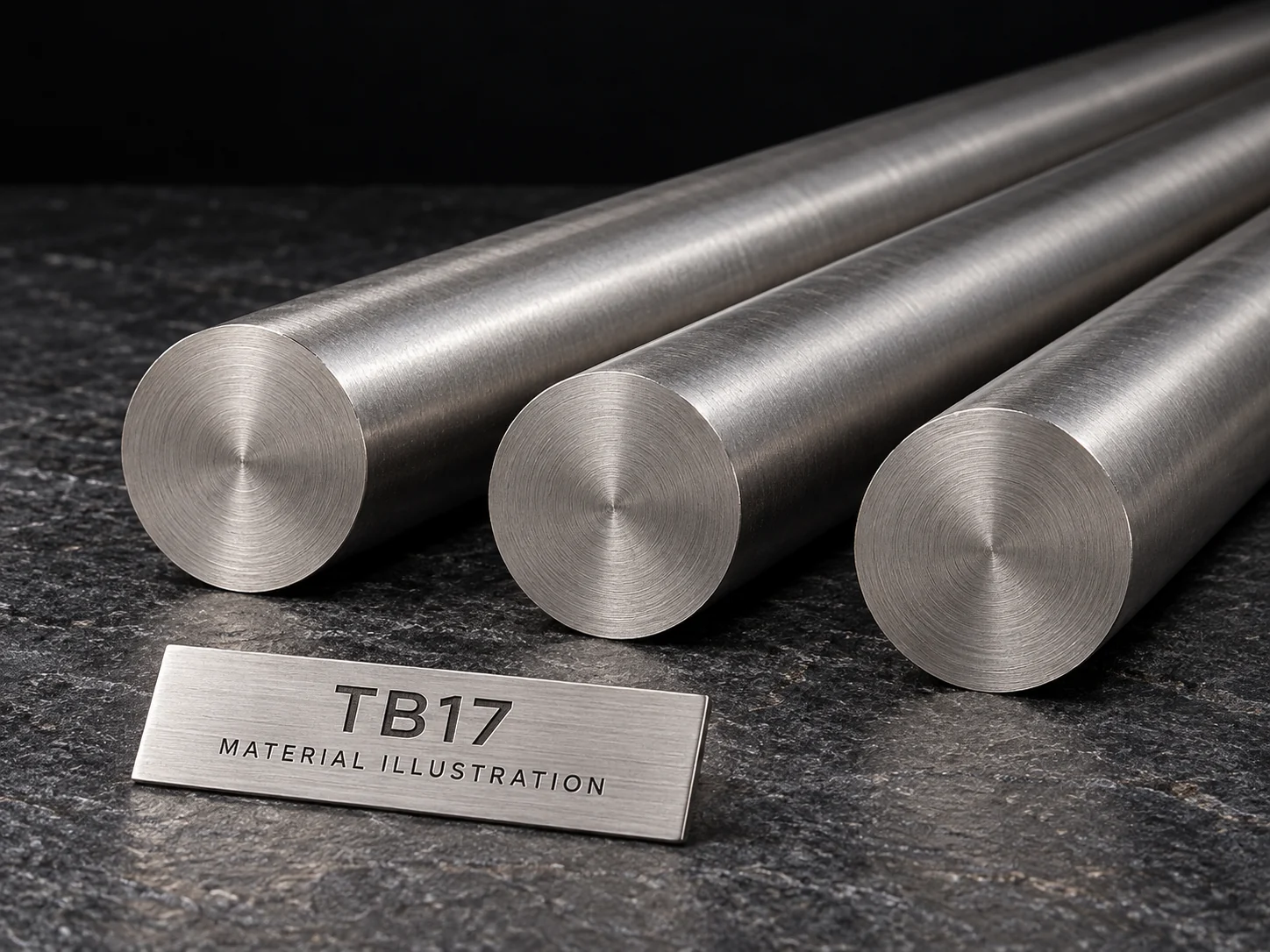
01 / 06
TB17 Titanium Alloy
TB17 high-strength alloy bar
Round stock for drawing-controlled structural machining and conversion.
- Specification
- Approved grade-specific product specification, drawing revision and delivery condition; confirm supply feasibility.
- Size & delivery
- Diameter, usable length, straightness, surface allowance and final delivery condition.
- Manufacturing review
- Review the required longitudinal and transverse properties alongside the intended downstream route.
- Inspection priorities
- Full chemistry, heat identity, structure, ultrasonic coverage and representative directional tests.
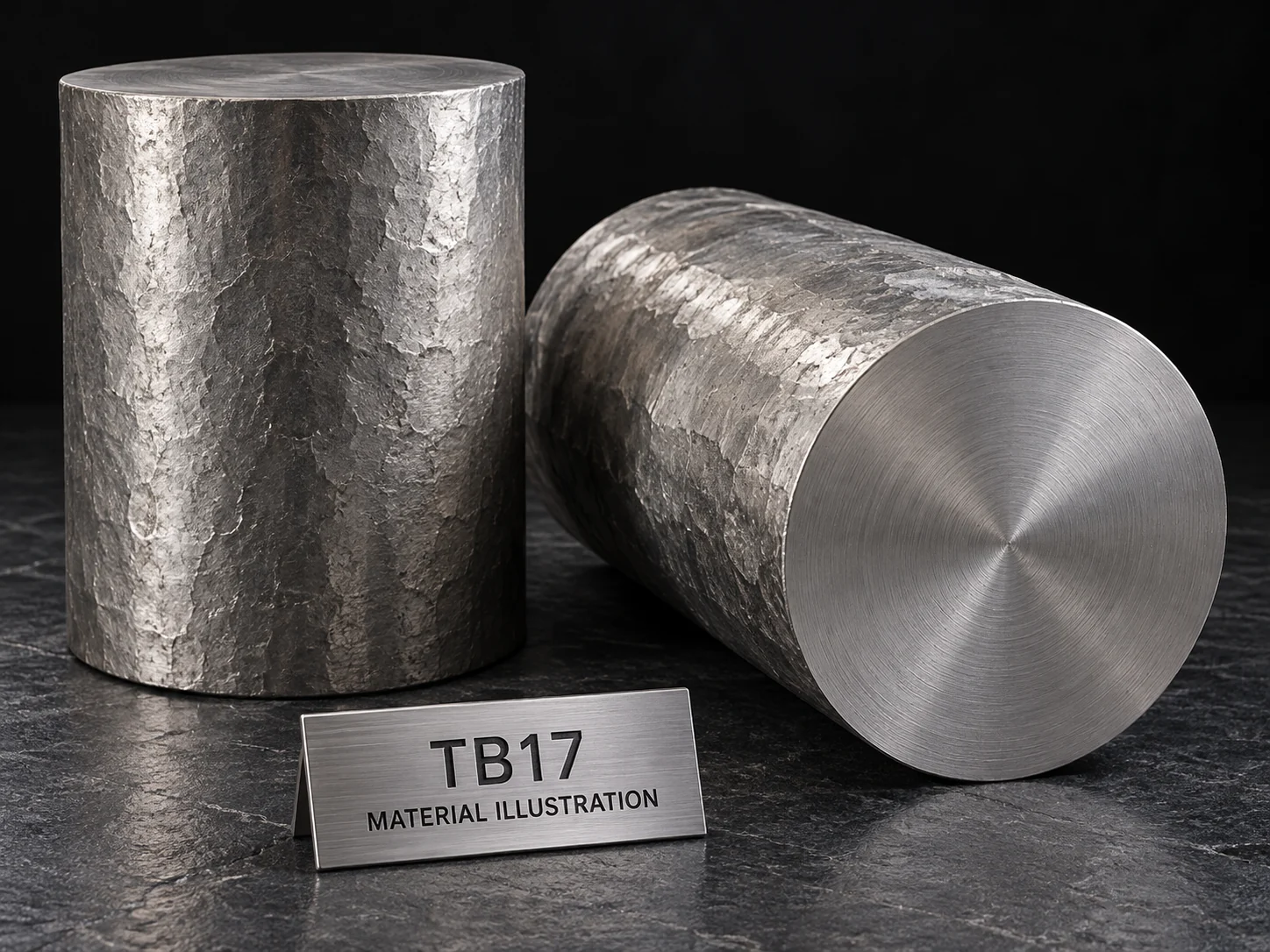
02 / 06
TB17 Titanium Alloy
TB17 forging billet
Starting stock for an approved structural-forging programme.
- Specification
- Approved grade-specific product specification, drawing revision and delivery condition; confirm supply feasibility.
- Size & delivery
- Billet envelope, crop allowance, surface condition and required converted section.
- Manufacturing review
- Define the forging stage, homogenisation/working history requirements and downstream process responsibility.
- Inspection priorities
- Agree internal soundness, structure uniformity and evidence linking the billet to the subsequent forging.
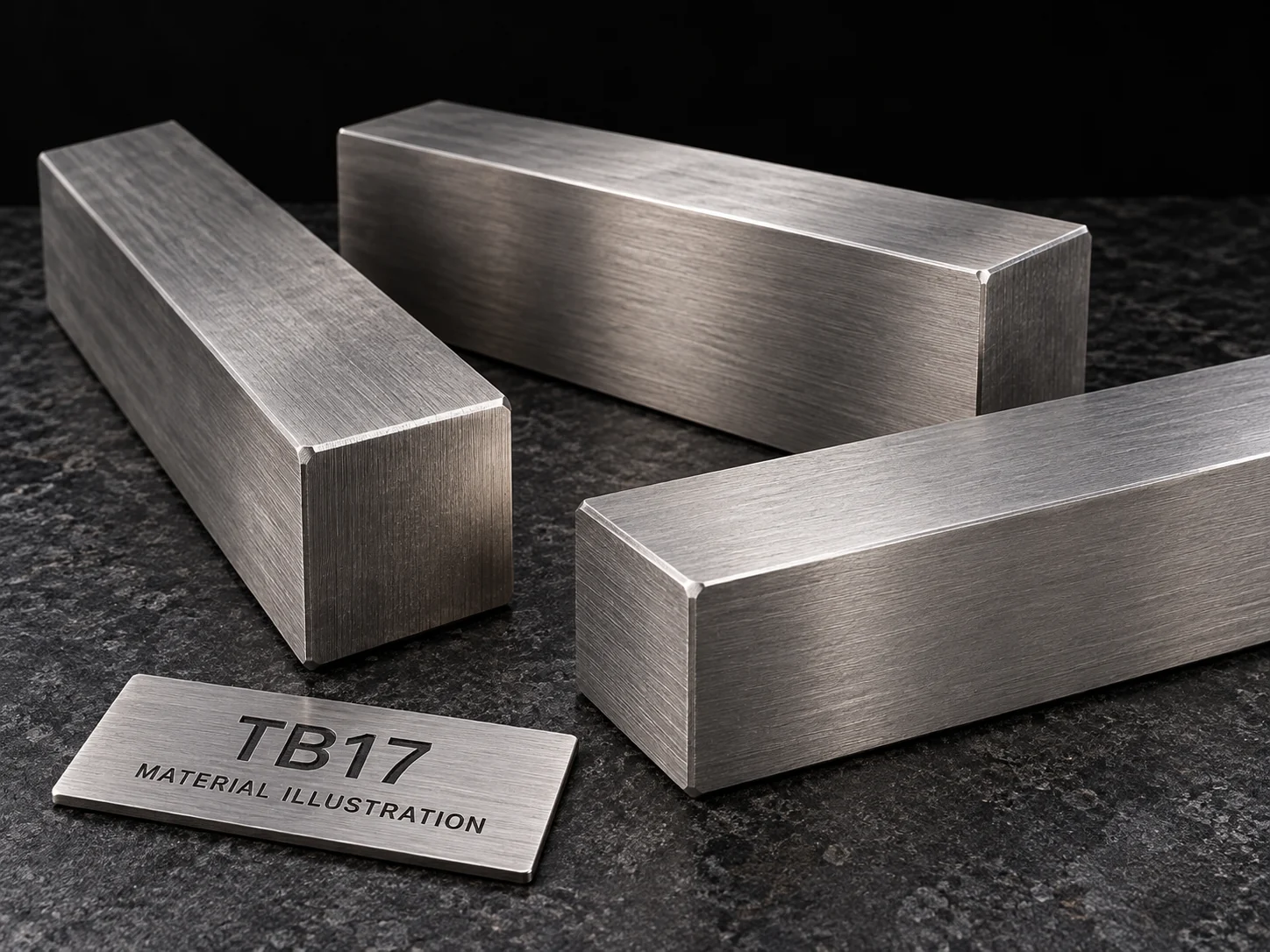
03 / 06
TB17 Titanium Alloy
TB17 cut machining blanks
Cut pieces with source and direction retained for structural machining.
- Specification
- Approved grade-specific product specification, drawing revision and delivery condition; confirm supply feasibility.
- Size & delivery
- Blank envelope, orientation, saw allowance, piece count and reserved test stock.
- Manufacturing review
- Locate each blank within the source bar or forging and relate its direction to the final part.
- Inspection priorities
- Dimensional checks, surface condition and unbroken heat-to-piece certificate linkage.
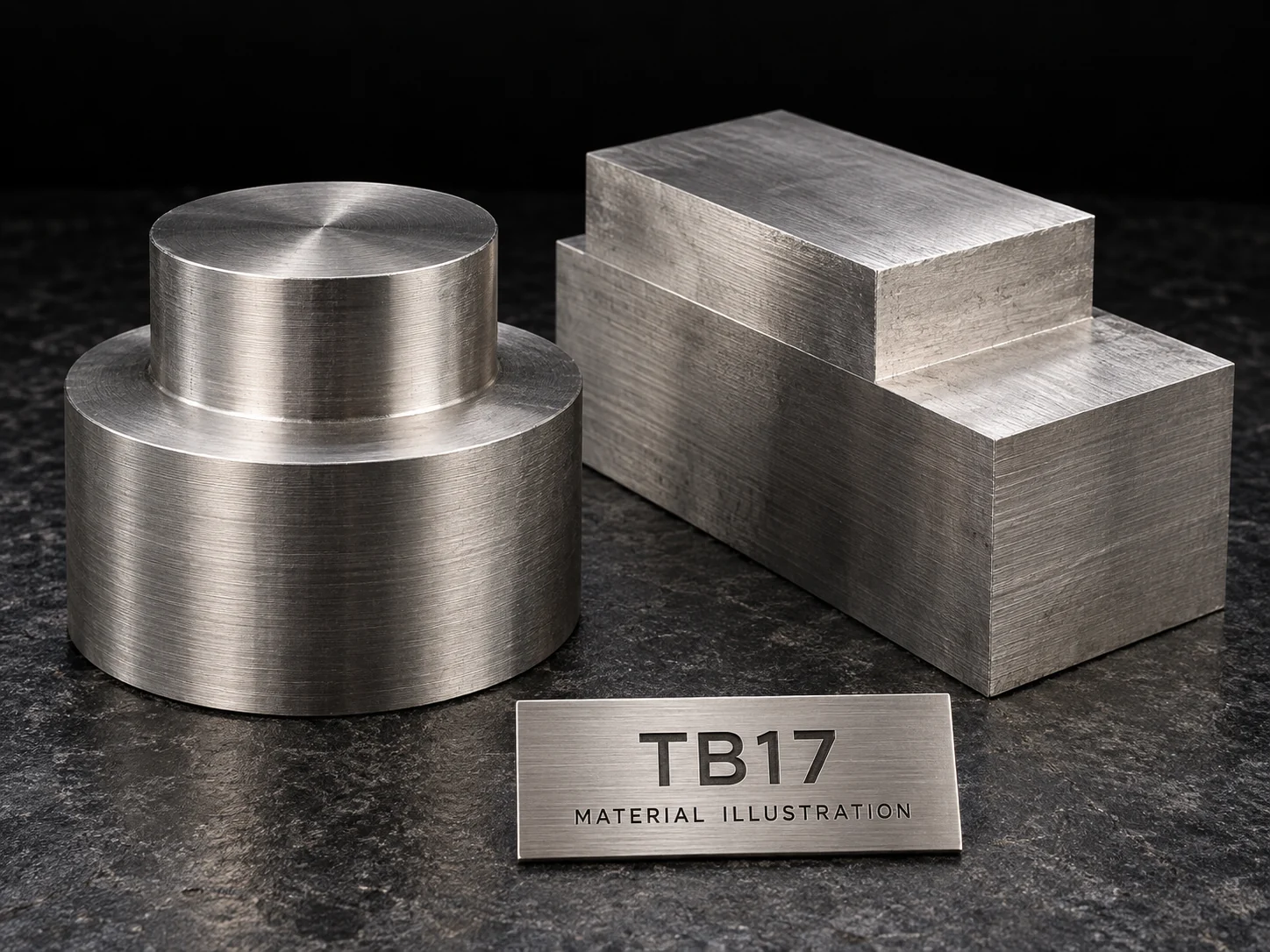
04 / 06
TB17 Titanium Alloy
TB17 forged preform enquiries
Drawing-defined preforms for a review of process feasibility and acceptance.
- Specification
- Approved grade-specific product specification, drawing revision and delivery condition; confirm supply feasibility.
- Size & delivery
- Supply preform and final geometry, section transitions and critical loading directions.
- Manufacturing review
- Discuss flow, reheating sequence, final treatment, sample zones and NDT access with the responsible manufacturer.
- Inspection priorities
- Specify structure and directional mechanical acceptance at the agreed supplied stage.
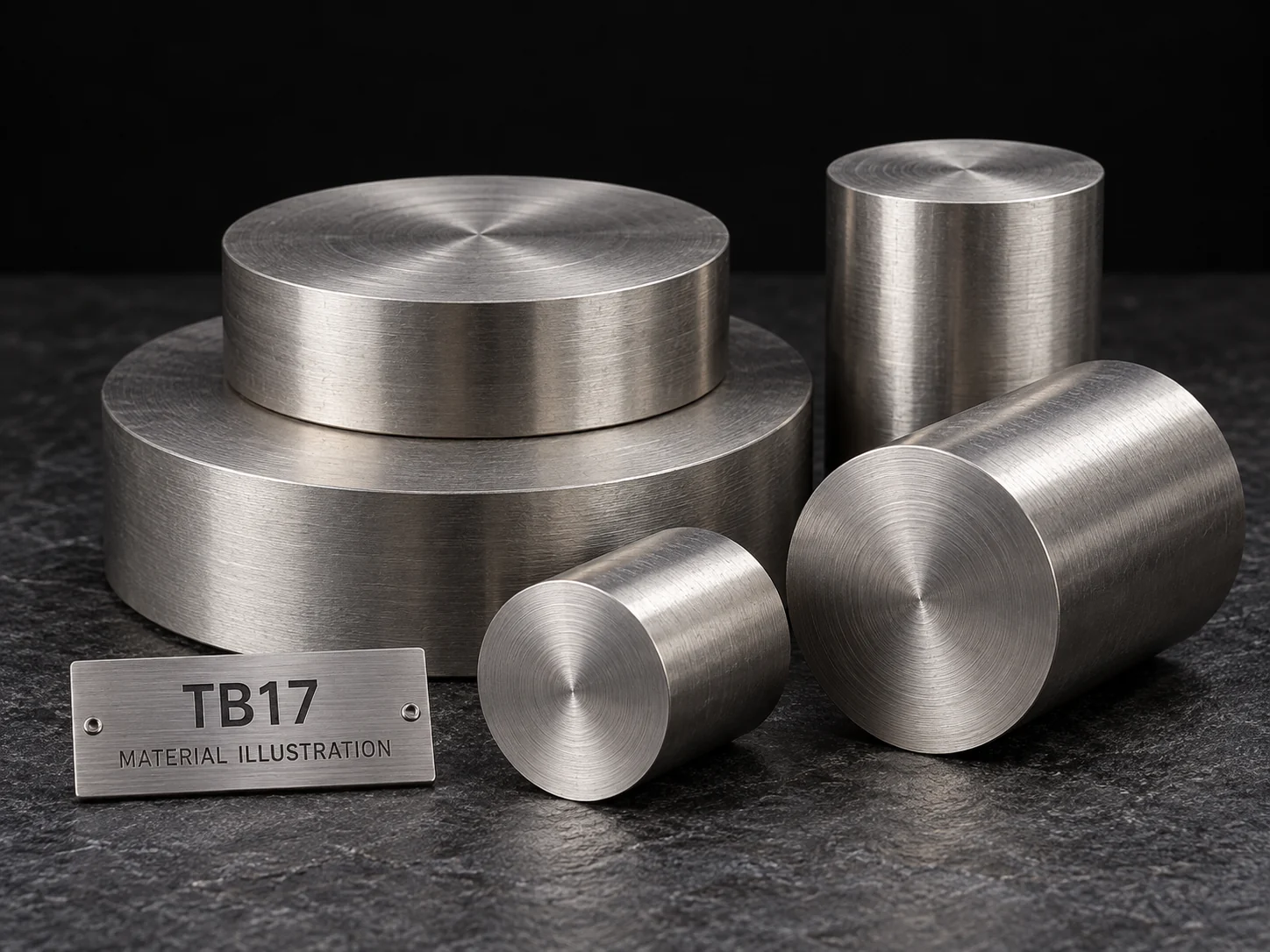
05 / 06
TB17 Titanium Alloy
TB17 sectioned forging stock
Identified sections for qualification, machining or approved further processing.
- Specification
- Approved grade-specific product specification, drawing revision and delivery condition; confirm supply feasibility.
- Size & delivery
- Source location, extraction direction, section thickness and remaining machining allowance.
- Manufacturing review
- Confirm whether sectioning is before or after final treatment and whether the material represents the intended component.
- Inspection priorities
- Preserve location maps, examination records and the agreed tests after cutting or treatment.
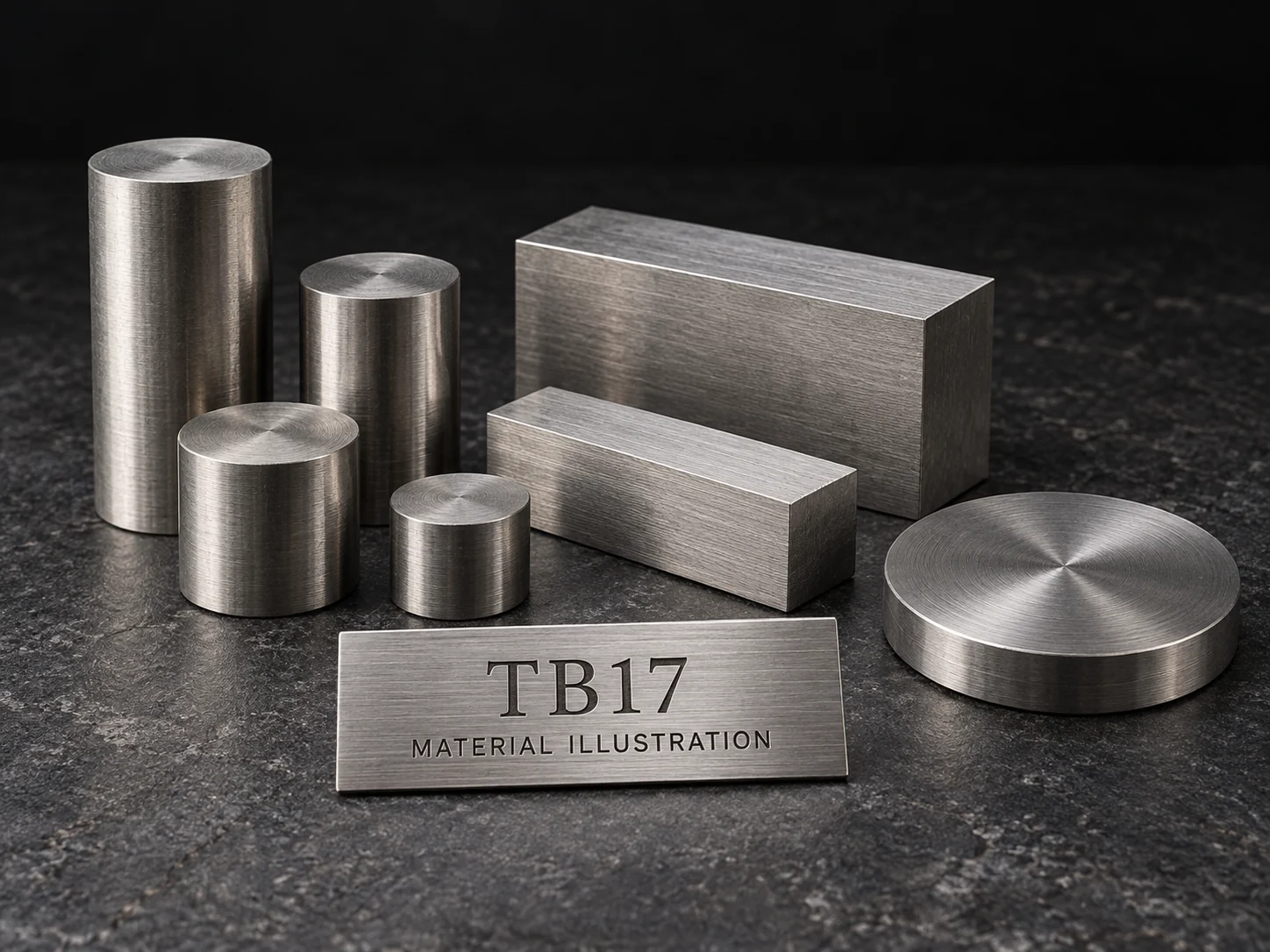
06 / 06
TB17 Titanium Alloy
TB17 directional test stock
Matched material for longitudinal, transverse and toughness evaluation.
- Specification
- Approved grade-specific product specification, drawing revision and delivery condition; confirm supply feasibility.
- Size & delivery
- Specimen blank dimensions, orientations, depths, quantities and retained reference stock.
- Manufacturing review
- Match heat, section and treatment to the proposed production route and allow for valid specimen geometry.
- Inspection priorities
- Report every required direction separately with test method, condition and source-location traceability.
Images illustrate material forms and application possibilities. Reference markings identify specification options; they do not establish dual certification, stock availability or approval of finished equipment.
Define the shape. Share the service.
These details help turn a material enquiry into a comparable quotation.
01 / Drawing review
High-strength structural material projects
Bar, billet and preforms with matched qualification stock. Agree representative test locations, directional acceptance, internal examination and complete heat-to-part records.
Discuss your drawing02 / Drawing review
Transverse-property acceptance
Bar or forging sections sized for the required transverse specimens. Report each direction separately and retain the extraction map; do not infer transverse results from a longitudinal certificate.
Discuss your drawing03 / Drawing review
Strength–toughness balance
Same-heat and same-condition stock for tensile and toughness testing. Link all results to the relevant heat-treatment lot, section and sampling plan, including validity requirements.
Discuss your drawing02 / Material identity
What is TB17 titanium?
TB17 is a Chinese metastable beta titanium alloy investigated for high-strength, high-toughness structural use. Its distinct procurement issue is directional consistency: a strong longitudinal test does not establish acceptable transverse behaviour or fracture toughness. Primary forging research addresses anisotropy and the relationship between thermal-mechanical history and the final property balance. Enquiries should therefore define representative samples and the complete final condition before discussing production scope.
Specify the exact standard edition, form and delivery condition. Nominal chemistry is only one part of an order; strength, microstructure, dimensional acceptance and traceability also need to be defined.
| Review item | Order basis | What to confirm |
|---|---|---|
| Directional properties | Longitudinal and transverse acceptance | Report the required orientations separately with extraction locations and final condition. |
| Strength–toughness balance | Same material state and representative section | Do not combine property values from different heats, treatment states or specimen directions. |
| Structure uniformity | Approved forging and examination plan | Address section variation and the relationship between working history and final samples. |
| Heat-treatment traceability | Heat and treatment-lot identity | Record the contracted treatment and any subsequent processing before final testing. |
| Repeatability | Controlled source and process changes | Define which changes trigger notification, review or additional qualification testing. |
| Selected element · wt % | Reference composition |
|---|---|
| Grade identity | TB17 under the ordered standard |
| Principal alloying system | Al, Mo, Cr, V, Nb, Sn and Zr |
| Complete element limits | Use the approved chemistry specification |
| Interstitial and residual limits | Report the complete ordered analysis |
| Titanium · Ti | Base metal |
This table identifies the alloy system only; it intentionally does not present a research heat as a universal chemistry range. The purchase order must specify the complete TB17 composition standard, edition and analysis acceptance.
TB17 and other beta alloys
TB6, TB10, TB15 and TB17 are distinct grade routes. The beta classification alone does not establish composition, treatment or property equivalence.
Longitudinal strength and full acceptance
A longitudinal tensile result cannot establish transverse ductility or toughness. Specify each required direction, location and test rather than relying on one headline value.
Industrial supply and project qualification
Published producer disclosures confirm industrial TB17 bar activity. They do not establish TiHubs inventory, approval for your component or availability in every section.
03 / Application priorities
TB17 in application.
Review each main use through its service conditions, material choice, manufacturing route and acceptance plan. These are sourcing discussions; approved drawings and qualification requirements govern the final component.
Application review / 01
High-strength structural material projects
TB17 enquiries should describe the structural requirement as a balance of properties. Raising tensile strength without maintaining the required ductility and toughness may not satisfy the design.
Products & manufacturing
Bar, billet and preforms with matched qualification stock.
Service & design review
Provide design-controlled strength, ductility and toughness requirements, critical directions and the final condition. Identify the drawing and approval authority.
Purchase & inspection priorities
Agree representative test locations, directional acceptance, internal examination and complete heat-to-part records.
Application review / 02
Transverse-property acceptance
The direction least represented by routine testing can be decisive for a loaded component. TB17 forging research specifically highlights the need to address anisotropy.
Products & manufacturing
Bar or forging sections sized for the required transverse specimens.
Service & design review
State longitudinal, transverse and any short-transverse requirements, specimen locations and final loading directions. Resolve section-size limitations before ordering.
Purchase & inspection priorities
Report each direction separately and retain the extraction map; do not infer transverse results from a longitudinal certificate.
Application review / 03
Strength–toughness balance
Strength and resistance to crack extension must be assessed in the same relevant condition. Results from different thermal states cannot simply be combined into one material claim.
Products & manufacturing
Same-heat and same-condition stock for tensile and toughness testing.
Service & design review
Define the test methods, temperature, orientation and acceptance basis for both properties. Specify whether the requirement applies to mill stock or a final forging.
Purchase & inspection priorities
Link all results to the relevant heat-treatment lot, section and sampling plan, including validity requirements.
Application review / 04
Forging-route qualification
A new geometry can change deformation distribution and the resulting structure. The manufacturing review should connect billet preparation, forging and final acceptance.
Products & manufacturing
Billet and drawing-controlled structural preforms.
Service & design review
Provide the component envelope, flow-sensitive regions, section changes and process qualification requirements. Identify any manufacturing changes needing prior review.
Purchase & inspection priorities
Agree macro- and microstructure examination, sample locations and the required evidence after the contracted forging stage.
Application review / 05
Section and structure uniformity
A large section requires attention to the difference between surface and interior material. Uniformity should be defined by an inspection and sampling plan.
Products & manufacturing
Large-section bar, billet and sectioned forging stock.
Service & design review
State critical depths, directions, final machining envelope and permitted structure variation under the approved specification.
Purchase & inspection priorities
Specify internal examination coverage, structure sampling and the relevant centre-to-surface property checks.
Application review / 06
Final heat-treatment control
TB17 properties depend on the condition in which it is tested and used. The supplied stage must be stated clearly when the customer plans additional thermal processing.
Products & manufacturing
Bar, preforms and qualification sections in an agreed state.
Service & design review
Define the final approved treatment, furnace control records, section constraints and responsibility for any later processing. Do not apply a research schedule without qualification.
Purchase & inspection priorities
Require treatment-lot traceability, representative testing and dimensional checks after the contracted operations.
Application review / 07
Machining blanks with retained evidence
Cutting and machining should preserve the location and orientation information needed to interpret the material certificate. This is especially useful when a part is cut off-axis from bar or forging stock.
Products & manufacturing
Cut blanks and sectioned forgings with transferred identification.
Service & design review
Provide the nesting plan, part axes, datum scheme, machining allowance and the point at which any witness material is removed.
Purchase & inspection priorities
Agree identification transfer, orientation marking and remaining inspection access before final material removal.
Application review / 08
Repeat-lot and change review
A qualified initial lot does not make every later route equivalent. Procurement should define which process and section changes must be reviewed before a repeat delivery.
Products & manufacturing
Consistent bar or billet lots and retained comparison stock.
Service & design review
Identify the approved source route, section range, treatment condition and test plan. Review changes in melt practice, forging sequence, section or final treatment with the customer.
Purchase & inspection priorities
Keep lot records comparable and require notification, disposition and any additional testing for agreed changes.
Material references and applicable product standards are listed below. Select the delivery condition and acceptance plan for the specific product and approved application.
TB17 procurement checklist
Connect the application to the material order.
A useful specification connects the intended component, the supplied stock and the acceptance evidence. Share the drawing and known requirements first.
Define the application
Provide design-controlled strength, ductility and toughness requirements, critical directions and the final condition. Identify the drawing and approval authority.
Define the supplied stage
Bar, billet and preforms with matched qualification stock. Distinguish raw stock, converted blanks and finished parts. Define who controls subsequent processing.
Define the acceptance evidence
Agree representative test locations, directional acceptance, internal examination and complete heat-to-part records.
Example: a useful TB17 material enquiry
TB17 high-strength alloy bar; required dimensions and quantity; standard and drawing revision; delivery condition; intended downstream process; mechanical, structural and dimensional acceptance; traceability, destination and required date.
Identify the approved product specification and any project-specific qualification. The grade designation and chemistry standard alone do not define component acceptance.
Discuss your material requirement ↗04 / Standards & documentation
Match the standard
to the product.
Choose the specification by product form, material condition and application. Identify the required edition on the order; a chemistry standard alone does not define product acceptance or application approval.
| Product / review | International / project route | Chinese reference | Clarify before quotation |
|---|---|---|---|
| Identity & chemistry | Approved product and project specification | GB/T 3620.1-2016View PDF ↗ | Review the complete chemical limits and product requirements; nominal alloy names do not establish automatic interchangeability. |
| TB17 forging anisotropy research · CN115870441A | TB17 forging anisotropy research · CN115870441APublisher reference ↗ | Compare the complete ordered Chinese requirements | Shaanxi Hongyuan Aviation Forging, publication 2023-03-31. Primary research on anisotropy and strength–toughness matching; process examples are not universal delivery properties. |
| TB17 hot-deformation research | TB17 hot-deformation researchPublisher reference ↗ | Compare the complete ordered Chinese requirements | Journal of Aeronautical Materials. Research uses forged TB17 bar; its experimental composition is not presented here as a universal purchase limit. |
| TB17 industrial bar context · issuer disclosure | TB17 industrial bar context · issuer disclosurePublisher reference ↗ | Compare the complete ordered Chinese requirements | Original issuer disclosure hosted by the Shanghai Stock Exchange, 2024. Records TB17 bar industrialisation context; it does not certify TiHubs stock or the customer’s component. |
| CN115870441A · English translation | Project and product requirements remain separately defined | CN115870441A · English translationView PDF ↗ | Forging method to improve anisotropy and strength-toughness matching in ultra-high-strength, high-toughness beta titanium alloys. Original publication: 2023-03-31. TB17 forging research on directional anisotropy and strength-toughness matching, with the full example, two property tables and two micrographs. English reference translation; original Chinese publication controls. Not a purchase specification. |
| Drawing-based blanks & parts | Approved drawing and controlled manufacturing plan | Agreed product / project specification | Define the supply stage, conversion route, heat treatment, structure, NDT, dimensions and traceability. Material certification is separate from finished component qualification. |
Agree the order basis.
The purchase order must identify the required revision, grade, product form, condition and inspection. Reference documents do not replace design approval, manufacturing qualification or application-specific acceptance.
Request the controlled specification revision for your order. Any substitution, equivalence or dual-certification claim requires a documented comparison and agreement.
05 / Order coordination
Know the scope
before ordering.
Our founder’s 20 years in titanium inform the questions we ask before quotation and the supply options we review with you.
A quotation you can evaluate
Agree the grade, standard edition, dimensions, tolerance, condition and quantity before comparing prices.
- Identify whether inspection, samples and tooling are included.
- Confirm packaging, transport and delivery terms.
- Record items that still need technical confirmation.
Acceptance agreed before supply
Confirm material identity, delivery condition, heat-to-piece traceability, dimensional checks and required testing before production. For converted parts, define inspection after forging, heat treatment and machining, including the specified microstructure and NDT scope.
Independent inspection can be discussed with its scope, timing, acceptance criteria and cost agreed for the order.
Delivery with clear milestones
Review the proposed lead time, approvals, production sequence and dispatch requirements. For several product forms, coordinate document and packing readiness together.
Material substitutions and technical changes require written approval. A schedule deviation should identify the impact, decisions needed and next steps.
One contact when an issue arises
Contact TiHubs with the order reference, affected items and supporting photos or inspection records.
We record the issue, review it against the agreed requirements and coordinate the next steps with the relevant manufacturing parties.
01 / Material identity
Material records
Grade, standard, test results and heat or batch identity matched to the supplied items.
02 / Agreed acceptance
Inspection records
Dimensional and testing records for the agreed scope, including critical drawing requirements.
03 / Ready for dispatch
Dispatch records
Item identification, packing list, protective packaging and required shipment documents.
06 / Questions before sourcing
Before you specify
TB17 Titanium Alloy.
A clear material designation is the beginning. Product form, specification revision, material condition and acceptance complete the requirement.
A useful first enquiry
- Product and specificationProduct form, standard edition, dimensions and material condition.
- Order and deliveryQuantity, destination and any required delivery date.
- Acceptance requirementsDrawing revision, inspection, certificates and packaging.
Not every detail is finalized? Send the information you have. We can help identify the questions to resolve before quotation.
What happens next: requirement review, technical clarification, then a supply proposal and quotation.
What is the main TB17 purchasing focus?
High-strength bar and forging stock with controlled directional properties and a defined strength–toughness balance. Supply scope is reviewed against the actual specification and section.
Is TB17 the same as TB15 or TB10?
No. They are different grade routes even though each is discussed within beta or near-beta titanium families.
Does TB17 have a confirmed common US equivalent?
No direct US equivalent is asserted on this page. Specify TB17 and the complete approved material and product requirements.
Why are transverse tests important?
Forging history can produce directional differences. Transverse ductility and toughness must meet the requirements relevant to the part rather than being inferred from longitudinal strength.
Can one strength result represent all conditions?
No. Mechanical results need the heat, section, sample location, direction and heat-treatment condition to be meaningful.
Do published industrial applications certify my order?
No. Producer disclosures establish context, while your part still needs the required supplier, process, material and component qualification.
Which chemistry limits should I order?
Use the complete TB17 chemistry standard and edition approved for the project, including interstitials, residuals and analysis rules. Do not substitute one research heat’s analysis.
Are sheet, tube or finished fasteners included?
They are not the supply focus of this page. The enquiry starts with bar, billet and defined forging or machining stock; any different route needs separate evidence and review.
What should a TB17 enquiry include?
Send the form, dimensions, quantity, drawings, specification editions, supplied and final conditions, required test directions, toughness criteria, NDT scope and destination.
07 / Your next step
Start with the
requirement you have.
Send the product details, drawing or operating conditions you already know. We will identify missing information and discuss a suitable supply route before quotation.
- Requirement review
- Technical clarification
- Supply proposal and quotation
Combine materials and parts in one enquiry.
Send one list of TB17 forms, sizes and quantities. Include drawing revisions, material conditions and items that must be supplied or dispatched together.
Share the service and acceptance priorities.
Include load and temperature conditions, critical sections, required material records, process qualification, inspection, destination and timing.
Baoji, China · info@tihubs.com
Start your TB17 Titanium Alloy enquiry
Send your material form, drawing or process conditions. We will help clarify the remaining requirements.
TiHubs specification library
CN115870441A · English translation
Forging method to improve anisotropy and strength-toughness matching in ultra-high-strength, high-toughness beta titanium alloys. Original publication: 2023-03-31. TB17 forging research on directional anisotropy and strength-toughness matching, with the full example, two property tables and two micrographs. English reference translation; original Chinese publication controls. Not a purchase specification.