Baoji High-tech Zone, ChinaTitanium sourcing · One contact


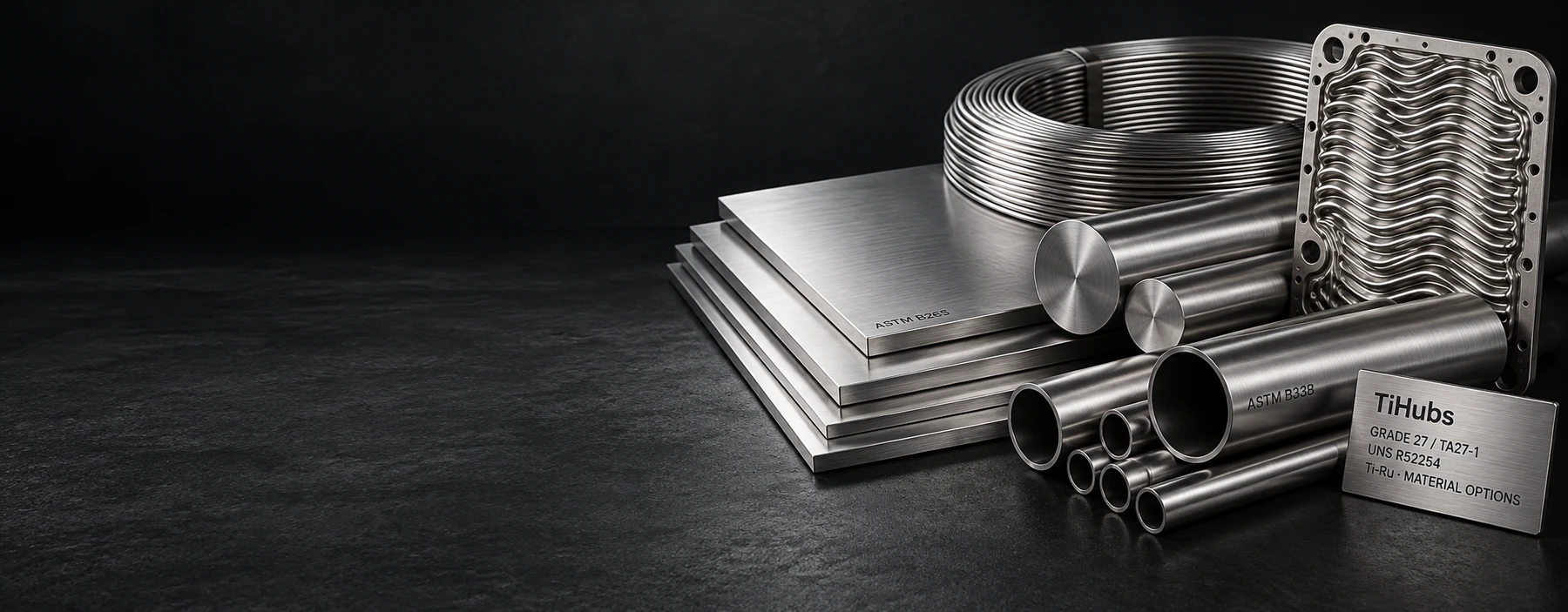
Grade 27 · Gr27 · TA27-1 · UNS R52254
Grade 27 / TA27-1 titanium.For formed corrosion-resistant parts.
Source Grade 27 / TA27-1 titanium-ruthenium sheet, bar, tube and wire for selected chemical duties. We review Gr27 requirements for formed heat-transfer plates, coils, condensers and fabricated wetted parts through one technical and commercial contact in Baoji.
Start with a specification, drawing or application. We’ll help identify the details still needed.
Material review. Supply coordination.
One contact in Baoji, China.
Grade 27 / TA27-1Gr27 · Ti-0.1Ru · UNS R52254
Defined material & conditionMatch the product, process and acceptance requirements
One contact20 years of founder experience · 100+ Baoji factories
01 / Product forms
Find your
Grade 27 / TA27-1 product.
Choose a material form or application. Send the dimensions, service conditions and required records so we can match the manufacturing route to your order.
01 / 06
Grade 27 / TA27-1 · Gr27 · Ti-0.1Ru
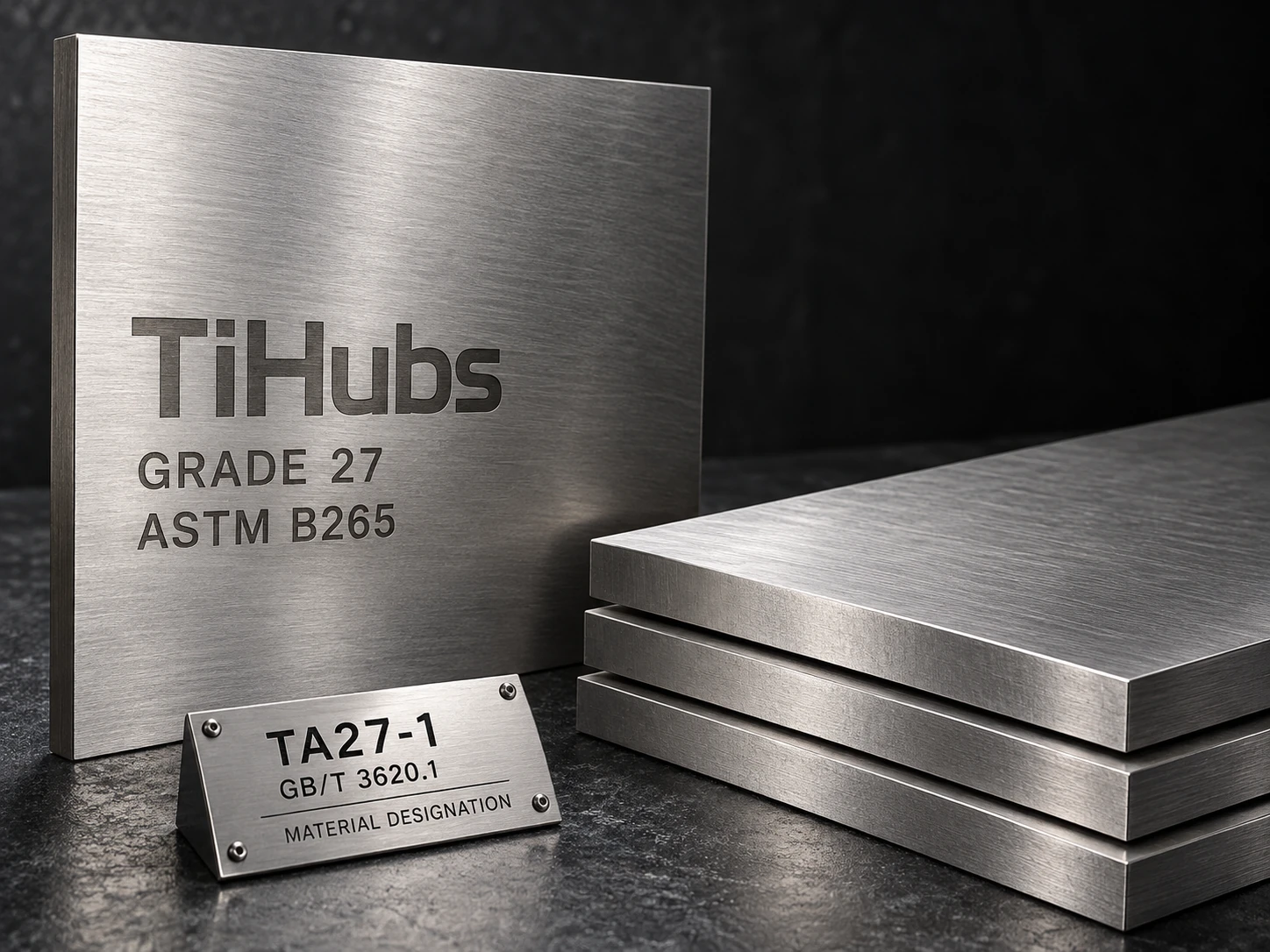
Grade 27 / TA27-1 titanium sheet & plate
For formed and fabricated corrosion-resistant parts where the lower-strength Ti-Ru route fits the design. Provide the finished geometry so starting thickness and forming requirements can be reviewed together.
- Specification
- ASTM B265 Grade 27 in the ordered condition. A TA27-1 order uses GB/T 3620.1 chemistry with an explicitly agreed product and mechanical acceptance specification.
- Dimensions
- Thickness × width × length, tolerances, flatness, rolling direction and surface finish. Include trimming allowance and minimum finished wall for formed parts.
- Forming
- Draw depth, bend radii, corrugations, local thinning and subsequent welding. Define tooling, first-article and dimensional acceptance before committing to production.
- Acceptance
- Ruthenium content, lower oxygen/iron limits, specified tensile and bend requirements, heat identity and surface condition. Finished-part checks are additional to raw-sheet acceptance.
02 / 06
Grade 27 / TA27-1 · Gr27 · Ti-0.1Ru
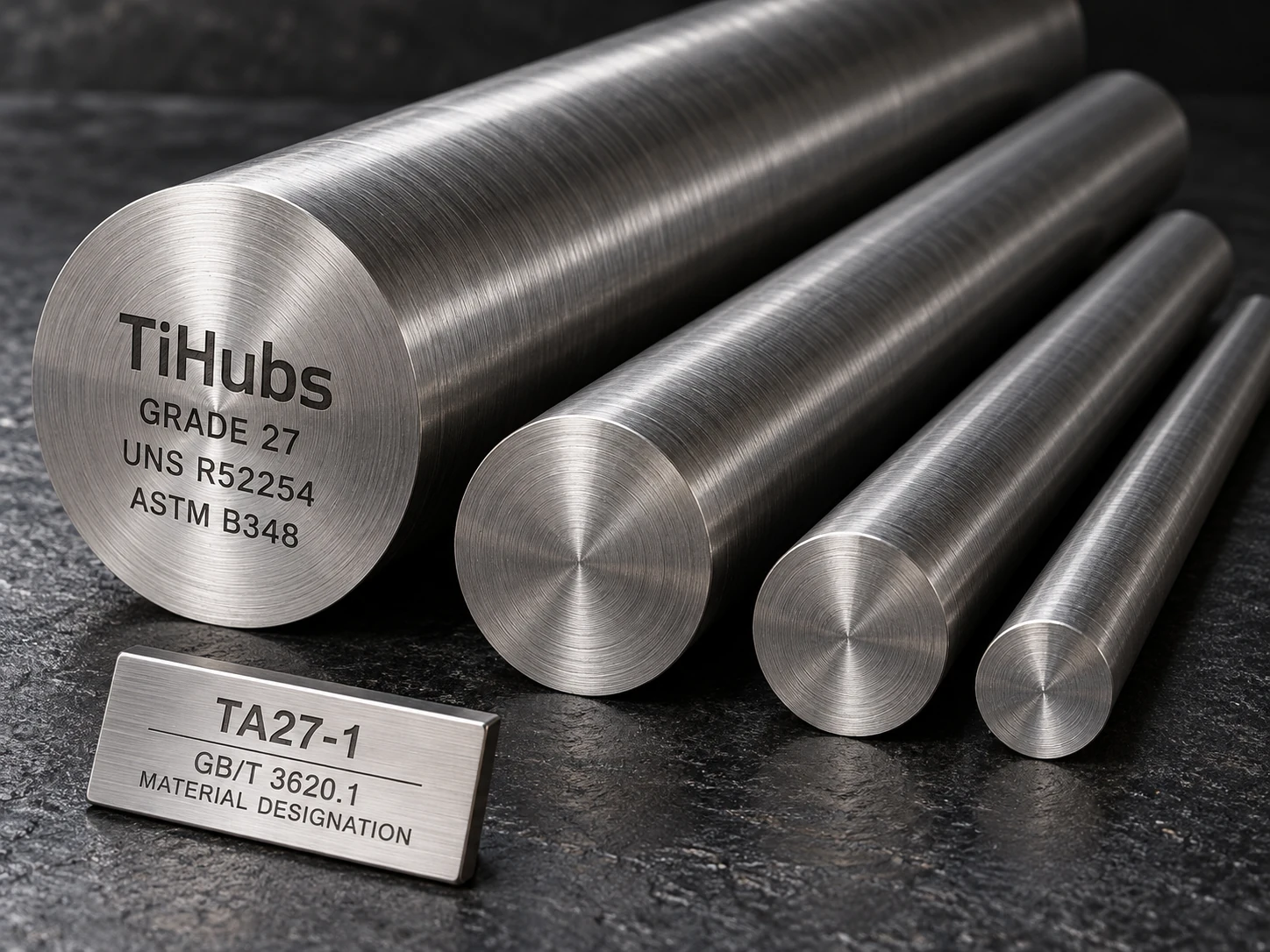
Grade 27 / TA27-1 titanium bar & rod
Machining stock for specified sleeves, connections and wetted components. Confirm that the lower-strength grade is suitable for the component loading and sealing geometry.
- Specification
- ASTM B348 Grade 27. For TA27-1, specify GB/T 3620.1 chemistry and agreed bar product requirements; the supplied GB/T 2965-2023 does not list TA27-1.
- Dimensions
- Diameter or section × length, straightness, surface condition, cut quantities and machining allowance.
- Design input
- Critical fits, threads, sealing surfaces, loading and permissible deformation. Distinguish a material blank from a fully machined or tested component.
- Acceptance
- Heat chemistry, ordered mechanical properties, traceability and agreed NDT. Add drawing-based dimensional and surface records when machining is in scope.
03 / 06
Grade 27 / TA27-1 · Gr27 · Ti-0.1Ru
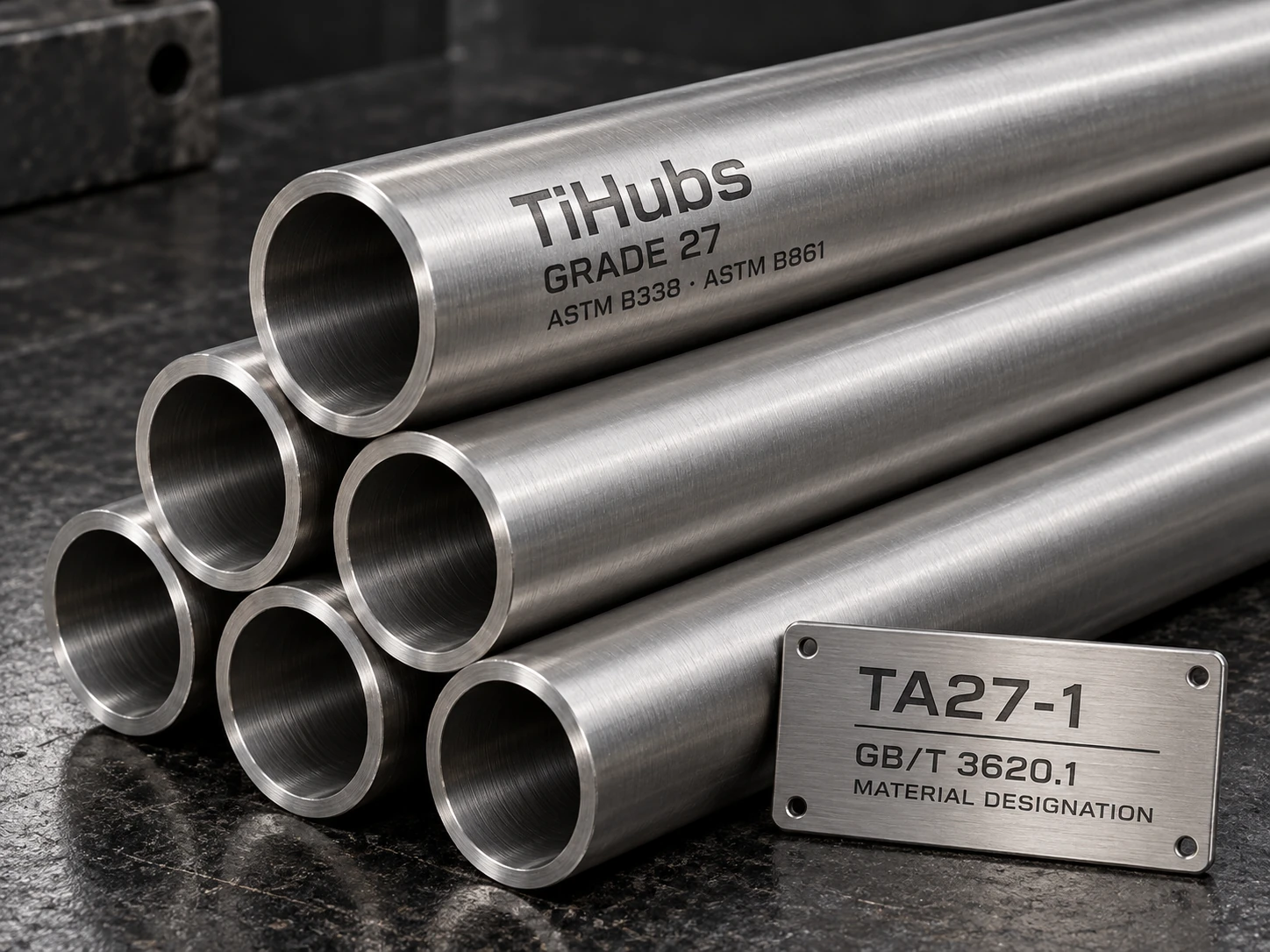
Grade 27 / TA27-1 seamless tube & pipe
Tube and pipe for selected corrosion and heat-transfer duties, with straight, bent or coiled geometry reviewed against the order. The supply specification and post-forming tests must be clear.
- Specification
- ASTM B338 Grade 27 for condenser and heat-exchanger tube; ASTM B861 Grade 27 for seamless pipe. For TA27-1, agree the corresponding product requirements alongside chemistry.
- Dimensions
- OD × wall × length or the specified pipe size system, wall basis and tolerance, straightness, end orientation and end preparation.
- Forming
- U-bends or coils, bend radius, pitch, ovality, thinning limits and end geometry. Define whether material is supplied straight for customer forming or formed to drawing.
- Acceptance
- Applicable tube/pipe product tests, heat traceability and any additional examination after bending. Specify separate leak or pressure-test criteria for the finished assembly.
04 / 06
Grade 27 / TA27-1 · Gr27 · Ti-0.1Ru
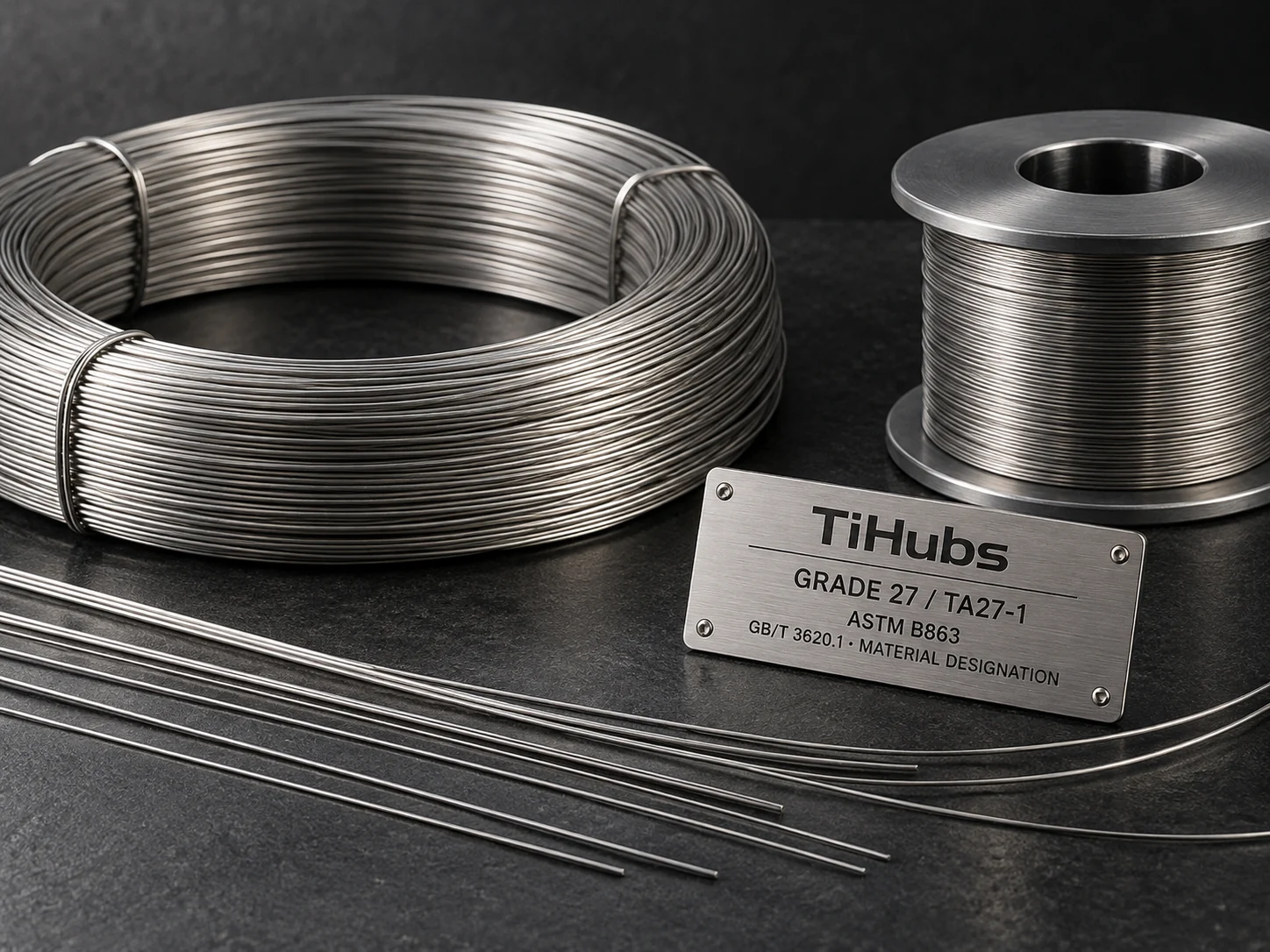
Grade 27 / TA27-1 titanium wire
Wire for defined component and fabrication requirements. State the intended use and final processing so diameter, condition, surface and packaging can be quoted on a clear basis.
- Specification
- ASTM B863 Grade 27 with the required edition and condition. TA27-1 wire needs agreed product requirements in addition to GB/T 3620.1 chemistry.
- Supply form
- Coils, spools or straight lengths; diameter and tolerance, cast, straightness, unit weight and required packaging.
- Processing
- Required softness or worked condition, cleanliness and any downstream forming, joining or surface preparation.
- Acceptance
- Chemistry, dimensions, surface and applicable mechanical tests. If the wire will be used as welding filler, identify its consumable classification and acceptance requirements separately.
05 / 06
Grade 27 / TA27-1 · Gr27 · Ti-0.1Ru
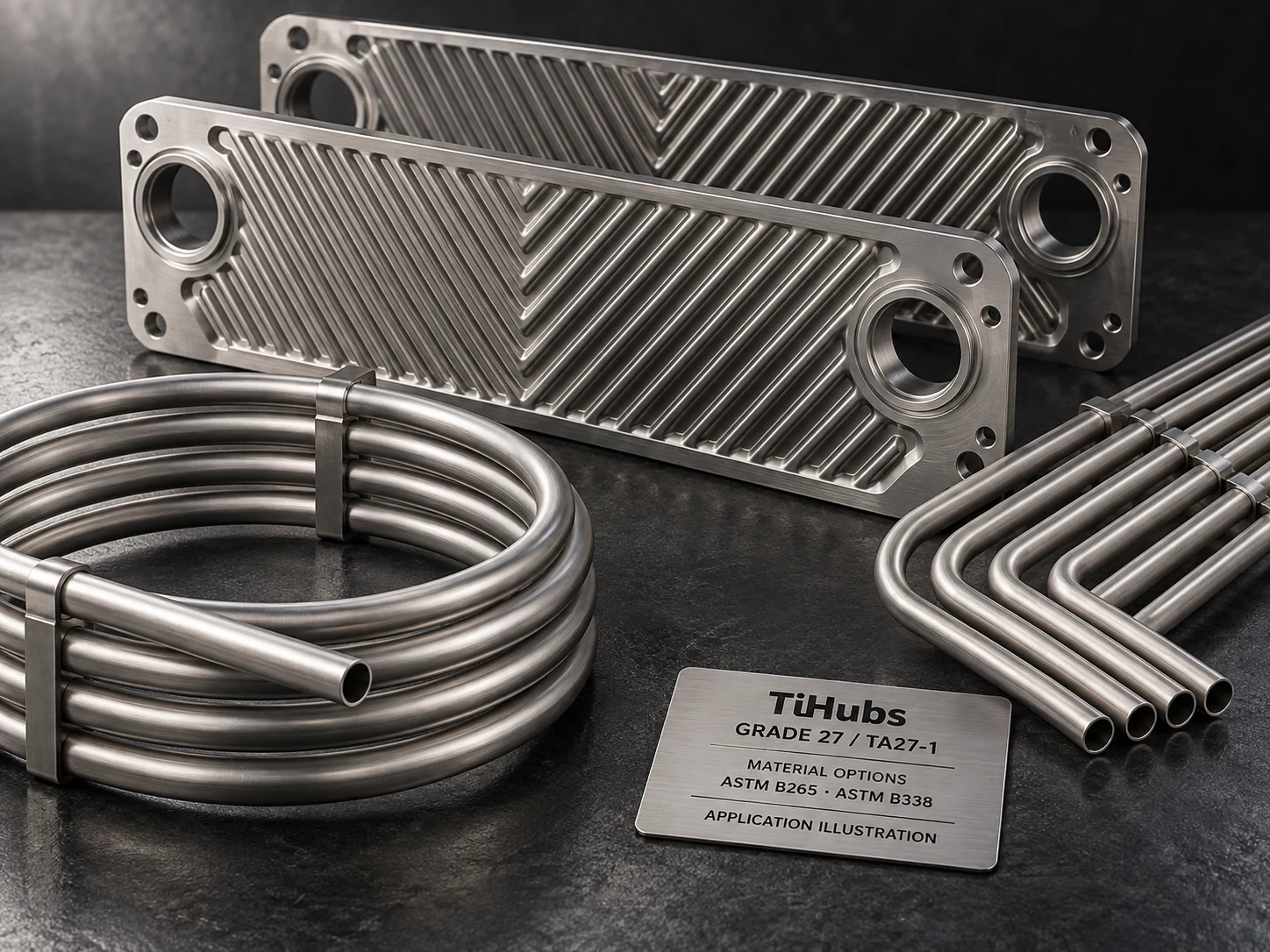
Formed heat-exchanger plates, coils & corrosion-resistant parts
Application illustration: material and forming coordination for a specified geometry. Grade 27 / TA27-1 can be reviewed where forming requirements and a selected Ti-Ru corrosion route need to be considered together.
- Geometry
- Plate pattern, corrugations, draw depth, bend radii, coil pitch and end orientation. Supply the drawing and any reference sample or tooling information.
- Material basis
- ASTM B265 Grade 27 sheet or ASTM B338 Grade 27 tube as appropriate, with TA27-1 identified through the agreed Chinese chemistry and product route.
- Process review
- Starting thickness, minimum wall after forming, thinning, springback, tooling and first-article approval. Define any welding or cleaning after forming.
- Acceptance
- Final dimensions, wall checks, surface condition, traceability and agreed leak or pressure tests. Raw-material standards do not certify the complete heat exchanger.
06 / 06
Grade 27 / TA27-1 · Gr27 · Ti-0.1Ru
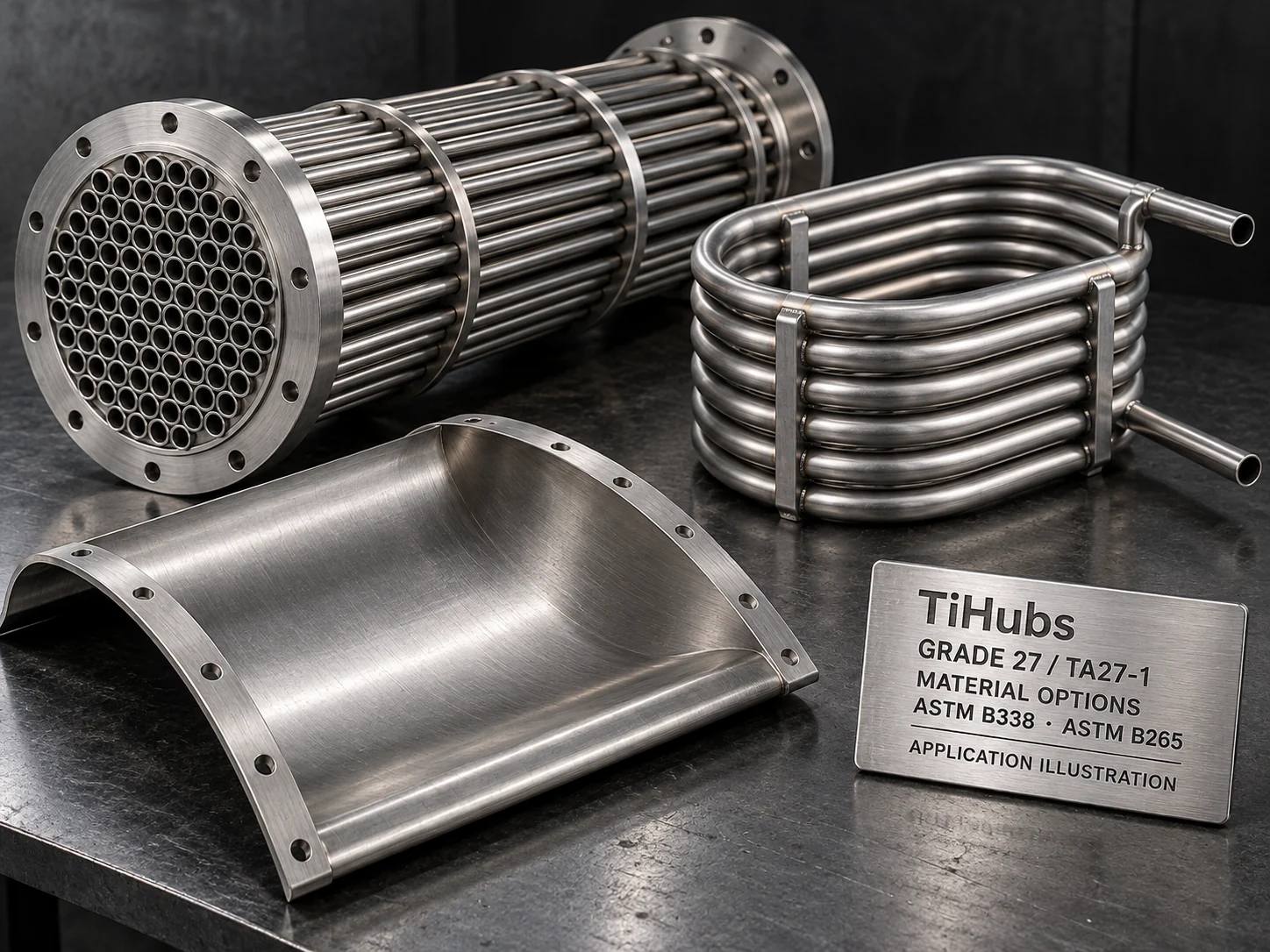
Condenser, evaporator & fabricated wetted components
Application illustration: straight or bent tube sets and selected formed parts for a defined equipment duty. Agree the supply boundary, chemistry exposure and acceptance plan before comparing quotations.
- Equipment duty
- Process and utility fluids, condensate composition, concentration changes, temperature, pressure or vacuum, deposits and cleaning cycle.
- Supply scope
- Straight tubes, U-tubes, coils, bundle components, formed liners or a specified subassembly. Identify joining, assembly and free-issued parts.
- Design & fabrication
- Tube-to-tubesheet joint, support spacing, thermal movement, minimum wall, forming and welding requirements, design-code responsibility and hold points.
- Acceptance
- Material records, heat identity, dimensions and agreed nondestructive, pressure or leakage tests. State which tests apply to raw material and which apply to the finished assembly.
Images illustrate material forms and application possibilities. Reference markings identify specification options; they do not establish dual certification, stock availability or finished-component approval.
Define the product. Share the requirement.
These details help turn your enquiry into a comparable quotation.
01 / Requirement review
From blank to formed part
Bring the drawing, minimum wall and forming details so material dimensions, tooling and first-article checks can be reviewed together.
Discuss your requirement02 / Requirement review
Coils and tube sets
Define bend geometry, end orientation, thinning limits and the inspection required after forming, alongside the starting tube specification.
Discuss your requirement03 / Requirement review
One coordinated order
Combine sheet, tube, bar and fabricated parts in one enquiry while keeping every material heat, item and acceptance requirement identifiable.
Discuss your requirement02 / Material identity
What is
Grade 27 / TA27-1 titanium?
Grade 27 / TA27-1 is the lower-strength Ti-Ru route, with lower oxygen and iron limits than Grade 26. Connect those material requirements with the forming process and the mechanical duty of the finished part.
Gr27 is UNS R52254. The TA27-1 suffix identifies the corresponding Chinese route and should remain visible throughout the drawing, purchase order and material records.
240MPa
Minimum tensile strength
138MPa
Minimum 0.2% yield strength
24%
Minimum elongation
ASTM B265-08 · Grade 27 · annealed sheet/plate reference
| Property or condition | Reference | Ordering implication |
|---|---|---|
| Reference scope | ASTM B265-08 · Grade 27 · annealed | Sheet/plate ordering values subject to Table 1 notes. They are not allowable design stresses or a finished-component pressure rating. |
| Yield strength range | 138–310 MPa | Both minimum and maximum matter when the forming and service requirements are being defined. Confirm test direction, thickness and condition. |
| Compared with Grade 26 | Lower strength; higher specified elongation | The cited sheet table gives Grade 26 a 345 MPa tensile minimum and 20% elongation minimum, versus 240 MPa and 24% for Grade 27. This comparison does not prove equal service performance. |
| Chinese designation | TA27-1 · GB/T 3620.1-2016 | The full suffix identifies the lower-oxygen, lower-iron Ti-Ru chemistry route. Retain “-1” on drawings, orders, labels and records. |
| After forming | Agree the finished-part acceptance | Starting material properties alone do not define wall thinning, dimensional conformity, leak tightness or the design capacity of a formed component. |
ASTM B265-08 Table 1 qualifies the values by product condition and thickness; other conditions and plate over 25 mm may require agreement. Use the actual product and finished-component requirements for design and acceptance.
| Element · wt% | Grade 27 · ASTM B265-08 | TA27-1 · GB/T 3620.1-2016 |
|---|---|---|
| Ruthenium · Ru | 0.08–0.14 | 0.08–0.14 |
| Oxygen · O | 0.18 max. | 0.18 max. |
| Iron · Fe | 0.20 max. | 0.20 max. |
| Nitrogen · N | 0.03 max. | 0.03 max. |
| Carbon · C | 0.08 max. | 0.08 max. |
| Hydrogen · H | 0.015 max. | 0.015 max. |
| Other residuals | 0.10 each / 0.40 total max. | 0.10 each / 0.40 total max. |
| Titanium · Ti | Balance | Balance |
Ranges and maxima from the cited chemistry routes. The lower oxygen and iron limits distinguish Grade 27 / TA27-1 from Grade 26 / TA27; verify the complete analysis and traceability for the supplied heat.
Grade 27 / Gr27 and TA27-1
Grade 27, abbreviated Gr27, is UNS R52254. TA27-1 is the corresponding Chinese Ti-0.10Ru designation with the lower oxygen and iron limits. The pair can be used to identify the intended material family, with a separate product specification completing the order.
Grade 27 and Grade 26 / TA27
The ruthenium ranges match, but the interstitial limits and strength requirements differ. Grade 27 is the lower-strength, higher-elongation route in the cited sheet specification. Evaluate forming needs and the final mechanical duty together; retain TA27-1 in full.
Grade 27 and Grade 11 / Grade 17
These are different corrosion-resistant titanium routes: Grade 27 is ruthenium-bearing, while Grades 11 and 17 are palladium-bearing. Compare actual service evidence, product availability and the complete quotation before approving a material change.
Grade 27 and Grade 1
Grade 27 adds ruthenium to a lower-interstitial titanium base. It is considered for selected corrosion conditions beyond an unmodified titanium requirement. The alloy addition does not remove the need to review contamination, crevices, cleaning or mechanical loading.
03 / Application review
Forming requirements meet chemical service.
For Grade 27 / TA27-1, review the finished geometry and operating duty together. These application discussions identify the information needed to assess forming, supply and acceptance before quotation.
Application review / 01
Formed components: define the shape and the remaining wall
Grade 27 / TA27-1 is a lower-strength Ti-Ru route that can be reviewed when corrosion requirements must be combined with demanding forming work. A useful enquiry starts with the finished shape, not only the blank size. The design must account for local thinning, the formed part’s mechanical duty and any change introduced by subsequent joining or surface work.
Products to discuss
Sheet blanks, drawn or pressed parts, formed covers and specified wetted shells. State whether the order includes tooling, sample development or production parts.
What we need to review
Released drawing, draw depth, radii, local wall limits, rolling direction, surface requirements and dimensional datums. Agree the forming route, first-article evidence, inspection points and final acceptance condition.
Application review / 02
Formed heat-transfer plates: align material, pattern and pressure duty
A corrugated plate needs both a suitable material selection and a feasible forming route. The grade name does not establish the achievable pattern depth, remaining wall or pressure capacity. For Gr27 / TA27-1, review the plate geometry with the equipment duty and the proposed manufacturing method before quoting a production quantity.
Products to discuss
Sheet cut blanks and drawing-based formed plates for selected heat-exchanger designs. Separate a material enquiry from a finished-plate or assembled-exchanger enquiry.
What we need to review
Plate pattern, thickness, port details, sealing or welding interfaces, tooling ownership and minimum wall after pressing. Add both-side media, design pressures and temperatures, cleaning method and leak-test requirements.
Application review / 03
Condenser tubes: specify the joint as well as the tube
Heat-exchanger tube acceptance and assembly acceptance are different scopes. A straight Grade 27 tube certificate does not by itself define the condition of a finished U-bend or a tube-to-tubesheet joint. Discuss the manufacturing sequence and the actual process and utility-side exposure so the quotation covers the necessary inspections.
Products to discuss
ASTM B338 Grade 27 straight or U-bent tube sets, specified tube-bundle components and selected fabricated wetted parts.
What we need to review
Tube OD, wall basis, length, straightness, end preparation, bend radius and joint design. Include condensate and utility analyses, temperatures, pressure, fouling, cleaning and the required product and assembly tests.
Application review / 04
Evaporator parts: review feed, concentrate and cleaning separately
In an evaporator, the liquid composition changes through the process and deposits can change conditions at the metal surface. Grade 27 / TA27-1 should be considered against the full duty cycle, including concentration, boiling and cleaning. Lower-strength material also requires the component designer to confirm wall and support requirements.
Products to discuss
Heating tubes, coils, formed liners and defined evaporator or concentrator internals. Identify whether supply covers raw material, formed parts or an assembled subcomponent.
What we need to review
Feed and concentrate analysis, solids, operating and wall temperatures, pressure or vacuum, heat-transfer conditions and cleaning chemistry. Add minimum wall, support layout, thermal movement, weld details and integrity-test criteria.
Application review / 05
Corrosion barriers and shells: distinguish protection from structure
A formed titanium lining protects against the selected process exposure, while the supporting vessel may carry the mechanical load. Those responsibilities should be explicit in a TA27-1 enquiry. Attachment, weld access, thermal movement and leak detection can influence both the material form and the manufacturing sequence.
Products to discuss
Cut or formed sheet liners, rolled sections, covers and specified wetted shells. Define the boundary between titanium material supply and the supporting equipment.
What we need to review
Service analysis, drawings, support and attachment details, minimum wall, forming radii, weld locations and access. Confirm inspection, leak detection, surface condition and the party responsible for equipment design approval.
Application review / 06
Coils and U-bends: agree the geometry after forming
Tube diameter and straight length are not enough to quote a coil. Pitch, bend radius, end orientation and allowed ovality determine whether the formed assembly can fit and perform as intended. For Gr27 / TA27-1, review the starting tube specification and the checks needed after bending as one manufacturing plan.
Products to discuss
Helical coils, U-bends and drawing-based bent tube assemblies for selected heat-transfer or process duties.
What we need to review
OD and wall, coil diameter, pitch, number of turns, end locations and dimensional datums. Specify wall-thinning and ovality limits, surface cleanliness, traceability, and any post-forming nondestructive or leak test.
Application review / 07
Hot-brine circuits: address crevices and stagnant exposure
Ruthenium-bearing titanium can be evaluated for selected hot-brine or reducing conditions, but a bulk-fluid analysis does not describe every location in a system. Deposits, gasket interfaces, dead legs and shutdown periods can create different local exposure. Grade 27’s forming advantages must be weighed against the pressure and mechanical requirements of the line.
Products to discuss
Reviewed tube and pipe sections, bent assemblies, liners and relevant WPT27 wrought fittings under the specified route.
What we need to review
Fluid composition and concentration range, pH, oxygen conditions, temperatures, solids and velocity. Identify stagnant sections, joint details, cleaning excursions, design code and any required service or corrosion-test evidence.
Application review / 08
Connections: check strength and sealing-face deformation
Grade 27 / TA27-1 bar and forging routes can support specified machined components, but lower strength changes the design questions. Thread loading, clamping, sealing-face deformation and wear should be reviewed before choosing this grade for a connection that previously used higher-strength titanium. Geometry and acceptance requirements need to accompany the material callout.
Products to discuss
ASTM B348 Grade 27 bar, ASTM B381 F-27 or GB/T 25137 F-27 forged blanks, and drawing-based sleeves or connectors.
What we need to review
Loading, pressure, temperature, mating materials, fits, threads, finish and permissible deformation. Define blank versus finished-part scope, critical dimensions, NDT and any separate leakage or functional test.
Technical references: ASTM B265 official scope ↗ · ASTM B348 official scope ↗ · ASTM B863-19 official scope ↗ · Ruthenium-enhanced titanium research ↗
Purchasing checklist
Agree what the finished part must meet.
Our founder’s 20 years in titanium inform the questions raised before quotation, from TA27-1 material identity to forming limits, final dimensions and delivery records.
A quotation with a defined boundary
Separate raw material, cut blanks, tooling, forming, machining and assembly. State the drawing revision, quantity, inspection, packaging and delivery terms, including any items needing separate confirmation.
Acceptance from material to final geometry
Agree chemistry and mechanical records, heat traceability, wall and dimensional checks after forming, surface requirements and any separate integrity test.
Approvals before the next stage
Set material review, tooling or sample approval, first-article and dispatch milestones. Technical changes need written agreement, with the impact on requirements, timing and cost made clear.
“We need TA27-1 formed plates and matching tube coils.”
Start with the plate pattern and coil drawing, minimum finished wall, material condition and service duty. Clarify tooling and samples, then agree how thinning, ovality, end positions, surface condition and leak integrity will be checked. Keep raw-material and finished-part acceptance linked but distinct.
This illustrates the order review process; it is not a published customer case or an assumed supply approval.
Discuss your requirement04 / Standards & documentation
Match the standard
to the product.
Select the standard for the actual material form, then add the forming or fabrication requirements. The linked files retain their supplied editions; Chinese TA27-1 identity is kept distinct from a complete product specification.
| Product form | ASTM / AMS / ASME route | Chinese standard route | Clarify before quotation |
|---|---|---|---|
| Material identity & composition | United States / technical reference Grade 27 · UNS R52254. Use the chemistry in the specified ASTM product standard. | ChinaGB/T 3620.1-2016View PDF ↗ TA27-1 · Ti-0.10Ru designation and chemical composition. | Full designation including suffix, oxygen/iron limits, ruthenium range and certificate basis. |
| Sheet & plate | United States / technical referenceASTM B265-08View PDF ↗ Grade 27 annealed sheet/plate reference. | ChinaGB/T 3620.1-2016View PDF ↗ TA27-1 chemistry plus agreed product requirements; the supplied GB/T 3621 does not list this grade. | Thickness, condition, rolling direction, formability requirements, surface and tests. |
| Bar & rod | United States / technical referenceASTM B348-08aView PDF ↗ Grade 27 bars and billets. | ChinaGB/T 3620.1-2016View PDF ↗ TA27-1 chemistry plus agreed bar requirements; the supplied GB/T 2965 does not list this grade. | Section, finish, straightness, machining allowance and mechanical acceptance. |
| Heat-exchanger tube | United States / technical referenceASTM B338-08bView PDF ↗ Grade 27 condenser and heat-exchanger tubes. | ChinaGB/T 3620.1-2016View PDF ↗ TA27-1 chemistry with an agreed tube specification and acceptance plan. | OD, wall basis, lengths, seamless/welded route, joints and product tests. |
| Seamless / welded pipe | United States / technical referenceASTM B861-10View PDF ↗ASTM B862-06b ε1View PDF ↗ Separate B861 seamless and B862 welded product routes. | ChinaGB/T 3620.1-2016View PDF ↗ Specify the TA27-1 product requirements explicitly. | Size system, end preparation, wall tolerance, weld checks and integrity tests. |
| Wire | United States / technical referenceASTM B863-19View PDF ↗ Grade 27 product wire; welding filler needs separate classification. | ChinaGB/T 3620.1-2016View PDF ↗ TA27-1 chemistry plus agreed wire requirements; the supplied GB/T 3623 does not list this grade. | Use, diameter, condition, surface, coil/spool and records. |
| Forgings & machined blanks | United States / technical referenceASTM B381-08aView PDF ↗ F-27 forging specification. | ChinaGB/T 25137-2010View PDF ↗ F-27; informative Annex B cross-references TA27-1. | Blank geometry, section, allowance, properties, NDT and component loading. |
| Fittings & formed assemblies | United States / technical referenceASME SB-363 · 2013View PDF ↗ ASME SB-363 WPT27 for the relevant wrought welding fitting route. | China Agree the route for the input material and the finished drawing-based product. | Fitting geometry, forming limits, joints, testing and system-code requirements. |
Agree the order basis.
GB/T 3620.1 defines the TA27-1 chemistry route; product dimensions, mechanical properties and tests need their own agreed basis. For coils, formed plates and assemblies, add the finished-part requirements to the starting-material specification.
Use the document edition, product scope and condition specified in the purchase order. Producer technical references support discussion; they do not replace ordered product acceptance requirements.
05 / Order coordination
Know the scope
before ordering.
Our founder’s 20 years in titanium inform the questions we ask before quotation and the supply options we review with you.
A quotation you can evaluate
Agree the grade, standard edition, dimensions, tolerance, condition and quantity before comparing prices.
- Identify whether inspection, samples and tooling are included.
- Confirm packaging, transport and delivery terms.
- Record items that still need technical confirmation.
Acceptance agreed before supply
Confirm the material certificate, full grade, heat or lot identity, delivery condition, dimensional checks and required testing before supply starts. Define any process records, NDT and purchaser approval points for the ordered product.
Independent inspection can be discussed with its scope, timing, acceptance criteria and cost agreed for the order.
Delivery with clear milestones
Review the proposed lead time, approvals, production sequence and dispatch requirements. For several product forms, coordinate document and packing readiness together.
Material substitutions and technical changes require written approval. A schedule deviation should identify the impact, decisions needed and next steps.
One contact when an issue arises
Contact TiHubs with the order reference, affected items and supporting photos or inspection records.
We record the issue, review it against the agreed requirements and coordinate the next steps with the relevant manufacturing parties.
01 / Material identity
Material records
Grade, standard, test results and heat or batch identity matched to the supplied items.
02 / Agreed acceptance
Inspection records
Dimensional and testing records for the agreed scope, including critical drawing requirements.
03 / Ready for dispatch
Dispatch records
Item identification, packing list, protective packaging and required shipment documents.
06 / Questions before sourcing
Before you specify
Grade 27 / TA27-1.
A clear material designation is the beginning. Product form, specification revision, material condition and acceptance complete the requirement.
A useful first enquiry
- Product and specificationProduct form, standard edition, dimensions and material condition.
- Order and deliveryQuantity, destination and any required delivery date.
- Acceptance requirementsDrawing revision, inspection, certificates and packaging.
Not every detail is finalized? Send the information you have. We can help identify the questions to resolve before quotation.
What happens next: requirement review, technical clarification, then a supply proposal and quotation.
What is Grade 27 titanium, and what does Gr27 mean?
Grade 27, abbreviated Gr27, is a titanium-ruthenium grade identified as UNS R52254. The cited specifications require 0.08–0.14% ruthenium with lower oxygen and iron limits than Grade 26. It is considered for selected corrosion-resistant components where forming and fabrication requirements are important.
Is TA27-1 the Chinese designation corresponding to Grade 27?
Yes. TA27-1 is the corresponding Chinese Ti-0.10Ru designation in GB/T 3620.1-2016. Retain the complete “-1” suffix because TA27 is a different strength and chemistry-limit route. Identify the controlling product specification, edition, condition and tests when ordering.
What is the practical difference between Grade 27 and Grade 26?
Both have the same specified ruthenium range, but Grade 27 has lower oxygen and iron limits. In the supplied ASTM B265-08 sheet table, Grade 27 has a 240 MPa tensile minimum and 24% elongation minimum, compared with 345 MPa and 20% for Grade 26. Selection should balance forming needs with the finished component’s mechanical duty.
Can Grade 27 / TA27-1 be used for formed heat-exchanger plates?
It can be reviewed for a specified formed-plate requirement. Provide the plate pattern, thickness, radii, ports, sealing or welding interfaces, minimum wall and equipment duty. Material selection, forming feasibility, tooling and finished-plate acceptance need agreement before supply; a sheet standard alone does not approve an assembled exchanger.
What standards should I specify for tubes, pipes and coils?
ASTM B338 Grade 27 is the supplied condenser and heat-exchanger tube route; B861 covers seamless pipe and B862 welded pipe. A coil or U-bend also needs drawing requirements for radius, ovality, thinning, end geometry and any post-forming tests. For TA27-1, agree the product route alongside the Chinese chemistry designation.
Do the usual Chinese plate, bar, tube and wire PDFs cover TA27-1?
The supplied GB/T 3621, GB/T 2965, GB/T 3624 and GB/T 3623 editions do not list TA27-1 in their product tables. Those forms therefore need an explicitly agreed product and acceptance specification. For forgings, GB/T 25137 defines F-27 and provides an informative TA27-1 cross-reference.
Can Grade 27 replace Grade 11 or Grade 17?
These grades can be compared for a defined corrosion duty, but Grade 27 contains ruthenium while Grades 11 and 17 contain palladium. Review the actual chemistry exposure, product specification, forming and strength requirements, service evidence and quotation before agreeing a substitution. No automatic replacement is implied.
What should I send for a quotation, samples and inspection?
Send the product form or released drawing, grade, standard edition, condition, dimensions and tolerance, quantity and destination. For formed or equipment parts, include service chemistry, pressure and temperature, minimum wall, joints and cleaning. Samples, first articles, material records, NDT and independent inspection can be defined with their timing and costs.
What are the MOQ, lead time and arrangements if an order issue arises?
They depend on product form, dimensions, forming or machining route, tooling and inspection. TiHubs confirms quantity and delivery milestones in the quotation. If an issue arises, we record the order reference and evidence, compare the affected items with the agreed requirements and coordinate the next steps with the relevant manufacturing parties.
07 / Your next step
Start with the
requirement you have.
Send the product details, drawing or operating conditions you already know. We will identify missing information and discuss a suitable supply route before quotation.
- Requirement review
- Technical clarification
- Supply proposal and quotation
Combine materials and parts in one enquiry.
Send one list of Grade 27 / TA27-1 forms, sizes and quantities. Include drawing revisions and items that need to be supplied together.
Define the condition and acceptance priorities.
Include the ordered specification, final application, material condition, inspection and documentation, destination and required delivery milestones.
Baoji, China · info@tihubs.com
Start your Grade 27 / TA27-1 enquiry
Send your material form, drawing or process conditions. We will help clarify the remaining requirements.