Baoji High-tech Zone, ChinaTitanium sourcing · One contact


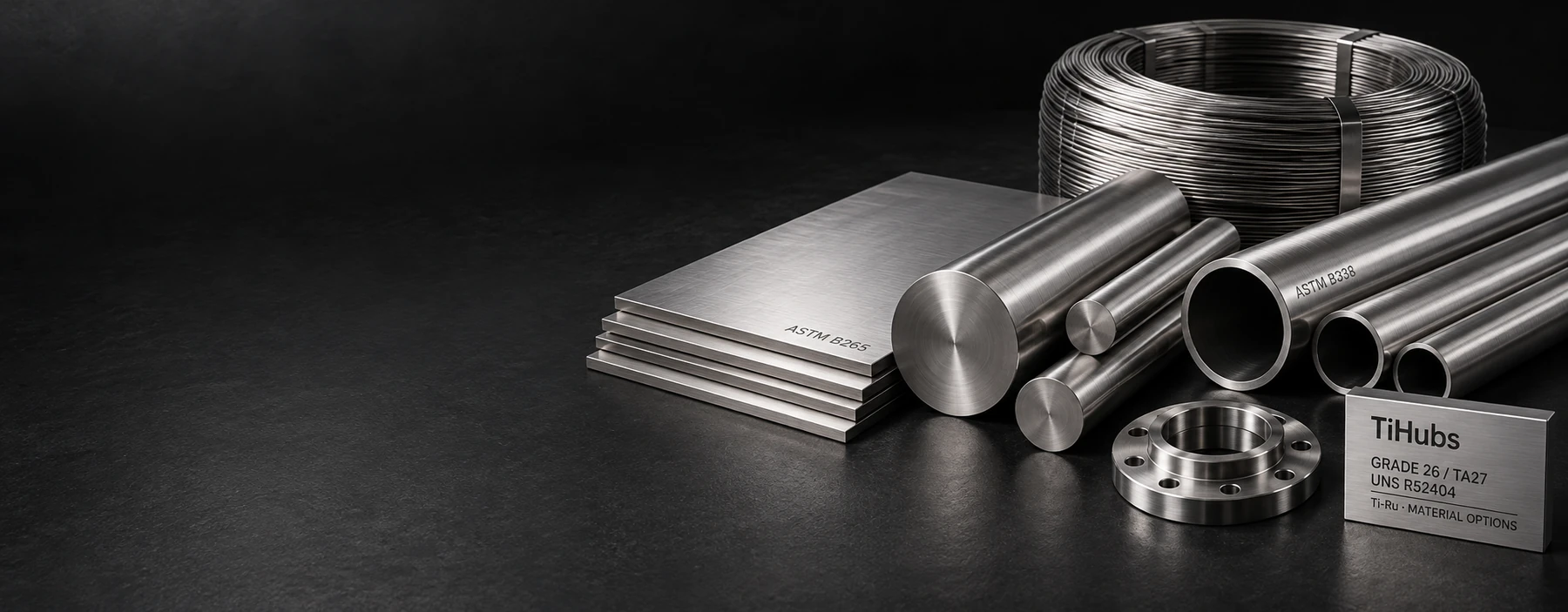
Grade 26 · Gr26 · TA27 · UNS R52404
Grade 26 / TA27 titanium.For chemical corrosion duties.
Source Grade 26 / TA27 titanium-ruthenium sheet, bar, tube and drawing-based parts for chemical equipment. We review Gr26 requirements for heat exchangers, hot-brine circuits, evaporators and pump or valve components through one technical and commercial contact in Baoji.
Start with a specification, drawing or application. We’ll help identify the details still needed.
Material review. Supply coordination.
One contact in Baoji, China.
Grade 26 / TA27Gr26 · Ti-0.1Ru · UNS R52404
Defined material & conditionMatch the product, process and acceptance requirements
One contact20 years of founder experience · 100+ Baoji factories
01 / Product forms
Find your
Grade 26 / TA27 product.
Choose a material form or application. Send the dimensions, service conditions and required records so we can match the manufacturing route to your order.
01 / 06
Grade 26 / TA27 · Gr26 · Ti-0.1Ru
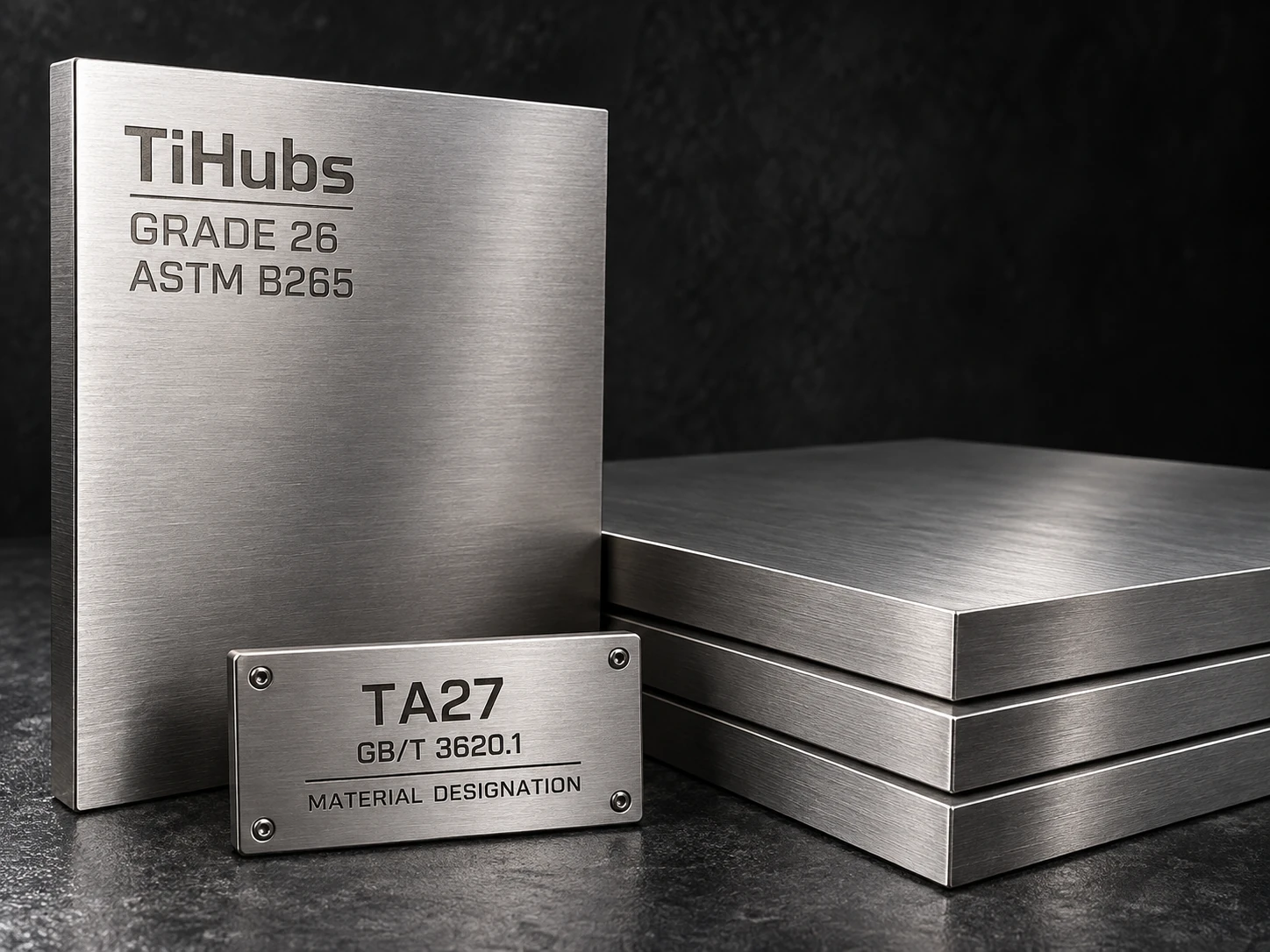
Grade 26 / TA27 titanium sheet & plate
Starting material for reviewed chemical-process shells, linings and heat-transfer parts. Quote the material and the finished geometry together when cutting or forming is required.
- Specification
- ASTM B265 Grade 26, with the agreed edition and condition. For a TA27 callout, use GB/T 3620.1 chemistry with an explicitly agreed product and acceptance specification.
- Dimensions
- Thickness × width × length; flatness, thickness tolerance, rolling direction, surface finish, cut-edge preparation and minimum finished wall.
- Fabrication
- Identify flat blanks, rolled shells or formed parts, the required bend radii and any subsequent welding. Include drawing revision and tooling or sample requirements.
- Acceptance
- Ruthenium-bearing chemistry, ordered tensile properties, heat identity, dimensional and surface checks. Keep material records traceable through cutting and forming.
02 / 06
Grade 26 / TA27 · Gr26 · Ti-0.1Ru
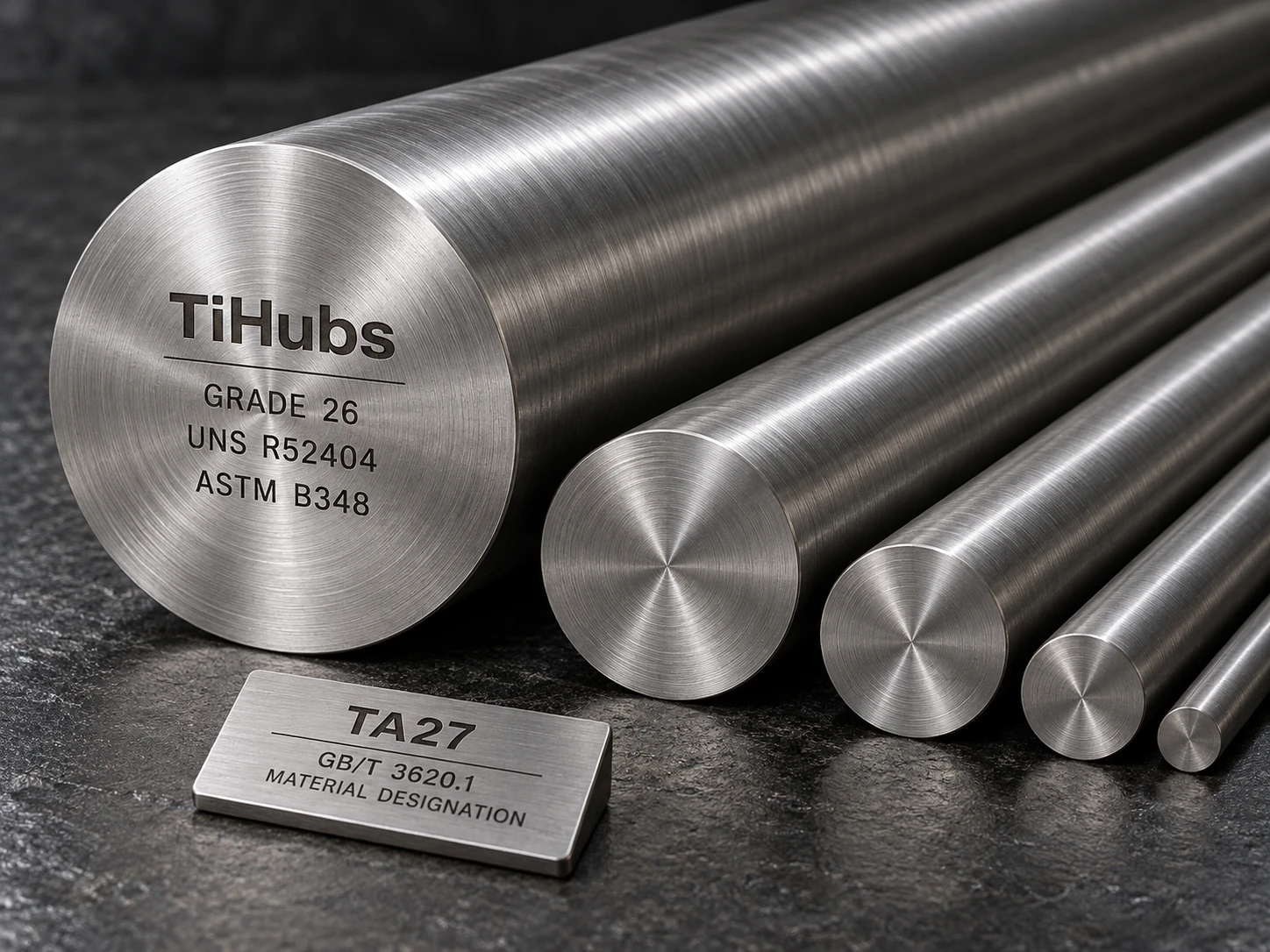
Grade 26 / TA27 titanium bar & rod
Bar stock for stems, sleeves, connectors and other machined wetted parts. The raw-material order should reflect machining allowance, component loading and the service environment.
- Specification
- ASTM B348 Grade 26. For TA27, identify GB/T 3620.1 chemistry and the agreed bar product requirements; the supplied GB/T 2965-2023 does not list TA27.
- Dimensions
- Diameter or section × length, straightness, turned or ground finish, machining allowance and quantity by size.
- Condition
- Specify delivery condition and surface preparation. State whether TiHubs is quoting stock lengths, cut blanks or a drawing-based machined component.
- Acceptance
- Heat chemistry including ruthenium, mechanical records, traceability and agreed ultrasonic or surface inspection. Add critical component dimensions when machining is included.
03 / 06
Grade 26 / TA27 · Gr26 · Ti-0.1Ru
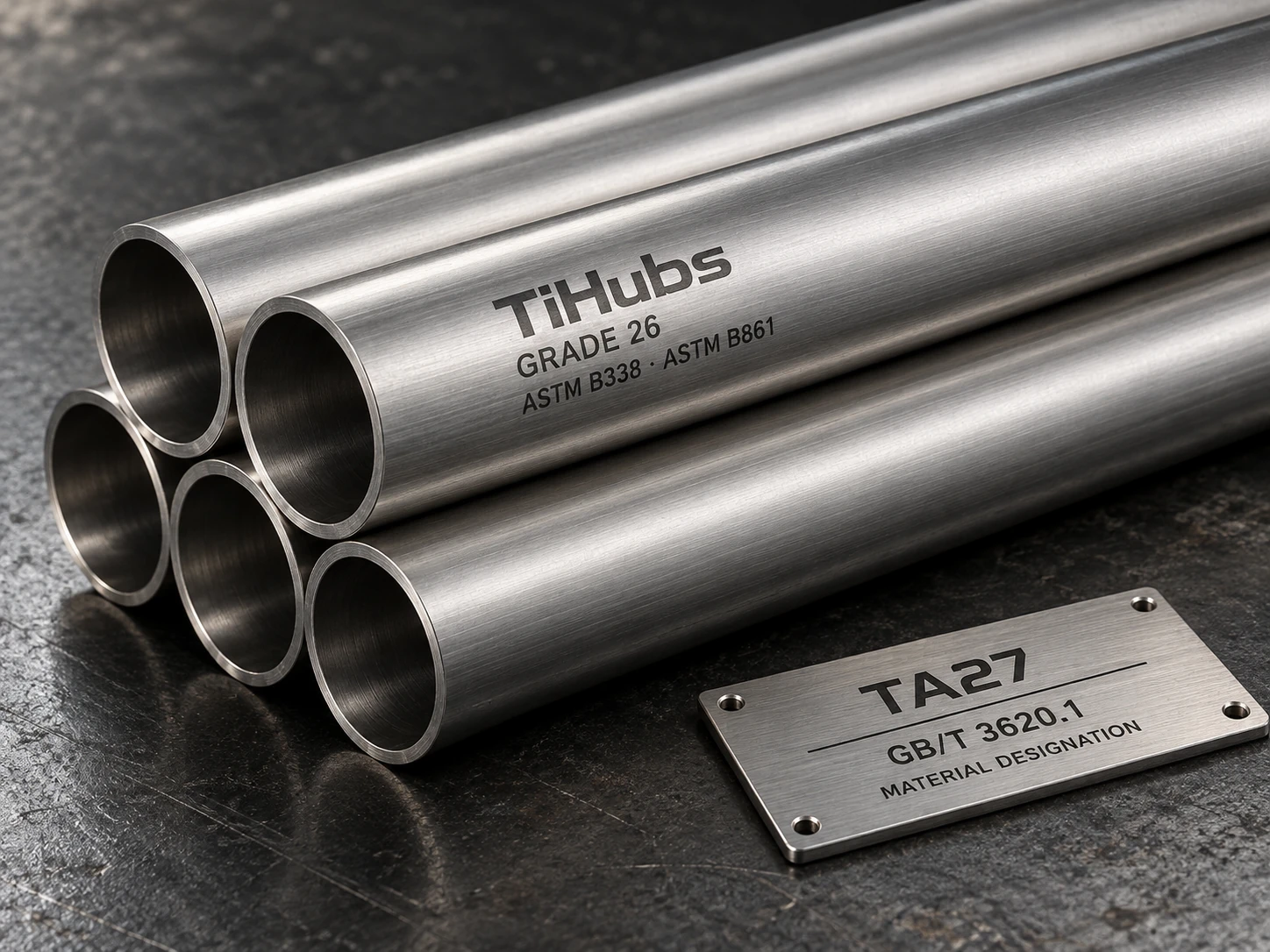
Grade 26 / TA27 seamless tube & pipe
For selected heat-transfer circuits and chemical process lines. Distinguish condenser tubing from pipe, then define the dimensional system, manufacturing route and integrity tests.
- Specification
- ASTM B338 Grade 26 for condenser and heat-exchanger tube; ASTM B861 Grade 26 for seamless pipe. A TA27 order requires the agreed product specification alongside its chemistry designation.
- Dimensions
- Tube OD × wall × length or pipe nominal size and schedule, wall basis and tolerance, straightness, cut length and end preparation.
- Bending & joints
- Straight, U-bent or coiled form; bend radius, ovality and thinning limits, tube-end requirements and the tube-to-tubesheet joint.
- Acceptance
- Applicable product tests and pressure or nondestructive electrical examination, heat identification and any additional post-bending inspection. Define leak-test criteria for assemblies separately.
04 / 06
Grade 26 / TA27 · Gr26 · Ti-0.1Ru
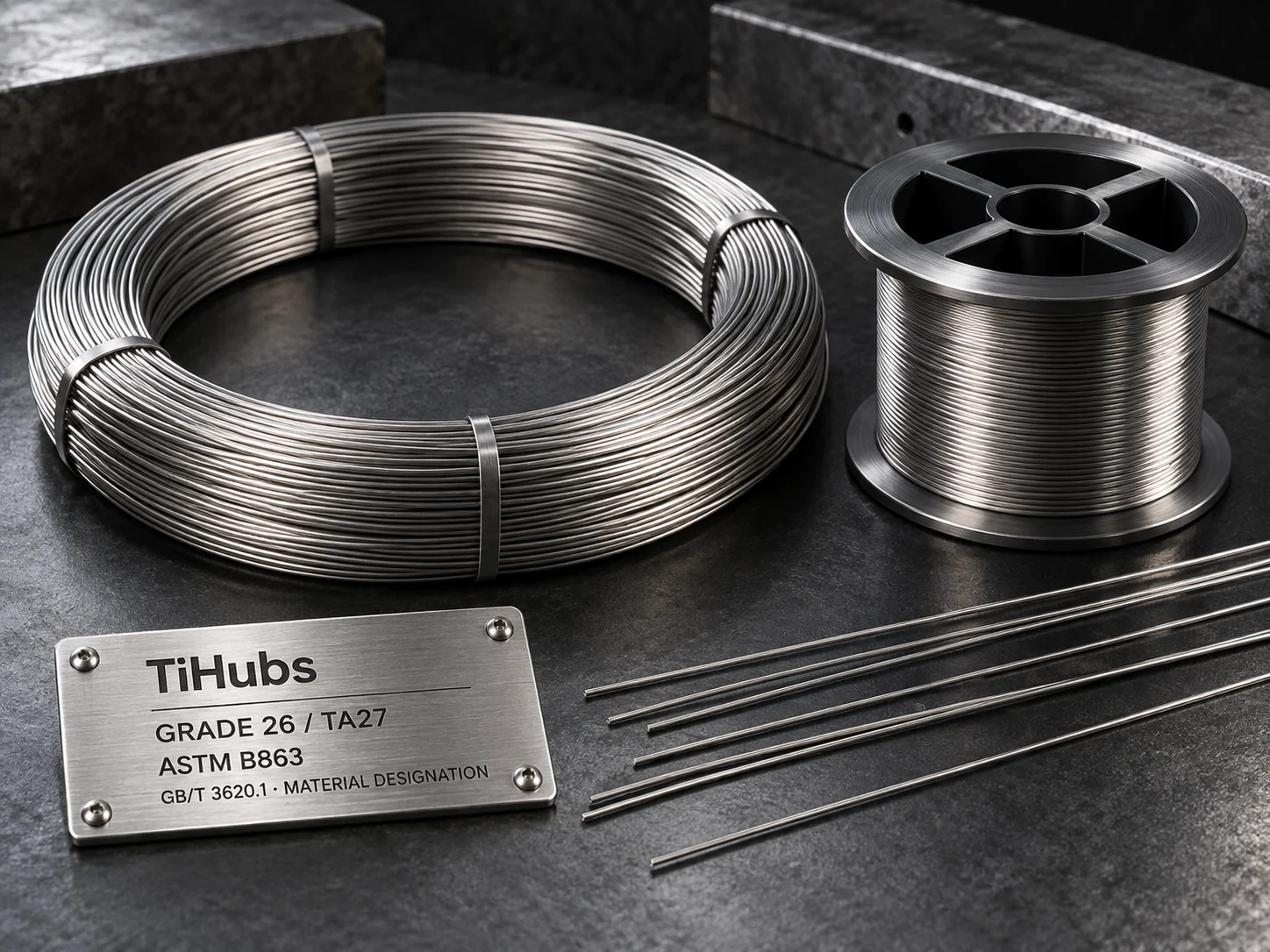
Grade 26 / TA27 titanium wire
Product wire for specified fabrication and component requirements. Give its intended use so the surface, delivery condition and acceptance scope can be matched before quotation.
- Specification
- ASTM B863 Grade 26 with the required edition and condition. For TA27 wire, agree the product requirements in addition to GB/T 3620.1 chemistry.
- Supply form
- Coil, spool or straight length; diameter and tolerance, cast or straightness, coil weight and packaging.
- Surface
- Finish, cleanliness and protection against handling or packaging contamination, especially where later processing is sensitive to surface condition.
- Acceptance
- Chemistry, dimensions, surface and applicable mechanical checks. If welding filler is needed, specify its separate consumable classification rather than relying on a B863 grade alone.
05 / 06
Grade 26 / TA27 · Gr26 · Ti-0.1Ru
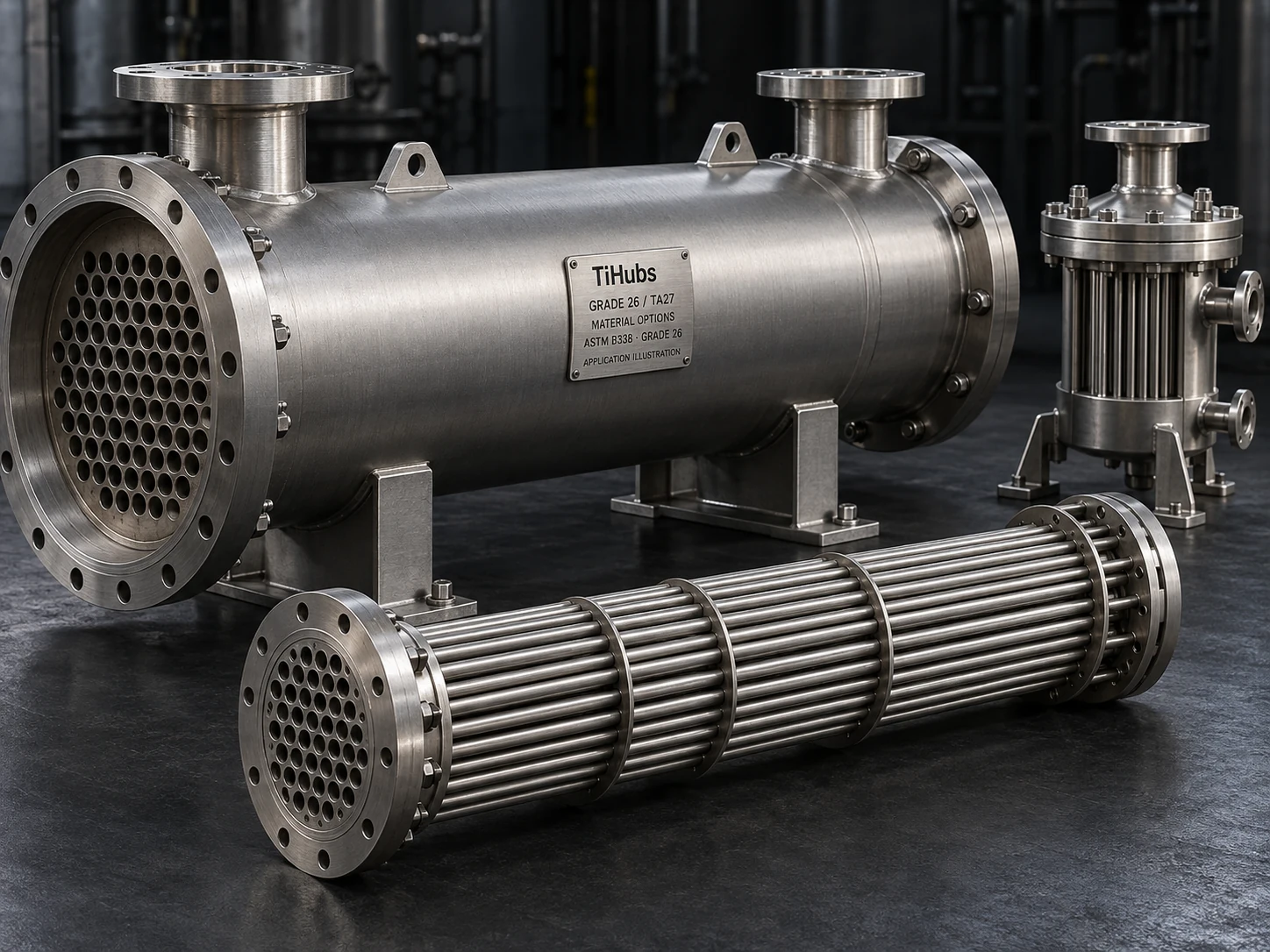
Heat exchangers, condensers & chemical-process equipment
Application illustration: Grade 26 / TA27 material and fabrication options for defined wetted parts. A useful proposal connects each material form with the actual heat-transfer and corrosion duty.
- Process duty
- Both-side fluids, concentrations, impurities, pH, wall temperature, pressure, flow, fouling and the complete cleaning cycle.
- Supply boundary
- Tube set, U-tube bundle, coil, tubesheet, shell lining, selected internals or a defined assembly. Identify free-issued and mating parts.
- Fabrication
- Released drawings, joint details, weld and forming requirements, required qualifications, hold points and document responsibilities.
- Acceptance
- Agreed design/fabrication code, dimensional and integrity tests, material records and final documentation. Raw-material compliance does not establish complete-equipment approval.
06 / 06
Grade 26 / TA27 · Gr26 · Ti-0.1Ru
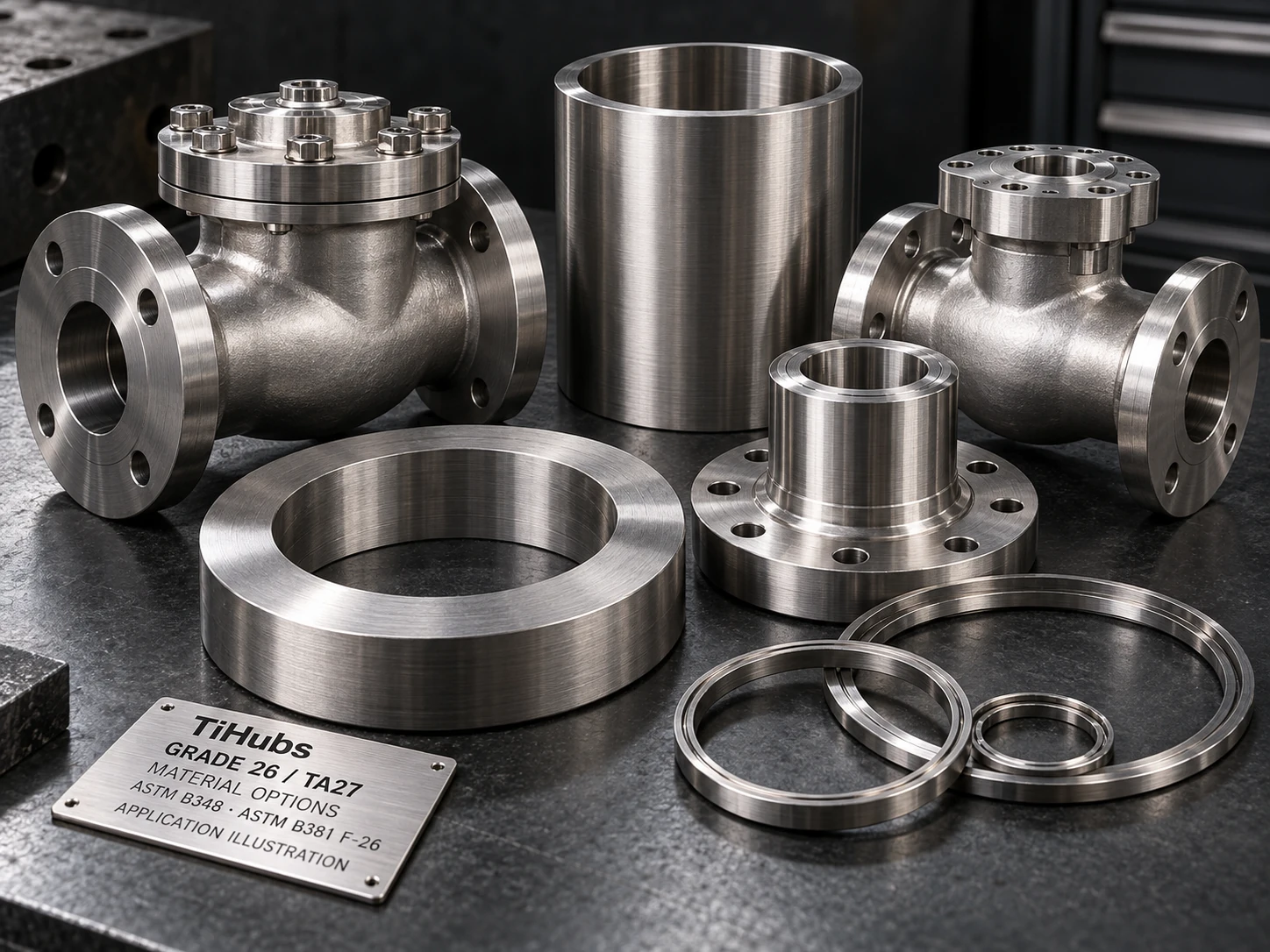
Pump, valve & sealing components from forged or bar stock
Application illustration: forged blanks and machined wetted parts for selected corrosion duties. Corrosion resistance, strength, sealing and wear must be reviewed together.
- Material route
- ASTM B348 Grade 26 bar or ASTM B381 F-26 forgings. GB/T 25137 defines F-26, with an informative TA27 cross-reference; specify F-26H only when required.
- Drawing
- Blank or finished part, revision, machining allowance, wetted surfaces, threads, concentricity, sealing-face geometry and surface finish.
- Operating duty
- Fluid composition, pressure, temperature, solids, velocity, cavitation risk, sliding contact and mating materials.
- Acceptance
- Material identity, specified properties, NDT and critical dimensions. Any component pressure, leakage or functional test requires its own agreed procedure and criteria.
Images illustrate material forms and application possibilities. Reference markings identify specification options; they do not establish dual certification, stock availability or finished-component approval.
Define the product. Share the requirement.
These details help turn your enquiry into a comparable quotation.
01 / Requirement review
Forged blanks to finished parts
Define whether the quotation covers F-26 blanks, machined parts or a tested component, with machining allowance and inspection agreed.
Discuss your requirement02 / Requirement review
Several material forms
Coordinate sheet, tube, bar and fittings under one item list, while keeping each product specification and heat identity clear.
Discuss your requirement03 / Requirement review
Service-based material review
Send the fluid analysis and operating cycle, including cleaning and upset conditions, so unresolved selection questions can be identified early.
Discuss your requirement02 / Material identity
What is
Grade 26 / TA27 titanium?
Grade 26 / TA27 combines a titanium base with a small ruthenium addition. Review chemistry, ordered strength and the actual corrosive duty together before selecting the product route.
Gr26 is UNS R52404. TA27 is the corresponding Chinese Ti-0.10Ru designation; the product standard and agreed acceptance requirements complete the order.
345MPa
Minimum tensile strength
275MPa
Minimum 0.2% yield strength
20%
Minimum elongation
ASTM B265-08 · Grade 26 · annealed sheet/plate reference
| Property or condition | Reference | Ordering implication |
|---|---|---|
| Reference scope | ASTM B265-08 · Grade 26 · annealed | The displayed values are sheet/plate ordering references subject to Table 1 notes; they are not allowable equipment design stresses. |
| Yield strength range | 275–450 MPa | The specification includes a maximum as well as a minimum. Confirm the ordered form, condition, thickness and test basis. |
| Grade 26H | 400 MPa minimum tensile strength | A separate higher-minimum-UTS designation in the supplied ASTM sheet file. Do not assume ordinary Grade 26 meets an order for 26H. |
| Chinese designation | TA27 · GB/T 3620.1-2016 | TA27 identifies the Ti-0.10Ru chemistry route. Mechanical and dimensional acceptance come from the agreed product specification. |
| Forged products | F-26 · ASTM B381 / GB/T 25137 | Apply the forging specification, section-size qualifications and sampling requirements rather than transferring a sheet table to every component. |
ASTM B265-08 Table 1 includes condition and thickness qualifications. Other conditions and plate over 25 mm may require agreed properties. The figures are not design allowables or universal acceptance values for every product form.
| Element · wt% | Grade 26 · ASTM B265-08 | TA27 · GB/T 3620.1-2016 |
|---|---|---|
| Ruthenium · Ru | 0.08–0.14 | 0.08–0.14 |
| Oxygen · O | 0.25 max. | 0.25 max. |
| Iron · Fe | 0.30 max. | 0.30 max. |
| Nitrogen · N | 0.03 max. | 0.03 max. |
| Carbon · C | 0.08 max. | 0.08 max. |
| Hydrogen · H | 0.015 max. | 0.015 max. |
| Other residuals | 0.10 each / 0.40 total max. | 0.10 each / 0.40 total max. |
| Titanium · Ti | Balance | Balance |
Ranges and maxima shown for the cited chemistry routes. Confirm the complete specified analysis, residual-element requirements and certificate basis for the supplied heat.
Grade 26 / Gr26 and TA27
Grade 26, abbreviated Gr26, is the US Ti-0.1Ru route identified as UNS R52404; TA27 is the corresponding Chinese designation. Use the full pair for material identification, then state the controlling product standard, edition, condition and inspection requirements.
Grade 26 and Grade 27 / TA27-1
Both have a 0.08–0.14% ruthenium range. Grade 27 has lower oxygen and iron limits and lower strength with greater specified elongation in the cited sheet table. Choose between mechanical requirements and forming needs, not the ruthenium content alone.
Grade 26 and Grade 7 / Grade 16
Grade 26 uses ruthenium; Grades 7 and 16 use palladium. These corrosion-resistant titanium routes can be compared for a defined environment, but substitution needs the purchaser’s material-selection and specification review. Compare actual quotations rather than assuming a fixed price advantage.
Grade 26 and Grade 2
Ruthenium modification is intended to extend performance in selected reducing or crevice-corrosion conditions. The Grade 2 name does not include that alloy addition. A previous Grade 2 drawing needs an explicit material change if Grade 26 is selected.
03 / Application review
Chemical service, defined by the duty.
For Grade 26 / TA27, a useful application review connects the process environment with the wetted geometry, manufacturing route and acceptance plan. Select a duty to see what to include in the enquiry.
Application review / 01
Chemical heat exchangers: connect the alloy to the actual heat-transfer duty
Grade 26 / TA27 is considered where a titanium-ruthenium route is selected for corrosive process exposure. In a heat exchanger, the environment at the metal surface can differ from the bulk liquid: heated walls, deposits and poorly swept joints deserve specific attention. A replacement tube order should identify whether it preserves an established material selection or introduces a new one.
Products to discuss
Straight or U-bent tubes, tube bundles, plate and sheet for selected wetted parts, and drawing-based tubesheet or connection work. Define the material for every item.
What we need to review
Process and utility-side analyses, design and operating temperatures, wall temperature where known, pressure, fouling and cleaning. Add tube-end details, expansion or weld joints, inspection hold points and required integrity testing.
Application review / 02
Hot-brine equipment: evaluate the concentrated and stagnant conditions
Ruthenium-bearing titanium can be evaluated when hot chloride service creates concern about localized attack in crevices or beneath deposits. Salt concentration alone does not establish suitability. The material review should address stagnant connections, gasketed interfaces and the operating cycle, including changes during shutdown and cleaning.
Products to discuss
Tube and pipe sections, circulation components, liners and specified valve or sealing parts for the reviewed brine circuit.
What we need to review
Brine composition, concentration range, pH, oxygen conditions, solids, flow velocity, temperatures and deposits. Identify crevices, previous damage locations, cleaning chemistry and the need for process-specific corrosion evidence.
Application review / 03
Evaporation and concentration: follow the chemistry through the process
The feed, concentrated liquor and cleaning solution can present different duties to the same equipment. Evaporation can increase dissolved-species concentrations while deposits alter conditions at heating surfaces. Grade 26 / TA27 proposals should therefore be tied to the complete exposure cycle, not just the name of the feed solution.
Products to discuss
Heating tubes and coils, selected lining or plate, evaporator internals and defined tube-bundle work. Separate raw-material supply from fabrication and complete-equipment scope.
What we need to review
Feed and final analysis, temperature and concentration profiles, boiling and wall temperatures, pressure or vacuum, solids, heat flux where available and cleaning duration. Include minimum wall, joint design, testing and code responsibilities.
Application review / 04
Chemical shells and linings: define the load-bearing boundary
A corrosion-resistant lining and a load-bearing pressure wall have different design and acceptance requirements. For Gr26 / TA27 sheet and plate, the enquiry should identify the role of the titanium, its attachment to the supporting structure and how welds or seams are inspected. Formed geometry also affects the required starting thickness and fabrication plan.
Products to discuss
Flat or cut plate, rolled shells, formed lining sections and drawing-based wetted internals, subject to the agreed material and fabrication scope.
What we need to review
Released drawings, minimum finished wall, forming radii, support and attachment design, thermal movement, weld access, leak detection and inspection. State the controlling equipment code and who approves the design.
Application review / 05
Process lines: keep pipe, fittings and joints on a consistent specification
A line enquiry needs more than a grade and nominal diameter. Pipe schedules and tube OD-by-wall sizes are different ordering systems, and straight material, fittings and welded assemblies have different test requirements. Dead legs, dissimilar-material connections and shutdown drainage should be included in the selection review.
Products to discuss
ASTM B861 Grade 26 seamless pipe, B862 Grade 26 welded pipe and the relevant ASME SB-363 WPT26 wrought fitting route.
What we need to review
Line list, size system, lengths, wall basis, fitting geometry, end preparation, flange interfaces and joint details. Add pressure and temperature, weld examination, pressure/leak testing and the required document package.
Application review / 06
Pump and valve parts: combine corrosion review with mechanical duty
A corrosion-resistant material does not by itself resolve sealing, wear, erosion or cavitation. In pumps and valves, local geometry, mating materials and contact stresses can govern component performance. Grade 26 / TA27 bar or forged stock should be selected with the component designer’s loading and surface requirements in view.
Products to discuss
Valve stems, sleeves, sealing rings, connectors, F-26 forged blanks and drawing-based machined parts. Identify blank-only, machining and component-test responsibilities.
What we need to review
Wetted surfaces, pressure, temperature, solids, flow, sliding contact and cavitation risk; plus critical dimensions, concentricity, thread details and sealing-face finish. Agree NDT and any separate leakage or functional acceptance.
Application review / 07
Liquor-handling components: review the full process analysis
Leach and recovery circuits can combine acids, salts, oxidizing species and abrasive solids. A titanium-ruthenium option needs to be assessed against the actual stream, including contaminants and changes between processing stages. Existing service history or a relevant corrosion test can help define the acceptance basis when published data do not represent the plant duty.
Products to discuss
Selected liners, transfer pipe, heating parts and machined wetted components for an engineering-reviewed hydrometallurgical service.
What we need to review
Liquor analysis, pH and oxidation conditions, temperature, solids content and particle behavior, velocity and wear locations. Identify fluoride or other aggressive contaminants, upset conditions and the evidence required for material approval.
Application review / 08
Formed and welded assemblies: carry traceability through the process
Cutting, forming and welding introduce requirements beyond the starting material certificate. A Gr26 / TA27 fabrication enquiry should define the geometry and the checks required after processing, especially where bending reduces wall thickness or welding changes the surface condition. Material marking must remain linked to the supplied heat or lot.
Products to discuss
Formed sheet, rolled sections, U-bends, coils and specified welded subassemblies. Product wire and welding consumables are separate ordering items.
What we need to review
Minimum remaining wall, bend radii, thinning and ovality, cleanliness, weld design, shielding and procedure requirements. Agree first-article review, post-process inspection, marking transfer and the final records.
Technical references: ASTM B348 official scope ↗ · ASTM B863-19 official scope ↗ · Alleima Grade 26 technical reference ↗ · Ruthenium-enhanced titanium research ↗
Purchasing checklist
Define the duty before the supply route.
Our founder’s 20 years in titanium inform the questions asked before quotation and the manufacturing resources reviewed for each Grade 26 / TA27 order.
A comparable quotation
Agree grade, standard edition, product form, condition, dimensions, quantity, inspection, documents, packaging and delivery terms. Identify samples, tooling and tests priced separately.
Acceptance before supply
Confirm ruthenium-bearing chemistry, mechanical test basis, traceability, critical dimensions and additional NDT or integrity testing before production begins.
Milestones and change control
Set drawing approvals, sample decisions, manufacturing and dispatch milestones. Material substitutions or technical changes need written agreement; deviations should state their impact and next steps.
“We need Grade 26 tubes for a brine heat exchanger.”
Clarify whether the requirement is ASTM B338 tube or another agreed route, the OD and wall basis, straight or U-bent geometry, both-side chemistry and temperature, joint design and test scope. Establish whether this is an unchanged replacement or a new material-selection decision.
This is an enquiry-planning example, not a claim about a completed customer project.
Discuss your requirement04 / Standards & documentation
Match the standard
to the product.
Choose the product route and the edition required by the order. The linked files retain their supplied versions; TA27 chemistry and Chinese forging options are distinguished from ASTM product specifications.
| Product form | ASTM / AMS / ASME route | Chinese standard route | Clarify before quotation |
|---|---|---|---|
| Material identity & composition | United States / technical reference Grade 26 · UNS R52404. Apply the chemistry in the specified ASTM product standard. | ChinaGB/T 3620.1-2016View PDF ↗ TA27 · Ti-0.10Ru designation and chemical composition. | Full grade, ruthenium range, residual elements and analysis/certificate basis. |
| Sheet & plate | United States / technical referenceASTM B265-08View PDF ↗ Grade 26; specify Grade 26H separately if required. | ChinaGB/T 3620.1-2016View PDF ↗ TA27 chemistry plus agreed product requirements; GB/T 3621-2022 does not list TA27. | Condition, thickness, flatness, surface, forming direction and required tests. |
| Bar & rod | United States / technical referenceASTM B348-08aView PDF ↗ Grade 26 bars and billets. | ChinaGB/T 3620.1-2016View PDF ↗ TA27 chemistry plus agreed bar product requirements; GB/T 2965-2023 does not list TA27. | Section, finish, straightness, machining allowance and NDT. |
| Heat-exchanger tube | United States / technical referenceASTM B338-08bView PDF ↗ Grade 26 condenser and heat-exchanger tubes. | ChinaGB/T 3620.1-2016View PDF ↗ TA27 chemistry with a defined tube specification and acceptance plan. | Seamless/welded route, OD, wall basis, length, joints and tube tests. |
| Seamless / welded pipe | United States / technical referenceASTM B861-10View PDF ↗ASTM B862-06b ε1View PDF ↗ Separate B861 seamless and B862 welded pipe routes. | ChinaGB/T 3620.1-2016View PDF ↗ Agree the TA27 product and fabrication requirements explicitly. | Size system, end preparation, wall tolerance, weld examination and integrity tests. |
| Wire | United States / technical referenceASTM B863-19View PDF ↗ Grade 26 product wire; filler classification is a separate requirement. | ChinaGB/T 3620.1-2016View PDF ↗ TA27 chemistry plus agreed wire requirements; GB/T 3623-2022 does not list TA27. | Use, diameter, condition, coil/spool, finish and records. |
| Forgings & component blanks | United States / technical referenceASTM B381-08aView PDF ↗ F-26; F-26H requires a separate callout. | ChinaGB/T 25137-2010View PDF ↗ F-26 / F-26H; informative Annex B maps these to TA27. | Blank geometry, section, allowance, properties and NDT. |
| Wrought welding fittings | United States / technical referenceASME SB-363 · 2013View PDF ↗ ASME SB-363 WPT26; use the correct grade and construction scope. | China A Chinese fitting route must be established for the actual input material and product. | Fitting dimensions, starting material, welding, tests and piping-code requirements. |
Agree the order basis.
For TA27, a chemistry reference is not a substitute for a product specification. Confirm the required edition and complete acceptance scope before order placement; listed PDFs do not imply all forms or sizes are in stock.
Use the document edition, product scope and condition specified in the purchase order. Producer technical references support discussion; they do not replace ordered product acceptance requirements.
05 / Order coordination
Know the scope
before ordering.
Our founder’s 20 years in titanium inform the questions we ask before quotation and the supply options we review with you.
A quotation you can evaluate
Agree the grade, standard edition, dimensions, tolerance, condition and quantity before comparing prices.
- Identify whether inspection, samples and tooling are included.
- Confirm packaging, transport and delivery terms.
- Record items that still need technical confirmation.
Acceptance agreed before supply
Confirm the material certificate, full grade, heat or lot identity, delivery condition, dimensional checks and required testing before supply starts. Define any process records, NDT and purchaser approval points for the ordered product.
Independent inspection can be discussed with its scope, timing, acceptance criteria and cost agreed for the order.
Delivery with clear milestones
Review the proposed lead time, approvals, production sequence and dispatch requirements. For several product forms, coordinate document and packing readiness together.
Material substitutions and technical changes require written approval. A schedule deviation should identify the impact, decisions needed and next steps.
One contact when an issue arises
Contact TiHubs with the order reference, affected items and supporting photos or inspection records.
We record the issue, review it against the agreed requirements and coordinate the next steps with the relevant manufacturing parties.
01 / Material identity
Material records
Grade, standard, test results and heat or batch identity matched to the supplied items.
02 / Agreed acceptance
Inspection records
Dimensional and testing records for the agreed scope, including critical drawing requirements.
03 / Ready for dispatch
Dispatch records
Item identification, packing list, protective packaging and required shipment documents.
06 / Questions before sourcing
Before you specify
Grade 26 / TA27.
A clear material designation is the beginning. Product form, specification revision, material condition and acceptance complete the requirement.
A useful first enquiry
- Product and specificationProduct form, standard edition, dimensions and material condition.
- Order and deliveryQuantity, destination and any required delivery date.
- Acceptance requirementsDrawing revision, inspection, certificates and packaging.
Not every detail is finalized? Send the information you have. We can help identify the questions to resolve before quotation.
What happens next: requirement review, technical clarification, then a supply proposal and quotation.
What is Grade 26 titanium, and what does Gr26 mean?
Grade 26, shortened to Gr26, is a titanium-ruthenium grade identified as UNS R52404. The cited specifications require 0.08–0.14% ruthenium. It is considered for selected chemical corrosion duties, including heat-transfer equipment and process-system parts. The full order must also identify product form, standard edition and delivery condition.
Is TA27 the Chinese designation corresponding to Grade 26?
Yes. TA27 is the corresponding Chinese Ti-0.10Ru designation in GB/T 3620.1-2016. The page covers Grade 26 and TA27 together. For purchasing, specify which product requirements govern dimensions, mechanical properties, testing and documents; a chemistry designation alone is not a complete product specification.
How do Grade 26, Grade 26H and Grade 27 differ?
The supplied ASTM B265-08 lists a 345 MPa tensile minimum for Grade 26 and 400 MPa for Grade 26H. Grade 27 is a lower-oxygen, lower-iron Ti-Ru route with a 240 MPa tensile minimum and 24% elongation minimum in that sheet table. Keep the exact designation and test basis on the order.
Where is Grade 26 / TA27 mainly considered?
The main focus is selected corrosion-resistant chemical equipment: heat exchangers, condensers, hot-brine circuits, evaporator parts, process piping and pump or valve components. Review the complete chemistry, concentration, temperature, deposits, crevices and mechanical duty before confirming material suitability.
Can Grade 26 replace Grade 7 or Grade 16?
They may be compared during material selection, but they use different alloying additions: Grade 26 contains ruthenium, while Grades 7 and 16 contain palladium. Replacement requires review of the actual environment, product specification and acceptance evidence. TiHubs can coordinate the information needed for that comparison before quotation.
Which standards cover Grade 26 tube, pipe and forgings?
The supplied options include ASTM B338 for condenser and heat-exchanger tube, B861 for seamless pipe, B862 for welded pipe and B381 F-26 for forgings. GB/T 25137 also defines F-26 and includes an informative TA27 cross-reference. Specify the product route, dimensions, condition and tests rather than using the grade name alone.
Can I use the usual Chinese sheet, bar, tube and wire standards for TA27?
The supplied editions of GB/T 3621, GB/T 2965, GB/T 3624 and GB/T 3623 do not list TA27 in their product tables. For those forms, state TA27 chemistry and agree an applicable product and acceptance specification. We will clarify the route before quoting, rather than attach a familiar standard number to an unsupported grade.
What information is needed for a quotation and inspection plan?
Send the product form or drawing, grade, standard edition, dimensions and tolerance, quantity, destination and required delivery. For process equipment, add fluid analysis, temperatures, pressure, cleaning and joint details. Material records, heat traceability, NDT, samples and independent inspection can be agreed with their scope, timing and costs.
What are the MOQ, lead time and arrangements for order issues?
Quantity and timing depend on form, size, manufacturing route, tooling and inspection. TiHubs confirms the quotation basis and milestones for the order. If an issue arises, provide the order reference, affected items and evidence; we record it, review it against the agreed requirements and coordinate the next steps with the relevant manufacturing parties.
07 / Your next step
Start with the
requirement you have.
Send the product details, drawing or operating conditions you already know. We will identify missing information and discuss a suitable supply route before quotation.
- Requirement review
- Technical clarification
- Supply proposal and quotation
Combine materials and parts in one enquiry.
Send one list of Grade 26 / TA27 forms, sizes and quantities. Include drawing revisions and items that need to be supplied together.
Define the condition and acceptance priorities.
Include the ordered specification, final application, material condition, inspection and documentation, destination and required delivery milestones.
Baoji, China · info@tihubs.com
Start your Grade 26 / TA27 enquiry
Send your material form, drawing or process conditions. We will help clarify the remaining requirements.