A removable fixture plate and a compact counterweight can require opposite material choices. Set the feature that cannot change, then calculate the metal volume and mass before comparing prices per kilogram.
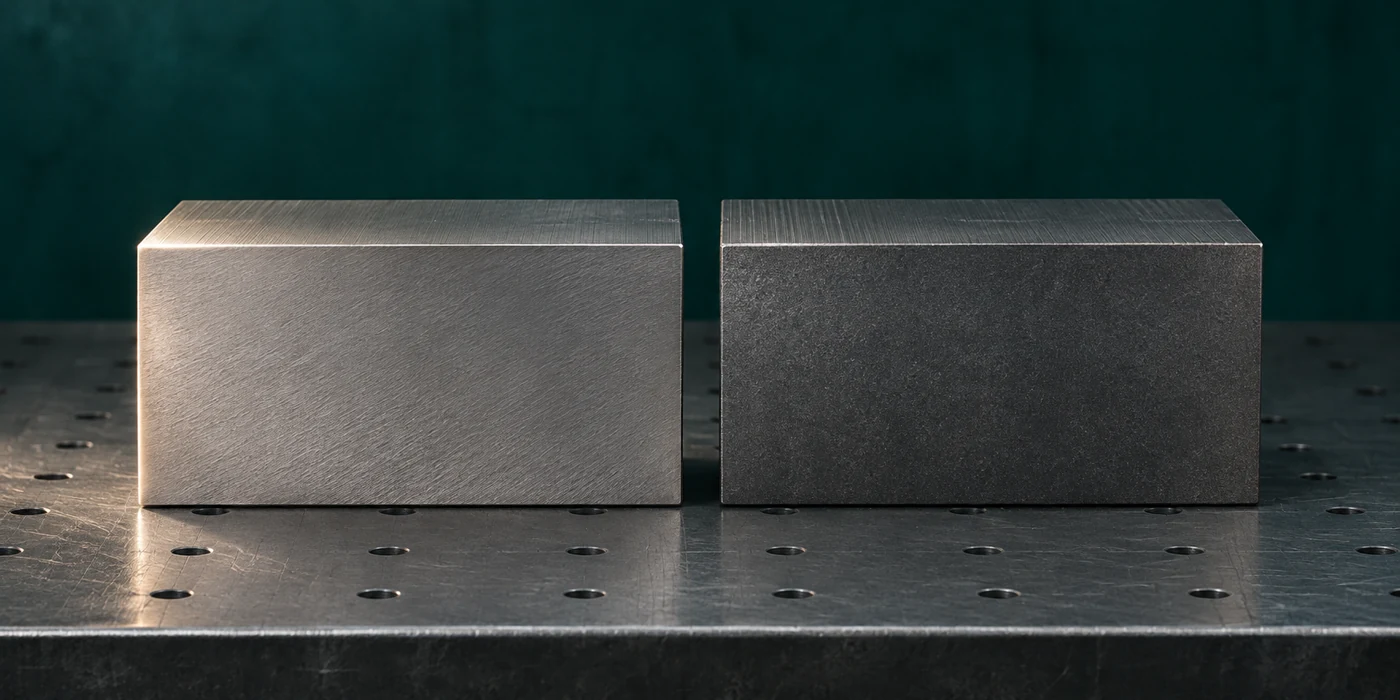
AI illustration; not a production or inspection record.
Quick answer
Typical density is 4.51 g/cm³ for TIMET Grade 2 and 19.25 g/cm³ for pure tungsten in Plansee’s published data. At equal solid volume tungsten is about 4.27 times as heavy. At equal mass titanium needs about 4.27 times the metal volume. Use the actual material designation for a heavy alloy or carbide.
01 / Start with the fixed condition in your fixture
Start with the fixed condition in your fixture
Start a titanium versus tungsten comparison with a sketch of the part in its machine. Mark what cannot change. A removable inspection fixture may have to match mounting holes and stay below a handling mass. A counterweight for a civilian packaging machine may have to add a specified mass inside a small pocket. A laboratory carriage may have room for a larger body but must retain the location of its centre of mass. The same two material data sheets support quite different decisions in these three cases. Write the fixed envelope, target mass and non-negotiable interfaces on separate lines before asking purchasing to find a lower price.
A fixed envelope sets the maximum exterior space, while metal volume describes the amount of solid material inside it. A rectangular body with an internal pocket occupies the same exterior space as a solid block of the same dimensions and contains less metal. This difference matters when the drawing includes counterbores, channels, threaded holes or a deep recess. If a drawing program reports volume, establish whether it reports the finished solid, a bounding box or an assembly containing other materials. Record the model revision and the units. A beautifully precise volume taken from the wrong model can produce a convincing but useless estimate.
Define the target as a finished part or an installed assembly. An operator may lift a fixture with its handle and clamps attached, while the buyer’s calculation covers only the plate. A counterweight may be specified complete with its retaining screw. Include the hardware mass if the requirement applies to the assembly, or reserve a documented allocation for it. An upper limit for manual handling differs from a target with both an upper and a lower tolerance. A lighter option can meet the former and fail the latter. Ask what happens if the part is too light as well as what happens if it is too heavy.
Finally select the exact material pair. This article compares commercially pure Grade 2 titanium, represented by TIMETAL 50A, with pure tungsten, represented by Plansee’s published metal density. A Grade 5 titanium component, a tungsten heavy alloy and a cemented carbide require their own records. This pair gives a reproducible starting point for understanding metal volume and mass. The decision about fit, load capacity, wear, joining and environmental suitability remains tied to the specific design. If the buyer only needs a titanium stock quotation after screening alternatives, identify that purpose. It helps the supplier select a suitable stock form and focus the bid on the remaining constraints.
02 / Compare mass at equal volume and volume at equal mass
Compare mass at equal volume and volume at equal mass
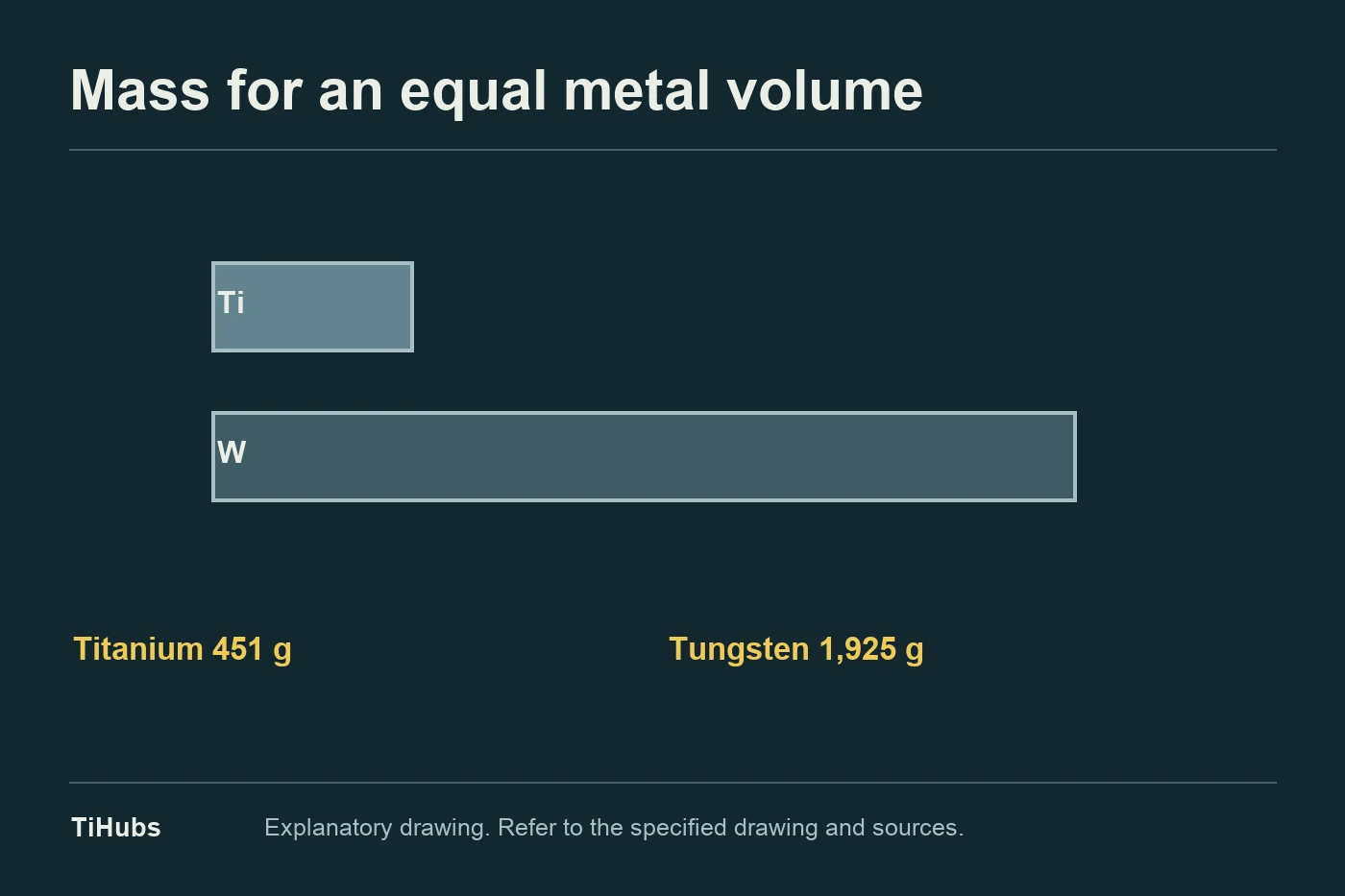
Use mass equals metal volume multiplied by density. The TIMET data sheet gives a typical density of 4.51 grams per cubic centimetre for its Grade 2 titanium. Plansee gives 19.25 grams per cubic centimetre for tungsten. For equal solid volumes of 100 cubic centimetres, those densities give 451 grams of titanium and 1,925 grams of tungsten. Dividing 19.25 by 4.51 gives about 4.27. A tungsten piece of the same solid geometry therefore has about 4.27 times the mass in this comparison. The ratio changes if the buyer changes material grade or removes different amounts of metal from each part.
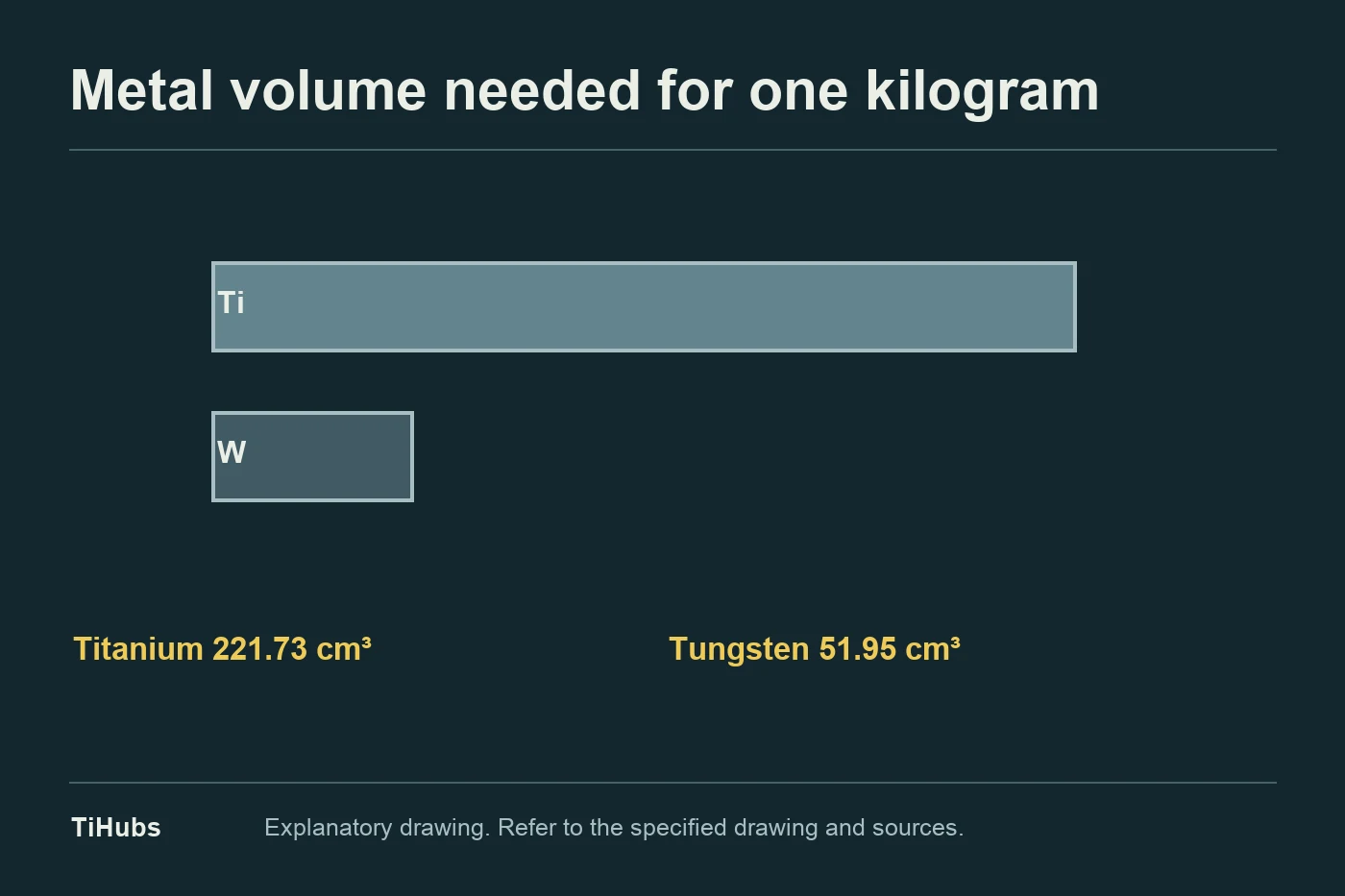
Reverse the calculation when mass is fixed. Divide the target mass by density, keeping grams and cubic centimetres together. One kilogram corresponds to about 221.73 cubic centimetres of the stated titanium and about 51.95 cubic centimetres of pure tungsten. If both parts have a fixed footprint of 100 square centimetres and a uniform solid section, the corresponding thicknesses are approximately 22.17 and 5.19 millimetres. They are idealised results before adding a screw, a recess or an edge treatment. For a thin layered assembly, carry out the same calculation separately for each material. A backing plate and a dense insert should not both be charged at the insert density.
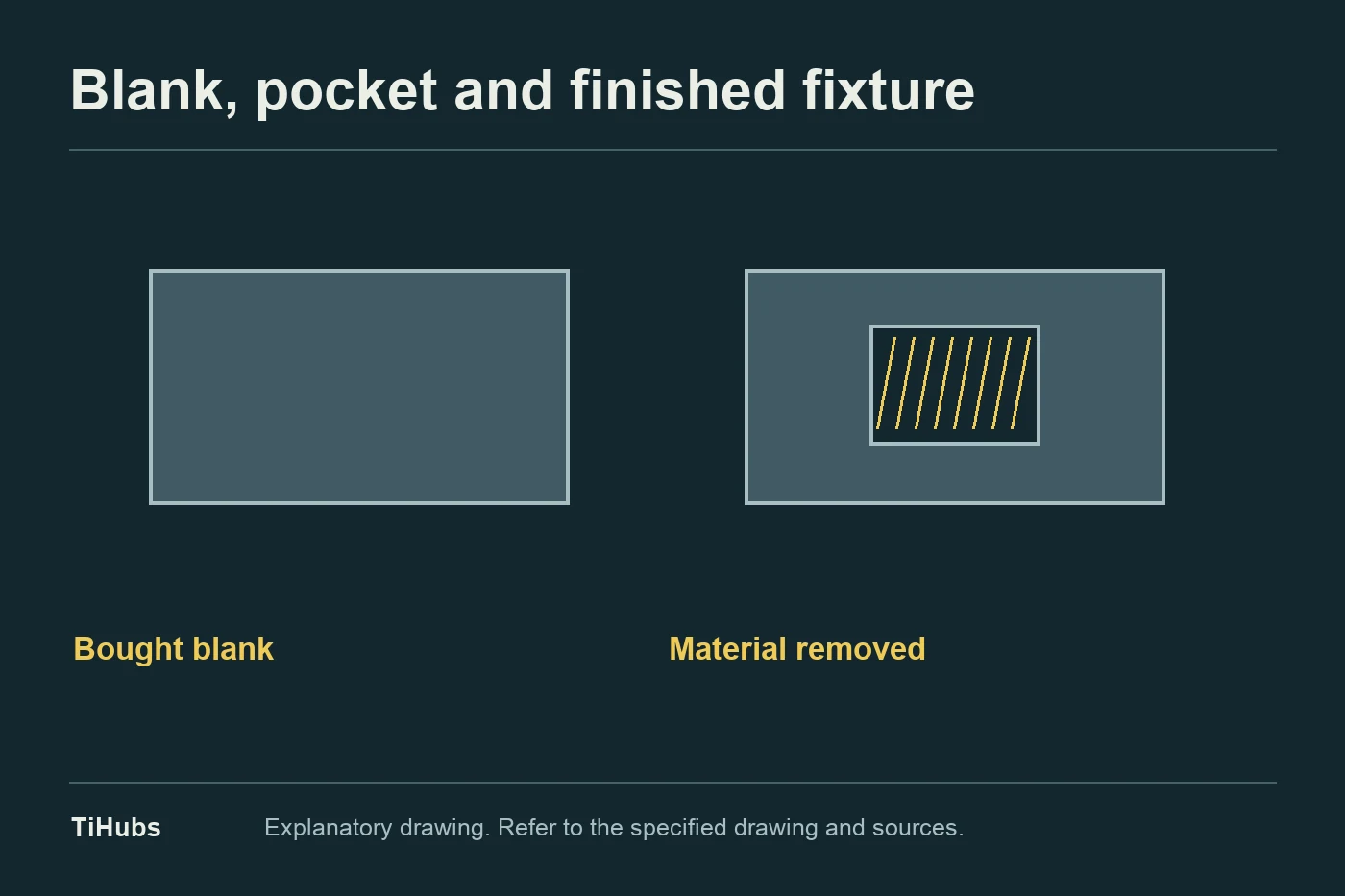
Consider the inverse problem of removing a pocket. An empty pocket of ten cubic centimetres reduces the solid titanium mass by about 45.1 grams, compared with about 192.5 grams for pure tungsten. The external envelope can remain identical. Where the pocket is placed can also move the centre of mass. A pocket positioned centrally and the same pocket beside a mounting foot remove the same mass from a uniform block, but can change how the finished assembly rests or balances. Provide the location as well as the removed volume when that distinction matters. Static mass is a single number and does not specify the distribution of that mass.
Keep rounded catalogue data distinct from guaranteed finished weight. Nominal material density, nominal sizes, edge breaks, surface treatments and actual machining all influence the final value. Show the rounding convention in a calculation and agree a measurement of the finished article for contractual acceptance if needed. When the measured result differs from the estimate, first check the product identity, model revision, hardware and units. A missing pocket or an included clamp can explain a discrepancy without implying a different alloy. Conversely, a correct final weight cannot certify chemistry when different materials and geometric combinations can reach the same result.
A third comparison sometimes settles a design meeting faster. Start with a tray whose empty pocket holds a maximum of 50 cubic centimetres of solid metal. The named titanium would add about 225.5 grams and the pure tungsten about 962.5 grams. A target of one kilogram cannot be reached by filling that pocket with either of these two solid materials at their stated densities. The options become changing the available volume, allocating some mass to another component or revising the target. Stating the shortfall as grams makes the design conversation clearer than arguing about which metal sounds heavy.
When only a portion of the exterior can be filled, enumerate each obstacle. A retaining screw may occupy the centre, a radius at the bottom of the pocket may remove corner volume and an access slot may need to stay clear for later servicing. Use the remaining usable solid volume in the calculation. Provide a sectional drawing if the limit is close. If a bidder proposes a heavy alloy more convenient to machine, repeat the calculation with the actual density of that grade and ask for the available stock dimensions. This gives the buyer a quick way to screen alternatives before requesting detailed drawings and costs.
Property or calculation
Grade 2 titanium
Pure tungsten
Published density
TIMETAL 50A, 4.51 g/cm³
Plansee, 19.25 g/cm³
Mass in 100 cm³ of solid metal
451 g
1,925 g
Volume for 1 kg of metal
Approximately 221.73 cm³
Approximately 51.95 cm³
One central 10 cm³ pocket removed
Approximate mass reduction 45.1 g
Approximate mass reduction 192.5 g
Fixed 100 cm² footprint at 1 kg
Ideal solid thickness about 22.17 mm
Ideal solid thickness about 5.19 mm
Industrial buying guide / 02Mass for an equal metal volume
The equal-volume bars represent 100 cubic centimetres of each named metal.
03 / Identify pure metal, heavy alloy and carbide
Identify pure metal, heavy alloy and carbide
A quotation using the single word tungsten needs a follow-up about composition and product form. Pure elemental tungsten is the material behind the density comparison above. Tungsten-base heavy alloys form a separate category that includes other metallic constituents. ASTM B777 concerns tungsten-base high-density metal and identifies a defined specification family. Cemented tungsten carbide is another class of material, typically combining hard carbide and a binder. The cutting insert used to machine a fixture and a dense metal insert used to add mass might both be called tungsten in conversation. They are quite different purchases.
Ask for the manufacturer’s exact designation and the data sheet for that designation. When a bidder proposes a heavy alloy for a compact weight, request its density basis, available stock forms and applicable material specification. Keep its quoted density in a new column. Copying the pure-metal value from this guide into an alloy calculation would misstate the amount of metal needed for a target mass. If a binder or alloy constituent matters to the process environment, tell the supplier why and ask for the material evidence the owner needs. A broad family name cannot identify all constituents or their influence on downstream work.
Use similar discipline for titanium. Grade 2 is a specific commercially pure grade. A request for titanium alloy bar can lead a bidder toward a different material and different properties. Define the grade, product form and condition relevant to the component. Where a drawing calls for plate, establish whether the buyer will accept a part cut from another form and what technical approval would be required. Two pieces with similar density can have different tensile properties, inspection histories or fabrication behaviour. If the buyer is comparing published mechanical data, record whether each figure is a typical value, a specified minimum or a result from a particular test lot.
Separate properties by task. A question about mass needs density. A question about stiffness needs elastic behaviour and the actual section geometry. A question about wear at an interface needs the defined contact conditions and the selection of both mating surfaces. The word stronger without a failure mode, condition and relevant test gives the bidder little to price. An industrial fixture can combine a light carrier with a separate replaceable contact element. In that case the purchase question may become which material belongs at each interface and how it will be attached. Ask the designer to document that arrangement and verify it before grouping all components under one material specification.
Industrial buying guide / 03Metal volume needed for one kilogram
At equal mass, the larger volume is on the titanium side.
04 / Translate the result into a useful stock drawing
Translate the result into a useful stock drawing
Translate the chosen constraint into a drawing that distinguishes incoming stock from the finished component. For plate, show the purchased length, width and thickness as well as the final outline. Mark whether the quoted thickness includes finishing stock on both faces. For bar, show the required starting diameter, available cut length and finished dimensions. If a counterweight or fixture is cut from a rectangular block, define the sawn surfaces that will be removed and the surfaces that will remain. A supplier may be able to improve yield by proposing another stock size, but its suitability depends on the machining allowance and reference faces the buyer needs.
A fixture can preserve an external envelope by moving material internally. Draw each pocket, bolt seat and insert at its actual position. Full-depth holes and partial-depth recesses remove different volumes even when they share a diameter on the top view. Specify which reference surface establishes depth. If fittings of another material remain inside the pockets, add their masses with the correct density or an actual measured value. Provide both a part drawing and an assembly drawing where the target applies after installation. This prevents a receiving inspector from rejecting a correctly light bare component that will meet its target only after hardware is added.
Mark the surfaces that carry the mounting position before changing material or thickness. A substantial reduction in thickness at equal mass can leave too little space for the original mounting arrangement, or alter the height of a datum relative to the machine. A larger titanium component that meets the mass of a tungsten insert can occupy space needed for access to adjacent fasteners. Review the geometry in the installed position, including the space needed for removal and service. A part can fit through the opening during initial assembly and still be impossible to remove later without dismantling another item. Communicate these constraints in the request rather than expecting the material supplier to infer them.
For a design still being explored, ask for a quote on defined alternatives. One line could cover Grade 2 plate cut oversize for the customer’s finishing process. Another could cover the same titanium part machined to a finished drawing with thickness and mass inspection. If a dense removable insert remains under consideration, show its interface and keep its supply optional. An all-inclusive price given from an early sketch may hide unanswered questions about attachment, finish and assembly. A short assumptions list allows the designer to learn what actually drives cost while retaining the ability to reject an unsuitable configuration.
Industrial buying guide / 04Blank, pocket and finished fixture
Subtract the pocket from solid metal volume before calculating the finished mass.
05 / Compare cost per finished component
Compare cost per finished component
A price per kilogram answers a narrow stock-purchasing question. To estimate the metal charge for a blank, multiply the purchased mass by the supplier’s unit price for that exact material form and order quantity. To compare finished components, include any minimum order, cutting, fixture work, machining, finishing, measurement and transport that belong to each option. A high-density metal can put much more purchased mass into the same geometric blank. A part with many pockets can also discard much of the purchased volume during machining. Both effects matter even if two suppliers quote superficially comparable prices per kilogram.
Consider a simple material utilisation example with a 120 cubic centimetre blank reduced to a 90 cubic centimetre finished solid. At a uniform density the volume yield is 75 percent for either material. The removed space is 30 cubic centimetres. That represents approximately 135.3 grams of Grade 2 titanium or 577.5 grams of pure tungsten using the stated densities. Do not treat those masses as cash savings without knowing how swarf and offcuts are handled. A reusable offcut, mixed chips and an intact returned remnant may have very different commercial treatment. Ask whether the quote includes any recovery credit and who owns material left after machining.
Separate recurring unit charges from one-time charges. A prototype shop may need a fixture to machine or measure a thin part, while a repeat order can reuse it. A stock distributor may invoice a full piece even when the buyer needs a small portion. A quoted minimum may be in kilograms for one material and in stock lengths for another. Convert both to the cost of the accepted quantity and state how much residual stock remains useful. Where the next revision is uncertain, a large minimum creates more exposure to obsolete stock. Where the part is a stable repeat item, the same minimum can support a practical replenishment plan.
Compare the acceptance evidence included in the price. One option might provide material identity and sawn dimensions only. Another may include finished mass, flatness on a defined support, position of holes and marking for installation. An assembly supplier may also verify that the purchased hardware fits and that the total mass meets the owner’s tolerance. Identify where the information is needed before pricing extra inspection. A material comparison becomes much clearer when each total represents the same installed function, the same inspection boundary and the same accepted quantity. Where the alternative materials lead to deliberately different functions, show those differences plainly in the engineering decision.
Keep the initial cash outlay for the full lot separate from recurring cost divided by accepted quantity. State whether the prototype bears the fixture cost or a proposed production run shares it. If the supplier stores unused stock, establish how long it is reserved, how it is identified and who can reclaim it. Where a larger plate is offered to improve yield, ask for the layout with cutting gaps, clamping areas and orientation. Dividing raw plate area by finished part area alone does not guarantee the number of useful blanks. Include any first article consumed in destructive inspection in the quantity and cost comparison.
06 / Write the purchase and acceptance requirements
Write the purchase and acceptance requirements
Write a short functional statement at the top of the enquiry. Explain whether the part is a portable fixture, a fixed support, a removable counterweight or an experimental comparison of stock. List the exterior envelope and the mass condition that determine acceptance. Attach the current drawing and identify the mounting datums, the space available around the part and any handling restrictions. Then name the material on each line. Where the buyer permits a substitute, ask the supplier to describe it separately with its designation, density basis, material records and proposed implications for machining or fit. This makes a substitution visible before money is spent on the wrong blank.
Define the condition for weighing. A bare plate can be weighed with or without protective film, screws or a removable handle. The result can differ enough to matter in a tightly controlled assembly. Identify which items remain on the scale, how any tare is handled and the resolution required to compare the result with the tolerance. For a mass distribution requirement, define the additional check independently. A scale reading alone cannot show that a weight is concentrated on the correct side of a fixture. If the final adjustment is made by the machine owner, state the allowed condition of the delivered part and who records the assembled result.
For receiving, match material documentation to each identified piece or lot before comparing mass. Check that stock dimensions leave the agreed machining allowance and that critical surfaces have transport protection. Compare the part revision with the revision used in the mass estimate. If the item includes a dense insert in a titanium carrier, verify the identification and retention arrangement from the assembly drawing. A single packed weight can also include packaging and several loose components. Record net part mass separately when the contractual requirement applies to the metal component. This habit prevents a freight value from finding its way into a future design calculation.
Save a decision record that another buyer can use on the next release. Include the two designations considered, the fixed constraint, the volume used, the source densities and the resulting expected masses. Add the actual delivered material, form, inspection results and any approved drawing changes. Where the choice favoured titanium for a removable fixture, the company can repeat the metal order without revisiting a broad comparison. Where the choice depended on a tight envelope for a counterweight, the record explains why a lighter replacement of identical dimensions would change the machine. That distinction is more useful for the next quotation than keeping a single price per kilogram detached from the part it represented.
07 / Build your RFQ
Request a technical quotation
A removable fixture plate and a compact counterweight can require opposite material choices. Set the feature that cannot change, then calculate the metal volume and mass before comparing prices per kilogram.
Information to include
Fixed envelope or target mass
Material designation and density basis
Finished volume and stock allowance
Pocket location and mating surfaces
Finished mass and inspection
Build your RFQ checklist
Choose the product and add the information you have. Copy the resulting brief or send your requirements to TiHubs. Submitting an enquiry does not place an order.
08 / FAQs
Questions buyers ask
How much heavier is tungsten than Grade 2 titanium?
At equal volumes the ratio using 19.25 and 4.51 g/cm³ is about 4.27. The result assumes the stated solid metals and excludes holes, coatings and fittings.
Can a tungsten carbide dimension be priced as pure tungsten?
Identify the exact carbide grade, binder and product form. The pure-metal density and machining assumptions do not define cemented carbide.
Can both mass and thickness stay identical after substitution?
With identical filled volume these two solid metals give different masses. A change in geometry, internal cavities or a separate added component would require its own design review.
09 / Key takeaways
Keep the purchase requirements connected.
Fixed envelope or target mass
Material designation and density basis
Finished volume and stock allowance
Pocket location and mating surfaces
Finished mass and inspection
Technical references
Sources and data scope
References reviewed November 20, 2026. Public source summaries support the discussion; the controlled specification, agreed edition and approved project requirements govern acceptance.
TIMET — TIMETAL 50A — Typical solid density of the named commercially pure titanium grade.
Plansee Group — Tungsten — Pure tungsten density and distinction between tungsten material families.
TiHubs coordinates titanium material and custom supply enquiries from Baoji, China. Send the product, drawing revision and acceptance requirements so the proposed supply scope can be reviewed. Learn about our sourcing role.
Contents
TiHubs
Talk to TiHubs
Ask about titanium materials, grades or custom parts.
Enter your email to start chatting.
We use your email to respond to your enquiry. Your conversation is stored on this website.
Our team is away right now. Leave your enquiry and we will follow up by email.