A room-temperature value answers a narrow question. A purchase for a heated fixture also needs the grade, mass, temperature range and the boundary of the energy calculation.
AI illustration; not a production or inspection record.
Quick answer
At 300 K the NIST Shomate equation gives about 528 J/(kg·K) for solid elemental alpha titanium. At 600 K the corresponding value is about 597 J/(kg·K). Integrating the same data over that interval gives about 170.88 kJ per kilogram, or 2.051 MJ for 12 kg of metal. The example excludes fixtures, heat losses and any phase change.
01 / What the property measures
What the property measures
A buyer receives two quotations for a titanium fixture intended to travel through a heating station. Both suppliers state the same overall dimensions but one proposes a hollow body and the other a solid block. The customer asks which fixture will heat faster. A table of specific heats can help calculate how much energy the metal stores. It cannot settle the question until the mass of each configuration, the way heat reaches it and the temperature at which the process is considered complete are known.
At constant pressure, specific heat is the energy needed per unit mass for a small rise in temperature. Heat capacity belongs to the whole object and increases with the amount of metal present. A thick titanium platen and a thin titanium foil of the same material at the same temperature can share the same mass-specific heat while having very different total heat capacities. Molar heat capacity uses a mole of atoms as its basis. These quantities answer closely related questions but carry different units and cannot share a spreadsheet column without conversion.
Take the frequently quoted room-temperature number of about 0.53. Without units it is unusable. Near 300 K, 0.528 J/(g·K) and 528 J/(kg·K) describe the same value after rounding. The corresponding molar value for elemental titanium is about 25.28 J/(mol·K). Entering 25.28 into a formula that expects joules per kilogram per kelvin will understate the energy substantially. Labelling an input field with the required unit is a practical control, especially if data come from sources using different conventions.
Heat capacity also changes with temperature. A value next to the words room temperature describes a point, while heating a part from one temperature to another involves a range. In a narrow range a representative constant value may be adequate for a preliminary estimate. For a wider range ask whether the source provides a table, curve, equation or a measured enthalpy change across the actual interval. Explain which approach the model uses so another engineer can recalculate the result when the start temperature changes.
The values below are for the alpha phase of the pure element. An industrial component sold as commercially pure Grade 2 still has a defined composition range. An alloy such as Ti-6Al-4V has a different composition and microstructure. State the model material whenever a property is carried from a public reference into an RFQ. A preliminary estimate for an elemental titanium block and a verified requirement for an alloy fixture may look equally precise on paper while answering different purchasing questions.
02 / Read and convert the source data
Read and convert the source data
The NIST Chemistry WebBook presents solid-phase data for titanium using the Shomate equation. The worked table uses the SI entry for alpha titanium from 298 to 700 K. In that entry the independent variable is the absolute temperature in kelvin divided by 1,000. Heat capacity comes out in joules per mole per kelvin. Other columns on the same page represent another temperature range or a different phase. Select the column by both phase and range before copying coefficients into an engineering calculation.
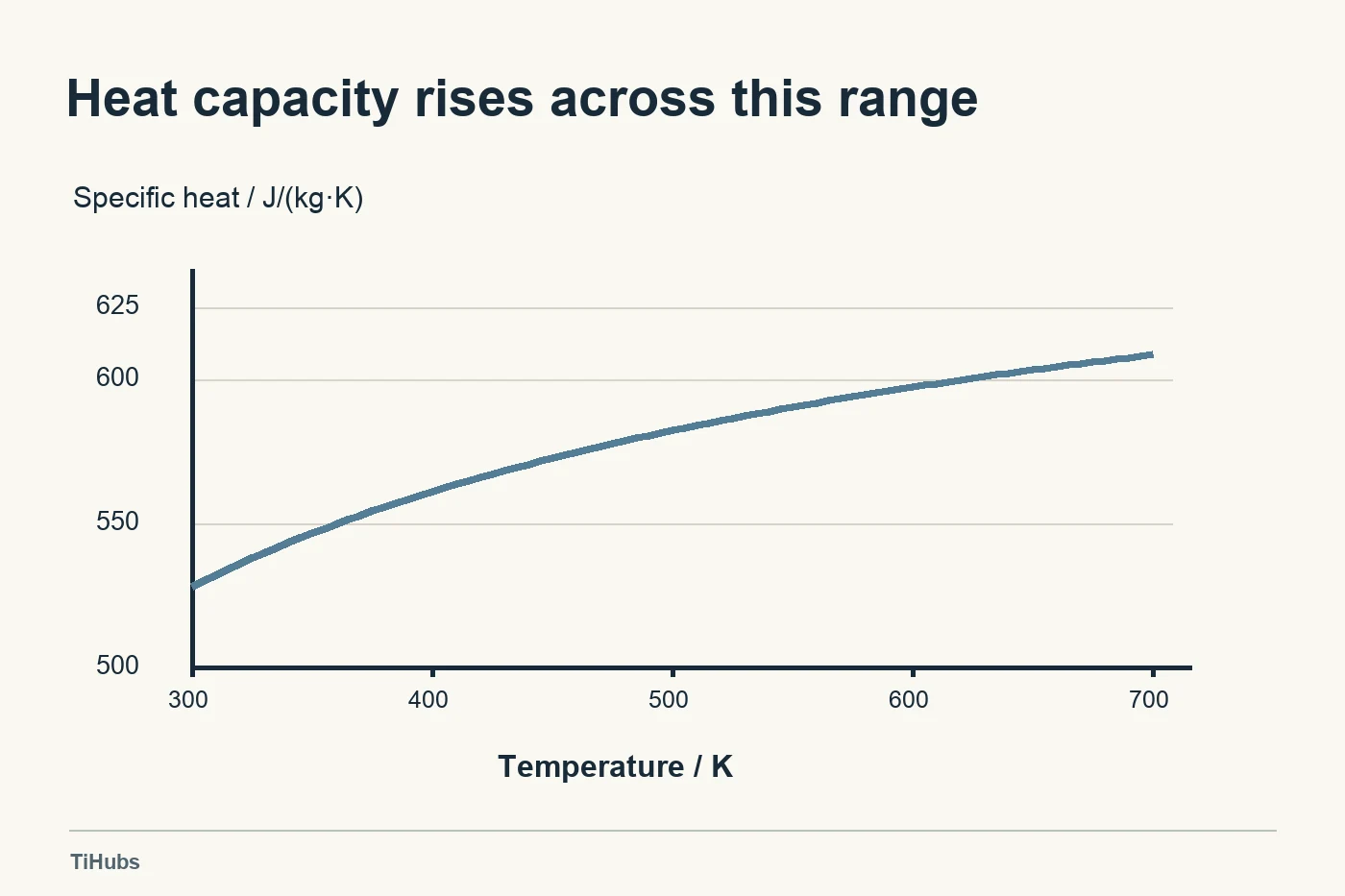
For a reproducible calculation, denote the scaled temperature by t. The equation is Cp = A + Bt + Ct² + Dt³ + E/t². For the interval used here, the coefficients A through E in the SI table are 22.61942, 18.98795, −18.18735, 7.080792 and −0.143457. At 300 K, substitute 0.300 for t. The result is approximately 25.276 J/(mol·K). Divide by 0.047867 kg/mol, the molar mass of titanium expressed in kilograms per mole, to obtain about 528.0 J/(kg·K). Carry the units through that division and the moles cancel.
There are two easy ways to obtain a plausible-looking wrong table. One is to open the calorie-unit view of the same WebBook entry and paste its coefficients into a sheet labelled joules. The other is to use 300 directly where the source expects 0.300. As a cross-check, calculate one row by hand, look up the corresponding molar value in the tabulated source and compare it before applying the mass conversion. That separates a coefficient error from a units error. Retain the source link and the chosen interval alongside the calculation.
The table shows selected points, rounded after conversion. It does not prescribe the number of significant figures appropriate for a particular fixture. If the part mass is preliminary or the supplier gives a wide allowance for machining, a heat estimate reported to the nearest joule would imply more certainty than the inputs warrant. Use enough digits during calculation to avoid rounding drift, then present results at a precision that matches the least certain important input.
If a process engineer proposes interpolation, ask where the intended temperature lies. Interpolation between nearby tabulated points within the same documented region can be a useful preliminary method. Extending the last line beyond the published interval is a different decision. At a change of phase or when more than one phase participates, sensible heat in a single phase does not describe the whole process. Where a purchase genuinely depends on that condition, specify the correct material and obtain data for the actual thermal path.
A useful receiving check for digital data is to recreate the 400 K row in an empty cell without copying the original formula. The expected result is approximately 26.861 J/(mol·K), or 561.2 J/(kg·K). If the first figure agrees and the second differs by a factor of a thousand, inspect how the molar mass was entered. If both are wrong, inspect the coefficient set, temperature scaling and signs. A discrepancy at every row that varies with temperature often points to a term in the polynomial rather than a simple unit multiplier.
Temperature (K)
Molar heat capacity J/(mol·K)
Mass-specific heat J/(kg·K)
300
25.276
528.0
400
26.861
561.2
500
27.878
582.4
600
28.596
597.4
700
29.135
608.7
Industrial buying guide / 02Heat capacity rises across this range
Values from the NIST alpha-phase fit, converted to a kilogram basis.
03 / Calculate a heating cycle
Calculate a heating cycle
Consider a hypothetical 12 kg mass of elemental alpha titanium that starts uniformly at 300 K and finishes uniformly at 600 K. Treat the metal as the entire calculation boundary. There is no phase change, fixture, heat leak or production throughput in this first calculation. The quantity sought is the increase in stored thermal energy. Separating that quantity from heater consumption gives the buyer one part of the decision that can be independently checked.
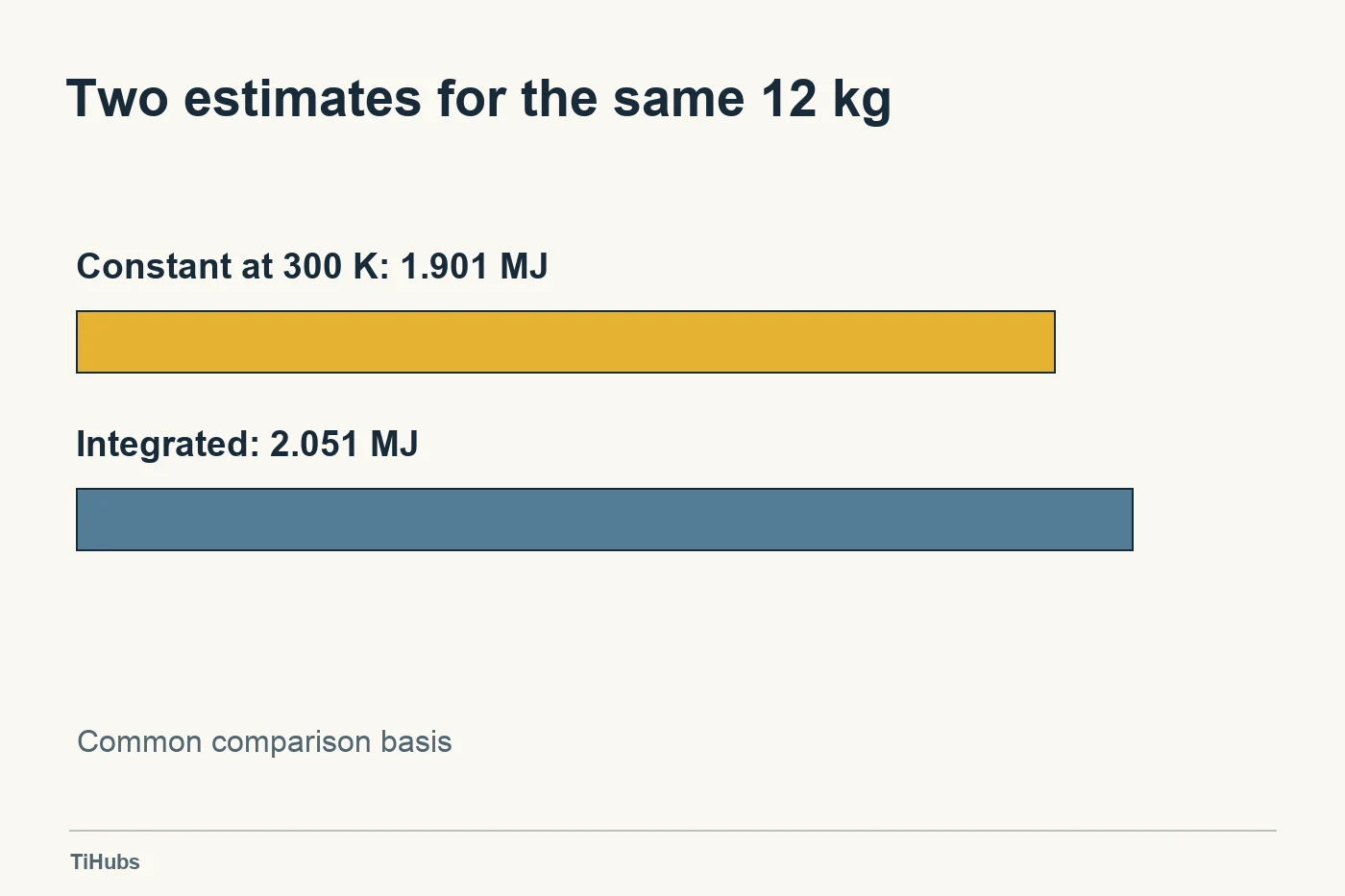
One approximation is to hold the 300 K heat capacity constant. Multiply 12 kg by about 528.0 J/(kg·K) and by a 300 K temperature increase. The result is approximately 1.901 MJ. A temperature increase of 300 K is also an increase of 300 degrees Celsius, but the absolute temperature inserted in the Shomate equation must be in kelvin. These two conventions coexist within the calculation. Confusing a temperature difference with a temperature coordinate is particularly easy when a process sequence is specified in degrees Celsius.
For the temperature-dependent answer, evaluate the difference between the NIST molar enthalpy expressions at the two endpoints. In the SI entry that difference is in kilojoules per mole. Divide by the molar mass in kilograms per mole to obtain approximately 170.88 kJ/kg for 300 to 600 K. Multiplying by the example batch mass gives 2,050.5 kJ, or about 2.051 MJ. Taking a difference at two endpoints cancels the common reference enthalpy. Avoid mixing one endpoint from the calorie table with one from the SI table.
The constant estimate is roughly 0.150 MJ lower in this example because it applies the lower starting heat capacity to the whole interval. The sign and size of the difference depend on the material and range under consideration. It is possible to use an effective average heat capacity for this one interval. Dividing the integrated 170.88 kJ/kg by 300 K gives approximately 0.570 kJ/(kg·K). Label it as an interval average. Reusing that value as a measured material property at a specific temperature would lose its meaning.
Now suppose, for illustration, that the energy must enter the metal in 30 minutes. Dividing 2,050.5 kJ by 1,800 seconds yields about 1.14 kW of average power delivered to the metal itself. The calculation has not sized a heater. It provides an ideal energy rate that a purchaser can distinguish from nameplate electrical input, peak demand and losses. If a quote promises a cycle time, ask for its load mass, starting temperature, measurement location and definition of completion before comparing it with that ideal estimate.
Industrial buying guide / 03Two estimates for the same 12 kg
The constant estimate uses the initial heat capacity throughout. The second applies the NIST enthalpy difference.
04 / Decide which mass enters the balance
Decide which mass enters the balance
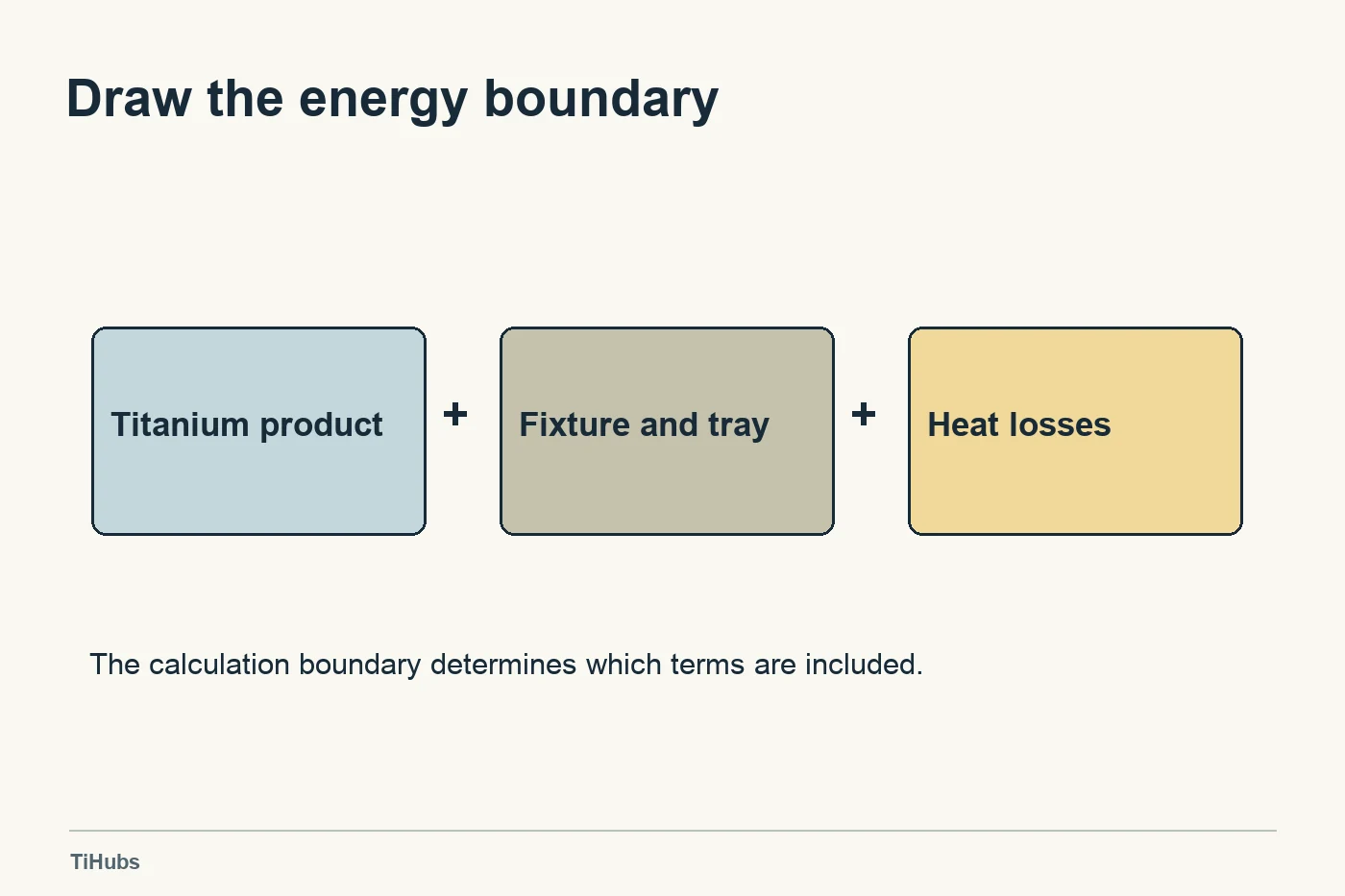
A bill of materials can answer the wrong mass question perfectly. The order might show the shipping mass of a crate, the purchase mass of a plate blank or the estimated mass of the finished fixture. Only some of that mass is actually heated in the operation being studied. Make a simple sketch of the load at the moment it enters the heating station. Mark the titanium part, temporary handling pieces, the tray and any work carried by the fixture. Give each separate item its own material and temperature history.
Use the delivered condition when buying against a thermal budget. A drawing with an outside envelope leaves scope for pockets, drilled passages and machining stock. If a supplier calculates mass from a solid square blank and the owner calculates it from final CAD geometry, their reported heating energies can differ even with identical property data. Ask for the reference drawing revision, density assumption, net volume and whether the result includes fasteners. If acceptance depends on weight, agree when the part will be weighed and what attachments will be present.
The tray deserves particular attention in repeated operation. A tray returning hot from the preceding cycle need not absorb the same energy as a cold replacement tray at the start of a shift. The incoming metal may also be held in a staging area at a temperature different from ambient. Model the first cold start and a representative repeating cycle separately when they serve different production decisions. A single average starting temperature can hide the very condition that limits start-up or delays the first saleable batch.
If the load contains several metals, use a separate mass and property curve or stated approximation for each. Add their individual energy changes over the temperatures each one actually experiences. The useful accounting check is kilograms by material on one side and heat stored in each material on the other. Multiplying the total assembly mass by the heat capacity of titanium implicitly assigns the titanium property to the whole assembly. That shortcut is particularly questionable for a fixture containing substantial steel backing, ceramic insulation or cooling fluid.
Where mass is uncertain, the effect can be shown without pretending to know the final answer. For this same 300 to 600 K elemental example, every additional kilogram of titanium represents approximately 170.88 kJ of extra stored energy. The purchasing team can carry that sensitivity beside the proposed mass range. It then knows whether weighing a sample or finalizing a pocket detail would materially improve the estimate. That is more actionable than debating the final decimal place of the heat capacity while the mass of the load remains open.
Record how scrap enters the commercial calculation. A supplier may legitimately charge for a heavier blank because the finished component requires machining stock. Offcuts removed before the thermal cycle belong in the purchase yield calculation, while only the finished metal belongs in the product’s stored-energy calculation. If the entire blank is first heated as part of upstream processing, that is a separate operation with its own mass and endpoints. Keeping the two operations separate allows procurement to discuss material yield without accidentally changing the thermal model for the customer’s fixture.
Industrial buying guide / 04Draw the energy boundary
Energy absorbed by the part is one item in an equipment balance.
05 / Separate heating time and temperature uniformity
Separate heating time and temperature uniformity
Two components can require the same energy to reach the same final average temperature and still take different times to meet a manufacturing acceptance criterion. Picture a compact block and a thin-walled fixture with the same mass. Heat enters through their exposed surfaces or contact pads and must travel to the locations the process cares about. The geometry, contact condition, surrounding medium and distribution of power influence this path. Specific heat describes stored energy per unit mass. Thermal conductivity helps describe the movement of energy through a temperature gradient.
Ask the engineering team what temperature ends the cycle. It might be the controller setpoint, a furnace air reading, a thermocouple on an external pad or the coldest required point inside a load. A process that ends as soon as one sensor reaches a setpoint is a different service from a process that requires all specified points to remain within a defined band for an agreed period. Write the endpoint into the enquiry. A bigger heater nameplate cannot by itself establish that a thick feature reaches the required condition.
A practical comparison starts with sensor positions on a section drawing. Mark where the reference sensor touches, how it is attached and which portions of the fixture can shield it from the heating medium. A loose bead against a surface, a sensor mounted in a well and one exposed directly to circulating air can respond differently. If two suppliers submit trial traces, ask whether the sensors, positions, load arrangement and initial conditions are comparable. Retain traces and calibration information if a witnessed thermal trial is part of the purchase.
Power readings have their own boundary. A meter at the electrical feed may include fans, controls or other auxiliaries. A result integrated across the whole cycle includes the rise, dwell and possibly an idle period. The calculated sensible heat of the product covers only its defined temperature change. Before calling a discrepancy an efficiency loss, identify the time window, actual load, instrumentation and other stored or transferred energy. Where the available evidence supports it, compare the measured input and calculated stored energy over the same boundary and interval.
For a quotation involving multiple loads, specify a representative arrangement and any permitted alternative. A small change in part spacing can alter exposure to the heating medium or access to a contact fixture. If the quoted performance applies to a sample of one part on an open tray, preserve that condition in the approval. Scaling the absorbed energy by a new mass is easy. Scaling temperature uniformity or cycle time to a crowded tray usually requires additional engineering or a representative trial.
Start the enquiry by identifying the decision the thermal data must support. An engineer estimating warm-up energy for a concept design can often work with a documented reference and a clearly marked approximation. An owner qualifying a production tool under a contractual temperature cycle may need a material-specific source, traceable specimen condition or an agreed test on the assembled fixture. Put the requested level of evidence beside the decision. A raw-material supplier should be able to tell which requirement it can document and which one belongs with the equipment designer or test laboratory.
State the exact titanium grade, material condition and form. Give the finished mass or identify the drawing from which it should be calculated. List starting and target temperatures, ramp and hold expectations, the locations to monitor and whether the fixture starts cold or returns hot. Where a calculation accompanies the enquiry, show units and the limits of the energy balance. Attach the public source or data sheet with an identifiable revision. If the form is only asking for bar or plate, keep acceptance of that stock distinct from guarantees about a complete heating station.
When a supplier offers a single heat-capacity value, ask what temperature and material it represents, what unit is used and whether it is typical, measured on the lot or guaranteed under a contract. An ordinary material certificate can confirm specified chemistry and mechanical tests without reporting heat capacity. If a project requires an actual thermal measurement, agree the method, specimen identity, temperature interval, uncertainty or reporting convention and who pays for the test. Put these details in the order before production, especially if testing removes material from an otherwise usable part.
Review competing quotations using the same engineering case. A quotation based on a finished machined plate can look expensive next to one for oversize stock. It may also describe less mass in service and different work for the receiving shop. Request the proposed delivered condition, inspection record and drawing revision from each supplier. Compare whether either offer includes measuring the fixture, preparing data or supporting an assembly trial. Price per kilogram tells the buyer little about those differences unless the supply boundary has already been agreed.
Keep an audit trail a future engineer can follow. Store the source and units, input mass, temperature interval and calculation version together. Mark the preliminary assumptions replaced by measured data after the first build. If a later modification removes material, changes the alloy or moves a support, the next purchaser can identify which part of the earlier calculation remains useful. A modest record of the physical inputs will outlast a single spreadsheet total whose temperature scale, mass basis and source have been forgotten.
For example, a technically comparable reply might identify the delivered part as an unheated machined blank, give its calculated net mass from the specified drawing revision and list the material certificate included in the quotation. The purchaser could then use a documented property curve for a preliminary energy estimate and separately commission the heating trial if required. A different supplier might propose to deliver the assembled fixture with a measured time-temperature record. Both offers can be viable, but the second includes a deliverable that must have its own test conditions, traceability and acceptance terms.
07 / Build your RFQ
Request a technical quotation
A room-temperature value answers a narrow question. A purchase for a heated fixture also needs the grade, mass, temperature range and the boundary of the energy calculation.
Information to include
Grade and material condition
Part and fixture masses
Starting and final temperatures
Mass or molar units
Property source and calculated boundary
Build your RFQ checklist
Choose the product and add the information you have. Copy the resulting brief or send your requirements to TiHubs. Submitting an enquiry does not place an order.
08 / FAQs
Questions buyers ask
Is 0.528 J/(g·K) the same as 528 J/(kg·K)?
Yes. A kilogram contains one thousand grams, so a kilogram needs a thousand times the energy of one gram for the same small temperature change. Write the whole unit next to the number. A value in joules per mole needs a separate conversion using molar mass.
Does the table apply directly to Grade 5 titanium?
The source describes elemental titanium in its alpha phase. For a Ti-6Al-4V component, use a documented property for the actual alloy, temperature and condition as required by the analysis. State explicitly whether an elemental value is only a preliminary estimate.
Can this calculation select my heater?
It gives the energy stored in a defined metal mass. Heater sizing also depends on the temperature ramp, equipment mass, transfer path, controls and losses. Ask the equipment owner to state which quantities are measured and which have only been estimated.
09 / Key takeaways
Keep the purchase requirements connected.
Grade and material condition
Part and fixture masses
Starting and final temperatures
Mass or molar units
Property source and calculated boundary
Technical references
Sources and data scope
References reviewed November 20, 2026. Public source summaries support the discussion; the controlled specification, agreed edition and approved project requirements govern acceptance.
TiHubs coordinates titanium material and custom supply enquiries from Baoji, China. Send the product, drawing revision and acceptance requirements so the proposed supply scope can be reviewed. Learn about our sourcing role.
Contents
TiHubs
Talk to TiHubs
Ask about titanium materials, grades or custom parts.
Enter your email to start chatting.
We use your email to respond to your enquiry. Your conversation is stored on this website.
Our team is away right now. Leave your enquiry and we will follow up by email.