Baoji High-tech Zone, ChinaTitanium sourcing · One contact


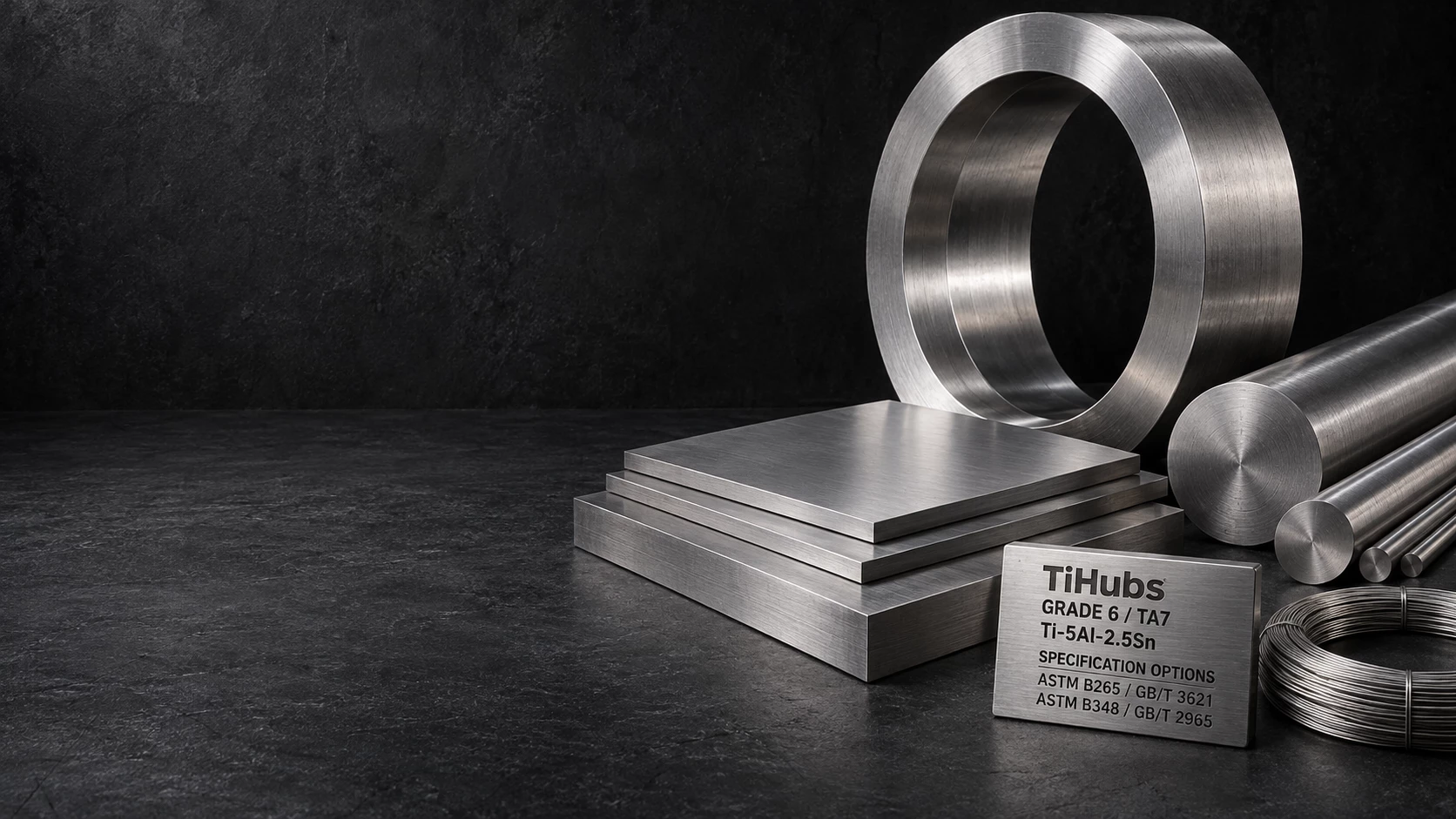
Grade 6 · Gr6 · TA7 · UNS R54520
Grade 6 / TA7 titanium.For aerospace components.
Source Ti-5Al-2.5Sn sheet, plate, bar, wire and forgings for engine casings, rings and formed-part requirements. TiHubs coordinates material, manufacturing and agreed inspection through one contact in Baoji.
Start with a specification, drawing or application. We’ll help identify the details still needed.
Material review. Supply coordination.
One contact in Baoji, China.
Grade 6 / Gr6 / TA7Ti-5Al-2.5Sn · Alpha titanium alloy
ASTM · AMS · GB/TProduct, revision and acceptance defined together
One contact20 years of founder experience · 100+ Baoji factories
01 / Product forms
Find your
Grade 6 / TA7 product.
Choose a material form or application example. We review the specification, geometry, condition and required evidence before proposing a supply route.
01 / 06
Grade 6 · Gr6 · TA7 · Ti-5Al-2.5Sn
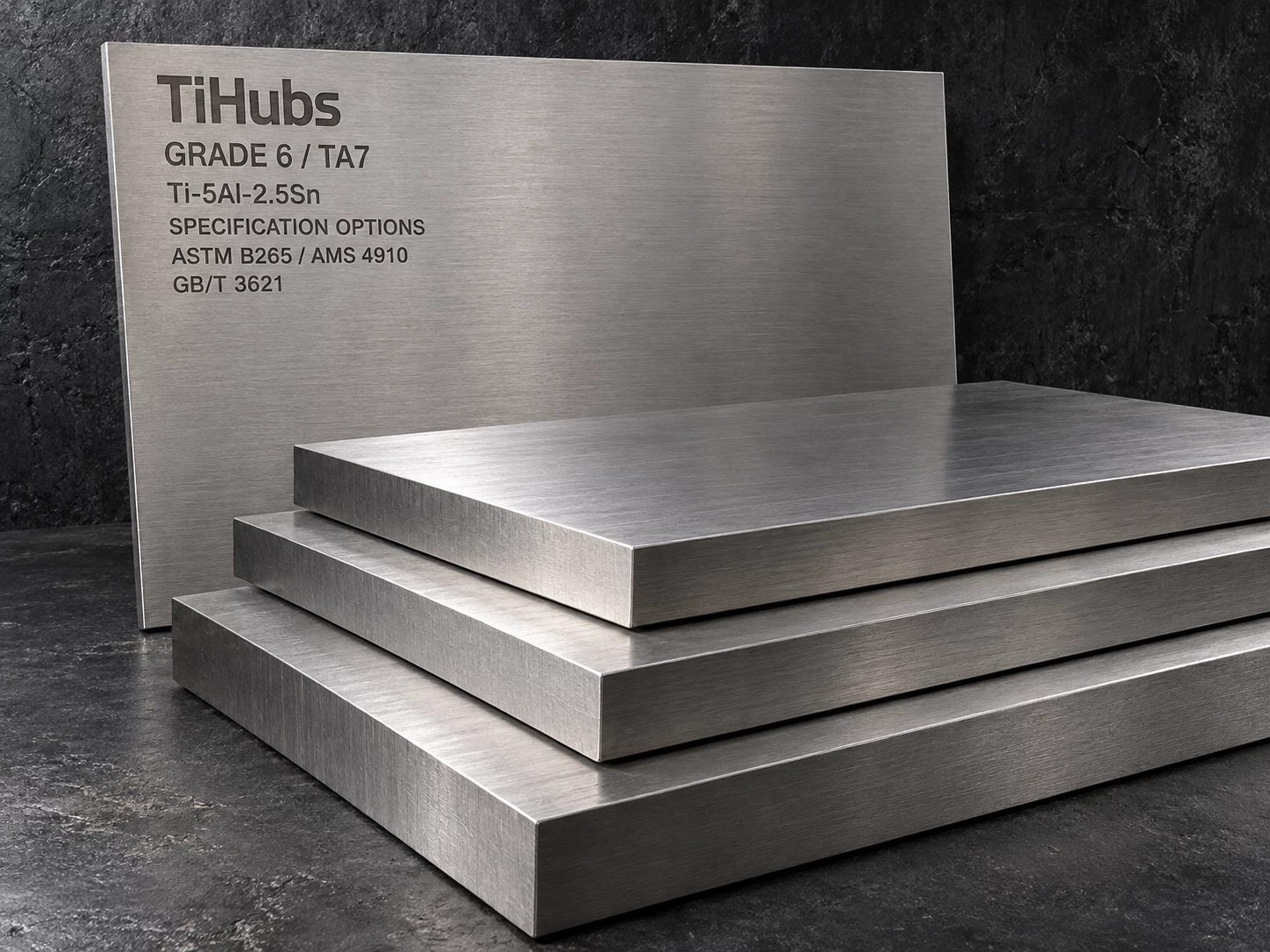
Grade 6 / TA7 titanium sheet & plate
For formed shells, wall panels and drawing-based parts. Send the finished geometry as well as the starting sheet size so forming direction, allowance and surface requirements can be reviewed.
- Specification
- ASTM B265 Grade 6; AMS 4910 when specified. TA7 plate and sheet are reviewed to GB/T 3621 and the ordered revision.
- Dimensions
- Thickness × width × length; thickness tolerance, flatness, rolling direction and cut-edge requirements.
- Condition
- Specified annealed condition and surface finish; identify subsequent forming, welding and heat treatment.
- Acceptance
- Material chemistry, tensile requirements, heat identity and the dimensional or additional test records required for your order.
02 / 06
Grade 6 · Gr6 · TA7 · Ti-5Al-2.5Sn
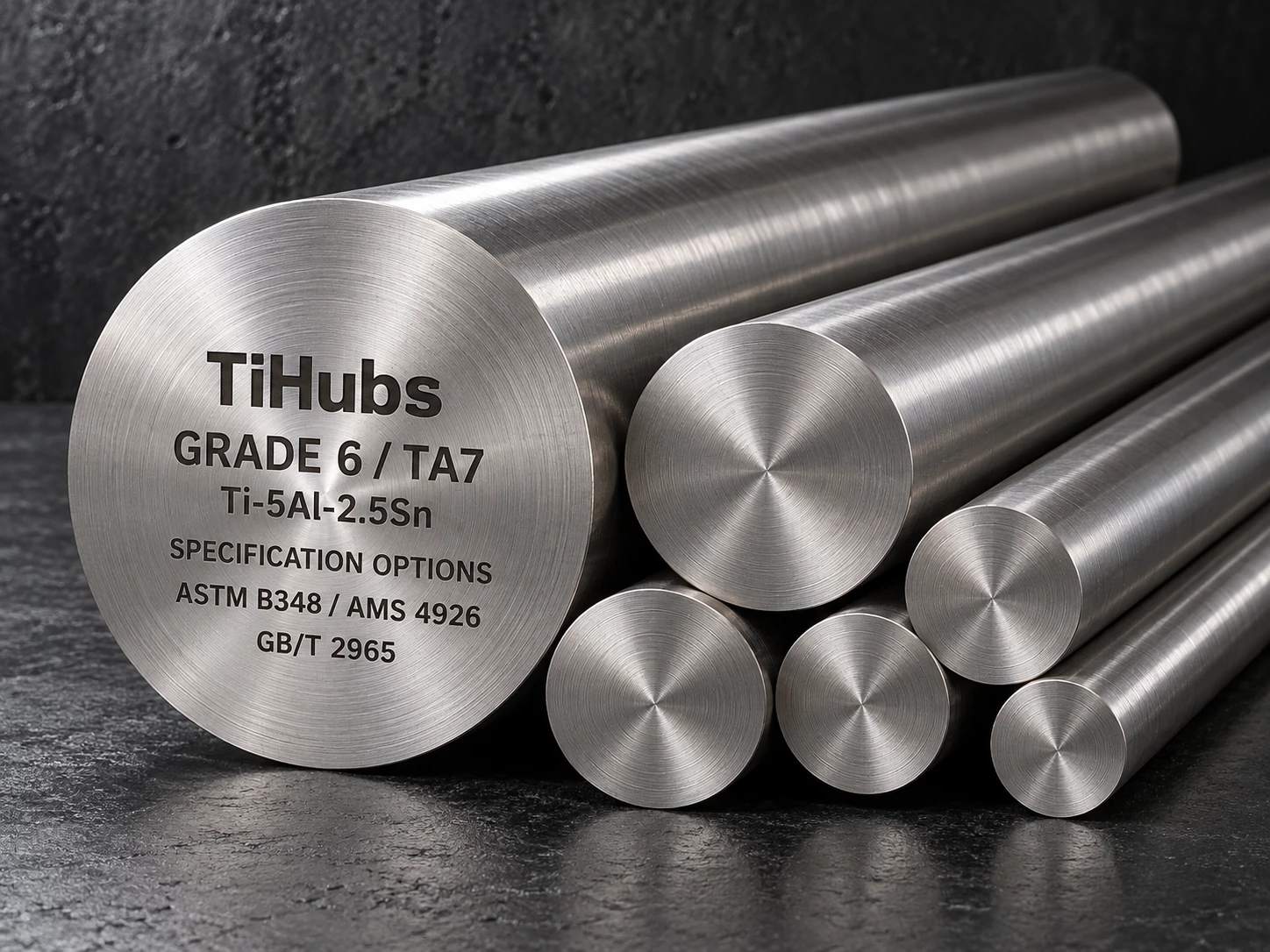
Grade 6 / TA7 titanium bar & rod
For machined fittings, sleeves, supports and other parts that specify Ti-5Al-2.5Sn. Match the starting section and condition to the finished drawing.
- Specification
- ASTM B348 Grade 6; AMS 4926 for its covered annealed bar scope. Chinese TA7 bar: GB/T 2965 with GB/T 3620.1 chemistry.
- Dimensions
- Diameter or section × length; straightness, surface allowance, cut lengths and quantity per size.
- Condition
- Annealed or the specified delivery condition; turned, ground or another agreed surface.
- Acceptance
- Heat and lot traceability, tensile records, microstructure and ultrasonic inspection where required by the controlling specification.
03 / 06
Grade 6 · Gr6 · TA7 · Ti-5Al-2.5Sn
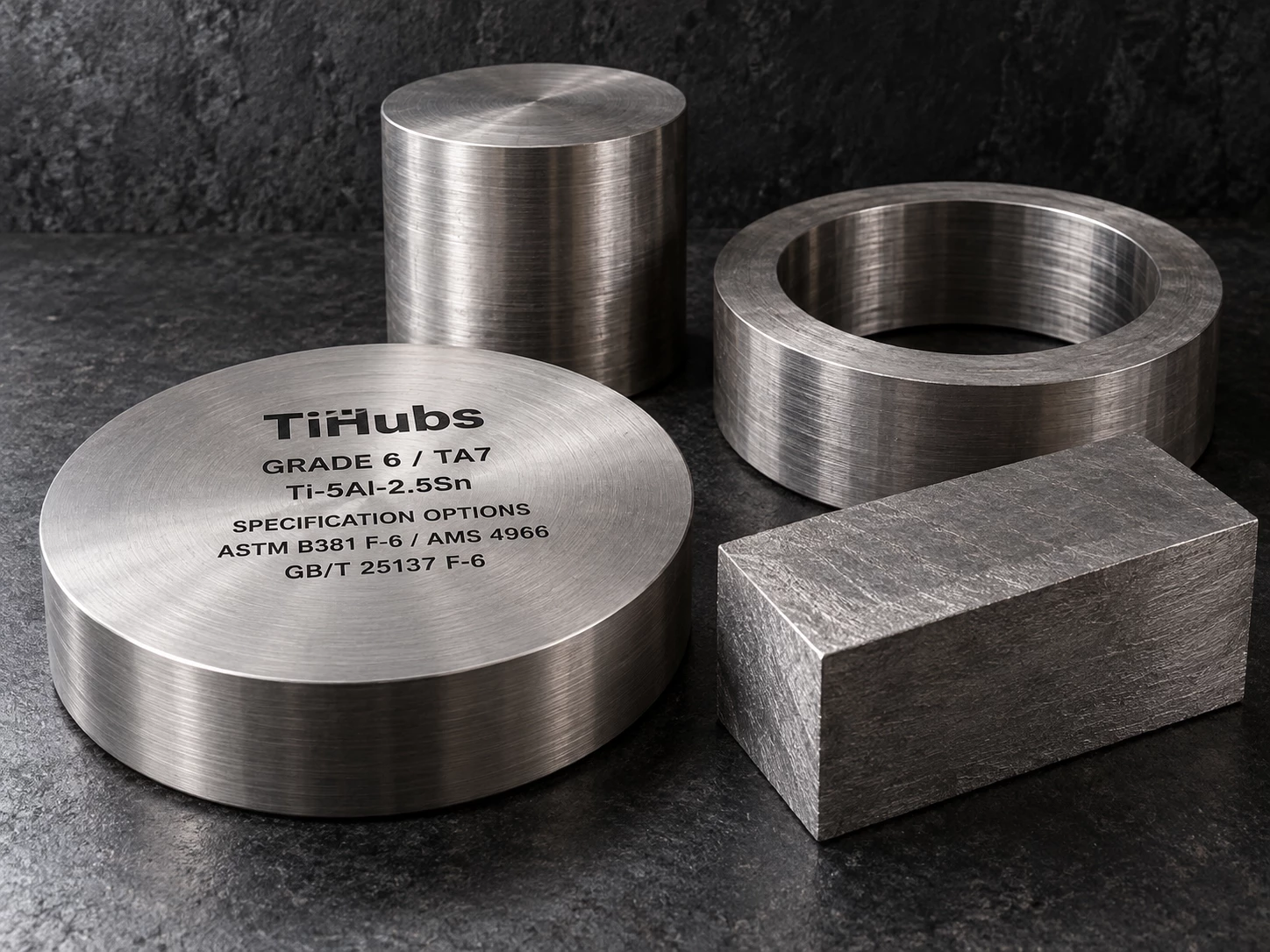
Grade 6 / TA7 titanium forging blanks
Discuss rings, discs, blocks and near-net blanks before final machining. Rough and finished drawings help define forging stock, machining allowance and test locations.
- Specification
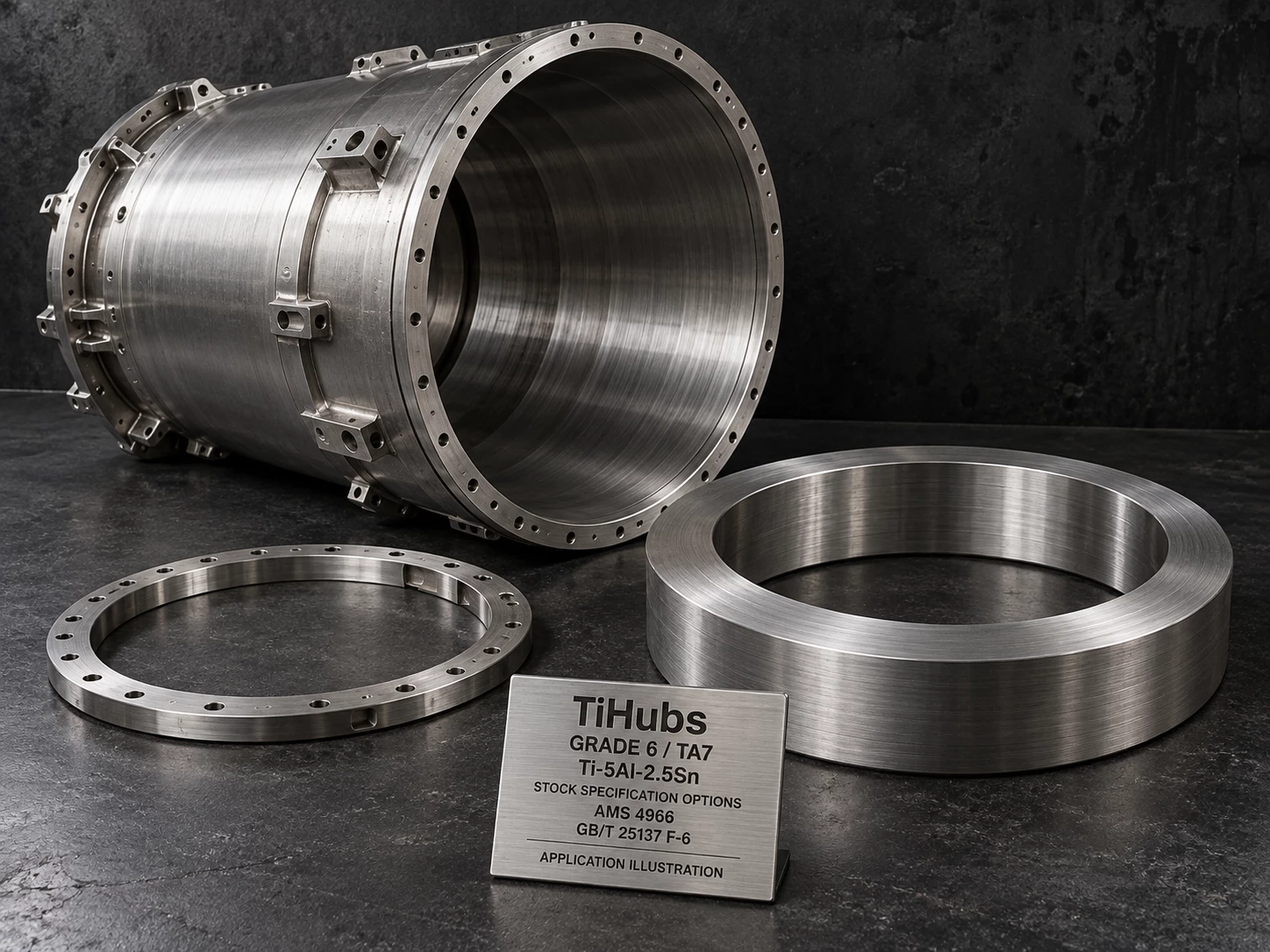
- ASTM B381 F-6 or GB/T 25137 F-6, as ordered. AMS 4966 is an aerospace forging option subject to its size and scope limits.
- Geometry
- OD × ID × height for rings; section and length for blocks; finished envelope, draft and machining allowance.
- Condition
- Forging route, grain-flow requirements, heat treatment and surface removal agreed for the part.
- Acceptance
- Required mechanical tests, orientation, microstructure, NDT method/class and identification retained through machining.
04 / 06
Grade 6 · Gr6 · TA7 · Ti-5Al-2.5Sn
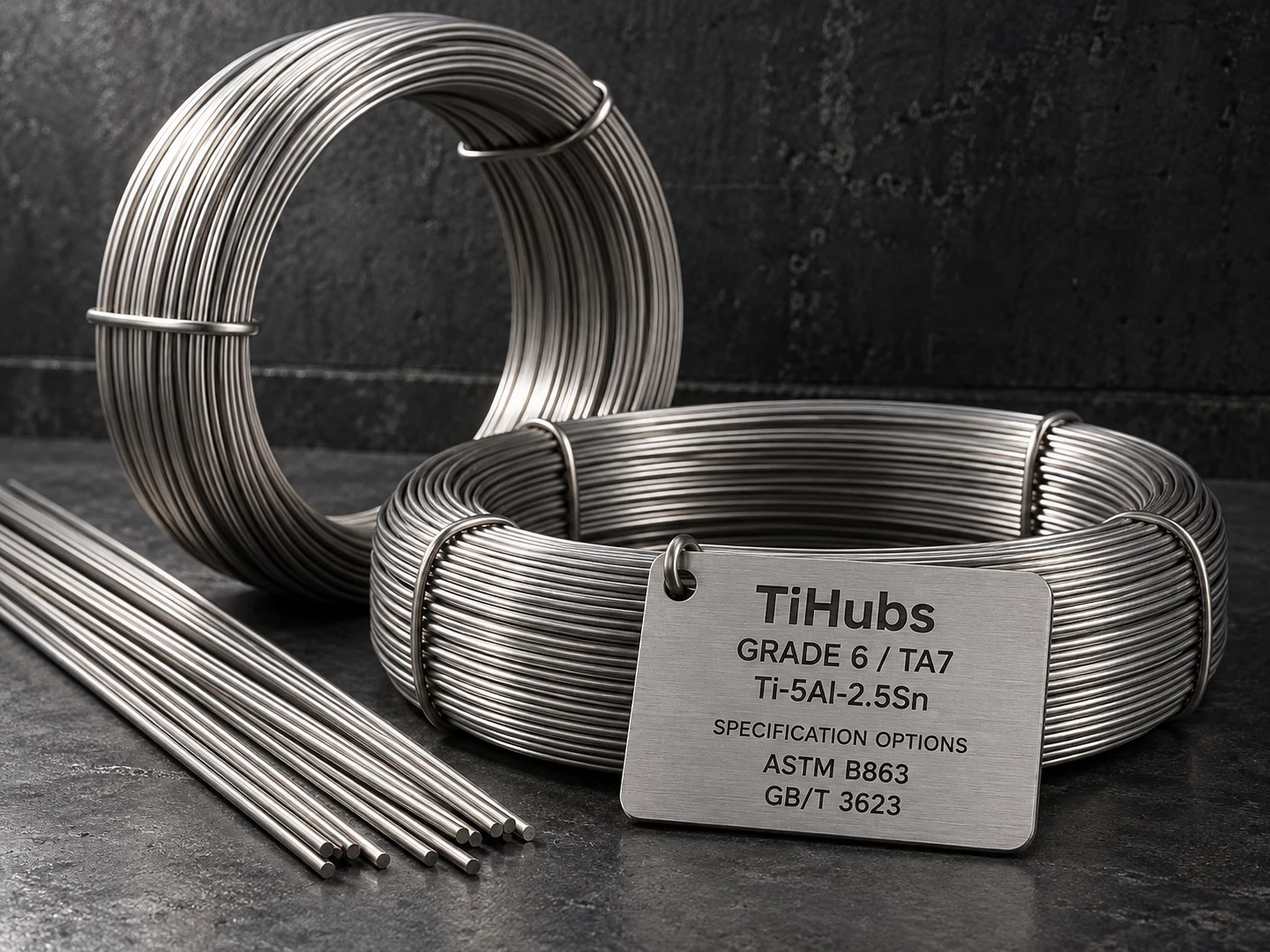
Grade 6 / TA7 titanium wire
Coil or straight wire for a defined forming or component-manufacturing process. Tell us the intended operation and required surface condition before quotation.
- Specification
- ASTM B863 Grade 6 or GB/T 3623 TA7. AMS 4926 may apply to its specified annealed wire scope.
- Dimensions
- Wire diameter and tolerance, coil weight or straight length, straightness and quantity.
- Condition
- Annealed or specified condition, surface cleanliness, handling and protective packaging.
- Acceptance
- Diameter and material records for the agreed scope. Welding filler and additive feedstock need their own specification and process qualification.
05 / 06
Grade 6 · Gr6 · TA7 · Ti-5Al-2.5Sn
Aerospace engine casings & ring forgings
Application illustration: discuss the material blank or a drawing-based casing route. Define whether you need a forged ring, a machined shell or a fabricated assembly.
- Material route
- Specify Grade 6 / Ti-5Al-2.5Sn or TA7 with the controlling material standard. Forged and flash-welded rings require different process scopes.
- Drawing
- Released drawing and revision; diameter, wall, flanges, machining allowance and critical interfaces.
- Service
- Temperature and duration, pressure or structural loads, cyclic duty and fatigue-critical features.
- Evidence
- Customer-approved source/process requirements, material records, NDT and first-article scope. Feasibility is reviewed before commitment.
06 / 06
Grade 6 · Gr6 · TA7 · Ti-5Al-2.5Sn
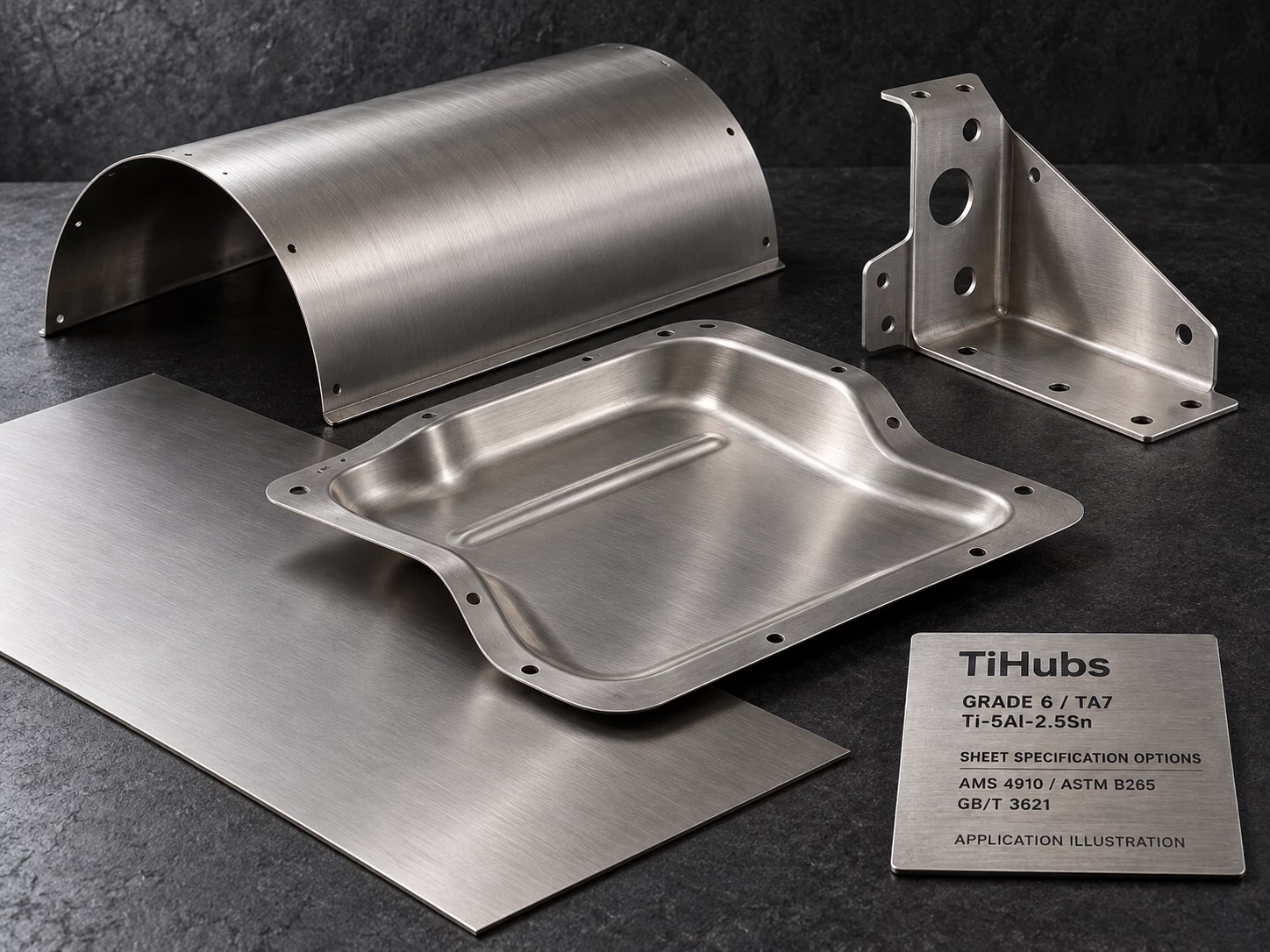
Aerospace thin-wall shells & formed parts
Application illustration: curved shells, formed panels and sheet brackets made to an agreed drawing. Review sheet stock and the forming route as one requirement.
- Starting material
- Grade 6 sheet to ASTM B265 or the specified AMS 4910 revision; TA7 sheet to the required Chinese specification.
- Geometry
- Finished wall thickness, bend radii, contours, forming direction, edge details and springback tolerance.
- Processing
- Forming temperature/process, tooling, weld details and any post-forming or post-weld treatment.
- Acceptance
- Surface condition, contour and thickness checks, weld inspection and first-article records as specified.
Images illustrate material forms and application possibilities. Markings show specification options; they do not establish dual certification, stock availability or approval of a finished aerospace component.
Turn your drawing into a defined enquiry.
Start with the information you have. We will identify what still needs agreement.
01 / Drawing review
Casings & ring blanks
Define forged, rolled or fabricated construction, rough geometry, finished wall and allowance. Include approval requirements before the manufacturing route is selected.
02 / Drawing review
Thin-wall formed parts
Share the developed blank and finished drawing where available. Confirm forming direction, radii, surface finish, welding and post-process requirements.
03 / Drawing review
Machined components
Identify critical interfaces, datum features, threads, surface requirements and quantity. State whether first-article approval is needed before the production batch.
02 / Material identity
What is
Grade 6 / TA7 titanium?
Grade 6 titanium, often written Gr6, is Ti-5Al-2.5Sn (UNS R54520), an alpha titanium alloy with nominal additions of 5% aluminum and 2.5% tin. TA7 is the Chinese designation in the same nominal alloy family. It is specified for aerospace casings, ring forgings and selected formed or machined parts.
For a TA7 titanium enquiry, specify the Chinese material and product standard. For an ASTM or AMS enquiry, specify that route explicitly. Nominal alloy correspondence does not authorize substitution or establish ELI compliance.
828MPa
Minimum tensile strength
ASTM B381-08a · F-6 forgings
795MPa
Minimum 0.2% offset yield strength
ASTM B381-08a · F-6 forgings
10%
Minimum elongation
ASTM B381-08a · F-6 forgings
| Property or condition | Reference | Ordering implication |
|---|---|---|
| Reference scope | ASTM B381-08a, Table 1, F-6 | These values describe the listed forging requirements. They are not universal values for Grade 6 sheet, bar, wire or an AMS order. |
| Delivery condition | Specified annealed material | Confirm the actual product specification, section size, heat treatment and specimen orientation. |
| Forming & fabrication | Process review before quotation | Agree forming and welding procedures, surface removal, dimensional recovery and required post-process checks. |
| Operating temperature | Part-specific design input | Provide temperature, exposure time, load and cyclic duty. A grade name or generic temperature figure is not a design allowable. |
Numerical source: ASTM B381-08a, Table 1. The drawing and ordered specification govern acceptance; the values above are not aerospace design allowables.
| Selected element · wt % | ASTM B381-08a · F-6 | GB/T 3620.1-2016 · TA7 |
|---|---|---|
| Aluminum · Al | 4.0–6.0 | 4.5–5.5 |
| Tin · Sn | 2.0–3.0 | 2.0–3.0 |
| Iron · Fe | 0.50 max. | 0.50 max. |
| Oxygen · O | 0.20 max. | 0.20 max. |
| Nitrogen · N | 0.03 max. | 0.05 max. |
| Carbon · C | 0.08 max. | 0.08 max. |
| Hydrogen · H | 0.015 max. | 0.015 max. |
| Titanium · Ti | Balance | Balance |
This selected-element comparison uses the F-6 forging specification and Chinese TA7 designation table. Aluminum and nitrogen limits differ. Check residual elements, analysis tolerances, sampling and all product-specific requirements in the ordered revision; do not transfer this table to AMS or ELI material.
Grade 6 / Gr6 and TA7
These names identify the same nominal Ti-5Al-2.5Sn family in different specification systems. Compare actual chemistry, product form, condition, testing and documents before approving a change.
Ordinary material and ELI
Ti-5Al-2.5Sn ELI has separately controlled interstitial content and acceptance requirements. GB/T 3620.1 also lists TA7ELI separately. Ordinary TA7 or Grade 6 records do not prove ELI compliance.
Grade 6 and Grade 5
Grade 6 is Ti-5Al-2.5Sn; Grade 5 / TC4 is Ti-6Al-4V. Their chemistry and metallurgy differ. Use the material specified by the responsible design authority.
Material and finished-part approval
A material test report supports the raw-material requirement. Finished aerospace parts additionally depend on the approved design, source, processes, inspection and customer acceptance.
03 / Aerospace applications
Grade 6 / TA7 for
aerospace procurement.
Engine casings and ring forgings first; formed sheet and machined components next. Keep cryogenic ELI requirements identified as a separate material route.
Application review / 01
Engine casings & structural shells
Ti-5Al-2.5Sn / TA7 has documented use in aircraft-engine casing applications. Begin with the construction route: a machined forging and a formed-and-welded shell need different starting stock and process evidence.
Products to discuss
Ring or shaped forgings for machined casings; sheet stock for a specified fabricated-shell route.
What we need to review
Released drawing, wall transitions, mounting interfaces, thermal duty, cyclic loads, machining allowance and customer-required source or process approvals.
Application review / 02
Ring forgings matched to the casing route
A ring enquiry should define both the material and how the ring is made. A seamless forged or rolled ring is a different manufacturing route from a flash-welded ring.
Products to discuss
Thick ring blanks, near-net rings and agreed machining stages; nominal OD, ID and height with final drawing.
What we need to review
Grain flow, test orientation, heat treatment, ultrasonic inspection zones and acceptance class. AMS 4926 covers flash-welded rings; assess AMS 4966 for the forging scope.
Application review / 03
Thin-wall titanium shells
For a specified TA7 or Grade 6 shell, finished wall thickness and contour matter as much as the starting sheet thickness. Bring forming and joining requirements into the material review.
Products to discuss
Thin sheet, curved shell sections and drawing-based fabricated components.
What we need to review
Bend radii, forming direction, thickness after forming, edge preparation, weld details, distortion limits and post-process inspection.
Application review / 04
Formed panels, brackets & wall sections
Sheet-forming requirements need a realistic process plan. TA7 forming behavior depends on temperature and deformation conditions; do not assume a room-temperature forming route will suit every geometry.
Products to discuss
Sheet blanks for formed panels and brackets; cut plate where machining is the specified route.
What we need to review
Blank layout, material direction, forming/tooling trials, corner radii, springback, finish and first-article dimensional records.
Application review / 05
Drawing-based Ti-5Al-2.5Sn components
For a component whose drawing specifies Grade 6 or TA7, select the starting stock around the finished geometry, usable section and required evidence.
Products to discuss
Bar, block, disc and ring blanks for agreed machined components.
What we need to review
Critical datums, wall and interface tolerances, material removal, surface integrity, heat identification after cutting and inspection records.
Application review / 06
Fastener & small-part feedstock
TA7 is used in selected fastener applications. The finished-part drawing and manufacturing process determine whether bar or wire is an appropriate starting form.
Products to discuss
Specified bar or wire stock for machining or forming; finished-part requests reviewed separately.
What we need to review
Thread standard, strength class, manufacturing route, forming condition, surface treatment and lot acceptance. B863 wire alone does not qualify welding filler.
Application review / 07
Ti-5Al-2.5Sn ELI for cryogenic aerospace
NASA documents Ti-5Al-2.5Sn ELI use in liquid-hydrogen-temperature engine hardware. This is a separate material enquiry: ordinary Grade 6 / TA7 must not be assumed to meet ELI requirements.
Products to discuss
ELI sheet or plate under AMS 4909; covered bar, wire, forging and ring products under AMS 4924.
What we need to review
Exact ELI designation and revision, temperature, loading, fracture/fatigue requirements, melt route, heat treatment, low-temperature testing and required source approvals.
Application review / 08
Prototype, test & production stages
A prototype order and a flight-deliverable order can require different evidence. State the intended stage early so the proposed supply route matches your acceptance process.
Products to discuss
Representative stock, trial blanks or production material to a defined purchase requirement.
What we need to review
Sample quantity, first-article hold point, retained samples, independent inspection, document approval and release milestones.
Application references: BAOTI — TA7 ring-forging applications ↗ · Journal of Aeronautical Materials — TA7 forming research ↗. These describe material applications, not TiHubs project history or flight approval.
Aerospace enquiry checklist
What should an aerospace RFQ include?
Give us the controlling requirements early so the supply route, evidence and quotation can be evaluated together.
Define the material route
Send the exact AMS or other specification revision, product form, dimensions and heat-treatment condition. Include melt-route or microstructure requirements when the specification calls for them.
Define the acceptance evidence
List heat and lot traceability, material test reports, dimensional records, NDT methods and acceptance classes. State any first-article, retained-sample or independent inspection requirements.
Identify required approvals
Include approved-source restrictions and any customer-required quality-system or special-process approvals. TiHubs reviews the required evidence and feasible supply route before commitment.
Example: a useful Grade 6 / TA7 ring-forging enquiry
Ti-5Al-2.5Sn ring forging to [standard and revision], [condition]; rough OD × ID × height; finished drawing and revision; machining allowance; quantity; required tensile orientation, NDT class and traceability; approved-source restrictions; destination and target delivery.
For a TA7 enquiry, state the Chinese specification or customer material callout. Attach the drawing even if some details still need clarification.
Separate enquiry / Cryogenic material
Specify Ti-5Al-2.5Sn ELI explicitly.
Low-temperature hardware needs the correct material route and project evidence. NASA describes Ti-5Al-2.5Sn ELI applications in liquid-hydrogen-temperature engine components. That experience cannot be transferred to an ordinary Grade 6 / TA7 order.
AMS 4909
Annealed ELI sheet, strip and plate. Confirm the required revision, thickness range and condition.
AMS 4924
Annealed ELI bars, wire, forgings, flash-welded rings and related stock within the standard scope.
Define low-temperature acceptance.
Supply the minimum temperature, loading and fracture-control requirements. Agree chemistry, melt route, test temperature/orientation, heat treatment and customer-required approvals before supply.
The SAE links open official standard pages, not TiHubs-hosted PDF files. TA7ELI appears separately in GB/T 3620.1; that designation standard alone does not establish an aerospace or cryogenic product specification. NASA cryogenic-alloy application reference ↗
04 / Standards & documentation
Match the standard
to the product.
Match Grade 6 / Gr6, AMS Ti-5Al-2.5Sn or Chinese TA7 to the actual product form. Open the supplied PDFs below, and state the required revision in your enquiry.
| Product form | ASTM / AMS route | Chinese standard route | Clarify before quotation |
|---|---|---|---|
| Material identity | United StatesTi-5Al-2.5Sn · UNS R54520
ASTM Grade 6 / Gr6; chemistry is governed by the ordered product standard. |
ChinaGB/T 3620.1-2016View PDF ↗
TA7 and TA7ELI are separate entries. Apply the relevant product specification as well. |
Designation, chemistry, residual elements and the purchase specification. |
| Sheet & plate | United StatesASTM B265-08View PDF ↗AMS 4910SSAE official standard page ↗ | ChinaGB/T 3621-2022View PDF ↗ | Thickness, dimensions, rolling direction, condition, forming route and inspection. |
| Bar & rod | United StatesASTM B348-08aView PDF ↗AMS 4926View PDF ↗ | ChinaGB/T 2965-2023View PDF ↗ | Section, usable length, condition, straightness, material records and NDT. |
| Forgings & ring blanks | United StatesASTM B381-08aView PDF ↗AMS 4966SSAE official standard page ↗ | ChinaGB/T 25137-2010View PDF ↗
This forging document uses F-6. Do not change its designation to TA7 without reviewing the ordered requirements. |
Forged/rolled versus flash-welded construction, size limits, grain flow, specimen orientation and acceptance. |
| Wire | United StatesASTM B863-19View PDF ↗AMS 4926View PDF ↗ | ChinaGB/T 3623-2022View PDF ↗ | Diameter, coil or straight length, surface, condition and intended manufacturing process. |
| ELI / cryogenic enquiry | United StatesAMS 4909M · ELI sheetSAE official standard page ↗AMS 4924K · ELI productsSAE official standard page ↗ | ChinaTA7ELI — separate requirementGB/T 3620.1-2016View PDF ↗
Confirm the application-specific product standard and acceptance criteria; ordinary TA7 is not an ELI certificate. |
ELI designation, service temperature, fracture/fatigue requirements, test plan and customer approvals. |
Order to the required revision. The supplied AMS 4926 file is linked without an assumed revision letter; confirm the issue printed inside it against your purchase requirement. Hosted ASTM and GB/T editions are shown above. Publisher links are references, not a substitute for the agreed order specification.
AMS 4926 covers bars, wire and flash-welded rings within its scope. AMS 4966 covers forgings and forging stock; it is not interchangeable with the ring-making scope of AMS 4926. Finished casings and formed components also require their own drawings and acceptance criteria.
05 / Order coordination
Know the scope
before ordering.
Our founder’s 20 years in titanium inform the questions we ask before quotation and the supply options we review with you.
A quotation you can evaluate
Agree the grade, standard edition, dimensions, tolerance, condition and quantity before comparing prices.
- Identify whether inspection, samples and tooling are included.
- Confirm packaging, transport and delivery terms.
- Record items that still need technical confirmation.
Acceptance agreed before supply
Confirm the material certificate, heat or batch identity, heat-treatment condition, dimensional checks and any additional testing before supply starts. For aerospace work, include the customer-required inspection and traceability scope.
Independent inspection can be discussed with its scope, timing, acceptance criteria and cost agreed for the order.
Delivery with clear milestones
Review the proposed lead time, approvals, production sequence and dispatch requirements. For several product forms, coordinate document and packing readiness together.
Material substitutions and technical changes require written approval. A schedule deviation should identify the impact, decisions needed and next steps.
One contact when an issue arises
Contact TiHubs with the order reference, affected items and supporting photos or inspection records.
We record the issue, review it against the agreed requirements and coordinate the next steps with the relevant manufacturing parties.
01 / Material identity
Material records
Grade, standard, test results and heat or batch identity matched to the supplied items.
02 / Agreed acceptance
Inspection records
Dimensional and testing records for the agreed scope, including critical drawing requirements.
03 / Ready for dispatch
Dispatch records
Item identification, packing list, protective packaging and required shipment documents.
06 / Questions before sourcing
Before you specify
Grade 6 / TA7.
A clear material designation is the beginning. Product form, specification revision, material condition and acceptance complete the requirement.
A useful first enquiry
- Product and specificationProduct form, standard edition, dimensions and material condition.
- Order and deliveryQuantity, destination and any required delivery date.
- Acceptance requirementsDrawing revision, inspection, certificates and packaging.
Not every detail is finalized? Send the information you have. We can help identify the questions to resolve before quotation.
What happens next: requirement review, technical clarification, then a supply proposal and quotation.
What is Grade 6 titanium, and what does Gr6 mean?
Grade 6, abbreviated Gr6, is Ti-5Al-2.5Sn, an alpha titanium alloy identified as UNS R54520. Its nominal alloying additions are 5% aluminum and 2.5% tin. The product specification, condition and inspection requirements still need to be stated.
Is TA7 the same as Grade 6 titanium?
TA7 is the Chinese designation in the same nominal Ti-5Al-2.5Sn family. Grade correspondence is useful for sourcing, but the actual specifications can differ: the selected ASTM F-6 and GB/T TA7 chemistry references shown here have different aluminum and nitrogen limits. Substitution or dual compliance requires review and supporting records.
Which applications should a Grade 6 / TA7 enquiry describe?
State whether the requirement is for an engine casing, ring forging, thin-wall shell, formed panel or another drawing-based component. Include the drawing revision, material callout, operating temperature and loading, manufacturing route and acceptance requirements.
Which standard applies to sheet, bar, wire or a ring forging?
ASTM B265 covers sheet and plate, B348 bars and billets, B863 wire, and B381 F-6 forgings. AMS 4910 is a sheet/plate route; AMS 4926 covers bars, wire and flash-welded rings; AMS 4966 covers forgings. TA7 requests need the applicable Chinese product standard. Specify the required revision and check the scope and size limits.
Is ordinary Grade 6 / TA7 suitable for a cryogenic ELI order?
An ordinary Grade 6 or TA7 certificate does not establish Ti-5Al-2.5Sn ELI compliance. Specify ELI explicitly, with the required AMS 4909, AMS 4924 or other controlled specification. State the temperature, fracture or fatigue requirements, test conditions and approval requirements. TA7ELI is separately listed in GB/T 3620.1.
Can TiHubs quote finished casings, formed shells or custom sizes?
Send the released drawing, material specification, rough and finished dimensions, quantity and destination. We review manufacturing feasibility, tooling, machining allowance, critical tolerances and inspection before commitment. Images are application illustrations; they do not mean every depicted part or size is stocked or approved for flight.
What are the MOQ, price and lead time for Grade 6 / TA7?
They depend on the form, dimensions, condition, quantity, material route and inspection scope. We confirm the quantity basis, included and separately priced items, proposed lead time and approval milestones in the quotation. Share your target quantity and delivery priority even if some technical details are still being clarified.
Can you provide traceability, samples and independent inspection?
Define material test reports, heat and lot identity, test orientation, NDT class and dimensional or first-article records during quotation. Samples and independent inspection can be discussed with scope, acceptance criteria, timing and cost agreed for the order. Include any approved-source or special-process restrictions.
Who coordinates the order and handles a problem?
TiHubs remains your technical and commercial contact. We clarify the order scope, coordinate manufacturing and agreed records, and review reported issues against the purchase requirements. Material changes require written agreement; a schedule deviation is communicated with its impact and proposed next steps.
07 / Your next step
Start with the
requirement you have.
Send your Grade 6 / TA7 product details, drawing or service conditions. Identify ELI separately if required. We will clarify missing information and discuss a suitable supply route before quotation.
- Requirement review
- Technical clarification
- Supply proposal and quotation
Combine several items in one enquiry.
Send one list of forms, sizes and quantities. Include drawing revisions, required AMS or other standards and items that must arrive together.
Share delivery and acceptance priorities.
Include the destination, target date, inspection scope and aerospace approval or traceability requirements that affect your order.
Baoji, China · info@tihubs.com
Start your Grade 6 / TA7 enquiry
Tell us what you need. Details can be clarified after your first enquiry.