AI illustration; not a production or inspection record.
Quick answer
For an equal-volume plate blank, Grade 2 titanium is substantially lighter than alloy 625. For a real component, make the decision against the actual fluids and crevices, the approved geometry, the fabrication boundary and the evidence needed to release the part. A quoted price per kilogram can be compared meaningfully only after converting each route into the same accepted deliverable.
01 / Material identity
Which titanium and which Inconel belong on the drawing?
A maintenance buyer receives two quotations for a cooler cover. One says “titanium plate”; the other says “Inconel plate”. Both sales descriptions mention seawater. The crucial detail is on the drawing: during normal operation one face sees cooling water, while an outer rim traps liquid beneath a gasket even after the cover is drained. The cover also has to fit existing fasteners and lift clear through a restricted opening. Before asking which metal is better, identify what failed in the old cover and which of these conditions the replacement must survive. Each changes what constitutes a comparable quotation.
This guide compares commercially pure Grade 2 titanium, UNS R50400, with nickel alloy 625, UNS N06625, sold under the INCONEL® name by Special Metals. A broad search for “titanium vs Inconel” also brings up Ti-6Al-4V, alloy 600 and precipitation-hardened alloy 718. Substituting handbook numbers from those materials changes the question. Write the two candidate designations in full on the enquiry, alongside the product form, delivery condition and intended component. If an alternative would require a change to an approved drawing, identify who can release that change before treating the second price as actionable.
Grade 2 is commercially pure titanium with controlled interstitial elements. Its identity cannot be reduced to a shop description such as “pure Ti”. ATI’s Grade 2 plate listing identifies the UNS number and product specifications and distinguishes plate properties from values shown for other forms. Alloy 625 is a nickel-chromium-molybdenum-niobium alloy. Special Metals gives nickel as at least 58% by mass and chromium as 20–23%. The numbers identify the published composition limits. A laboratory result belongs to a particular heat; a range copied from a brochure does not establish which heat was delivered.
Question on the requisition
Grade 2 titanium plate
Alloy 625 plate
Material identifier
UNS R50400
UNS N06625
Reference for flat stock
ASTM B265 covers titanium strip, sheet and plate
ASTM B443 covers specified nickel alloy plate, sheet and strip including N06625
Published density used below
4.52 g/cm³, ATI plate listing
8.44 g/cm³, Special Metals alloy bulletin
What the buyer must still specify
Applicable edition, size, condition, tolerances and inspection
Applicable edition, grade or heat-treatment condition, size, tolerances and inspection
A request can legitimately invite both routes. Give the incumbent one line and the proposed substitution another. Require the exception list to state whether the change affects parent metal only, weld consumables, inspection, the mating equipment or the owner’s qualification. This small change to the RFQ prevents a sales comparison from silently becoming a materials approval. It also allows a titanium supplier to give a firm proposal for the titanium part while the equipment owner reviews the nickel alternative.
02 / Mass and geometry
What does the lower density actually save?
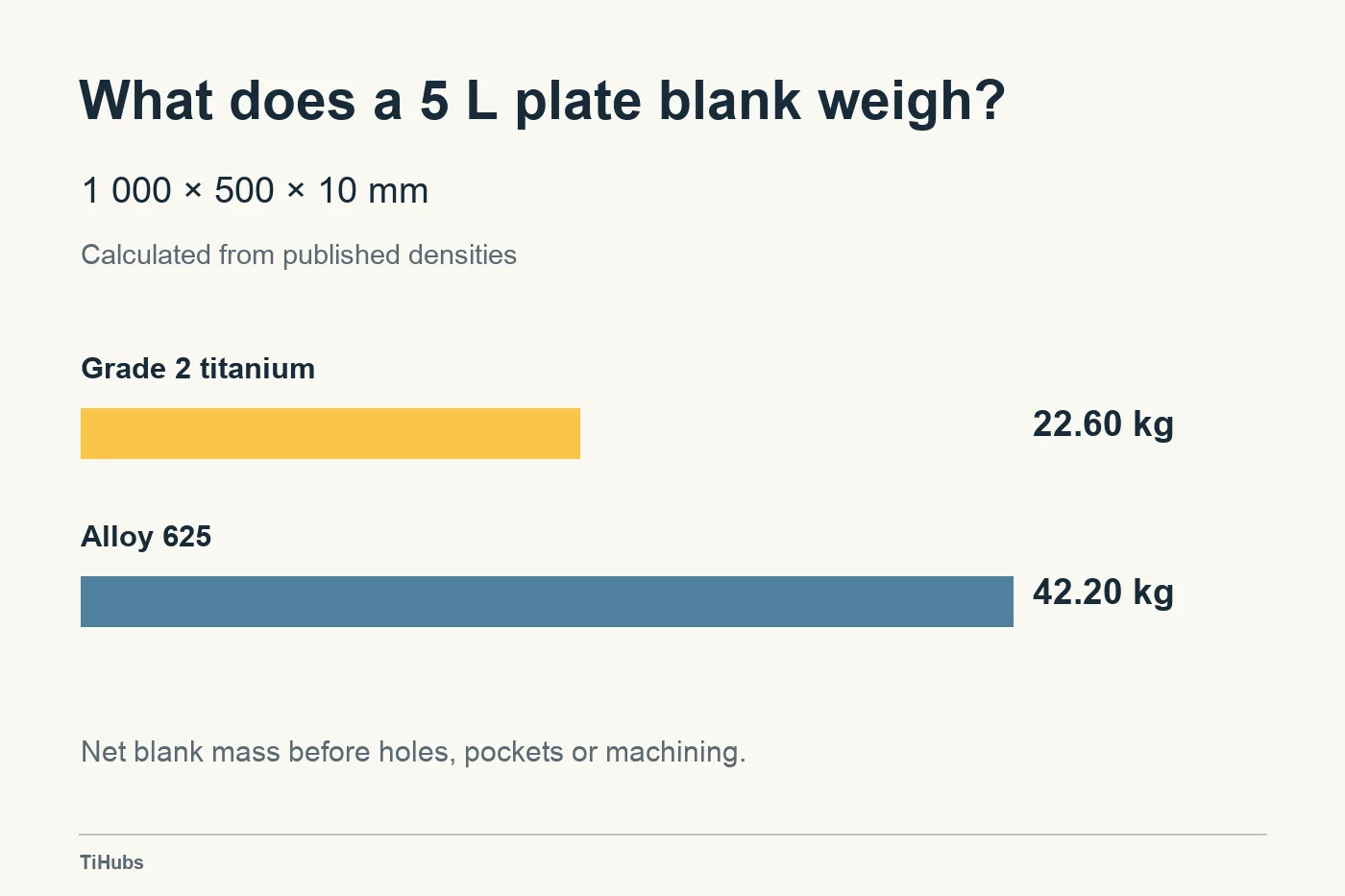
Imagine a rectangular plate blank measuring 1,000 by 500 by 10 mm before machining. Its solid volume is five litres. For this exercise use the ATI plate density of 4.52 kilograms per litre and the Special Metals value of 8.44 for alloy 625. The calculated masses are 22.60 and 42.20 kilograms. At this particular geometry the titanium blank weighs about 46.4% less, with the nickel blank as the denominator. These are calculated material quantities. They exclude holes, welds, lifting lugs, packaging and any extra stock the shop needs to hold the blank.
Blank for this example
Volume
Grade 2 calculated mass
Alloy 625 calculated mass
One 1,000 × 500 × 10 mm blank
5.00 L
22.60 kg
42.20 kg
One blank of the same footprint at 12 mm
6.00 L
27.12 kg
50.64 kg
Four blanks of the original 10 mm thickness
20.00 L
90.40 kg
168.80 kg
Suppose the original cover had a pocket behind the gasket land. A vendor quoting solid plate and a vendor quoting a machined cover can both give an entirely correct weight and still be describing different deliveries. Ask both to distinguish purchased blank, net part, handling fixture and packed shipping mass. Use blank mass when assessing metal purchases, net mass when reviewing lifting arrangements, and packed mass when comparing transport. Retain units in the quotation. A price per kilogram cannot safely be multiplied by a number taken from a packing list for a different scope.
The arithmetic also explains why a simple substitution based on a drawing’s finished thickness can mislead. Available stock may come in a different thickness, or extra material may be necessary for a final flatness or sealing-face requirement. The shop might recover some scrap or quote an entire commercial sheet. Ask which dimensions control the invoice and what credit, if any, is included for offcuts. Compare price per acceptable finished cover from each route. This keeps the purchasing comparison valid even if the two manufacturers buy their feedstock in different units.
For equipment selection, stiffness, deflection, pressure loading, joint preload and the allowable gasket movement remain separate checks. Lower density alone cannot establish equivalent wall thickness. Take a simple example: a lighter cover may be easier to handle but the assembly could still leak if its sealing face rotates excessively under the specified loading. Send the proposed substitution to the party responsible for the equipment design. Once a thickness and geometry have been approved for each option, rerun the weight and commercial comparison with those approved dimensions.
Industrial buying guide / 02Equal volume, different handling mass
Illustrative blank before machining. The plot uses the published densities and the dimensions in the example.
03 / Exposure
Where will the metal actually see the process fluid?
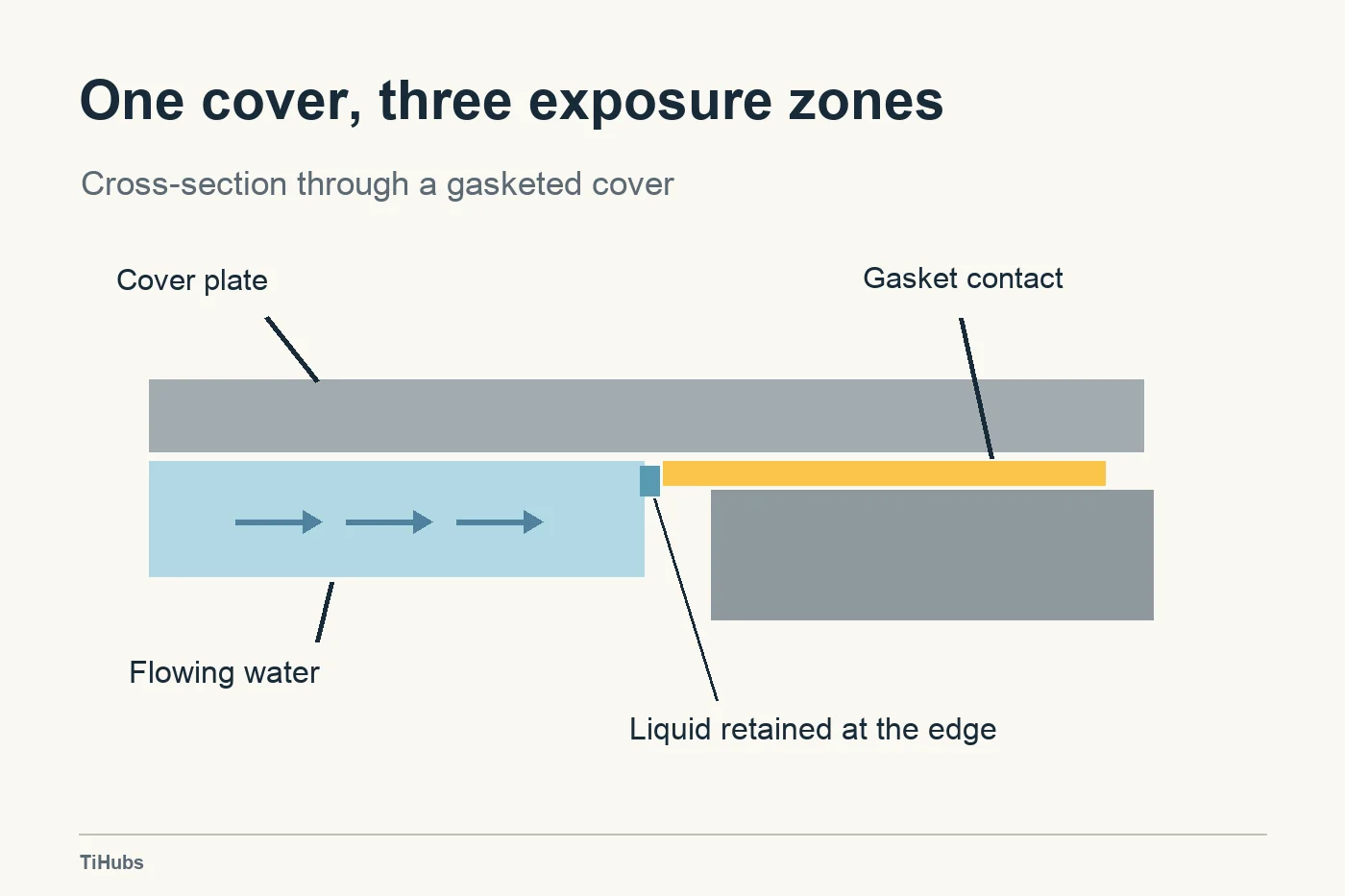
A phrase such as “salt water at ambient temperature” describes a sample of fluid, not the complete exposure of a fitted part. Ask which surfaces are continuously flushed, which remain damp after shutdown, which sit beneath a gasket and which contact deposits. Mark each region on a sketch. Identify the fluid on the other side of the wall too. A cooler that looks like a seawater application to purchasing may see a cleaning solution, condensate or another process stream on the opposite face. A material review based on one side can miss the limiting condition entirely.
Titanium’s protective surface film is part of the reason commercially pure grades are considered for many aerated water duties. TIMET’s corrosion manual distinguishes bulk exposure from attack in confined crevices and discusses interactions among temperature, chemistry and geometry. Special Metals describes alloy 625 performance in seawater and provides information on local attack. Neither publication qualifies a particular gasketed assembly at an unspecified temperature. Ask for the evidence closest to the actual duty, and document the gap between the reference exposure and the equipment under review.
A common purchasing error is to record the supply-water temperature as the metal temperature. A plate beside a hot stream can run at a different temperature from the water entering the unit. Heat transfer, partial wetting, deposits and temporary loss of flow can make the difference important. Ask the operator for the normal range, maximum credible metal temperature, duration and frequency of the excursion. Where only inlet and outlet measurements are known, identify the missing wall-temperature estimate as an engineering question. An invented number gives a quotation a precision the plant data cannot support.
Consider shutdown as its own operating case. The plant might drain the main passage, leave liquid under the gasket and reopen the cover weeks later. It may use a different solution to clean deposits before restart. Request the cleaning chemicals and concentrations actually used on site and the quality of the rinse. If the recipe is confidential, have the owner exchange it with its materials specialist under the existing project arrangements. Providing chemistry to the person deciding suitability is more valuable than asking every bidder to repeat a generic statement about corrosion resistance.
Where to look
Evidence the buyer can collect
Decision it supports
Main flowing passage
Fluid analysis, normal and excursion temperatures, flow history
Whether published exposure data are relevant
Contact under gasket or deposit
Sketch of contact, retained liquid, photos of both mating faces
Whether local exposure needs separate testing
Drain-down and cleaning
Sequence, dwell periods, cleaning medium and rinse conditions
In a failure review, take photographs before cleaning if site procedures permit. A photograph of the whole opening helps locate the damage. A close view of the edge or gasket track helps a specialist decide what samples to request. Add an orientation arrow or matching drawing reference; an unlabelled close-up can be impossible to relate to the flow path. Record whether the original identification and heat number survived. Uncertainty about the incumbent material changes how much weight the service history can carry.
Industrial buying guide / 03The gasket changes local exposure
Mark stagnant pockets and both sides of the component when documenting the actual service.
04 / Fabrication
Which delivery route produces an interchangeable part?
Plate stock, a profile-cut blank and a tested fabrication are three different products. For a bare plate, clarify thickness, flatness, surface condition and any surface that must remain identifiable after cutting. For a profile cut, indicate which dimensions are rough, which need finishing and whether edge condition matters at the next operation. For a finished part, supply a drawing with functional datums, agreed tolerances and the intended sealing surface. A quote can satisfy the material specification and still leave most of the buyer’s machining and inspection costs outstanding.
A change of material may affect the entire manufacturing route. In a welded item identify the parent product form, proposed filler, joint configuration, welding procedure qualification and any production inspections. Shielding and surface cleanliness matter when fabricating titanium. The owner should decide what evidence the fabricator must retain for the actual joint. For a nickel alloy order, agree the alloy and condition of the parent product and the consumable selection instead of assuming that material bearing a similar trade name will meet the procedure. Keep the two fabrication records distinguishable throughout a competitive trial.
A dissimilar transition deserves a line of its own in the quotation. Retaining an existing nickel nozzle and changing a surrounding component to titanium creates an engineering question at the interface. The available choices may include a mechanical joint or an engineered transition. Each requires defined mating geometry and separate acceptance. Ask the supplier to identify the included boundary on a marked drawing. If the offer stops at a prepared titanium edge, record which party is responsible for the transition and what the next shop needs for fit-up.
Surface finish calls for the same precision. An overall note saying “smooth” tells a machinist very little about the gasket track, a radiused edge or a cosmetic outer face. If roughness matters, give the parameter, units, location and measurement direction where relevant. If the design uses a drawing specification for the seal pattern, cite it. Avoid applying a costly finish to every face merely because one annular land needs it. The supplier can then show the sealing surface as a controlled feature and quote a practical finish on the other faces.
During review of a sample, check the features that define interchangeability before discussing batch price. Will the locating feature enter its mating recess? Does the bolt pattern use the datum shown on the assembly? Can the cover be removed without disturbing the adjacent connection? A dimensional report may show every value inside a tolerance band yet rely on a different reference origin. Ask for a marked drawing or a first-article report that makes the measurement references explicit. Retain any functional checks separately from purely dimensional checks.
05 / Technical acceptance
What evidence should accompany the order?
Start with the material certificate. It should connect the ordered material to a heat or lot, product form, specification, applicable condition and reported results. Check that the units and material designation match the order. Where a service centre cuts plate, ask how identity is transferred to the pieces and linked to the cutting record. A certificate for the original mother plate is helpful only when the receiving team can follow the chain from that certificate to the pieces in front of them. The chain remains important after the pieces reach another machine shop.
The type of evidence should follow the failure mode. Chemical identification helps establish which alloy family the part belongs to. It does not show the final gasket face, the mechanical properties of the particular ordered condition, or the soundness of a finished weld. A dimensional report answers a different question from a leak test. If a supplier proposes an alternative examination, have the responsible engineer describe what it detects, which zones it covers and which acceptance requirement it satisfies. That explanation is more valuable than an extra certificate with an impressive heading.
For a prototype used to investigate an exposure problem, write the test question before sending samples. Should the comparison represent polished open surfaces, a crevice under a gasket, or the welded condition of the proposed fabrication? A flat polished coupon may be useful for one of these questions and irrelevant to the next. Include the intended comparison material, the exposed area, the conditions to be recorded, and what observations will be reported. If the test is exploratory, preserve that status when the findings are carried into a later production specification.
Make the report review workable for the receiving inspector. Pair each acceptance feature with a document or a check: heat identity with traceability records, gasket land with the drawing and dimensional report, weld identification with the weld map, final assembly integrity with the approved test report. Give the inspector the latest drawing revision and a way to flag unresolved exceptions. A list of twenty certificates is less effective than four records that directly answer the questions needed to release the particular part into the plant.
What if a distributor offers a substitute condition after the purchase order has been placed? Keep the part on hold while the supplier describes the change and its effect on intended use. Ask for the actual material paperwork and the proposed revision to the supply scope. Route the request to whoever approved the original condition. A pricing concession or an earlier delivery date can be evaluated after technical disposition. Keep the final decision linked to the purchase line so the substitute does not become a silent precedent on the next repeat order.
06 / Quote review
How to compare cost and leave a usable enquiry
Compare offers at the same delivery stage and in the same currency. Ask for any minimum purchase quantity, cutting charge, inspection charge, documentation cost and packaging that affects the landed total. If timing matters, distinguish the lead time for stock, the date for a finished first article and the date for the accepted production quantity. A plate available this week and a complete inspected cover available next month cannot be ranked by the first date printed on each quotation.
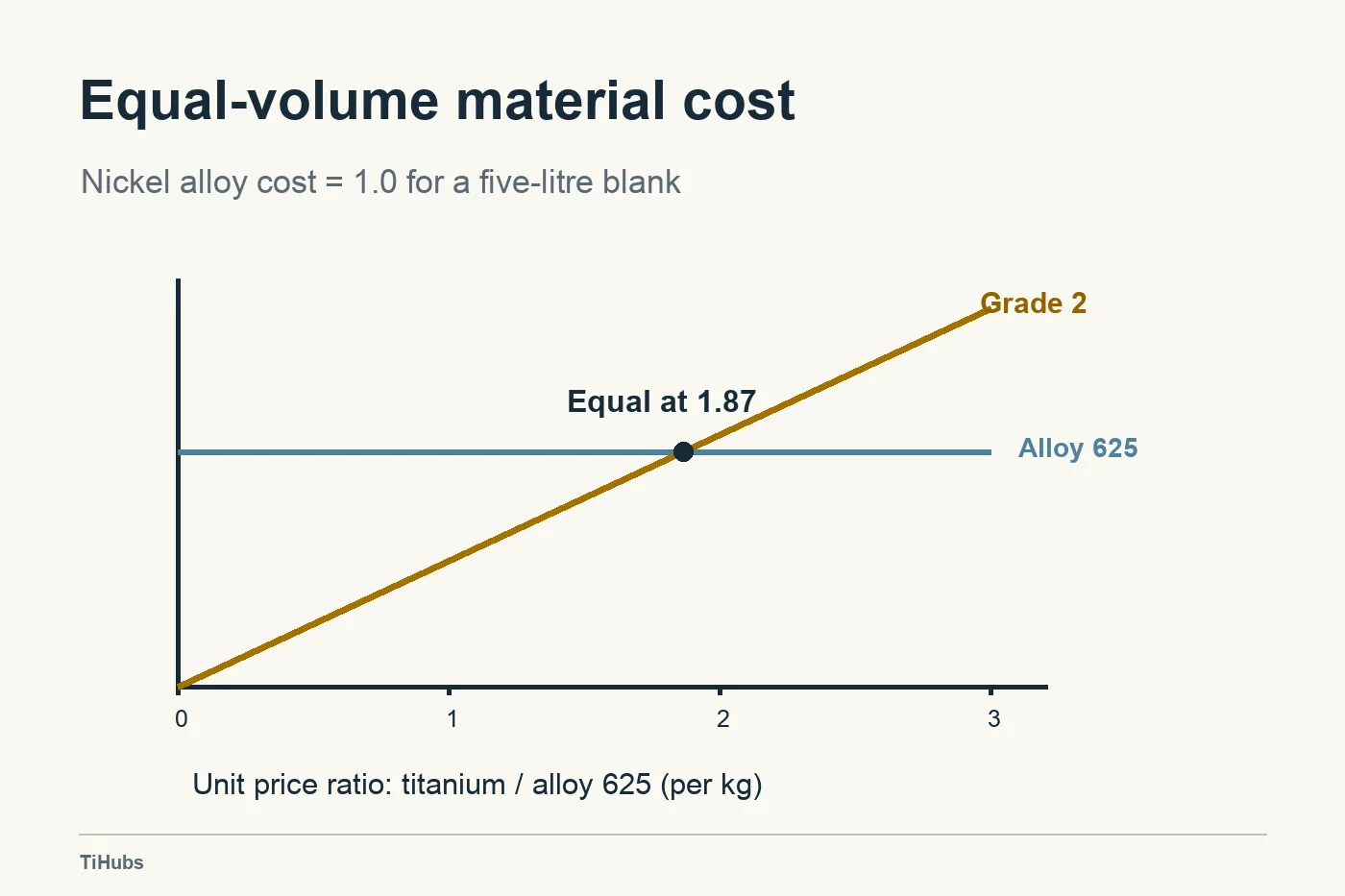
To compare raw material with different densities, work first in cost per volume. For a simple equal-volume exercise, let the titanium price per kilogram be T and the alloy 625 price per kilogram be N. The two raw blank costs in the example are 22.60 × T and 42.20 × N. They are equal when T is about 1.87 × N. This is a mathematical break-even for those identical blanks and stated densities only. It is not a market price prediction. Changing approved thickness, purchased sheet size, scrap recovery or machining changes the comparison.
A useful decision sheet carries three columns for each alternative: what is confirmed, what remains open and who will resolve it. One offer might clearly define traceability but leave the gasket finish open. Another might give an attractive finished price while excluding the dissimilar connection. Put each gap beside its technical or commercial consequence instead of trying to settle everything with a single weighted score. Where the equipment is already approved for one material, make the engineering review time and responsibility visible in the alternative route.
For a first enquiry to TiHubs, send the current Grade 2 titanium plate requirement as a purchasable line. Identify whether you need mill plate, a cut blank or a finished component, and show any features the next shop must finish. Give the drawing revision, quantity, delivery destination, service summary and the evidence required for acceptance. If the enquiry concerns a fabricated pressure boundary, identify the code and who owns design approval. For more information on interpreting a heat record, use the titanium mill test certificate guide.
Finally, keep a short record of why the choice was made. A decision that rested on lifting space and an approved water duty may not transfer to another plant with different cleaning chemistry. Record the approved grade and condition, the exposure reviewed, the accepted drawing and any limits on substitution. The next buyer can then reorder a defined component, recognize when the service has changed, and ask for a fresh review before an apparently minor drawing revision becomes a new materials decision.
Industrial buying guide / 06Break-even for the five-litre blank
The horizontal line represents alloy 625. The sloping line assumes an equal volume of Grade 2 titanium. Prices are normalized, not market quotations.
07 / Build your RFQ
Request a comparable titanium plate quotation
Attach the current drawing and identify exactly which material and finishing scope TiHubs should quote. Separate engineering questions about a proposed substitution from the requirements already approved for manufacture. If delivery is urgent, show the dates for bare plate, first article and the final batch individually.
Information to include
Product form and applicable edition
Finished drawing and stock dimensions
Wetted surfaces, fluids, temperature and shutdown history
Material condition and project-specific inspection
Delivery stage and any proposed exceptions
Build your RFQ checklist
Choose the product and add the information you have. Copy the resulting brief or send your requirements to TiHubs. Submitting an enquiry does not place an order.
08 / FAQs
Questions buyers ask
Is the density difference a reliable estimate of freight savings?
Only for the metal portion of equal-volume items. Freight may depend on gross mass, the dimensions of the crate, the route or a minimum charge. Two covers that fit in the same crate can have much the same handling cost even if their net weights differ. Request separate net and packed weights and ask the forwarder to price the actual shipment. If the purpose of the weight limit is a maintenance lift, check the cover with all hardware attached and use the lifting plan applicable to the site.
Can a previous successful seawater installation settle the choice?
It provides relevant evidence if the equipment history can be reconstructed. Identify its alloy, geometry, temperature, water composition, cleaning practice and the length of time in service. An installation inspected regularly may have useful photographs and thickness readings. One described only as still operating gives much less information. Document the differences between the reference installation and your own, especially at seals and during shutdown, before relying on that history when ordering the replacement.
Can either vendor accept a quotation request without the full design file?
A budget enquiry can be issued against a clearly identified sketch and assumptions. Ask the supplier to label its price as preliminary and list the information that would change it. For example, a rectangular sawn plate can be priced before the gasket groove is finalized if finishing is excluded. Reissue the drawing before buying the completed cover. In this way both parties know which technical decisions remain open and purchasing can still establish a realistic budget.
Which product line should I use for a replacement exchanger tube?
Switch the enquiry from plate to tube and provide the tube outside diameter, wall basis, length, end preparation, quantity and applicable tube specification. Include how the tube is joined to the tubesheet and how acceptance is tested. The flat-product specifications in this comparison do not define a finished tube. Retain the material and exposure comparison where useful but have the tube product form and the mechanical design of the replacement reviewed on their own terms.
09 / Key takeaways
Keep the purchase requirements connected.
Product form and applicable edition
Finished drawing and stock dimensions
Wetted surfaces, fluids, temperature and shutdown history
Material condition and project-specific inspection
Delivery stage and any proposed exceptions
Technical references
Sources and data scope
References reviewed November 20, 2026. Public source summaries support the discussion; the controlled specification, agreed edition and approved project requirements govern acceptance.
ATI — CP Grade 2 — Density from the plate section and UNS identifier.
ASTM B443 — Scope including rolled UNS N06625 flat products.
Ti
About TiHubs
TiHubs coordinates titanium material and custom supply enquiries from Baoji, China. Send the product, drawing revision and acceptance requirements so the proposed supply scope can be reviewed. Learn about our sourcing role.
Contents
TiHubs
Talk to TiHubs
Ask about titanium materials, grades or custom parts.
Enter your email to start chatting.
We use your email to respond to your enquiry. Your conversation is stored on this website.
Our team is away right now. Leave your enquiry and we will follow up by email.