Natural passivity explains titanium behavior. A purchase order still needs a defined surface objective, applicable procedure and evidence for the delivered parts.
AI illustration; not a production or inspection record.
Quick answer
Titanium naturally forms a protective oxide under suitable conditions, but that does not certify a delivered part as clean or processed to a specified procedure. Define the objective first. ASTM B600 concerns titanium cleaning and descaling; ASTM A967/A967M concerns stainless-steel passivation. Select an applicable procedure and tests for the actual titanium component, then preserve final dimensions, cleanliness and lot records.
01 / What passivation means
Natural passivity is not a complete purchase specification
Titanium passivation can refer to the passive condition of the metal or to an intentionally specified surface-treatment operation. A purchase order should establish which meaning applies. Titanium naturally develops a protective oxide when a fresh surface encounters suitable oxygen-containing conditions. That material behavior does not prove that a delivered component has undergone a named treatment, is free from manufacturing contamination or satisfies a particular cleanliness requirement.
TIMET describes a strongly adherent protective film that forms on exposure to air or moisture and explains that its ordinary thin condition is not visible. This is the technical starting point, rather than a reason to demand a visible coating on every titanium part. A photograph cannot demonstrate the film’s composition, thickness or conformity to a customer process. [1]
Ask what the buyer needs to achieve
When a drawing simply says passivate titanium, ask what problem the instruction is intended to solve. Is the objective removal of shop contamination, removal of heat scale, a defined surface chemistry, preparation for a later operation or compliance with an existing customer procedure? Each objective leads to different process and acceptance questions. Treating them as one generic acid dip can leave the actual requirement unverified.
A useful enquiry identifies the material and its current condition, the surfaces affected, the intended final state and the evidence required. A new machined component, a heat-exposed fabrication and a used process part do not necessarily arrive at the treatment supplier with the same surface. The proposed operation should address that starting condition, not merely repeat the wording of a familiar finish code.
Natural film formation does not remove contamination
A part can have titanium oxide on exposed areas while still carrying oil, particles or other unwanted residues elsewhere. These are separate questions. Do not use the statement that titanium self-passivates as an acceptance record for a finished part. Conversely, do not conclude that every titanium item requires an additional treatment merely because stainless-steel purchases commonly contain a passivation instruction.
Keep the service review separate as well. A passive surface does not establish compatibility with every chemical environment. The actual medium, concentration, temperature and other conditions remain relevant to material selection. Surface processing cannot be assumed to make an unsuitable grade or operating condition acceptable. The process owner should define the requirement and any evidence needed for the specific application.
State who approves the interpretation
If the requirement comes from an approved drawing or customer specification, the supplier should not delete or reinterpret it unilaterally. Raise a technical query that identifies the ambiguity and proposed resolution. Procurement can coordinate that question while the responsible authority confirms the intended process and acceptance. Preserve the answer with the drawing revision so repeat orders do not restart the same discussion.
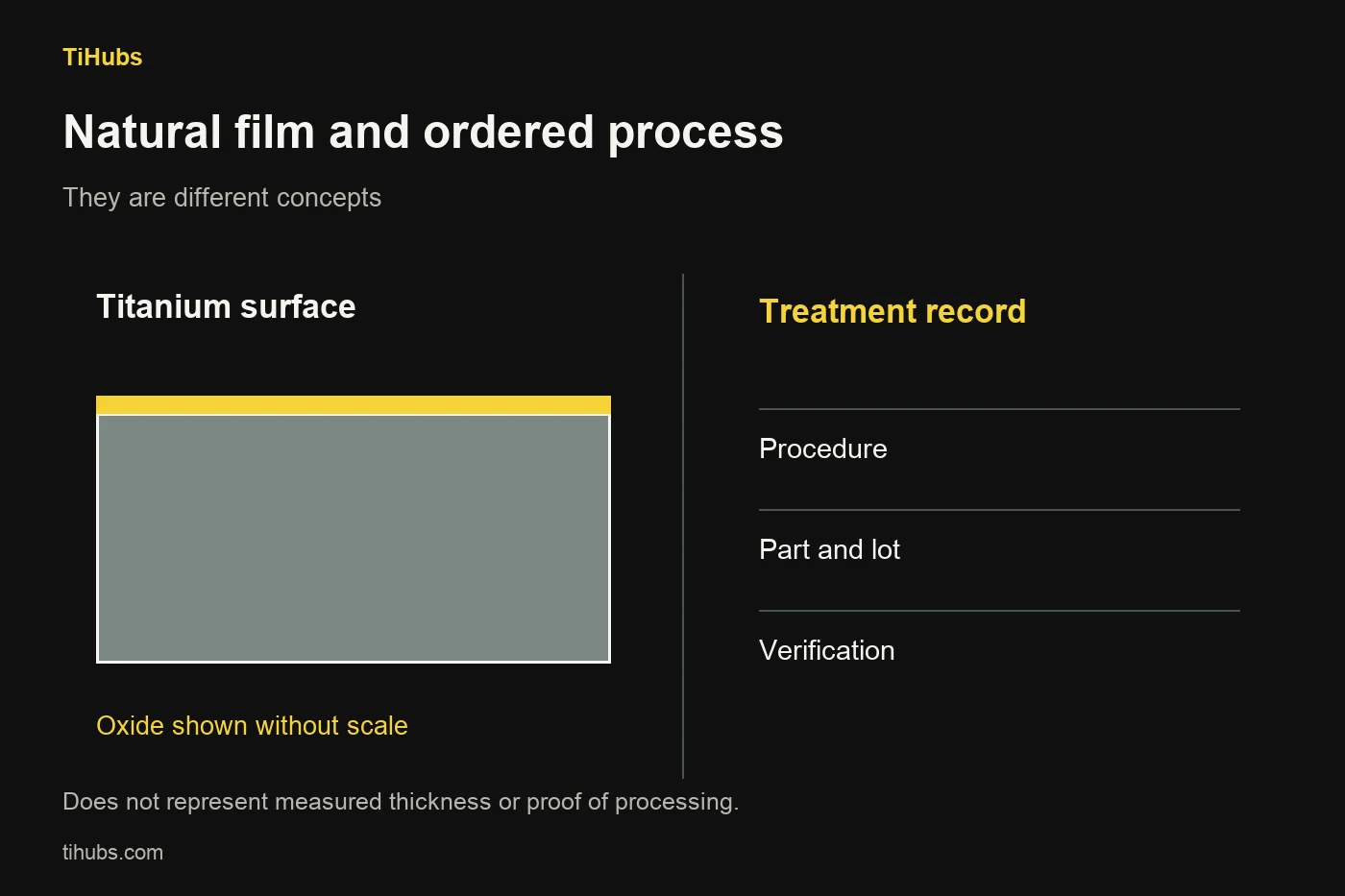
Industrial buying guide / 01A natural film is not a process certificate.
Schematic only, not to scale. No oxide thickness or measured surface chemistry is represented.
02 / Cleaning and pickling
Separate the treatment objective from the process name
Cleaning, descaling, pickling, passivation treatment and anodizing are related surface topics, but the names should not be used as interchangeable acceptance statements. This article concentrates on defining a passivation requirement. The broader titanium surface-finish guide addresses finish selection; use the two pages together when both appearance and final surface condition matter.
Comparison of purchasing objectives. The table does not prescribe a chemical recipe or certify an individual process.
Term
Question to resolve
Evidence still required
Cleaning
Which unwanted residues must be removed?
Defined cleanliness condition and verification
Descaling / pickling
Which oxide or affected surface condition is being removed?
Approved removal process and final-part acceptance
Specified passivation treatment
Which procedure and final state does the drawing require?
Procedure identity, processing record and applicable tests
Natural passive film
What material behavior is being described?
It is not a record of an ordered treatment
Anodizing
Is a separately controlled electrochemical surface process required?
Its own specification and acceptance criteria
Review the starting surface
Identify machining residues, handling contamination, heat exposure and any prior finishing. State whether the part is new or has been used. A used component may carry process deposits that are absent from a new part, while a fabrication may contain inaccessible areas that a simple coupon does not represent. Provide that information before asking the treatment supplier to confirm a route.
Do not infer the required removal from color alone. A visual observation can identify a condition to investigate, but the appropriate action depends on the manufacturing history and governing specification. If dimensions or surface texture are already close to their limits, review the permitted effect of any subsequent operation. The treatment plan must preserve the finished requirements rather than treating surface processing as dimensionally irrelevant.
Make the sequence explicit
Define the stage at which the specified surface condition must exist. If a component is treated and then machined, welded, marked or handled through another operation, the earlier treatment record may not describe the final delivered surface. Identify which operations precede final acceptance and which, if any, are permitted afterward. Include masking or protected areas where the design requires them.
For a machined titanium component, the drawing, final dimensional inspection and cleaning requirement should refer to a consistent delivery stage. For a fabricated item, the same principle applies to joints and inaccessible surfaces. A complete sequence makes it possible to distinguish an omitted operation from a properly controlled operation performed at the wrong stage.
Do not buy a chemical name without a process definition
A chemical name alone leaves concentration control, exposure conditions, equipment compatibility, rinsing, drying and verification unresolved. These belong in an approved process managed by a competent treatment provider. The buyer’s task is to establish the applicable specification, outcome and evidence, not to assemble an unvalidated recipe from unrelated internet examples. Ask the quotation to identify the procedure and any deviations requiring approval.
03 / Standards and scope
Use a titanium-relevant basis and an agreed edition
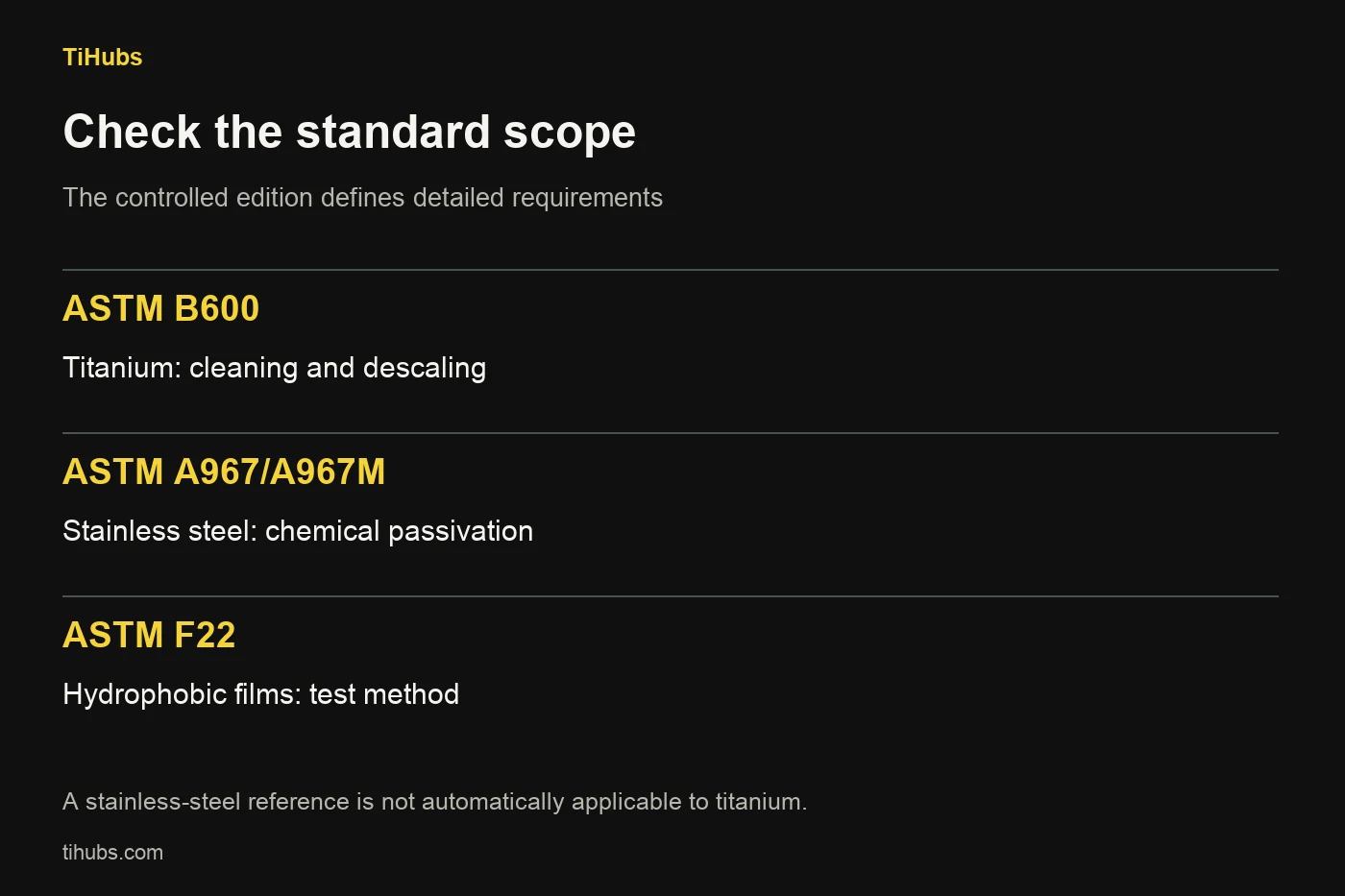
A standard number is useful only when its scope matches the material and task. ASTM B600 addresses cleaning and descaling of titanium and titanium-alloy surfaces. ASTM A967/A967M addresses chemical passivation treatments for stainless-steel parts. ASTM F86 concerns surface preparation and marking of metallic surgical implants. These documents have different purposes; none should be reduced to the generic label metal passivation. [2][3][4]
Verified public scope comparison. The agreed controlled document supplies the detailed requirements.
Reference
Published scope
Procurement implication
ASTM B600
Cleaning and descaling titanium and titanium-alloy surfaces
Relevant starting reference for that task; define applicable requirements
ASTM A967/A967M
Chemical passivation treatments for stainless-steel parts
Do not assume automatic applicability to titanium
ASTM F86
Surface preparation and marking of metallic surgical implants
Application-specific scope; not a general claim of device approval
ASTM F22
Detection of hydrophobic surface films by a water-break test
A cleanliness-related method, not a universal passivation certificate
Resolve a stainless-steel instruction on a titanium drawing
If a titanium part drawing invokes a stainless-steel treatment document, do not silently ignore the callout or claim full conformity without resolving the mismatch. Ask the design authority whether the reference was intentional, which requirements apply and whether a titanium-specific procedure is required. The response should identify the approved interpretation or drawing change. That record protects both manufacturing and receiving inspection from incompatible assumptions.
The same discipline applies to a customer procedure that incorporates parts of several standards. Obtain the controlled procedure and its revision, not only a supplier’s shorthand description. A project may establish additional requirements, but those requirements must be explicit and approved. A public catalogue abstract cannot resolve every contractual detail or authorize a departure from the issued drawing.
Identify the edition and document hierarchy
Specify the edition required by the order and how conflicts between drawing, customer procedure and general standard are resolved. A supplier may hold an older copy while a buyer checks a newer catalogue entry. Both can use the same standard number and still refer to different requirements. Resolve the edition before the quotation becomes a production instruction.
For implant-related work, ASTM F86 itself identifies an application-specific surface-preparation scope and recognizes relevant implant-specification requirements. A reference to that practice does not establish regulatory approval, sterility or the suitability of a finished device. Keep any such requirements with the responsible device specification and source controls. This article does not convert a general titanium supply enquiry into an approved implant-manufacturing service.
Keep the certificate wording proportionate
A process certificate should identify the work actually performed under the applicable procedure. It should not claim compliance with an entire document when only a selected operation was ordered or demonstrated. State approved deviations and excluded requirements where relevant. Precise certificate wording is more useful than a broad declaration that cannot be connected to the part, process and acceptance records.
Industrial buying guide / 03Check scope before citing a standard.
Public scope distinctions support document selection; the controlled specification and agreed edition govern the work.
04 / Acceptance evidence
Choose a test that answers the actual question
Before selecting a test, identify the characteristic being accepted. Visible residue, a particular contaminant, a final surface texture and a specified chemical surface state are not the same property. One test may support one of these requirements without demonstrating the others. A useful inspection plan maps each requirement to a method, acceptance criterion, sampling basis and record.
Visual inspection has a defined role
Visual inspection can document accessible appearance, visible residues or specified surface defects under agreed conditions. Define the surfaces, lighting, magnification if applicable and acceptance references. A general statement that the part looks clean is difficult to compare between inspectors. At the same time, visual appearance alone cannot establish an invisible oxide film’s detailed properties or identify every form of contamination.
Photographs can support the record when the feature is visible and the part identity is clear. They should not be treated as a substitute for measurements or tests that address nonvisible characteristics. If a cavity cannot be observed adequately, agree an appropriate access or verification approach. A photograph of the external face does not establish the condition of an inaccessible internal channel.
A water-break test is not a universal passivation test
ASTM F22 addresses hydrophobic films. Its published guidance describes a qualitative cleanliness evaluation and notes limitations including rough or porous surfaces and unsuitable access or water-entrapment situations. Where the method is appropriate and specified, it can support its defined cleanliness objective. Passing it does not by itself establish oxide thickness, absence of every contaminant or corrosion performance in a service environment. [5]
Likewise, do not transfer a stainless-steel verification method to titanium solely because it appears in a familiar passivation standard. Confirm material compatibility, purpose and acceptance through the approved specification. The test should answer the project’s question rather than create a reassuring result with no defined connection to the titanium part’s requirement.
Quantitative requirements need quantitative definitions
If the project requires a numerical limit for a specific residue or surface characteristic, identify the measurand, method, units, sampling location and reporting basis. State whether results concern the actual part, a representative witness sample or a process sample. Those are different kinds of evidence. A witness coupon may support process control without proving every inaccessible surface on a complex component.
Agree how uncertain or borderline results are handled before the lot is processed. Identify who reviews deviations and whether retesting or reprocessing is permitted. Avoid replacing a failed defined test with a different easier test after the fact. The acceptance decision should remain tied to the agreed requirement and documented evidence, not to whichever result is most convenient.
Preserve dimensions and functional surfaces
Include final dimensional or surface checks where treatment can affect the controlled features. Define the acceptance stage for threads, sealing faces, thin walls or other sensitive geometry. A treatment certificate does not supersede the drawing’s finished dimensions. The receiving package should allow material, process and final-part conformity to be reviewed together without confusing their separate scopes.
05 / Process and traceability
Protect the accepted surface through the whole supply chain
Write the process scope around identifiable parts and lots. Record the part number, drawing revision, material grade and delivered condition, quantity and relevant manufacturing history. Identify whether all surfaces or only specified areas are treated. If an assembly contains dissimilar materials or components that cannot share the same process, resolve that constraint before the work is released.
Agree the records before treatment
The required record package should identify the procedure and revision, processing lot, date, applicable inspections and acceptance results. The level of detail depends on the project; do not demand unrelated paperwork merely to make the package appear substantial. Each requested record should answer a specific material, process or final-condition question and connect to the delivered parts.
For outsourced processing, identify how the manufacturing lot is linked to the treatment lot. If a lot is divided, the records should preserve which parts received which operation and inspection. A certificate for a large processing batch is incomplete for receiving purposes if there is no reliable relationship to the items in the shipment. Package labels and dispatch records can be part of that connection.
Rinsing, drying and packaging belong to the final condition
The approved process should address removal of processing residues and the delivered dry or otherwise specified state. The buyer should define the outcome and any restrictions relevant to the application, while the provider confirms an appropriate controlled method. Do not assume that completion of the main treatment step proves that the part is ready for shipment or for the customer’s next operation.
Agree final handling and packaging with the cleanliness objective. Specify whether protective contact materials, individual packing or restrictions on marking are required. An accepted surface can be exposed to new contamination during sorting, inspection or packing. The point of release and the protection applied afterward therefore need to be part of the same documented supply scope.
Control subsequent work and reprocessing
If the part is returned for machining, repair or another operation after treatment, review whether the previous acceptance still describes the final surface. Do not simply reuse an earlier certificate. Establish whether additional work, cleaning or verification is needed under the governing procedure. The new record should identify the actual sequence and preserve the relationship to the original part lot.
Reprocessing also needs an approved basis. Repeating a treatment is not automatically harmless to dimensions, surface condition or material acceptance. Record the reason, authorization and final checks. When a repeated order changes supplier, procedure or manufacturing sequence, review the change rather than assuming that the word passivation guarantees an identical result across every provider.
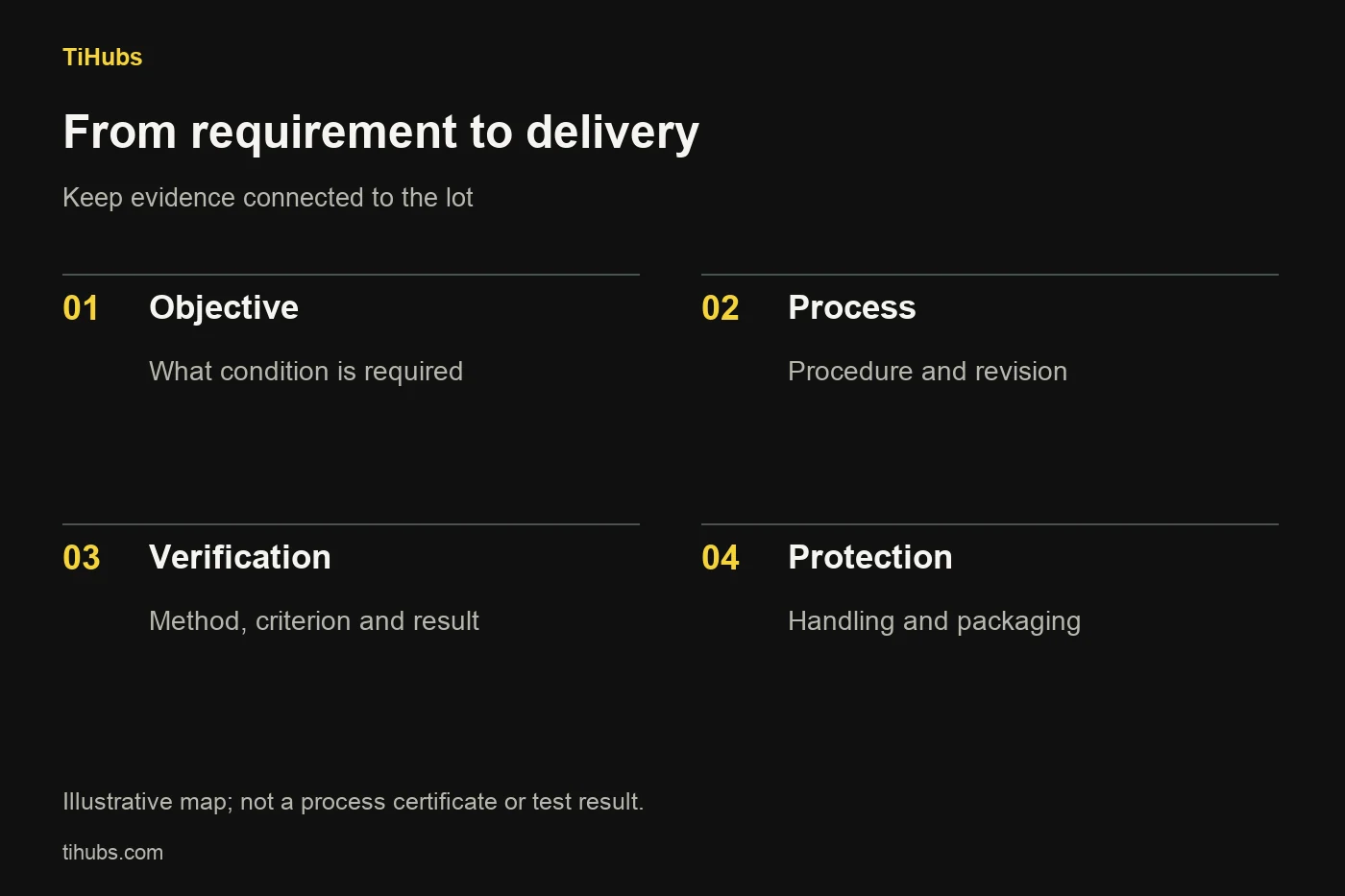
Industrial buying guide / 05Keep the accepted condition connected to the lot.
Illustrative procurement sequence, not a record of treatment or a laboratory test result.
06 / RFQ and decision path
Turn an ambiguous callout into a reviewable supply requirement
Start with four linked questions: what material and surface are being supplied, what final condition is needed, which procedure governs the work, and what evidence releases the lot? If one answer is missing, mark it as an open technical question. This is more effective than adding a generic passivation line and expecting the supplier to infer the intended standard and test.
Use a clear enquiry structure
Identify the titanium product, drawing revision, material grade and condition, manufacturing stage and surfaces in scope. Describe the intended application sufficiently to explain the cleanliness or surface objective. Add the controlled procedure, edition, final dimensional requirements, inspection plan, packaging and records. State quantity and delivery information separately so commercial comparison does not obscure technical differences.
For a new requirement, ask the supplier to propose a route for review and identify what remains unconfirmed. For an established requirement, ask for confirmation against the issued documents and a separate deviation list. Those are different quotation tasks. A proposal to develop a procedure should not be represented as a commitment to an already qualified production process.
Compare offers by outcome and evidence
One offer may cover cleaning only, another a specified treatment with process records, and another additional final testing and protected packaging. Compare their actual scopes before comparing price. Ask which inspections are performed on the parts, which use samples and which are excluded. A longer certificate list does not necessarily provide better evidence if the documents do not address the required final condition.
Do not request an unsupported percentage improvement in corrosion resistance or an invented passive-film thickness merely to make the comparison numerical. Any numerical claim needs an applicable test or measurement basis and defined conditions. A truthful scope comparison is more useful than a precise-looking performance table assembled from unrelated studies or other metals.
Keep the final decision with the approved requirement
Resolve the technical query, confirm the accepted route and issue a controlled purchase description. Preserve the supplier’s response, deviations and required records with the order. At receipt, review part identity, material evidence, process certificate, final checks and packaging against that description. If a requirement is unmet, identify the specific gap rather than treating all surface concerns as a generic passivation failure.
TiHubs can coordinate titanium material and custom-component enquiries with the requested surface and documentation requirements included in the sourcing review. Send the information you have and identify unresolved points. The objective is a defined proposal for the actual product and application, with process capability and acceptance confirmed before ordering rather than implied by a marketing label.
07 / Build your RFQ
Build a titanium surface-treatment enquiry
Use this brief to connect the product, surface objective, governing procedure and acceptance. Mark missing information for review instead of choosing an unrelated standard by default.
Information to include
Product and drawing revision; grade and delivered condition.
Manufacturing history and surfaces to be treated.
Final surface objective and intended application.
Applicable procedure, edition and approved deviations.
Final dimensions, cleanliness method, criteria and sampling.
Lot records, handling, packaging, quantity and destination.
Build your RFQ checklist
Choose the product and add the information you have. Copy the resulting brief or send your requirements to TiHubs. Submitting an enquiry does not place an order.
08 / FAQs
Questions buyers ask
Does titanium need passivation?
It depends on the meaning of the requirement. Titanium naturally forms a protective oxide, while a project may still require cleaning or a specified surface process. Define the final condition and governing procedure rather than assuming that every part needs the same treatment.
Is pickling the same as passivation?
Do not use the terms as interchangeable purchase instructions. Identify the surface condition to remove, the intended final state and the approved process. The order should state how that result will be verified.
Can ASTM A967 be applied automatically to titanium?
No. Its published scope concerns stainless-steel parts. A titanium drawing containing that reference needs an approved interpretation or correction, not an unsupported conformity claim.
Does a water-break test prove complete passivation?
No. ASTM F22 addresses hydrophobic films within its stated limits. It does not by itself establish oxide thickness, every contaminant or service corrosion performance. Use it only for the agreed applicable objective.
Can color or a photograph prove the passive film?
No. Ordinary appearance does not establish the detailed properties of a thin film or prove that an ordered process was performed. Photographs support visible observations, while other requirements need appropriate evidence.
What should a process certificate identify?
Connect the part and lot to the procedure and revision, work performed, applicable inspection and results, and approved deviations. Keep material certification and final dimensional or cleanliness records separate but traceable.
09 / Key takeaways
Keep the purchase requirements connected.
Define the final surface objective before selecting a process name.
Keep titanium-relevant requirements separate from stainless-steel passivation scope.
Choose tests for the actual characteristic, material and geometry.
Inspect and protect the final condition after all relevant operations.
Link the approved procedure and evidence to the delivered lot.
Technical references
Sources and data scope
References reviewed November 17, 2026. Public source summaries support the discussion; the controlled specification, agreed edition and approved project requirements govern acceptance.
TIMET — Corrosion Resistance of Titanium — Manufacturer reference on protective oxide and service-dependent corrosion behavior; not a certificate for supplied parts.
TiHubs coordinates titanium material and custom supply enquiries from Baoji, China. Send the product, drawing revision and acceptance requirements so the proposed supply scope can be reviewed. Learn about our sourcing role.
Contents
TiHubs
Talk to TiHubs
Ask about titanium materials, grades or custom parts.
Enter your email to start chatting.
We use your email to respond to your enquiry. Your conversation is stored on this website.
Our team is away right now. Leave your enquiry and we will follow up by email.