Review titanium-made crucibles and cups by drawing, contents and operating conditions. A crucible made from titanium is a different enquiry from a crucible used to melt or evaporate titanium.
20 years in titanium100+ Baoji factory connections
Service review · Internal geometry · Contamination control
Define the vessel you need
Use a section drawing to connect capacity, wall geometry and the equipment interface.
Cylindrical cups
Cylindrical cups
Specify internal diameter, usable internal depth, outside envelope and bottom thickness. Identify corner radii and the rim profile. A nominal capacity does not uniquely define the shape or the amount of material in the wall. Include the support arrangement and how the cup is handled during the intended process.
Internal cavity and depth
Wall and bottom definition
Support and handling
Specify more than capacity
Internal volume, external fit, wall thickness and operating conditions are separate requirements.
Order item
Include in your enquiry
Why it matters
Product meaning
Vessel made of titanium or equipment for melting titanium
Keep the enquiries distinct
Material
Grade, product specification and condition
Define permitted substitutions
Contents
Medium, concentration, impurities and residues
Review actual contact conditions
Temperature
Normal, maximum, transient and cleaning conditions
Do not use melting point as a service rating
Atmosphere
Air, inert gas, vacuum or other defined environment
Include inside and outside conditions
Capacity
Cavity volume and intended fill level
Separate geometric and working volume
Geometry
Internal and external dimensions with tolerances
Define radii and measurement planes
Thickness
Wall, bottom and local minimum requirements
Check after final manufacturing
Interfaces
Holder, lid, rim and handling features
Clarify contact and support
Acceptance
Material, dimensions, cleanliness and agreed tests
State methods, limits and records
Your starting specification.
Titanium-made vessel or titanium-melting equipment; drawing and revision; grade and condition; contents and impurities; temperatures and atmosphere; internal geometry and working volume; wall and bottom thickness; support and lid; cleanliness; inspection; quantity and destination.
Dimensions, material condition, quantity, testing and delivery are confirmed in the quotation and order.
Select against the actual process
A titanium grade must be reviewed for the contents, atmosphere, temperature and contamination limits.
Chinese designations and international names are reference routes, not automatic substitutes. Grade, product specification, condition and acceptance requirements must be agreed together.
A similar cup shape does not establish compatibility with a different medium or heating system.
Drawing-led process cups
Describe the material held, contact time, operating conditions and required cleanliness. State whether the part is open, covered or connected to other equipment. The useful sourcing question is whether an identified titanium vessel can meet that process definition, not whether titanium is generally described as corrosion resistant.
What to sendContents, conditions, sectional drawing and acceptance.
Equipment replacement parts
Provide the equipment interface and the original part specification. A sample helps review shape and wear, but may not preserve original dimensions or surface condition. For a broader custom component, the titanium CNC machined parts page covers drawing-led supply beyond crucible geometry.
What to sendOriginal drawing, holder details and replacement history.
Larger fabricated assemblies
If the requirement includes a larger vessel, nozzles, supports or a pressure boundary, use the titanium vessels and process equipment route for a complete assembly review. A small open-cup purchase description cannot substitute for equipment design and its required approvals.
What to sendAssembly scope, design basis and required documentation.
Resolve the cavity and service envelope
A reliable purchase description combines dimensions with operating and acceptance requirements.
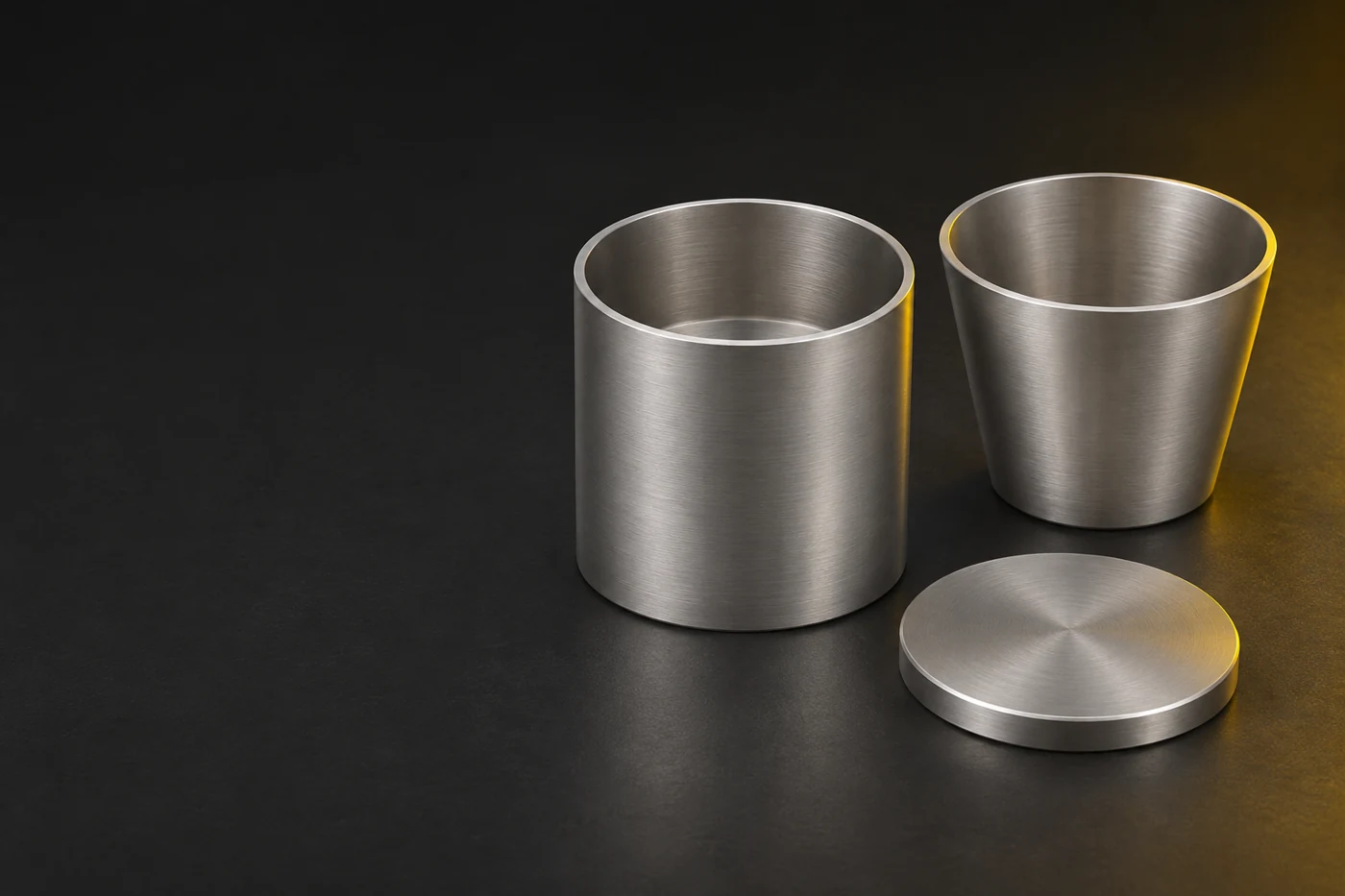
Conceptual illustration of empty titanium-made cups and a loose lid; it does not demonstrate a melting process or operating temperature.
Control internal cavity, wall, bottom and rim separately; a capacity label does not define the complete section.
Order geometry schematic; not a dimensional drawing.
Distinguish the crucible material from its contents
Titanium crucible can describe a container manufactured from titanium, but search results also use similar wording for equipment that melts or evaporates titanium. These are different purchasing tasks. State at the beginning of the enquiry whether titanium is the vessel material, the charge material or both. A photograph of a metal cup is not enough to resolve that distinction.
Specialist melting and deposition equipment uses process-specific containment arrangements. For example, published cold-crucible research describes cooled copper systems, while Kurt J. Lesker discusses a particular intermetallic crucible for thermal evaporation of titanium. Neither example supports a claim that an ordinary titanium cup is suitable for melting titanium. The equipment supplier’s process definition remains essential.
This page addresses drawing-led enquiries for vessels made from titanium. Suitability still requires review of the actual contents, temperature, atmosphere and geometry. If the requirement is a furnace crucible or deposition source for titanium feedstock, identify the equipment and process first so the enquiry reaches the appropriate technical supply route rather than being quoted as a generic titanium container.
Write a complete service description
List the principal contents and any constituents that can contact the vessel during normal operation, startup, shutdown and cleaning. Include concentration, impurities, solids or residues where relevant. A trade name or a statement such as chemical service may conceal the variables that determine compatibility. Explain whether the material is liquid, solid, powder or molten during each stage.
Record the normal operating temperature, maximum expected temperature and relevant transient conditions. Describe heating and cooling methods, contact duration and whether the inside and outside see different environments. These details allow a service review to address the actual exposure rather than a single nominal temperature taken from a machine display.
TIMET’s corrosion guidance emphasizes that operating environments and impurities can differ from reference tests and recommends evaluation under the anticipated conditions. Apply that principle to the enquiry. A laboratory table or supplier experience with a different medium is supporting context, not automatic approval of the proposed crucible. Keep the final suitability decision and any required trial evidence identified.
Do not convert melting point into a temperature rating
The melting point of a metal does not establish the maximum usable temperature of a finished vessel. Strength, chemical interaction, atmosphere, exposure time and dimensional stability can become relevant before melting. A crucible must retain the required shape and containment function under its actual process, not merely remain nominally solid.
Titanium’s response at elevated temperature also depends on its environment and cleanliness. TIMET’s fabrication guidance discusses sensitivity to contamination during heating. This is a reason to specify the full heating and surface condition, not a basis for publishing one universal safe temperature for every titanium cup. Avoid copying a value from a heat-treatment schedule into a continuous-service rating.
If a supplier proposes an operating limit, request the material, geometry, environment, duration and acceptance basis to which it applies. Distinguish a demonstrated test condition from a design limit and from a typical material property. Where the service is new, agree how the responsible technical team will evaluate it before production quantities are committed.
Separate geometric capacity from working fill
Geometric cavity volume is determined by the internal shape. Working capacity also depends on the intended fill level and process allowances. A buyer asking for a particular number of millilitres should state whether that value means brimful volume, volume to a reference line or the intended operating charge. Those definitions can produce different vessel dimensions.
For an ideal cylindrical cavity of internal diameter d and depth h, V = πd²h/4. For an ideal conical frustum with internal end diameters D and d and axial height h, V = πh(D² + Dd + d²)/12. All lengths must use the same units. If lengths are in millimetres, the result is in cubic millimetres; divide by 1,000 to express millilitres. These are geometric identities, not offered capacity ranges.
Real cavities may include bottom radii, steps, tapered transitions or other features excluded from the ideal equations. Use the actual drawing or an agreed measurement method when capacity is an acceptance characteristic. A calculated nominal volume should not be represented as a calibrated delivered volume without specifying tolerances, fill reference and verification conditions.
Capacity definitions that should not be mixed
Definitions for comparing drawings and quotations; no unverified stock capacities are listed.
Term
Definition for the order
Required clarification
Geometric cavity volume
Volume of the defined internal shape
Include radii, steps and reference plane
Brimful volume
Volume to the agreed rim boundary
Define the boundary and measurement method
Working fill
Intended process charge or fill level
State process allowance and operating conditions
External envelope
Space occupied by the vessel
Check holder and equipment clearances
Material volume
Solid material in walls and bottom
Not the same as usable cavity volume
Dimension the wall and bottom independently
Specify wall thickness and bottom thickness as separate characteristics. A cup can have a uniform-looking exterior while its internal bottom radius or machined cavity leaves a different section near the transition. Identify any minimum local thickness and the locations where it must be verified. A nominal wall value alone does not define every part of the vessel.
Review the final geometry after the proposed manufacturing route. Machining, forming and fabrication can create different thickness distributions or inspection access. Ask the supplier to identify how the required sections will be measured and reported. If an area cannot be checked by the proposed method, resolve that gap before accepting a generic statement of wall conformity.
Connect thickness requirements to the approved design rather than a copied catalogue convention. More thickness changes mass, cavity size and the equipment interface; less thickness changes other design considerations. Neither direction is automatically an improvement. The purchase drawing should contain the accepted dimensions so the supplier is not left to infer them from capacity and outside diameter.
Control the rim, base and holder interface
The rim may locate a lid, support the vessel or provide a handling surface. Identify which of these functions it performs and specify the relevant dimensions and geometric controls. A visually smooth rim is not necessarily flat enough for a defined mating requirement, and a loose cover does not establish a sealed joint. Keep the functional interface visible on the drawing.
Describe the base and the actual support arrangement. A flat-bottom cup, a radiused base and a tapered vessel can seat differently in a holder. Include the holder drawing or its relevant limits, especially where the part must fit existing equipment. Confirm which surfaces are intended to contact and which require clearance during operation and removal.
If a pouring lip, handle or other feature is required, show its geometry and attachment requirements. Identify whether it affects balance, cleaning or the allowed handling method. Do not infer a lifting capacity from the presence of a handle. The design and any necessary verification must establish the intended use of those features.
Compare manufacturing routes by final requirements
A machined cup can be produced from a defined starting product, while other geometries may be proposed through forming or fabrication. The appropriate route depends on the drawing and service requirements. Ask the quotation to identify the proposed construction, including any joints, rather than treating every externally similar cup as the same product.
A raw-material standard applies to its stated product form. ASTM B348 concerns titanium bars and billets, and ASTM B265 concerns sheet, strip and plate. Referencing one of these for starting material does not by itself specify the complete finished crucible. The drawing must still define geometry, surface, permitted processing and acceptance after manufacture.
If the design requires a joint-free construction, state that requirement explicitly and agree how it is documented. If welding is permitted, identify the applicable welding and inspection requirements for the actual service. Do not leave the presence of a seam to be discovered at receiving inspection. Compare offers on the same accepted construction basis.
Define cleanliness as an acceptance characteristic
Cleanliness can mean different things: absence of loose particles, removal of machining residues, control of particular contaminants or a defined condition for a sensitive process. State the actual objective and the acceptance method. Descriptions such as high purity or laboratory clean are incomplete unless the relevant limits and evidence are identified.
Separate bulk material chemistry from surface contamination. A material certificate identifies its specified tests, but does not prove that a finished cavity is free from processing residues or handling contamination. Conversely, a clean surface does not establish the alloy composition. Request the records needed for each requirement and connect them to the supplied lot.
Agree cleaning, final handling and packaging together. Specify any restrictions on cleaning agents or packaging materials and identify who approves the procedure. The final accepted condition should be preserved through shipment and opening. If the end user performs a final cleaning or qualification step, state that division of responsibility rather than implying that a general supplier cleaning operation completes every process requirement.
Review atmosphere and the complete thermal cycle
Identify the environment on both sides of the vessel. An inert atmosphere, vacuum or air exposure is not a complete specification without the relevant process conditions and acceptance requirements. Include any change during loading, heating, holding, cooling and unloading. A nominal chamber setting does not necessarily describe the local condition at every surface.
Record the heating and cooling sequence needed for design review without assuming that a successful single cycle establishes indefinite reuse. Repeated exposure can have different acceptance concerns from a one-time demonstration. If cycle life or dimensional stability is required, define the duty and the evidence that will support that requirement. Do not advertise an unsupported number of reusable cycles.
Any qualification trial should use representative contents, support and operating conditions, with observations agreed in advance. Record changes in dimensions, surface condition, mass or process contamination where those are relevant to the acceptance objective. A trial report is useful only when the tested configuration and its limits remain identifiable.
Specify inspection methods before placing the order
Define which internal and external dimensions will appear on the report and the references used to measure them. Include wall and bottom checks, rim and base requirements, and any lid or holder fit. For deep or narrow cavities, discuss access and method suitability before production rather than discovering that the critical feature cannot be reached by the planned instrument.
If capacity is inspected, identify the method, fill reference and conditions. If leak tightness is required, define the actual boundary and test configuration; an open cup is not a closed pressure vessel. Any leak, pressure or vacuum acceptance belongs to the specified assembly and method, not simply to the titanium grade. Keep numerical limits tied to an approved technical requirement.
Specify the inspection quantity and any first-piece hold point. The report should show the measured characteristics and acceptance limits, not only a general pass statement. Material, manufacturing and inspection records should connect to the delivered item or lot. For small quantities, item-level identification may be useful where the order requires individual results.
Use samples to establish a controlled specification
A physical sample can support a replacement enquiry, but identify whether it is unused, worn, deformed or chemically exposed. Service may have changed its wall, cavity, rim or surface. Copying the current shape can reproduce damage rather than the original requirement. Recover drawings and equipment records wherever possible.
Agree what can be measured from the sample and what must come from the process owner. Material identity, original condition, working capacity and service acceptance are not always recoverable from appearance. Mark those gaps in the technical review. A photograph is useful for orientation, while a sectional drawing is needed to define hidden geometry and thickness.
After the sample or first article is approved, issue a controlled drawing and acceptance record for repeat orders. Keep changes in geometry, material, route or cleaning visible. A reference sample can remain part of the package, but should not be the only instruction connecting procurement, manufacturing and receiving inspection.
Compare quotations on the same finished scope
Ask each supplier to confirm material grade and condition, construction, final dimensions, surface state, inspection and documents. Identify lids or other accessories as explicit included or excluded items. A price for an unfinished blank cannot be compared directly with a cleaned, inspected vessel and matching lid unless the remaining work is accounted for.
Separate proposed deviations from the base offer. A different alloy, wall definition, corner radius or manufacturing route may affect the approved process. The commercial team should be able to see those changes without searching through a generic catalogue. Obtain the appropriate technical decision before the final order is released.
TiHubs can review titanium-made crucible and cup enquiries through its Baoji supplier network. Send the drawing together with the contents, operating conditions, cleanliness objective, quantity and destination. The response should define a proposed supply scope and any unresolved suitability questions. Confirm the accepted requirements before production so the delivered component can be inspected against an agreed basis.
Inspect the finished vessel
Material records, geometry, cleanliness and any functional tests need their own defined scope.
Illustrative vessel acceptance map; no temperature rating, test result or cleanliness certification is implied.
Order documentationTiHubs
Traceable from heat to shipment.
Material identificationGrade + specification
Batch identificationHeat / lot reference
Inspection scopeAgreed tests & results
Shipment identificationMarks + packing list
Illustrative document checklist. Not a certificate or test report.
01Material and condition
Connect the starting material and finished item identity.
Traceable material02Cavity and envelope
Measure the defined internal and external features.
Dimensional fit03Wall and bottom
Verify required sections after manufacture.
Section acceptance04Surface and cleaning
Use the agreed final condition and method.
Contamination control05Functional checks
Apply only the specified assembly and test basis.
Defined evidence06Packaging and records
Preserve cleanliness and lot identity through delivery.
Protected supply
Use references with clear limits
Material and process guidance does not certify a custom vessel or provide a universal operating temperature.
Library PDFs may be earlier editions. Check the document cover and your contractual revision. A reference file does not certify a supplied product.
TiHubs coordinates titanium sourcing through a local manufacturer network. Your specification guides the supplier review, technical discussion and delivery requirements.
Confirm grade, dimensions, state, quantity and the purpose of the stock.
Review the supply route
Discuss manufacturing, finishing, inspection and documentation with the relevant supplier.
Agree the commercial scope
Confirm the quotation, lead time, acceptance requirements and delivery terms.
Coordinate inspection & delivery
Follow the agreed checks, marking, packing and shipment documentation.
Before you order
Clarify the material, contents and working conditions before selecting a titanium-made crucible.
TITANIUM CRUCIBLES · BAOJI SOURCING
Send your specification.
Review titanium-made crucibles and cups by drawing, contents and operating conditions. A crucible made from titanium is a different enquiry from a crucible used to melt or evaporate titanium.
You do not need to finalize every detail before contacting us.
TiHubs
Talk to TiHubs
Ask about titanium materials, grades or custom parts.
Enter your email to start chatting.
We use your email to respond to your enquiry. Your conversation is stored on this website.
Our team is away right now. Leave your enquiry and we will follow up by email.