Specify the required force, movement and installed envelope before choosing a titanium spring. Drawing-led sourcing connects alloy condition and manufacture to measurable finished-spring acceptance.
20 years in titanium100+ Baoji factory connections
Load and travel · Alloy condition · Finished-spring checks
Describe the spring action
Compression, extension and torsion require different functional definitions and inspection fixtures.
Compression springs
Compression springs
Define free length, outside or inside diameter, wire size, end form and the required loads at stated compressed lengths. Include the minimum installed length and clearance from solid height. A nominal spring rate alone does not establish the installed force or the available travel. Explain any guide rod, surrounding bore or orientation that constrains the spring.
Loads at defined lengths
Solid-height clearance
End form and guidance
Specify measurable behavior
Connect every load requirement to a length or angle and a defined test condition.
Order item
Include in your enquiry
Why it matters
Function
Compression, extension, torsion or custom action
Use the correct force or torque definition
Geometry
Wire, coil, free length and end details
Identify drawing datums and limits
Load
Force at specified length or torque at angle
Do not quote a free-floating load value
Rate
Required interval and units
Separate nominal slope from acceptance points
Travel
Installed range and limiting position
Review solid height or end interference
Material
Alloy, product specification and final condition
Distinguish wire state from finished-spring state
Duty
Cycles, frequency, dwell, temperature and environment
Define the qualification conditions
Surface
Permitted treatment and final surface acceptance
Connect processing to fatigue requirements
Inspection
Fixture, method, sampling and records
Make supplier and receiving checks comparable
Order
Quantity, sample stage and traceability
Keep development separate from repeat production
Your starting specification.
Spring form; drawing revision; alloy and condition; wire and coil dimensions; free and installed geometry; force or torque at defined positions; travel; cycle and temperature duty; surface requirements; inspection, quantity and destination.
Dimensions, material condition, quantity, testing and delivery are confirmed in the quotation and order.
Confirm the alloy and condition
A titanium grade name does not establish finished-spring stiffness, fatigue life or relaxation performance.
Chinese designations and international names are reference routes, not automatic substitutes. Grade, product specification, condition and acceptance requirements must be agreed together.
Provide the mating parts, movement and environment that determine what the spring must do.
Weight-sensitive mechanisms
State the mass target together with the required force, travel and package dimensions. Changing only the material of a steel spring can change its stiffness; a redesigned geometry may be needed to satisfy the same function. Compare accepted finished springs, not equal volumes of unrelated stock. For starting material enquiries, see titanium wire.
What to sendForce-position requirements, envelope and mass target.
Repeated-motion equipment
Describe the full movement cycle, including minimum and maximum positions, dwell, frequency and temperature. Identify how failure is defined: fracture, load loss, permanent set or another event. These details turn a vague request for long life into a qualification question that can be discussed with the spring manufacturer.
What to sendCycle profile, environment and failure criterion.
Replacement and development
A used sample can reveal geometry but may no longer preserve its original free length or load. Supply original drawings and test records where available, and explain the reason for replacement. If the design must be reconstructed, agree the measurement, prototype and approval stages before ordering a production batch.
What to sendOriginal records, sample condition and approval plan.
From force requirements to delivery
Review geometry, material state and test methods as one specification.
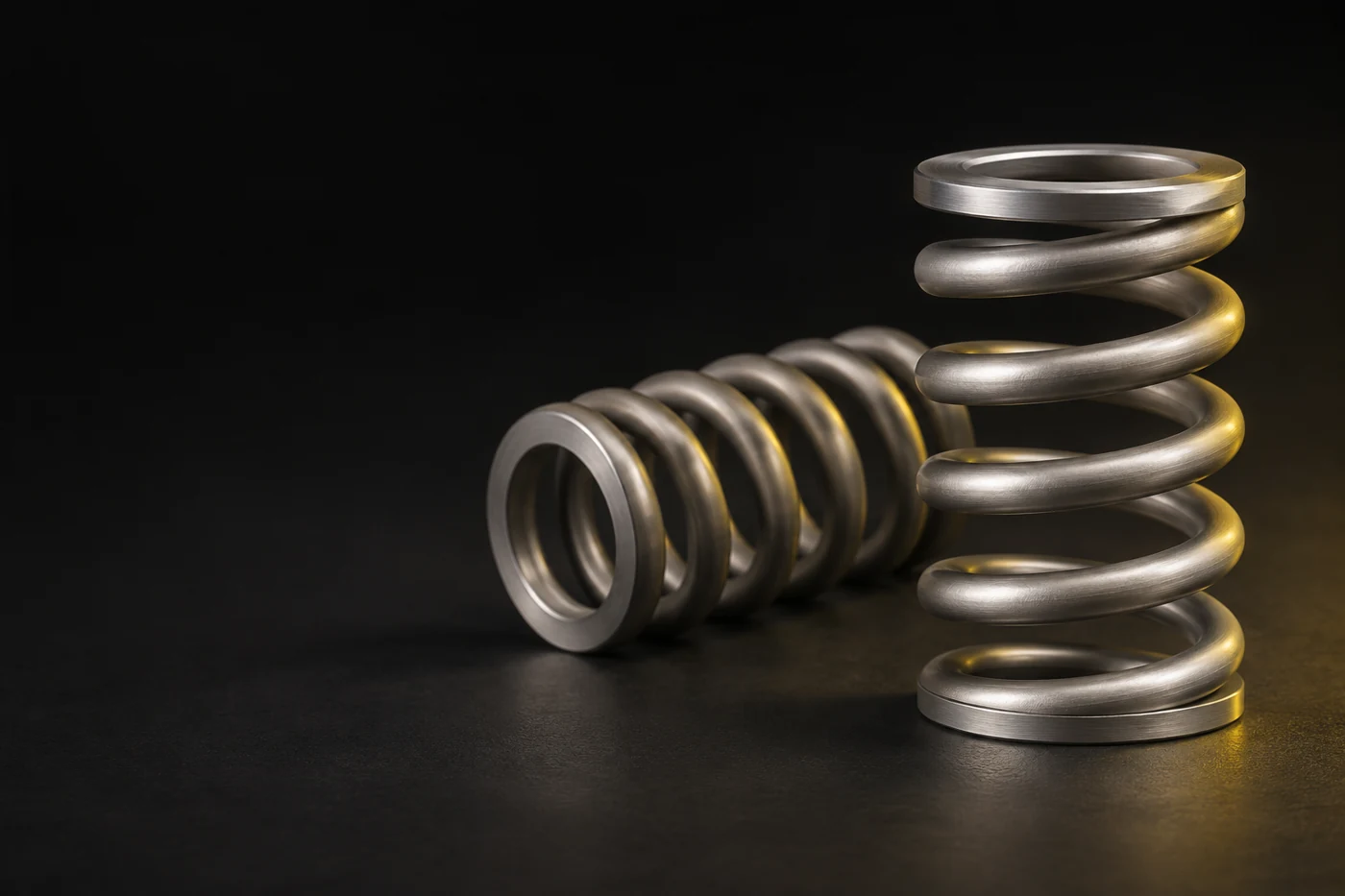
Illustration of titanium compression springs; the supplied geometry and performance are defined by the approved drawing.
Define coil dimensions, free length, end condition and the positions at which loads are accepted.
Order geometry schematic; not a dimensional drawing.
Define force at a position
The most useful spring requirement states what force or torque is needed at a defined position. For a compression spring, pair each load with the corresponding compressed length. For an extension spring, define the reference length and extension, including any initial-tension requirement. For a torsion spring, pair torque with an angle and show the leg orientation used as the reference. The unit and position are part of the requirement, not explanatory notes that can be omitted from the quotation.
Identify the installed range separately from the maximum movement that might occur during assembly or a fault. A spring that meets two normal operating points may still encounter an unintended limiting condition when the mechanism is assembled. Include the mating seats, guide rod or brackets so the review addresses how the spring is supported and loaded. If the component acts through a lever, make clear whether the stated force is measured at the spring or elsewhere in the mechanism.
Keep the load tolerances and dimensional tolerances consistent with the design objective. When several requirements conflict, ask for a technical clarification rather than allowing a supplier to choose which one to satisfy. The approved drawing should show the agreed priority and acceptance method.
Understand what spring rate describes
Spring rate is a relationship between a change in load and a change in displacement over a specified interval. For a linear compression-spring region, k = ΔF / Δx, with units such as N/mm. A rate value does not by itself define the force at every installed length unless the reference position and applicable behavior are also known. Extension springs with initial tension and torsion springs require their own appropriate definitions.
Spring Manufacturers Institute guidance distinguishes the useful linear region from behavior near the beginning of compression and near solid height. This is why a test method should identify the points used rather than simply request a rate measurement. If the design has a progressive response, specify the required loads or a defined curve across the working interval. Do not force a nonlinear response into one average value and assume that intermediate behavior is acceptable.
For quotation comparison, ask the supplier to state how the rate will be measured and what fixture and preconditioning apply. Record the same method for receiving inspection. A disagreement can arise from different measurement intervals even when both parties are testing the same spring correctly according to their own assumptions.
Use the geometry equation within its limits
For a conventional close-coiled helical compression spring made from round wire, the familiar idealized relation is k = Gd⁴ / (8D³Nₐ). Here G is the shear modulus, d the wire diameter, D the mean coil diameter and Nₐ the number of active coils. The relation helps explain sensitivity: wire diameter enters to the fourth power, mean diameter to the third power in the denominator, and the number of active coils affects the rate. It is a design model, not a production acceptance certificate.
Do not confuse mean coil diameter with outside diameter or total coils with active coils. The end construction affects which coils contribute to the working behavior. Material modulus must correspond to the selected alloy and condition; Young’s modulus and shear modulus are different quantities. A value copied from an unrelated titanium grade can therefore produce a misleading prediction even when the arithmetic is correct.
Use the model to identify questions for the spring designer, then verify the finished component with the agreed tests. Unusual helix angles, contact, end effects, nonuniform geometry and installation constraints may require a more complete analysis. The purchasing specification should preserve the resulting functional requirements rather than promote a simplified calculation into an unrestricted guarantee.
Evaluate titanium as a redesign choice
A steel-to-titanium change should be reviewed as a spring design change. Lower material density can be useful, but final mass depends on the geometry needed to achieve the required force, travel and life. A same-size replacement does not necessarily have the same spring rate. Compare the proposed finished spring at the same functional duty and installed envelope, including any changes to guides, seats or attachments.
ATI identifies Beta C as a metastable beta alloy and distinguishes its solution-treated and aged conditions. Its data sheet lists coil springs among the applications and labels the reported properties as typical rather than guaranteed design limits. That distinction is important when selecting material: a typical property can help screen a concept, while the order needs the approved material specification, condition and finished-spring acceptance.
If a quotation offers a different alloy, ask for the effect on the load-position requirements, processing, qualification and delivery. Do not treat a familiar grade number as proof of equivalence. A substitution needs review against the mechanism’s actual performance requirements, not only a comparison of nominal tensile strength.
Separate wire condition from final spring condition
The state in which wire is supplied may differ from the state of the finished spring. AMS 4957 is a material specification for the identified titanium alloy in bar and wire form; it is not a complete finished-spring qualification. The order should establish the approved starting material and the required final treatment, together with any processing records that must accompany the batch. Avoid leaving the final condition implied by the material trade name.
Discuss forming, heat treatment and surface operations as a controlled sequence. A later operation can change dimensions, surface state or mechanical behavior, so functional acceptance should occur at the stage specified by the drawing. If a sample is tested before the final process and production is tested afterward, the results may not represent the same delivered condition. Keep that distinction visible in the approval plan.
Where the project restricts particular processes, identify the reason and the required evidence. Do not add a generic treatment merely because it appears in another supplier’s spring catalogue. The actual alloy, geometry and duty should guide the qualified route, and deviations should be approved before production rather than discovered in the final records.
Check the installed envelope and limiting positions
A compression spring needs a usable operating range, not just an acceptable free length. Identify the shortest working length, the solid height and the design clearance between them. Show the surrounding bore or guide rod and the end seats. Review whether lateral movement, buckling or rubbing could occur in the actual arrangement. The spring manufacturer should not have to infer the installation from an isolated coil drawing.
For extension springs, review the hook or loop against the mating pin and the full movement path. The end feature can govern local behavior even when the coil body appears suitable. For torsion springs, include leg interference, support clearance and the direction in which the spring is loaded. A correct free angle does not guarantee clearance throughout rotation.
Distinguish normal travel from assembly travel and transport restraints. If the spring must be compressed or extended beyond its operating position to install it, that event belongs in the design review. Record the approved installation method and any fixture requirements so a new batch is not damaged before it enters service.
Define fatigue and relaxation separately
Fatigue qualification concerns repeated loading under a defined cycle. Specify the minimum and maximum load or position, number of cycles, frequency, temperature, environment and failure criterion. A statement such as tested for many cycles is not comparable unless those conditions are known. Decide whether failure means fracture, visible cracking, a specified load change or another event relevant to the mechanism.
Relaxation and permanent set require different questions. A spring held at a position for a defined time can lose force without fracturing. A spring can also change its unloaded geometry after a specified loading history. State the hold condition, duration, temperature and measurement sequence when those effects matter. A room-temperature dimensional check cannot replace a high-temperature dwell evaluation.
Keep qualification samples connected to the production route. If the wire condition, heat treatment, geometry or surface process changes, determine whether the existing qualification still covers the supplied spring. Do not advertise a life number from another spring as a guarantee for a new design. The relevant evidence is the approved test scope and its relationship to the delivered configuration.
Control the surface and contact locations
Surface condition matters when a spring repeatedly flexes or contacts adjacent parts. The drawing should distinguish appearance from functional surface requirements, including permitted defects, treatment and final cleanliness where specified. Review coil-to-coil contact, end-seat contact and any rubbing against a guide. A polished appearance alone does not demonstrate the absence of a relevant surface discontinuity or establish fatigue performance.
If shot peening, chemical treatment or another operation is required, identify the governing process specification and the evidence needed. The order should say whether functional measurements occur before or after that operation. Avoid combining treatment names from unrelated designs into an unsupported universal recipe. The qualified spring route must account for the selected alloy and the final dimensions and surface state.
Packaging can preserve or damage that state. Specify separation and protection appropriate to the parts, especially where hooks can tangle or coils can rub during shipment. Keep labels tied to material and production lots. Small cosmetic damage may be irrelevant in one application and unacceptable in another; receiving inspection needs a defined criterion to make that distinction consistently.
Make load testing reproducible
Agree the test fixture and alignment before comparing results. For compression springs, the bearing surfaces and installed orientation affect how the spring sits during measurement. For extension or torsion forms, the attachment geometry and reference positions need equally clear definition. Record the applicable test speed, preconditioning and sequence when the specification requires them. Two numbers without the method can conceal different tests.
Identify which characteristics receive individual testing and which follow an agreed sampling plan. A first-article report should connect the measured dimensions, load points and material condition to the approved drawing revision. Production records should identify the batch and the acceptance method. Avoid replacing measured results with a repeated copy of the nominal drawing values.
When supplier and receiving results differ, compare the methods before changing the drawing. Check reference positions, fixtures, units and the condition of the spring after earlier testing. Retain the affected samples and records so the discrepancy can be reproduced. This approach is more informative than adjusting acceptance limits simply to make an unexplained difference disappear.
Compare the evidence by purpose
Evidence comparison; no universal load, fatigue life or dimensional capability is claimed.
Question
Appropriate evidence
Boundary
Is the material correctly identified?
Material certificate and lot traceability
Does not establish spring load or life
Does the spring fit?
Dimensions against the controlled drawing
Does not prove functional load acceptance
Does it provide the required force?
Load at defined length or torque at angle
Applies to the stated test condition
Does it survive the duty?
Approved cycle or dwell qualification
Applies to the tested configuration and conditions
Use this separation when reviewing a supplier dossier. A complete material record is valuable, but it cannot answer a missing load test. A successful room-temperature load check does not answer a long-duration temperature requirement. Ask which requirement each document supports and which requirements remain open. The result should be a coherent acceptance package rather than a large collection of unrelated certificates.
A practical quotation comparison lists material, final condition, geometry, functional checks, qualification, samples, documentation and packaging as separate items. Identify tooling or development charges and the conditions for repeat orders. Confirm whether a proposed alternative changes only the commercial route or also changes the technical definition. Approve any technical change through the drawing and test requirements before releasing production.
Prepare the enquiry and receiving plan
Send the drawing revision, required quantity and destination with the force-position requirements and duty description. Include any retained sample as supporting evidence, clearly identifying whether it is unused, worn or failed. A sample should not silently override the approved dimensions or material condition. Where the original design is incomplete, agree a development stage with explicit acceptance criteria.
For a repeat order, preserve the approved material route, final treatment, surface state and test method. Record any allowed supplier alternatives and the evidence required for them. At receipt, reconcile package identity, drawing revision, material records and functional results before the springs are mixed into production inventory. Keep different grades or revisions separated even when their appearance is similar.
TiHubs can review drawing-led titanium spring enquiries through its Baoji supplier network. Provide the functional requirements and identify unresolved points so the proposed supply route can be assessed. The quotation should confirm the actual configuration, inspection scope, development needs and delivery terms. A defined specification gives both the sourcing team and the buyer a clear basis for deciding whether the offered spring meets the application.
Verify the finished spring
Material records and dimensional checks support, but do not replace, functional acceptance.
Illustrative spring acceptance map; no measured load or fatigue results are shown.
Order documentationTiHubs
Traceable from heat to shipment.
Material identificationGrade + specification
Batch identificationHeat / lot reference
Inspection scopeAgreed tests & results
Shipment identificationMarks + packing list
Illustrative document checklist. Not a certificate or test report.
01Material state
Connect alloy, product specification and final condition.
Material records02Geometry
Measure the drawing features and end construction.
Dimensional fit03Load points
Record force or torque at the stated positions.
Functional acceptance04Duty evidence
Use the agreed cycle or dwell conditions.
Qualification scope05Surface
Check the final treatment and contact features.
Delivered condition06Lot identity
Keep the tested configuration connected to shipment.
Traceable delivery
Keep material and spring evidence distinct
Use material references within their scope and define finished-spring tests separately.
Library PDFs may be earlier editions. Check the document cover and your contractual revision. A reference file does not certify a supplied product.
TiHubs coordinates titanium sourcing through a local manufacturer network. Your specification guides the supplier review, technical discussion and delivery requirements.
Confirm grade, dimensions, state, quantity and the purpose of the stock.
Review the supply route
Discuss manufacturing, finishing, inspection and documentation with the relevant supplier.
Agree the commercial scope
Confirm the quotation, lead time, acceptance requirements and delivery terms.
Coordinate inspection & delivery
Follow the agreed checks, marking, packing and shipment documentation.
Before you order
Tie material, dimensions and processing to the force or torque the installed mechanism actually requires.
TITANIUM SPRINGS · BAOJI SOURCING
Send your specification.
Specify the required force, movement and installed envelope before choosing a titanium spring. Drawing-led sourcing connects alloy condition and manufacture to measurable finished-spring acceptance.
You do not need to finalize every detail before contacting us.
TiHubs
Talk to TiHubs
Ask about titanium materials, grades or custom parts.
Enter your email to start chatting.
We use your email to respond to your enquiry. Your conversation is stored on this website.
Our team is away right now. Leave your enquiry and we will follow up by email.