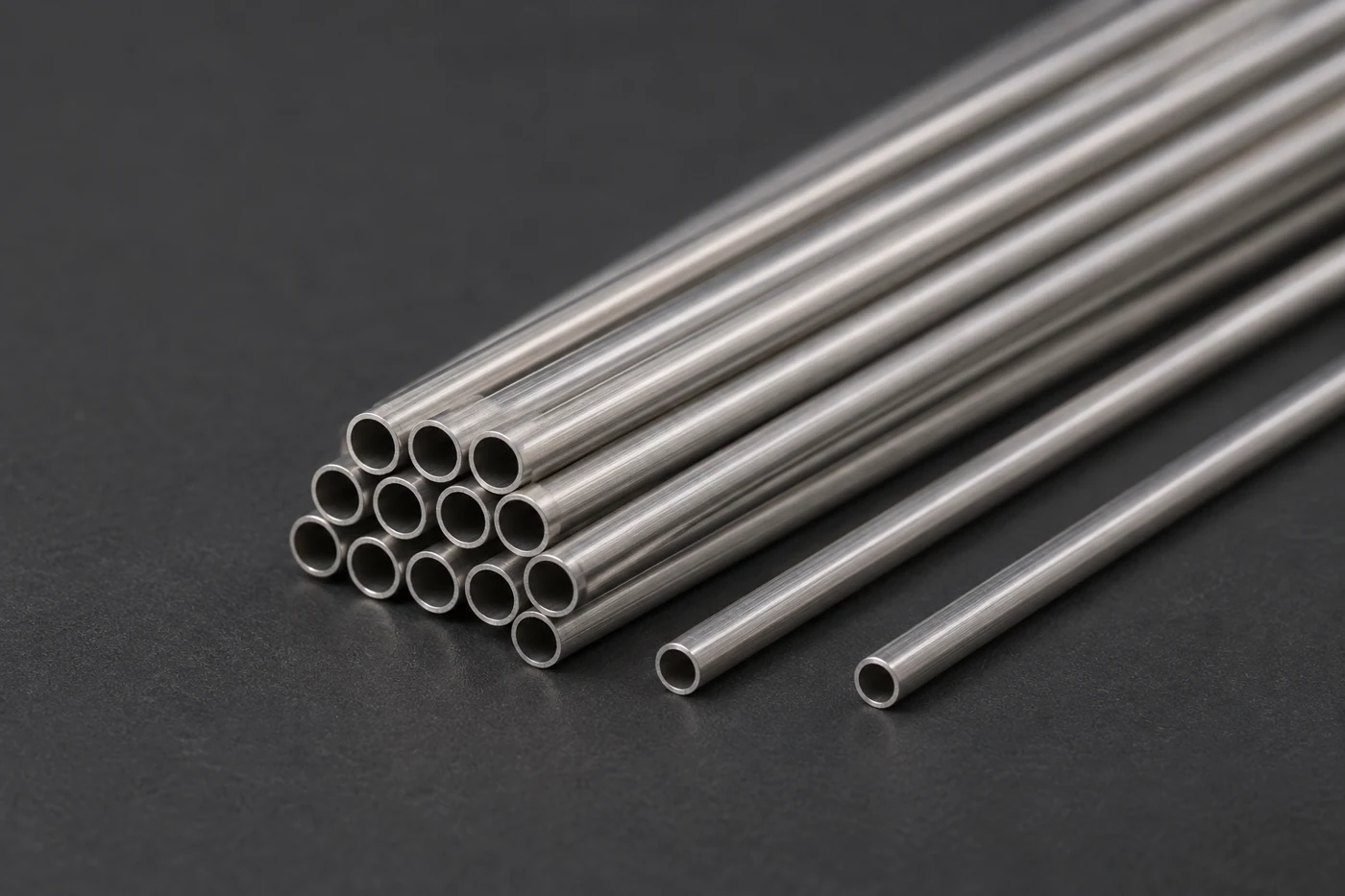
Small-bore titanium tubing for drawing-defined fluid paths and precision components. Specify the bore, wall, length and delivered condition so the material and processing route can be reviewed.
20 years in titanium100+ Baoji factory connections
OD and ID review · Bore and end requirements · Traceable supply scope
Define the small-bore supply
Straight, coiled and cut tubing need different handling and acceptance details. Identify what must be true at delivery.
Straight lengths
Straight lengths
Specify outside diameter, inside diameter or wall thickness, length and the dimensions that control function. Identify straightness and end requirements where the tube must enter a fixture or connect to another component. The word capillary does not define a universal size range, tolerance or flow characteristic. Supply feasibility is reviewed against the complete drawing and quantity.
OD, ID and wall relationship
Length and straightness basis
Grade, route and delivered condition
Specify the bore and the wall together
Identify controlling dimensions and their acceptance basis. A nominal OD alone does not define an internal fluid path.
Order item
Include in your enquiry
Why it matters
Material
Grade, product specification, edition and condition
Confirm applicability to the offered tube
Section
OD, ID and wall-thickness basis
Identify controlling dimensions and limits
Bore geometry
ID variation, ovality and wall eccentricity as required
Agree the measured features and locations
Length and form
Straight lengths, cut pieces or coil geometry
Define usable length and accepted quantity
Ends
Squareness, burrs and any preparation
State whether the bore must remain protected
Cleanliness
Defined internal and external condition
Agree method, acceptance and preservation
Inspection
Dimensions, bore passage and specified tests
State coverage, sample and criteria
Delivery
Traceability, separators, end protection and destination
Confirm packaging and quoted timing
Your starting specification.
Grade and condition; OD, ID and wall basis; tolerances and length; straight or coiled form; bore and end requirements; cleanliness; intended medium and temperature; quantity; inspection, traceability and destination.
Supply is assessed from the drawing, grade, dimensions, route, condition and quantity. Illustrations do not establish minimum bore, tolerance, stock availability, pressure rating, sterility or device certification.
Connect grade to the tube requirement
These are enquiry routes, subject to drawing and supplier review. No extreme size range, stock position or application qualification is implied.
Chinese designations and international names are reference routes, not automatic substitutes. Grade, product specification, condition and acceptance requirements must be agreed together.
The tube may guide a fluid, connect an instrument or become a component. The acceptance requirement should match that task.
Small fluid paths
Identify the fluid, concentration where relevant, temperature and intended duty before selecting the material. Where flow matters, define the test conditions rather than asking for a generic capillary performance guarantee. Small changes in the internal passage can matter to function, but a flow result does not uniquely prove bore geometry. Separate material compatibility, dimensional acceptance and system validation.
What to sendMedium, temperature, bore, usable length and functional requirement.
Instrument and sampling connections
Provide mating interfaces, joining method, allowable dead volume where relevant and any surface or cleanliness restrictions. State whether the delivered tube is raw material or a prepared segment. If a connector, weld or seal is part of the assembly, define its scope separately. An open bore at receipt does not qualify the complete installed sampling system.
What to sendInterface drawing, joining sequence, cleanliness and inspection scope.
Precision tube components
For a tube that will be cut, formed or incorporated into a device, send the final drawing and identify critical features. Later processing may alter shape or cleanliness, so specify where acceptance occurs. A material grade or supplier catalogue does not qualify a finished medical or other regulated device. For broader sizes and routes, see titanium tube and pipe.
What to sendFinal geometry, process responsibility, quantity and required records.
Control the route into the finished bore
Manufacturing, sizing, cutting and cleaning can affect different features. Agree the sequence and the delivered condition.
AI illustration of a coiled tube; actual coil dimensions and allowable forming are project-specific.
For an ideal concentric round tube: wall = (OD − ID) / 2. Local wall, ovality and eccentricity require their own defined assessment.
Order geometry schematic; not a dimensional drawing.
Choose a route that matches the specification
State whether seamless construction is required and identify the product standard and condition. If an alternative route is proposed, review it explicitly rather than treating the word capillary as a manufacturing method. Superior Tube’s product overview confirms that small-diameter titanium tubing is a distinct manufactured product class; its size capabilities are not TiHubs supply limits. For the general route, see seamless titanium tube.
Resolve the dimensional relationship
For an ideal concentric round section, nominal wall thickness is (OD − ID)/2. This relationship does not prove local minimum wall, roundness or concentricity. If all three dimensions are specified with independent limits, check that the permitted combinations are coherent and manufacturable. Identify the controlling dimension and any minimum-wall requirement. Use the tube wall-tolerance guide for the broader acceptance distinction.
Define bore and end preparation
A clean-looking outside surface does not establish internal cleanliness. Agree the required condition, how it is assessed, and whether cutting or later handling can introduce particles or residues. Specify end condition separately: burr control, cut squareness and protection affect the next operation. If a functional passage test is required, define the medium, conditions and acceptance basis; do not confuse passage with proof of pressure integrity.
Preserve the condition through delivery
Specify how straight lengths are supported and how coils are restrained without damage. Agree suitable end protection and packaging for the required cleanliness level, plus identification that survives unpacking and cutting. Separate one-time sample or qualification work from repeat production inspection. A sealed package is not automatically sterile, and a protective cap is not a pressure seal. Keep the claim aligned with the actual supply scope.
Verify what the application needs
A material certificate, dimensional report and functional test answer different questions. Specify coverage and acceptance before production.
AI macro illustration of tube ends; it is not proof of bore tolerance, cleanliness or inspection results.
Order documentationTiHubs
Traceable from heat to shipment.
Material identificationGrade + specification
Batch identificationHeat / lot reference
Inspection scopeAgreed tests & results
Shipment identificationMarks + packing list
Illustrative document checklist. Not a certificate or test report.
01Material identity
Link the specified grade, condition and tube route to the delivered lot.
Certificate scope02OD and ID
Measure agreed dimensions with a suitable method and sampling basis.
Dimensional record03Wall and shape
Define local wall, eccentricity, ovality and straightness where required.
Drawing acceptance04Bore and ends
Assess passage, burrs and specified internal condition separately.
Functional features05Additional tests
Agree any leak, pressure or other test conditions and acceptance.
Project-specific evidence06Packing and identity
Maintain the agreed condition and traceability through delivery.
Lot release
Choose a standard for the actual application
ASTM B338 addresses titanium tubing for condensers, evaporators and heat exchangers. It is not a universal capillary-tube approval. Confirm the applicable product specification, edition, dimensional scope and additional requirements for the intended use.
Library PDFs may be earlier editions. Check the document cover and your contractual revision. A reference file does not certify a supplied product.
TiHubs coordinates titanium sourcing through a local manufacturer network. Your specification guides the supplier review, technical discussion and delivery requirements.
Confirm grade, dimensions, state, quantity and the purpose of the stock.
Review the supply route
Discuss manufacturing, finishing, inspection and documentation with the relevant supplier.
Agree the commercial scope
Confirm the quotation, lead time, acceptance requirements and delivery terms.
Coordinate inspection & delivery
Follow the agreed checks, marking, packing and shipment documentation.
Before you order
Clarify the internal passage and delivered condition before comparing offers.
TITANIUM CAPILLARY TUBE · BAOJI SOURCING
Send your specification.
Small-bore titanium tubing for drawing-defined fluid paths and precision components. Specify the bore, wall, length and delivered condition so the material and processing route can be reviewed.
You do not need to finalize every detail before contacting us.
TiHubs
Talk to TiHubs
Ask about titanium materials, grades or custom parts.
Enter your email to start chatting.
We use your email to respond to your enquiry. Your conversation is stored on this website.
Our team is away right now. Leave your enquiry and we will follow up by email.