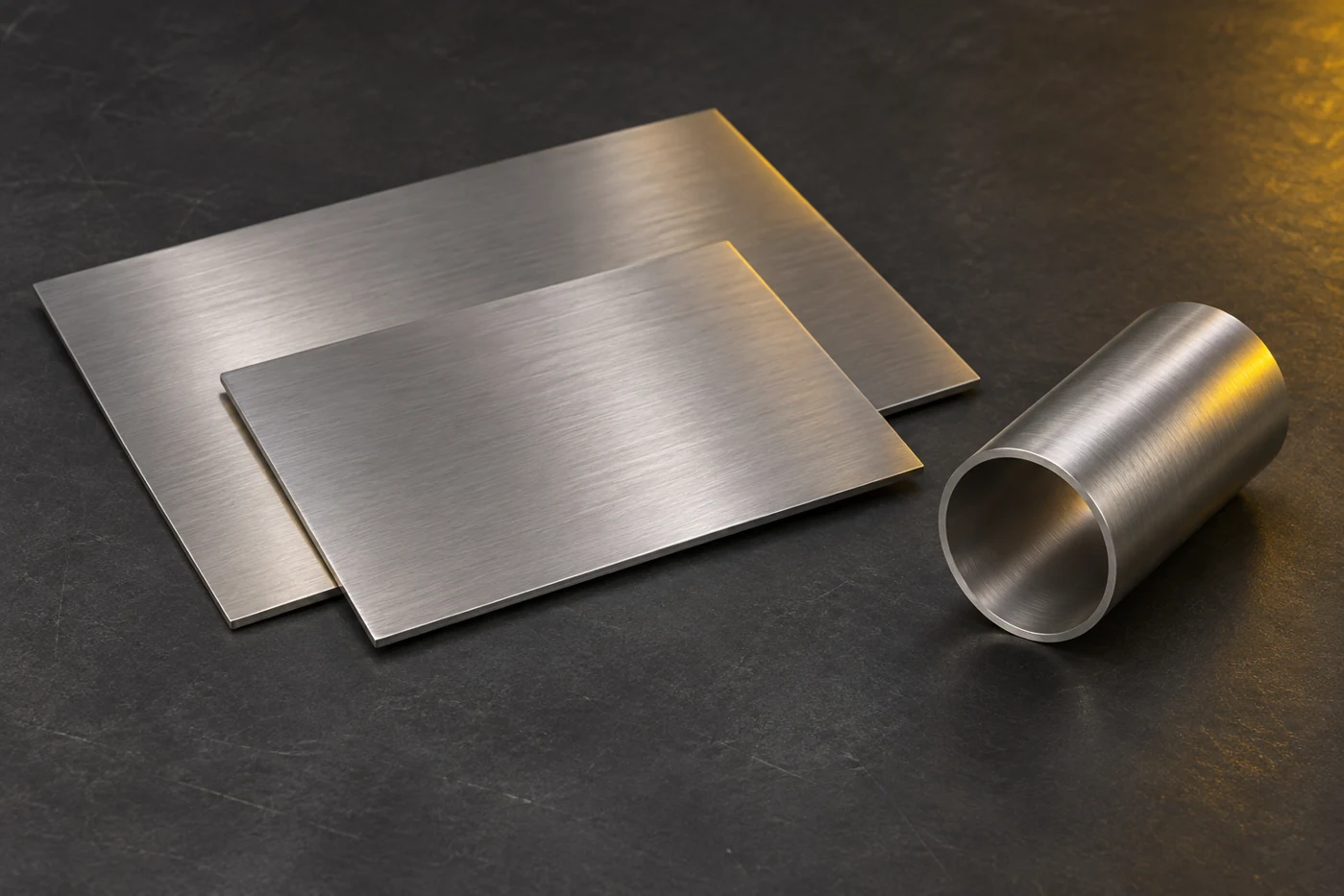
AI illustration; not a production or inspection record.
Quick answer
Titanium does not form red iron rust, but it does oxidize and can corrode under unsuitable conditions. Its protective oxide film is part of its normal corrosion resistance. Brown marks on titanium can come from transferred contamination or deposits; colour alone does not establish the cause. Investigate the surface, exposure history and material identity before cleaning, rejecting or releasing the product.
01 / Rust and oxidation
Titanium oxidizes. That is not the same as red rust.
Titanium does not form the familiar red-brown iron rust associated with ordinary carbon steel. It does react with oxygen, developing a thin protective oxide film. Consequently, “titanium does not rust” is a useful short answer only when rust means iron corrosion products. It is not a promise that every titanium component will remain unchanged in every environment.
The distinction matters when a buyer sees a brown mark on a new sheet or a maintenance team finds discoloration on a tube. The visible material could be a deposit, transferred iron contamination, an altered oxide film or a sign associated with actual attack. A photograph alone usually cannot distinguish all these possibilities. Start by describing the observation before naming its cause.
What the protective film explains
Kobe Steel’s titanium technical information describes passivity as central to titanium’s corrosion resistance. The practical implication is environmental dependence: a useful protective surface in one service condition does not establish suitability for another. A commercial statement about corrosion resistance should therefore identify the material and the environment to which it applies.
An oxide film is not the same thing as paint, plating or a thick sacrificial coating. Do not ask a supplier to remove every trace of oxygen from an ordinary titanium surface as a condition of delivery. Instead, specify the surface condition needed for the next manufacturing operation or the intended service. A weld preparation, an architectural face and a precision sealing surface can require different acceptance criteria.
Use the right vocabulary on the inspection record
“Brown stain adjacent to the steel strap” is an observation. “Titanium corrosion caused by defective material” is a conclusion that requires supporting evidence. Recording the first accurately preserves the investigation. Writing the second prematurely can send the buyer and supplier toward an unnecessary grade dispute while the actual source remains packaging, handling or an adjoining component.
Equally, the absence of red rust is not proof of an intact component. A serviceability assessment may concern wall loss, local pits, cracking or changes that are not obvious in a general photograph. For pressure equipment or other critical hardware, appearance cannot replace the inspection and acceptance requirements established by the responsible technical authority.
Separate three purchasing questions
First, was the correct grade, product form and condition delivered? Second, does the surface meet the agreed delivery requirement? Third, is that material suitable for the actual service? A satisfactory material certificate can help answer the first without resolving the other two. A clean-looking surface can answer neither grade identity nor compatibility by itself.
This article focuses on investigating rust-like marks and defining an actionable enquiry. For broader choices between titanium and stainless steel in marine service, use the separate seawater material comparison. Keeping the tasks separate prevents a general corrosion ranking from being mistaken for a diagnosis of one particular stained item.
02 / Read the surface
Classify the mark before choosing a remedy
Inspect the location, distribution and relationship of the mark to the surrounding hardware. Is it beneath a strap, beside a weld, inside a stagnant pocket, along a scratch or spread across every exposed face? The pattern can direct the investigation, although it does not establish the mechanism on its own. Photograph the full component and then the local area, including a scale and an item identifier.
Investigation framework; appearance is not a laboratory identification
Observation
Possible explanation to investigate
Useful next evidence
Red-brown particles or streaks
Transferred iron-containing material or corrosion products from nearby steel
Handling history, neighbouring components and deposit identification where needed
Straw, blue or purple colour near heating
A thermally altered surface oxide
Process history and the applicable weld or surface acceptance criteria
Chalky or crusted deposits
Dried process material, salts or cleaning residues
Fluid chemistry, cleaning records and controlled examination beneath the deposit
Local cavity or measurable thinning
Material loss requiring investigation
Mapped dimensions, exposure conditions and an appropriate technical examination
Repeated marks at contact points
Packaging, fixtures, crevices or dissimilar-material contact
Contact geometry and a comparison with unaffected locations
The table is a decision aid, not a colour chart for accepting titanium. Several mechanisms can occur together. A removable deposit may cover an attacked surface, while a conspicuous colour change may occur without the particular loss of section someone assumed. Record what remains after any approved cleaning rather than treating removal of the visible mark as automatic closure.
New material and used equipment require different histories
For incoming stock, establish when the package was opened, whether it became wet, how it was stored and which tools touched the material. Check whether the mark appears on the outer pieces only or continues through the bundle. An intact inner piece can provide a useful comparison, but it does not automatically establish the condition of every affected item.
For equipment already in service, collect the operating and shutdown history. A tube exposed to a nominally benign process during normal production may encounter a different cleaning solution, concentrated residue or stagnant condition during an outage. The description “used in water” is insufficient if the actual exposure includes chemicals, elevated temperature and periods of evaporation.
Do not turn a photograph into a certificate
Lighting, camera processing and viewing angle can change the apparent colour of a reflective metal. Include close and wider views, but avoid aggressive image adjustments that erase texture or exaggerate contrast. If a dimensional defect is suspected, a photograph with a ruler is still not a substitute for a suitable measurement of the defect itself.
A supplier can use this record to propose the next check and review the delivered scope. They should not be expected to certify an unknown deposit, declare an in-service component safe or identify a corrosion mechanism solely from an image. Good initial evidence makes that limitation productive: it tells everyone which question remains unanswered and who should resolve it.
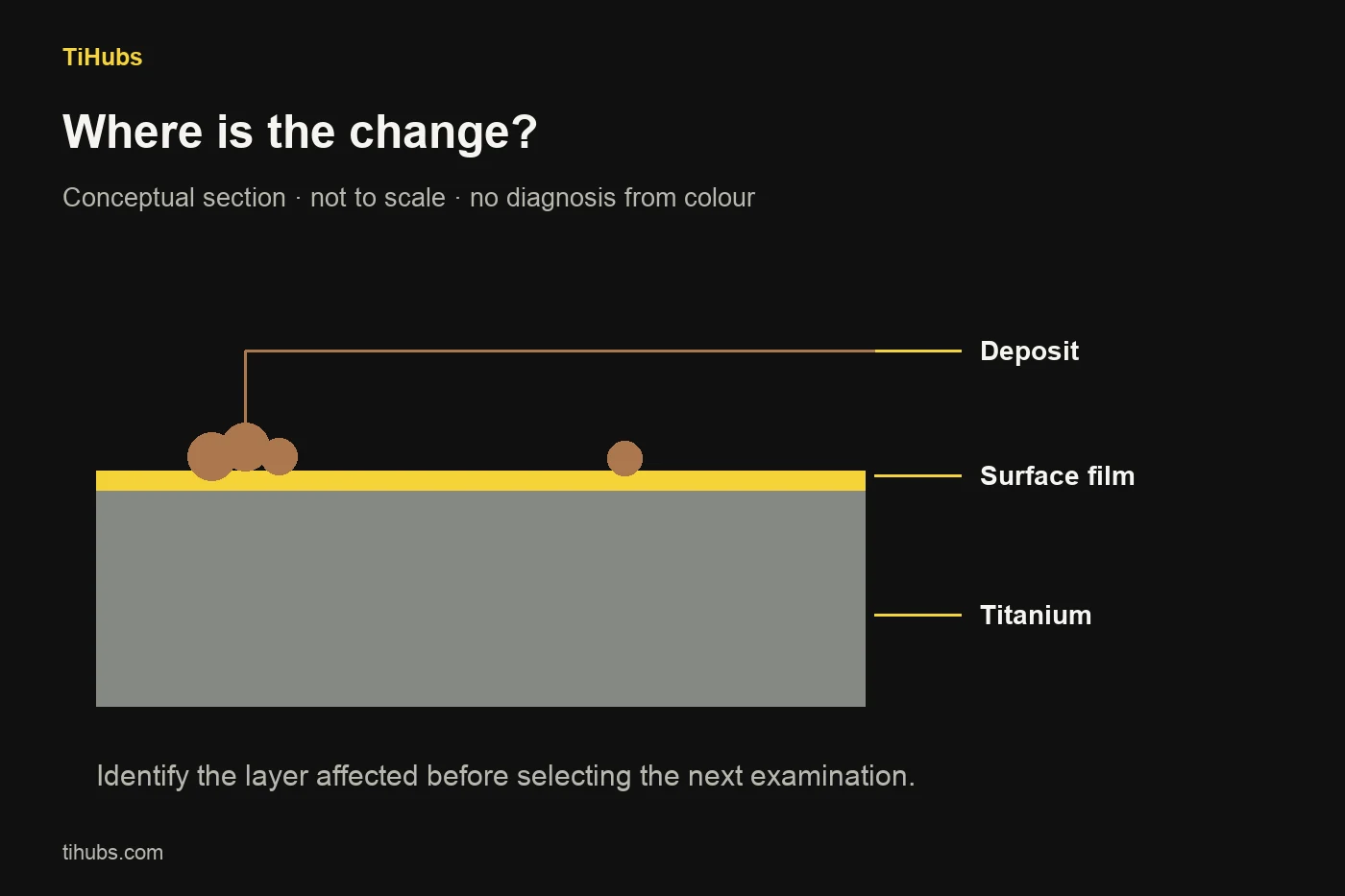
Industrial buying guide / 02A mark has a location.
Identify whether the concern is a deposit, the surface film or the underlying material. This schematic is not a diagnosis.
03 / Service conditions
Corrosion resistance belongs to a defined environment
The phrase “corrosion resistant” leaves out the conditions that make the statement meaningful. Collect the chemical composition, concentration, temperature range, exposure time and physical configuration. Include contaminants and credible upset conditions. Where the process owner does not yet know these details, record the uncertainty instead of substituting a generic statement such as “chemical service.”
TIMET’s corrosion handbook documents substantial differences between environments, including limits associated with reducing media, fluoride-containing conditions and localized attack. Its data are useful for screening questions, not for promising a universal corrosion rate for an unspecified titanium order. The alloy, conditions and source context must remain attached to any technical value used in a selection.
Normal operation is only part of the exposure
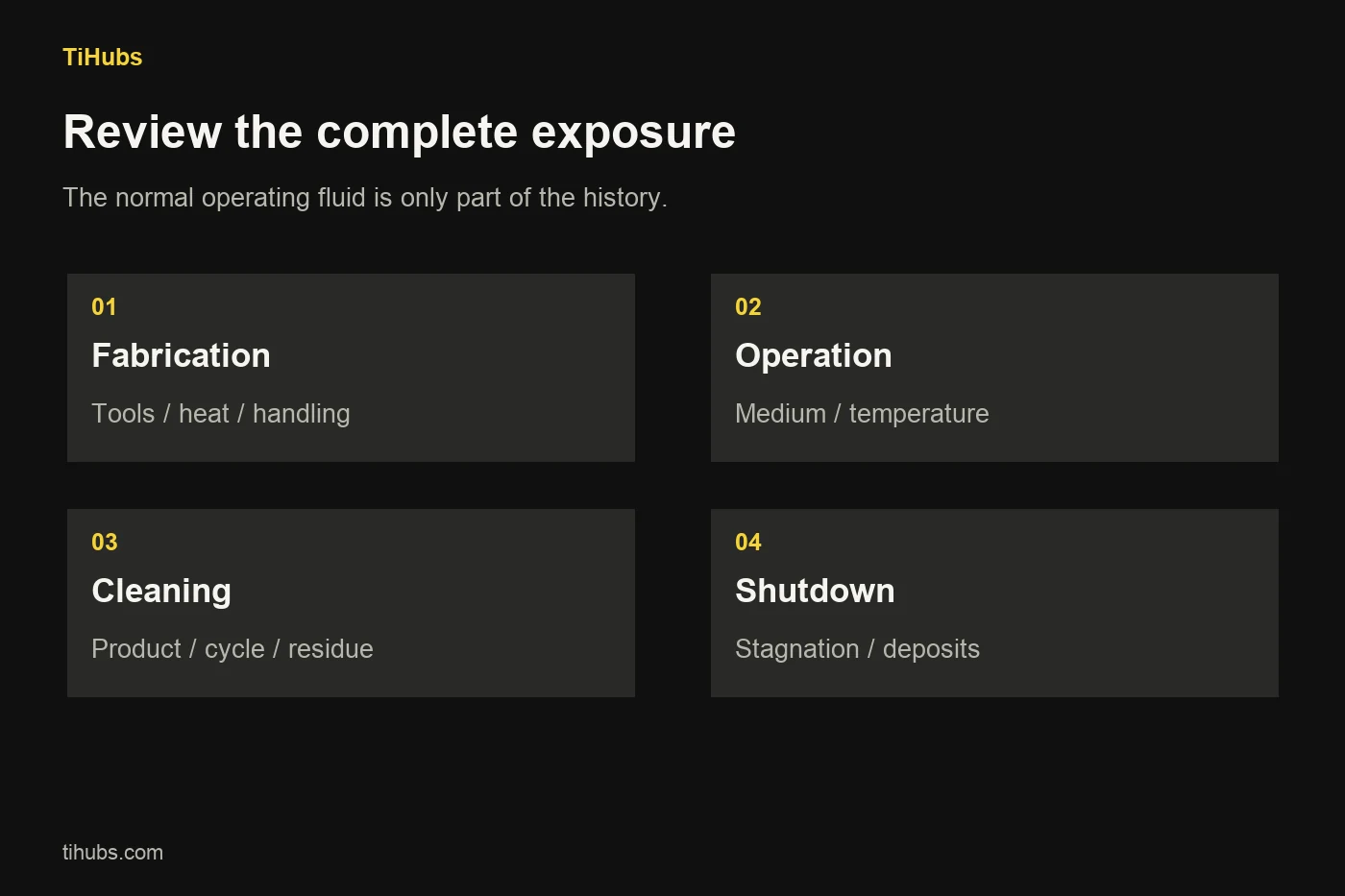
Build a simple exposure sequence: fabrication, storage, installation, commissioning, routine operation, cleaning, shutdown and restart. A surface can encounter a different medium at each stage. Ask which stage first preceded the appearance of the mark. If cleaning occurred immediately before the complaint, obtain the actual product and process record rather than assuming that a cleaner suitable for steel was also suitable for titanium.
Temperature should describe the metal’s relevant exposure, not merely the room temperature or the nominal inlet reading. A local heated surface or an evaporating pocket may need separate assessment. Likewise, distinguish a measured concentration from an approximate recipe and identify whether the reported value concerns fresh solution or accumulated process liquor.
Geometry can change the local question
A flat coupon immersed freely in a liquid does not reproduce every gasketed joint, shielded contact or deposit-covered area. Identify tight gaps, stagnant pockets and locations that are difficult to flush. The procurement implication is to describe the component configuration alongside the medium. A material selection based only on the fluid name may overlook the feature at which the actual problem appears.
For dissimilar-metal assemblies, list the adjoining materials and how they contact the process. A titanium component can remain visually sound while another member of the assembly suffers. Electrical contact, the electrolyte and exposed areas are relevant to a galvanic assessment; the presence of two different metals alone does not quantify the outcome. Escalate the complete arrangement to the responsible corrosion or design specialist.
A stronger grade is not automatically the answer
Changing from one titanium grade to another should address a defined requirement. A tensile-strength advantage does not by itself prove improved resistance in the troublesome medium. Conversely, a grade selected for a corrosion problem still needs to meet forming, welding, dimensional and mechanical requirements. Ask for the basis of the proposed substitution and whether the product form is available in the required condition.
When published information does not represent the service, a project-specific test or specialist assessment may be necessary. Define what such a test is intended to establish and how its specimens relate to production. A favourable result in one short exposure should not silently become a lifetime guarantee for every operating and cleaning condition.
Industrial buying guide / 03Review the complete exposure.
Normal operation does not describe every condition encountered by a component.
04 / Handling and cleaning
Preserve evidence before altering the surface
When a stain is found, the first response should preserve both the material and the information needed to understand it. Identify and separate the affected pieces, retain the packaging where relevant, and record their original condition. Agree who can authorize cleaning or rework. This is especially important when surface finish, thickness or a subsequent fabrication operation is controlled by the order.
Avoid introducing a second problem
Shared work surfaces, dirty supports and unsuitable tools can move contamination between materials. TWI’s titanium welding guidance emphasizes cleanliness and avoiding iron contamination during fabrication. For purchasing, translate that principle into agreed handling and preparation requirements rather than assuming that a final visual wipe can compensate for an uncontrolled process.
Do not use an improvised acid treatment, an unidentified rust remover or aggressive grinding as a diagnostic shortcut. Such actions can remove evidence, change dimensions or leave a surface unsuitable for the next operation. A treatment that makes a mark disappear has demonstrated a change in appearance; it has not necessarily established the original cause or the acceptability of the remaining material.
Use a controlled cleaning route
ASTM B600-22 is a guide addressing cleaning and descaling of titanium and titanium-alloy surfaces. Its public scope includes ordinary shop soils, oxides, scales and foreign surface contamination. Referencing that guide does not eliminate the need to agree which procedure, surface condition and acceptance checks apply to the particular product.
The purchase order should distinguish cleaning before fabrication from restoration of an affected finished component. The latter may require a rework disposition, additional inspection and confirmation that drawing requirements remain satisfied. A supplier’s normal production cleaning route is not automatically an approved repair procedure for equipment that has already entered service.
Inspect the result against the original requirement
After authorized treatment, document the process used, the treated locations and the resulting appearance. Recheck dimensions or other characteristics where the intervention could affect them. If the original concern was a pit or local thinning, obtain the relevant measurement after the deposit no longer obstructs inspection. If the concern was contamination before welding, use the specified preparation and acceptance requirements.
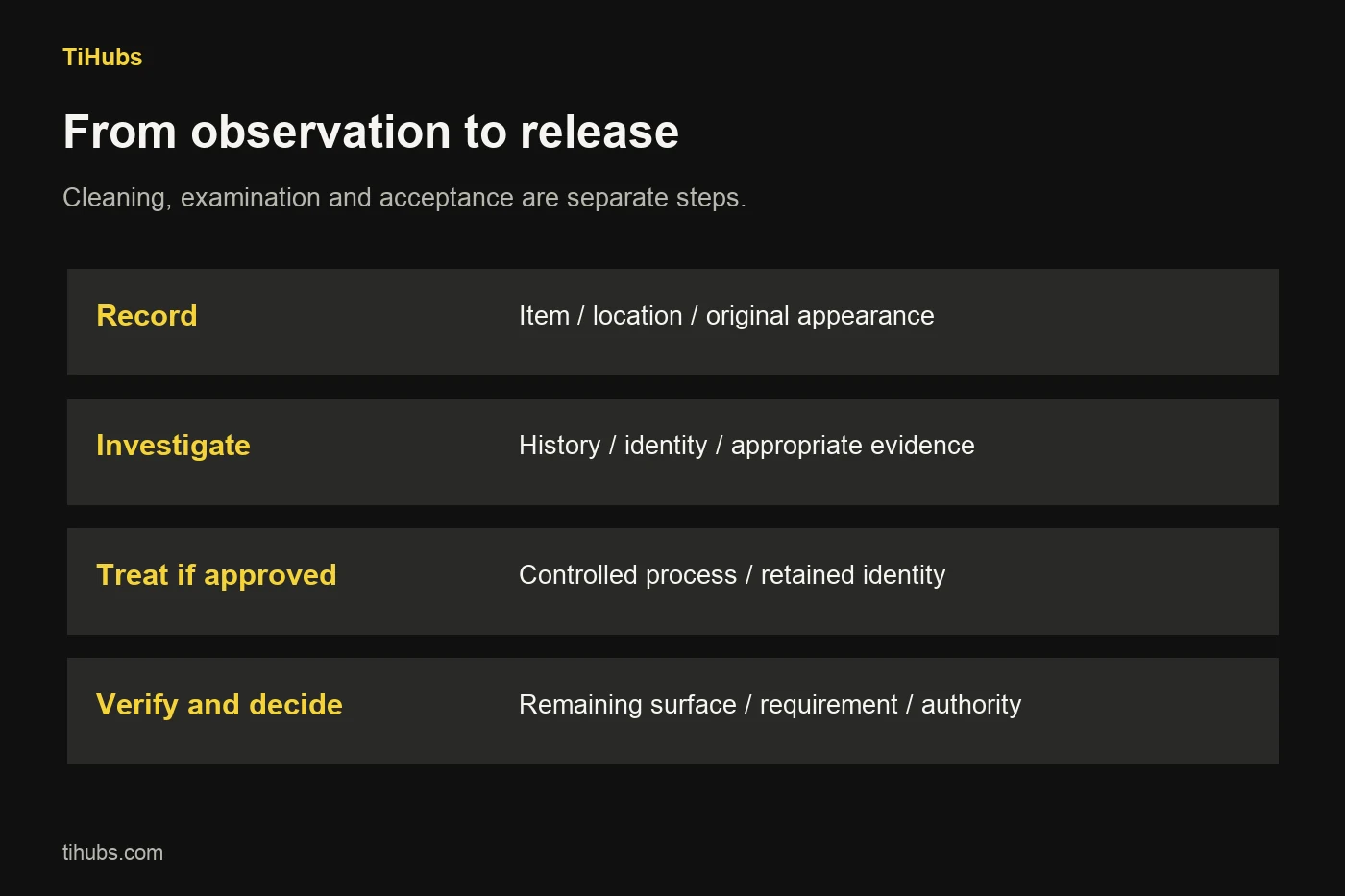
Retain a clear distinction between “cleaned,” “examined” and “accepted.” These words describe different stages. Cleaning is an operation; examination produces evidence; acceptance is a decision against a requirement. Combining all three into an informal statement such as “the rust is fixed” makes it difficult to determine what was actually done and whether anyone approved release.
For future deliveries, agree practical prevention measures that respond to the identified source: suitable separation from steel accessories, clean supports, protection of finished faces and traceable packaging. Avoid adding elaborate requirements without a reason. The most useful control is the one that addresses the demonstrated transfer or exposure route and can be checked consistently by both parties.
Industrial buying guide / 04Cleaning is one step.
Preserve the original observation and verify the remaining surface before an authorized release.
05 / Purchase requirements
Specify a surface you can actually inspect
A good titanium order describes more than the absence of rust. Start with the product form, grade, applicable specification and edition, dimensions, condition and quantity. Then define the surface requirement in terms that the supplier can quote and the receiving team can evaluate. If appearance matters, identify the relevant faces and the agreed viewing or inspection conditions.
Examples of information to agree; these are not universal acceptance limits
Order element
Information to provide
Why it matters
Material identity
Grade, product specification, edition and delivered condition
Connects the physical item to the required material
Surface scope
Relevant faces, finish and cleanliness requirement
Separates cosmetic needs from fabrication or service needs
Service exposure
Media, temperatures, cleaning cycle and assembly contacts
Supports a meaningful compatibility review
Inspection
Method, locations, acceptance criteria and records
Prevents appearance judgments from replacing agreed evidence
Disposition
Hold, rework approval and release responsibility
Controls what happens when an unexpected mark is found
Make the requirement specific to the next operation
For sheet intended for forming, protect the specified faces and identify whether surface defects could remain visible after manufacture. For tube intended for welding, describe the required preparation of the ends and the cleanliness of accessible internal surfaces. For a sealing component, link surface condition to the drawing requirement rather than substituting a vague commercial finish name.
These examples do not establish a universal finish or inspection method. The design owner should define what is necessary, and the supplier should confirm the proposed delivery scope. Where a reference sample is used, identify it, preserve it and state which features it controls. An unlabelled photograph from an unrelated order is a weak basis for accepting a new production lot.
Keep documentation proportional and connected
Request the material documentation and inspection records needed for the application. Make sure the item or package marking links to those records after cutting and repacking. A certificate for the original heat is useful only when its relationship to the delivered pieces is maintained. It does not describe every later handling event or certify a particular service environment.
For an enquiry to TiHubs, identify what is already fixed and what still needs review. If you need titanium sheet or titanium tube, include sizes and quantity alongside the surface and service information. Supply availability, processing, testing and delivery can then be reviewed together, without inventing an unconditional corrosion guarantee.
06 / Resolve a stained delivery
Turn the complaint into an evidence-based decision
Consider an illustrative case: a buyer opens a bundle of titanium sheet and finds brown streaks near steel packaging hardware. This is not a TiHubs test record or a claim about a customer’s delivery. The example shows how to organize the response without prematurely blaming either the titanium grade or the packaging.
First, identify the affected sheets, photograph the unopened or newly opened arrangement where possible, and retain the package labels. Record whether moisture was present and whether the streaks correspond to the contact locations. Compare an unaffected area and an inner sheet while maintaining their identities. The objective is to establish distribution and chronology, not to manufacture proof of a preferred explanation.
Next, review the order and documents. Confirm the required grade, condition and surface scope, and check the connection between the heat identification and the delivered pieces. Agree whether deposit identification, controlled cleaning or a dimensional examination is needed. If the parties disagree about the cause, define the unresolved question before commissioning a test.
Different findings lead to different dispositions
If an approved examination identifies transferred contamination and the cleaned surface meets every applicable requirement, an authorized release may be possible. If unacceptable material loss remains, removing the brown colour does not make the sheet conforming. If the evidence is inconclusive, retain the hold and obtain the specialist review needed for the application. The disposition should follow the finding and the requirement together.
Write the closing record so another person can follow it later: item identifiers, original observation, investigation performed, results, remaining limitations and release or replacement decision. Include the agreed preventive action where a source was established. A short, complete record is more valuable than a long exchange containing several incompatible uses of the word rust.
The same approach applies to service equipment, with the additional operating history and authority needed for an engineering disposition. TiHubs can review a material supply enquiry and the available delivery evidence. Suitability of an installed component, changes to a process and continued operation belong to the responsible technical team.
The useful purchasing answer is therefore precise: titanium’s protective oxidation is different from iron rust, but rust-like marks deserve a structured investigation. Describe the surface, establish the exposure, preserve traceability and accept the material against an agreed requirement. Those steps turn a broad search question into a practical decision about the product you actually need.
07 / Build your RFQ
Describe the material and its environment.
Send the grade, product form, dimensions and quantity. For a surface concern, include identifiable photographs, the delivery or operating history and the applicable acceptance requirement. For a new service, identify the media, temperature range, cleaning conditions and adjoining materials so that the supply scope can be reviewed meaningfully.
Information to include
Product form, grade, specification edition and condition
Dimensions, quantity and destination
Required surface finish and relevant faces
Media, concentration, temperature and cleaning cycle
Photographs, affected locations and handling history
Traceability, inspection records and acceptance responsibility
Build your RFQ checklist
Choose the product and add the information you have. Copy the resulting brief or send your requirements to TiHubs. Submitting an enquiry does not place an order.
08 / FAQs
Questions buyers ask
Does titanium oxidize in air?
Yes. Titanium develops a protective oxide film. Oxidation in this sense is not the red iron rust associated with carbon steel, and the presence of a normal oxide film does not by itself indicate a defective titanium product.
Why is there a brown mark on my titanium?
Possible sources include transferred iron-containing contamination, deposits or other surface changes. Identify the location, exposure and handling history. A photograph or colour description alone cannot determine the mechanism or establish that the underlying material is acceptable.
Is titanium completely corrosion proof?
No. Compatibility depends on the alloy, medium, temperature and configuration, including cleaning and upset conditions. General corrosion resistance should not be converted into an unlimited service guarantee. A defined application may require specialist review or representative testing.
Can I remove the stain with ordinary rust remover?
Do not assume that a product intended for steel is suitable for titanium. Preserve evidence and use an approved cleaning procedure appropriate to the surface and application. Afterwards, inspect the result against the original requirements rather than accepting it solely because the colour disappeared.
Does a higher titanium grade number mean better corrosion resistance?
No. Grade numbers are material designations, not a universal ranking of corrosion performance. Review the actual alloy and exposure, together with the required mechanical properties, product form and fabrication route.
What should I send with a titanium corrosion enquiry?
Provide the material designation, product form, dimensions, photographs, traceability and exposure history. Include the media and temperature during operation and cleaning, nearby materials and the requirement that the delivered or inspected product must meet.
09 / Key takeaways
Keep the purchase requirements connected.
Titanium oxidation and red iron rust are different phenomena.
A surface colour is an observation, not a diagnosis or acceptance certificate.
Review operating, cleaning, shutdown and contact conditions together.
Authorize cleaning and verify the resulting surface before release.
Specify material identity, surface condition and service requirements separately.
Technical references
Sources and data scope
References reviewed November 16, 2026. Public source summaries support the discussion; the controlled specification, agreed edition and approved project requirements govern acceptance.
TiHubs coordinates titanium material and custom supply enquiries from Baoji, China. Send the product, drawing revision and acceptance requirements so the proposed supply scope can be reviewed. Learn about our sourcing role.
Contents
TiHubs
Talk to TiHubs
Ask about titanium materials, grades or custom parts.
Enter your email to start chatting.
We use your email to respond to your enquiry. Your conversation is stored on this website.
Our team is away right now. Leave your enquiry and we will follow up by email.