Process chemistryWetted constructionVerified evidence
Grade 2 titaniumUNS R50400
HASTELLOY C-276UNS N10276
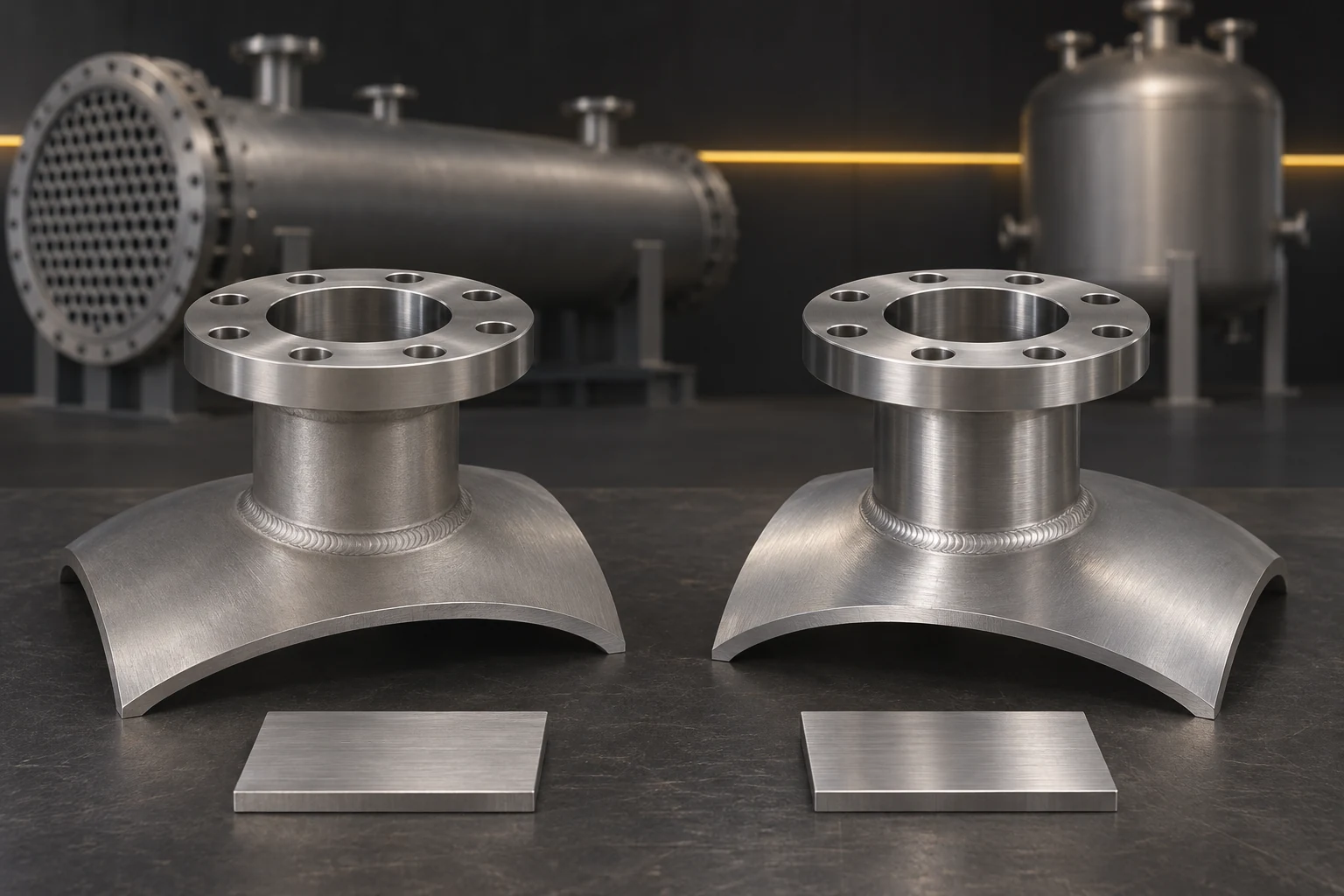
AI illustration; not a production or inspection record.
Quick answer
Grade 2 titanium and C-276 cannot be ranked for all chemical duties. Define composition, temperature, local exposure, cleaning and credible deviations; then evaluate relevant corrosion evidence and the complete fabricated assembly. Titanium has lower published density, but equipment weight, cost and suitability depend on the approved design. Neither an alloy name nor one laboratory corrosion rate establishes service life.
01 / Define the comparison
Grade 2 titanium and C-276 are different material systems
A chemical-equipment enquiry often starts with a short question: should this vessel, coil or heat exchanger use titanium or Hastelloy? That question is incomplete. Titanium describes a family of materials, while HASTELLOY is a trademark covering several alloys. This guide compares commercially pure Grade 2 titanium with HASTELLOY C-276, not every titanium grade with every nickel alloy.
The useful decision is whether a defined material and fabrication route can meet the equipment’s actual service and acceptance requirements. A corrosion-resistant reputation, a lower density or a higher price is not sufficient. Establish the process envelope first, then compare the evidence for the exposed surfaces, joints and operating states within that envelope.
Material identity and published density; not pressure-design allowables
Item
Grade 2 titanium
HASTELLOY C-276
UNS designation
R50400
N10276
Material family
Commercially pure titanium
Nickel-chromium-molybdenum alloy with tungsten
Published density
4.51 g/cm³
8.89 g/cm³ at room temperature
What the name does not establish
Product specification, dimensions, final condition, joint qualification or suitability for a particular process
Separate corrosion selection from mechanical design
A material can be promising for the fluid but unsuitable for a proposed geometry, joining method or design basis. Conversely, satisfying a mechanical calculation does not demonstrate resistance to the process environment. Keep a corrosion review and an equipment-design review as distinct deliverables, then reconcile them before purchase. Both must refer to the same alloy, product form and final condition.
For a replacement item, record what is actually installed. A historic drawing may say titanium while a repair record identifies an alloyed grade, a liner or a different tube material. Verify the material certificates and exposed construction rather than relying on color or a general equipment description. An operating history is useful only when its material and service conditions are known.
If the current specification requires C-276, a quotation for Grade 2 is a proposed substitution. Identify the approval authority and evidence needed before treating it as an equivalent offer. The same applies in the opposite direction: a more expensive alloy does not automatically preserve dimensions, joining details, thermal behavior or a qualified equipment design.
Use this article to structure the enquiry and identify missing evidence. It does not assign a universal winner. The decision record should explain why the selected material fits the actual exposure and how the delivered equipment will demonstrate conformity, including the interfaces where one material system meets another.
02 / Build the service envelope
Describe the fluid at the metal surface, not only in the tank
Begin with a stream description that includes all relevant constituents and their ranges. An acid name and one concentration are rarely enough for a mixed process. Record concentration units, water content, impurities, solids and possible carryover from upstream operations. Distinguish an analytical measurement from a nominal recipe and identify which constituents vary during a batch.
TIMET explains that titanium’s protective oxide depends on its environment: strongly reducing or complexing conditions can undermine resistance. Its handbook also distinguishes wet from dry halogen service and discusses acidic fluoride exposure. These distinctions are reasons to investigate the actual chemistry, not instructions to modify a process or assume that a small additive will make an unsuitable exposure acceptable.
Normal operation is only one row of the enquiry
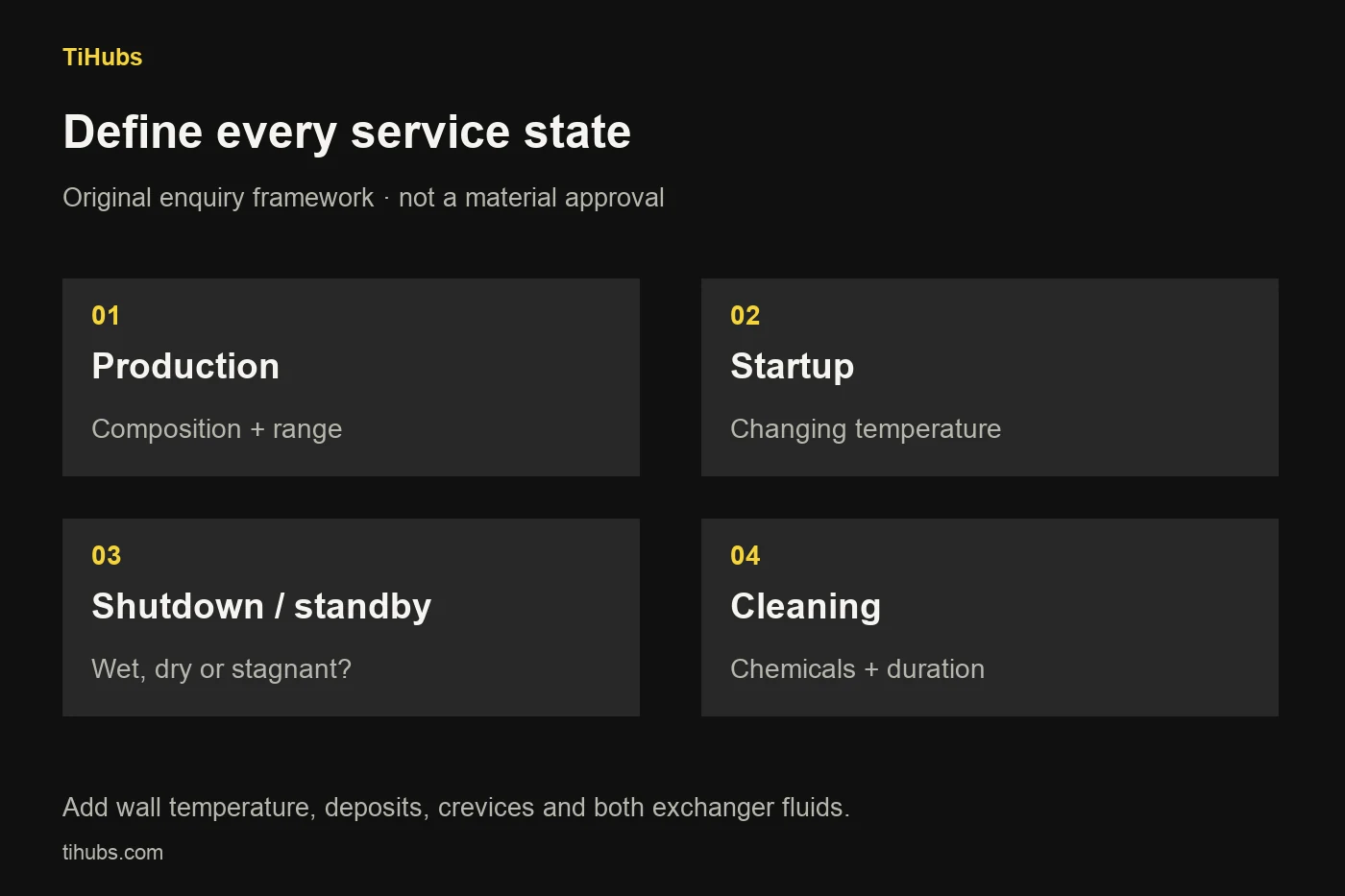
Create separate rows for normal production, startup, shutdown, standby and cleaning. For each, record fluid composition, temperature, duration, flow and whether the surface is wet, partly dry or covered by deposits. A vessel may spend most of its time in one benign condition but experience a short, materially different cleaning exposure every week.
Identify credible deviations with the process owner. Examples include loss of cooling, concentration during evaporation, a changed feed impurity or incomplete rinsing between chemicals. These are review prompts rather than predictions about a particular plant. The buyer should state which deviations the equipment must tolerate and which are controlled by operating safeguards outside the material purchase.
A bulk liquid temperature may not represent a heated wall. Ask the equipment designer for the relevant surface-temperature range and heat-transfer conditions. Similarly, the sampled liquid may not represent material beneath deposits or inside a gasket crevice. Do not translate a favorable open-surface coupon result into approval for every local feature without examining those differences.
Map where exposure changes
On a simple equipment sketch, mark liquid zones, vapor spaces, liquid-vapor interfaces, nozzles, drains, gasket lands and stagnant pockets. Add locations where condensate, solids or cleaning liquid can collect. The point is not to make the drawing complicated; it is to avoid approving an entire vessel using evidence for only one well-mixed liquid zone.
For an exchanger, describe both sides independently. A corrosion problem on the process side does not disappear because the cooling-water side suits titanium. Include potential cross-contamination when the integrity assessment requires it. Material selection, leak consequences and inspection access belong in the same equipment review even though they are different engineering questions.
Where composition is uncertain, obtain representative analysis before requesting a definitive material recommendation. A supplier can prepare a conditional offer, but its assumptions should remain visible. A statement such as suitable for acid service conceals too much. A useful proposal identifies the stated stream, operating range, excluded conditions and evidence still needed for release.
Industrial buying guide / 02One equipment item has several exposure states
Original enquiry framework: record production, startup, shutdown and cleaning separately, including local wall conditions.
03 / Use real corrosion data
Read the conditions before comparing the numbers
The following manufacturer data illustrate temperature sensitivity within one alloy and one acid concentration. They are not a direct Grade 2 versus C-276 test.
C-276 in 5 wt% hydrochloric acid: selected Haynes laboratory results
Temperature, °C
Corrosion rate, mm/year
52
0.02
66
0.31
79
0.75
93
1.25
Source: Haynes C-276 brochure, page 5. Reagent-grade acid, laboratory conditions; the source encourages field testing. These rates are not guaranteed plant performance or an allowable operating envelope.
A valid comparison needs a common exposure
It would be misleading to add titanium results from a different acid concentration, boiling condition or test duration to this table and declare a numerical winner. Real numbers can still produce a false comparison. A useful comparative test defines the same solution, temperature, exposure period and specimen basis, then identifies any deliberate differences between the materials.
Ask what the reported corrosion rate measures. A mass-loss-derived average does not describe every possible localized penetration or other damage mechanism. The test report should explain specimen preparation, exposed area, cleaning after exposure, measurements and examination. A low average value should not be interpreted as evidence that crevices, welds or stressed regions are automatically acceptable.
Decide acceptance criteria before testing. The equipment owner and responsible engineer must determine what damage is acceptable for the design and inspection strategy. Selecting the smallest number after the test is not an acceptance plan. Both candidates may fail the requirement, or both may satisfy it while differing in fabrication, availability and cost.
Make the specimen represent the purchase
If welded construction is central to the equipment, consider what evidence is needed for the actual joint and heat-affected region. A polished parent-metal coupon answers a narrower question. If a crevice is unavoidable, decide whether and how the test should represent it. Record the surface condition and any preparation so the reported result can be related to the delivered component.
Laboratory work can isolate variables, while relevant operating history can capture a more complex exposure. Neither should be used without context. For service history, ask about duration, inspection findings, process changes and repairs. For laboratory evidence, ask which important operating conditions were represented and which were omitted. Their value comes from relevance, not simply from being labeled proven.
Do not extrapolate a straight-line corrosion rate into an unconditional equipment lifetime. Service may change, localized damage may govern and an inspection limit is not necessarily total wall consumption. A life assessment needs its own engineering basis. The purchasing decision should instead state what evidence supports the material, what uncertainty remains and what monitoring or inspection is required.
If the evidence is incomplete, define the next discriminating step. This might be analysis of a process sample, a representative test or review of comparable equipment. Avoid commissioning a large test program that cannot change the decision. Each requested result should resolve a specific uncertainty about one of the competing supply routes.
04 / Construction and interfaces
Compare the complete pressure boundary and wetted assembly
Specify whether the offer is for solid material, a lined assembly, clad construction or a replaceable wetted component. These arrangements can have different load paths, inspection access and repair requirements. A price comparison between solid C-276 equipment and a titanium-lined design is not just an alloy comparison; it is a comparison of two equipment constructions.
Identify the governing design code and the party responsible for the design. Confirm the permitted material specification, product form, condition, temperature basis and required documentation through that controlled process. Do not use the density table or a generic tensile-strength webpage to select wall thickness. Product availability and code acceptance are separate questions that need explicit answers.
Joining is part of the material decision
Require a fabrication plan appropriate to the actual materials and joints. Ask which welding qualifications, personnel qualifications and inspections are required by the project. Titanium and nickel-alloy fabrication should not be treated as interchangeable merely because both materials are weldable. The proposed shop must identify its applicable route rather than relying on a general claim of experience with exotic metals.
For mixed-material equipment, mark every transition: tube to tubesheet, liner to nozzle, flange to mating pipe and fastener to assembly. Establish how the joint will be made, inspected and maintained. A proposal that names the main shell material but leaves transitions unresolved may hide the most difficult part of the purchase.
Review dissimilar-metal contact in the actual electrolyte and geometry. The relevant question is the behavior of the assembled system, including area relationships and any isolation method. Do not add an insulating component without considering its pressure, temperature, sealing and maintenance requirements. Any such feature becomes part of the approved equipment design.
Finish, cleanliness and repair need defined scope
State surface requirements where they serve a purpose: sealing, cleaning, product purity or inspection. Avoid a blanket mirror-finish requirement when the process needs a different measurable condition. Conversely, a visually smooth surface does not establish freedom from harmful contamination or compliance with a specified cleaning procedure. Define the required final state and verification.
Ask how repairs are handled before authorizing fabrication. Identify which repairs require approval, what records accompany them and how final acceptance is repeated. A repaired area is not automatically unacceptable, but an undisclosed repair can make the delivered route differ from the one reviewed. The purchase order should make that distinction clear.
For replacement components, verify installation dimensions and assembly access against the actual equipment. A material change may require review of expansion, stiffness, supports or joint details even when nominal dimensions are unchanged. The design team should assess those consequences; procurement should ensure that the necessary drawings and approvals are included in the supply scope.
A complete offer therefore includes more than metal and fabrication hours. It identifies the wetted construction, controlled drawing revision, joining route, final condition, examination plan and document package. This makes it possible to compare two technically credible solutions instead of accepting a cheap quotation whose important interfaces will be designed later.
05 / Weight and lifecycle cost
Use density correctly and compare accepted equipment
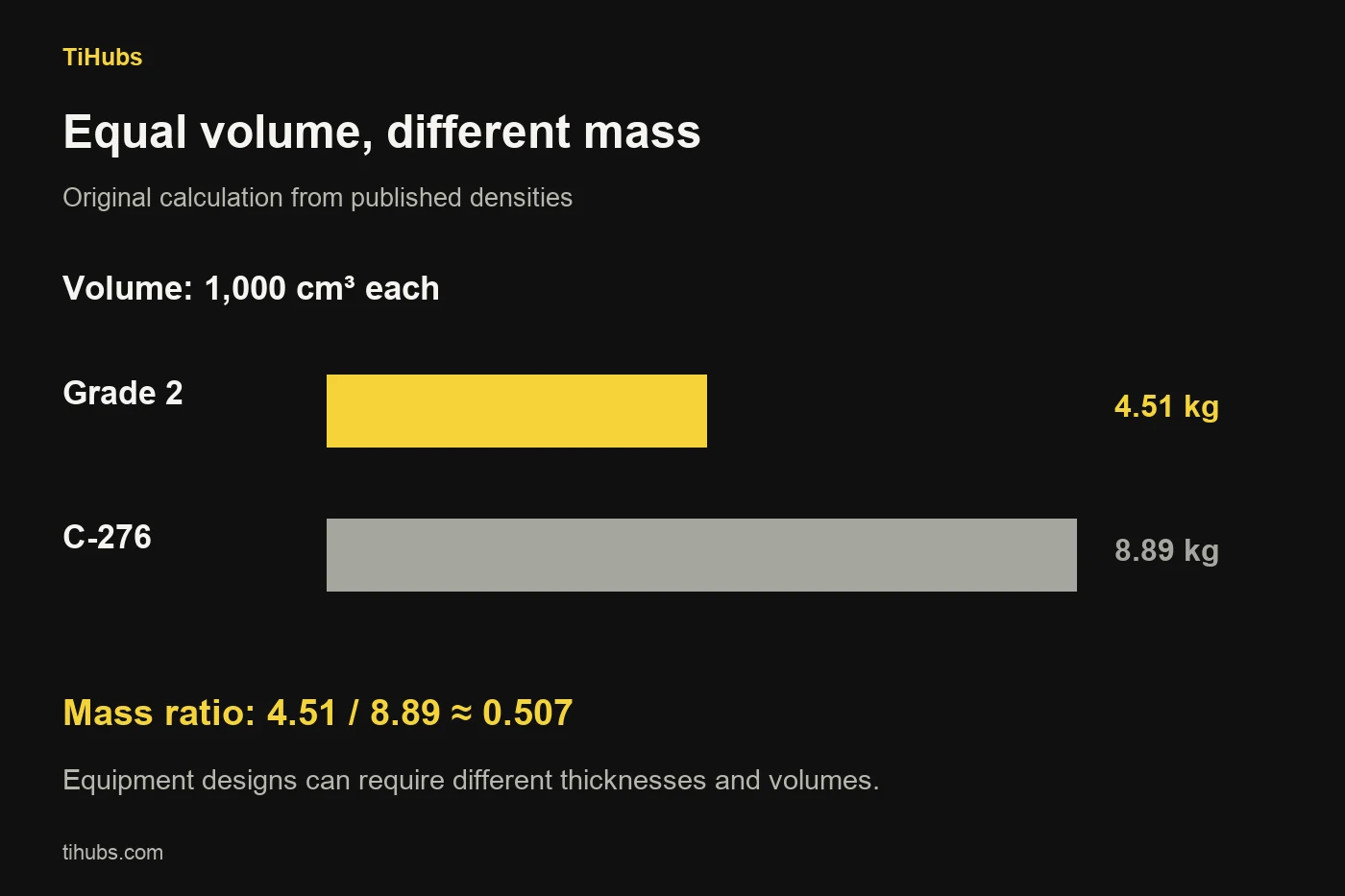
The published densities support a simple original calculation. For equal material volume, Grade 2 mass divided by C-276 mass is 4.51 / 8.89, approximately 0.507. In that restricted comparison, titanium has about 50.7% of the mass. A 1,000 cm³ solid volume would therefore correspond to approximately 4.51 kg and 8.89 kg, respectively.
This is not a prediction that a titanium vessel will weigh half as much. Required wall thickness, geometry, supports, corrosion allowance, joints and construction can differ. Compare the actual approved bills of material. A density advantage may matter for handling or installation, but it must be carried through the equipment design before it becomes a credible project benefit.
Compare quotations at the same delivery boundary
Separate raw material, forming, joining, machining, examination, documentation, packing and installation-related scope. Check whether nozzles, gaskets, fasteners and supports are included. A lower quoted total can result from omitted components rather than a better material choice. Use a scope reconciliation sheet before comparing commercial totals.
Do not apply a universal price-per-kilogram multiplier to these alloys. Actual offers depend on product form, dimensions, order quantity, source, fabrication and delivery conditions. A small machined fitting and a large fabricated shell have different cost structures. Request current project quotations and state their validity, rather than presenting a market price as a permanent material property.
Material yield also matters. Plate nesting, forming allowances, tube lengths and machining stock influence purchased quantity. Scrap value and recovery arrangements can differ between suppliers. Ask for the supplied quantity and finished scope, but do not assume that a lower scrap percentage alone means lower accepted-equipment cost.
Make lifecycle assumptions visible
A lifecycle comparison can include initial delivered cost, planned maintenance, inspection, energy consequences where demonstrated and replacement or outage costs. Keep each assumption separate. Do not claim that a material will last a particular number of years without relevant evidence. Use several clearly labeled scenarios when service life remains uncertain.
For example, let the initial cost difference be ΔC and the verified annual operating-cost difference be ΔO. A simple undiscounted payback calculation ΔC / ΔO is meaningful only when ΔO is positive, credible and sufficiently stable. It does not account for financing, changing production or uncertain failure events. This is a decision framework, not a promise of savings.
Schedule can dominate a replacement project. Compare time to approved drawings, available material, fabrication, inspection and accepted delivery. A stock-material lead time is not the delivery time of a qualified assembly. Ask how a failed inspection, drawing revision or unavailable mating component would affect the critical path.
The commercial recommendation should identify the technical basis it assumes. If titanium is being considered only after a successful corrosion review, keep that condition attached to the cost comparison. Procurement can evaluate alternatives in parallel, but a favorable price or delivery date must not silently become authorization for an unresolved material substitution.
Industrial buying guide / 05Equal-volume mass is not finished-equipment weight
Original calculation using published densities: 1,000 cm³ gives 4.51 kg for Grade 2 and 8.89 kg for C-276. Actual designs can require different volumes.
06 / Enquiry and decision
Turn the comparison into a reviewable purchasing package
Send a process sheet, equipment drawing and acceptance requirements together. The process sheet should describe normal and exceptional exposures; the drawing should identify wetted construction and interfaces; the acceptance requirements should specify design, fabrication, inspection and documentation. Separating these files is reasonable, but their revisions and assumptions must agree.
Use two technical cases to test the enquiry. In a hypothetical chloride-water exchanger, Grade 2 may merit evaluation, but the review must still include temperature, crevices, deposits, cleaning and the other fluid. In a hypothetical reducing-acid duty, titanium’s reputation in seawater is not relevant proof; C-276 also requires evidence for the actual concentration and temperature. These are decision examples, not TiHubs customer installations.
For each candidate, record evidence supporting selection, conditions not yet demonstrated, fabrication constraints and the approval owner. A short matrix can be more useful than a large brochure collection. It should make clear whether the proposal is technically accepted, conditionally quoted or still under investigation.
At receipt, reconcile material identification and certificates with the purchase order, drawings and supplied components. Check the required inspection reports, joining records, dimensional results and any approved deviations. A certificate for the base plate does not by itself establish conformity of a completed vessel. Acceptance must follow the agreed scope for the actual deliverable.
TiHubs can review the titanium supply scope for vessels and process equipment and heat-exchanger enquiries. Provide the service and engineering requirements so material availability, manufacturing scope and documentation can be confirmed. This comparison does not imply that TiHubs supplies every nickel alloy or provides project design approval.
Release the order when the chosen material, construction, operating assumptions and evidence are aligned. Preserve that decision for future replacements. If the feed, cleaning regime or operating temperature changes, revisit the basis instead of automatically reordering the same material designation. A disciplined comparison remains useful after purchase because it records the conditions under which the selection was justified.
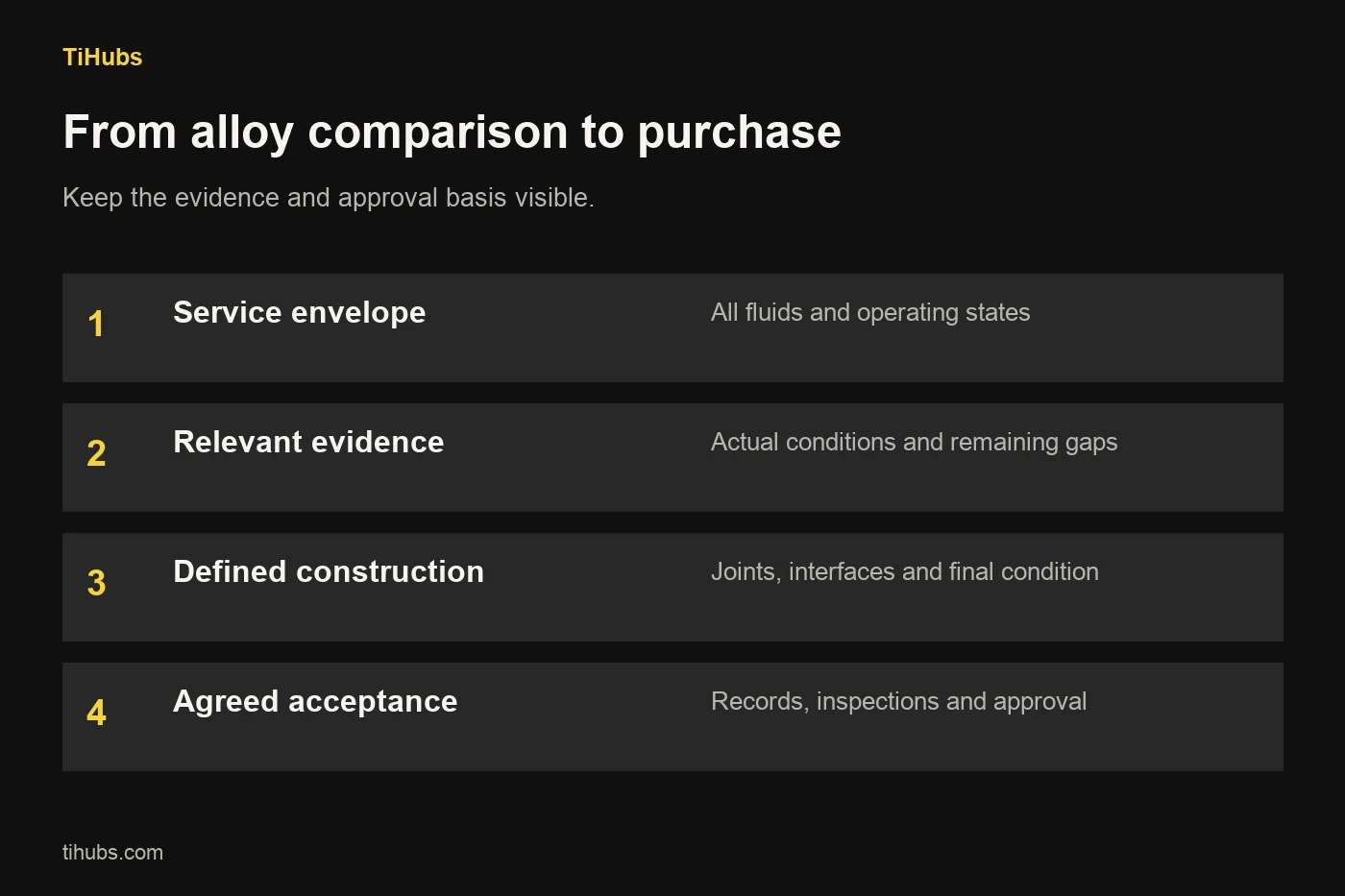
Industrial buying guide / 06Keep evidence and approval attached to the quote
A material proposal becomes a purchasing decision through service review, fabrication definition and agreed acceptance.
07 / Build your RFQ
Prepare a chemical-equipment material enquiry
Provide the actual process envelope and controlled equipment requirements. Identify whether titanium is specified or proposed as an alternative, and who will approve the final material selection.
Information to include
All constituents, concentration ranges, impurities and water content
Normal, startup, shutdown and cleaning temperatures and durations
Wetted drawing, joints, crevices, deposits and both exchanger fluids
Design basis, material specification, inspection and document requirements
Quantity, replacement constraints, delivery and substitution approval
Build your RFQ checklist
Choose the product and add the information you have. Copy the resulting brief or send your requirements to TiHubs. Submitting an enquiry does not place an order.
08 / FAQs
Questions buyers ask
Is titanium more corrosion resistant than Hastelloy C-276?
There is no universal ranking. Compare the actual chemistry, temperature, water content, local features and exposure history. Grade 2 titanium and C-276 are different material systems; evidence from seawater, one acid or another alloy cannot automatically approve a chemical-equipment substitution.
Can C-276 handle every hydrochloric-acid condition?
No. The selected manufacturer data show different rates at different temperatures even at the same 5 wt% concentration. They describe laboratory exposure, not guaranteed plant behavior. Define the actual stream and acceptance criteria before selecting a material.
Will a titanium vessel weigh half as much?
Not necessarily. The density ratio is approximately 0.507 for equal material volume. A real vessel may require different thickness, supports, joints or construction. Compare approved designs and bills of material rather than applying the density ratio to total equipment weight.
Can cleaning determine the material choice?
Yes, cleaning is a separate exposure that must be included in the service review. State the actual chemicals, temperatures, duration and rinsing conditions. Do not infer cleaning compatibility from resistance to the normal production fluid or modify a cleaning process from a general materials article.
Is a low average corrosion rate enough to approve equipment?
No. The relevant damage modes, local geometry, welds, design requirements and inspection strategy also matter. Define representative evidence and acceptance criteria in advance. A laboratory average is not a universal lifetime or pressure-integrity guarantee.
What should a replacement enquiry include?
Include existing material records, operating and cleaning history, inspection findings, current drawings, required design basis and the proposed delivery scope. Identify any process changes and who may approve substitution. This helps separate a like-for-like replacement from a new material-selection decision.
09 / Key takeaways
Keep the purchase requirements connected.
Define Grade 2 and C-276 precisely before comparing offers.
Include local exposure and every operating state in the process sheet.
Keep corrosion numbers tied to their actual test conditions.
Compare complete construction, joints and accepted delivery.
Use density and lifecycle calculations only within stated assumptions.
Technical references
Sources and data scope
References reviewed November 15, 2026. Public source summaries support the discussion; the controlled specification, agreed edition and approved project requirements govern acceptance.
TiHubs coordinates titanium material and custom supply enquiries from Baoji, China. Send the product, drawing revision and acceptance requirements so the proposed supply scope can be reviewed. Learn about our sourcing role.
Contents
TiHubs
Talk to TiHubs
Ask about titanium materials, grades or custom parts.
Enter your email to start chatting.
We use your email to respond to your enquiry. Your conversation is stored on this website.
Our team is away right now. Leave your enquiry and we will follow up by email.