AI illustration; not a production or inspection record.
Quick answer
Cold rolling adds further reduction to previously processed titanium and is often considered for thin sheet and dimensional control. It does not automatically make the delivered material stronger or suitable for a tighter bend: final annealing, grade, thickness, orientation and surface all matter. Specify the finished requirement, compare evidence on the same basis, and qualify the actual forming route where needed.
01 / Process and condition
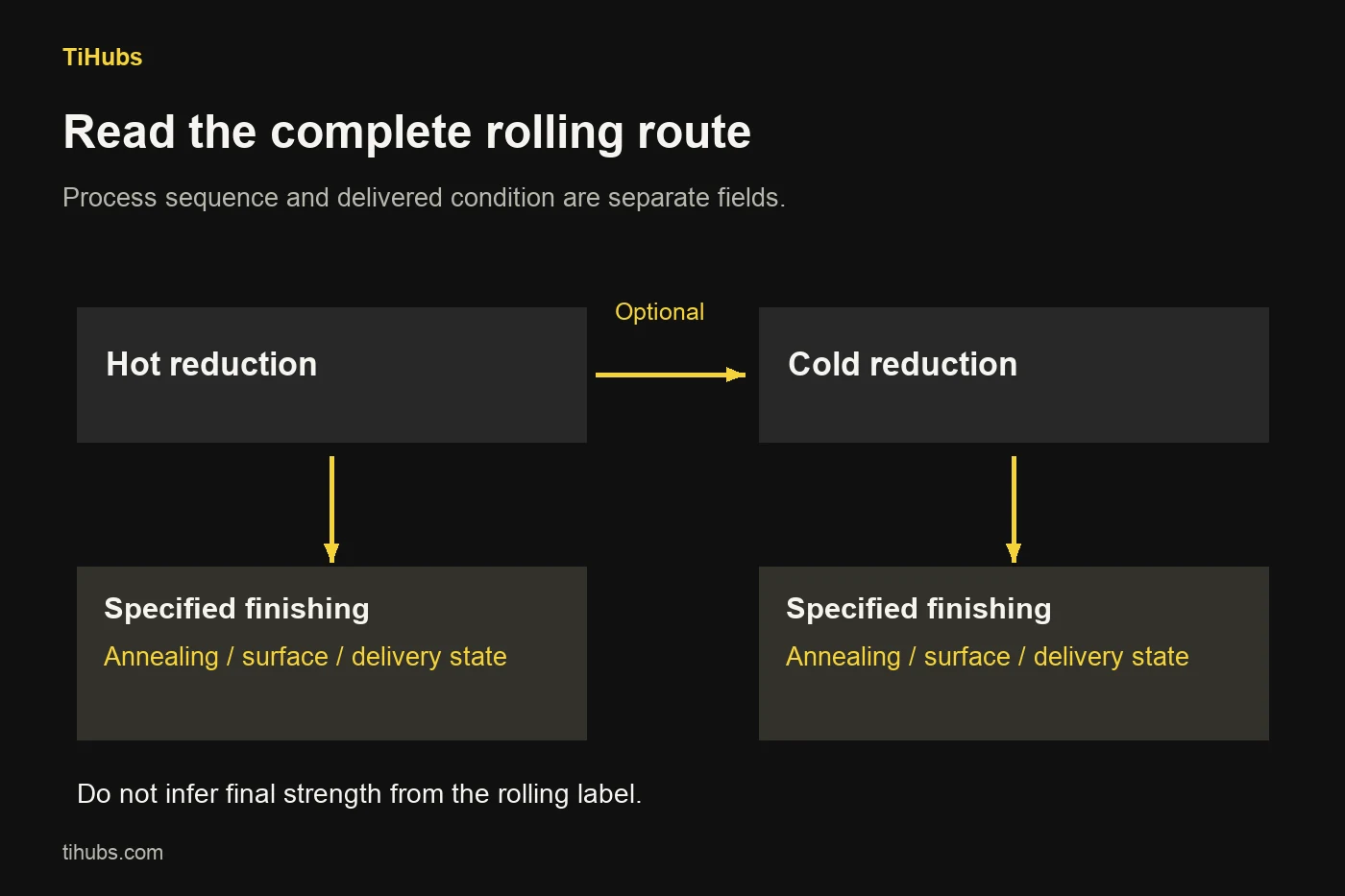
Read the complete rolling route
A drawing calls for a formed titanium cover, and two offers arrive: hot-rolled sheet at a lower price and cold-rolled sheet with a brighter surface. Neither description tells the buyer whether the cover will form, meet its thickness requirement or remain within the permitted surface condition. The useful comparison starts with the finished part and works backward to the stock. Rolling route is one input; alloy, thickness, annealing, surface treatment and inspection complete the purchase description.
Kobe Steel’s published production sequence shows hot rolling before the additional cold-rolling and annealing stages used for cold-rolled coil. Cold rolling therefore does not mean that the titanium never experienced hot rolling. It identifies a later reduction stage. The supplier should describe the delivered condition rather than asking the buyer to infer it from one process word.
Reduction and heat treatment answer different questions
Reduction changes section geometry and introduces deformation. Subsequent heat treatment changes the resulting material state. For a purchase, ask whether the final product is annealed, supplied with retained cold work, or made to another explicitly specified condition. A statement such as “cold rolled, therefore stronger” omits that distinction. It can be misleading when the delivered sheet has subsequently been annealed.
Kobe Steel separately identifies annealed and as-rolled conditions in its foil product information. That naming distinction is useful even when the purchase concerns thicker sheet: a route and a final condition are not interchangeable labels. The foil product range itself must not be transferred to a different alloy, mill or sheet thickness. Confirm the actual available dimensions for the proposed material.
Separate the material specification from the process preference
The public scope of ASTM B265-25 covers annealed titanium and titanium-alloy strip, sheet and plate. An order citing that specification still needs the grade, edition, dimensions and relevant additional requirements. “Cold rolled titanium” alone is not an alternative material specification. If a customer drawing specifies a different delivery state, resolve the relationship before using a standard name as a shorthand description.
Also distinguish how the material is sold. A coil, a cut-to-length sheet and a machined blank can come from related upstream stock but transfer different work to the buyer. A coil order needs winding and handling details. A sheet order needs usable dimensions and a flatness basis. A blank order needs the cutting method, orientation, edge condition and identification that remain after cutting.
For an exploratory design, ask the supplier to propose a suitable route against the required outcome. For an approved drawing, request the specified route and list alternatives separately. This avoids paying for an unnecessary process restriction while also preventing an unapproved substitution. The distinction belongs in the enquiry itself, before a purchasing spreadsheet reduces the offers to price per kilogram.
Industrial buying guide / 01The delivered state completes the route
Cold reduction can follow hot rolling. Identify subsequent annealing and finishing before assigning a property expectation.
02 / Verified comparison
Compare delivered stock, then interpret the data
The following table compares purchasing questions rather than assigning universal property values to two manufacturing labels. Its process sequence follows Kobe Steel’s published overview; the acceptance questions are a buyer’s review framework. Actual size capability, surface and tolerances depend on the offered product and specification.
Process-level comparison; confirm the specific supplied condition
Question
Hot-rolled supply route
Cold-rolled supply route
Reduction sequence
Hot reduction, followed by the specified finishing operations
Additional cold reduction of previously processed stock
Final state
Confirm annealing and subsequent operations
Confirm whether supplied annealed or with retained cold work
Thin gauge requirement
Check whether the available route meets the requested gauge
Often considered for further reduction; verify mill capability
Strength comparison
Use grade-, size- and condition-specific evidence
Use the same evidence basis; the route name is insufficient
Surface and shape
Specify measurable requirements
Specify measurable requirements; appearance is not acceptance
A published example of directional properties
China Steel Corporation reported room-temperature tensile results for commercially pure titanium processed by several routes. Two selected conditions from its 2023 paper are shown below. L denotes the longitudinal direction and T the transverse direction. These are research results for the described products, not TiHubs tests or guaranteed values for a named ASTM grade.
Selected results from China Steel Technical Report No. 36, Table 1, page 82
Reported product condition
Yield strength T, MPa
Yield strength L, MPa
Difference, MPa
2.4 mm hot-rolled sheet
290
201
89
0.6 mm sheet, 75% cold reduction + vacuum annealing
213
210
3
Source: In-Ting Hong, The Anisotropic Properties of Rolled Pure Titanium Sheet. Thickness and processing differ between the rows. The results illustrate why orientation and the full route matter; they do not isolate cold rolling as the only changed variable or establish a universal improvement.
For a buyer, the practical consequence is a question: which direction matters to the part, and does the available evidence represent it? A single tensile number without orientation can conceal a relevant difference. If a formed panel is nested in a different direction to increase material yield, the purchasing and production teams should review that change together instead of treating it as an exclusively commercial optimization.
A sound comparison distinguishes three types of numbers. A specification limit is a contractual requirement when the relevant document applies. A producer’s typical value describes a reference product. An actual lot result describes a tested specimen and the material it represents. Put the type of value beside the number. Comparing a typical value from one route with a minimum limit from another does not establish which delivered sheet is stronger.
Likewise, do not convert lower directional variation into a claim of universal isotropy. Through-thickness behavior, in-plane directions and the actual forming path are separate questions. The material may satisfy its stock specification while still needing a forming trial for a demanding geometry. That trial should address the part’s limiting feature rather than attempt to recreate every experiment in a research paper.
Industrial buying guide / 02Keep the direction beside the result
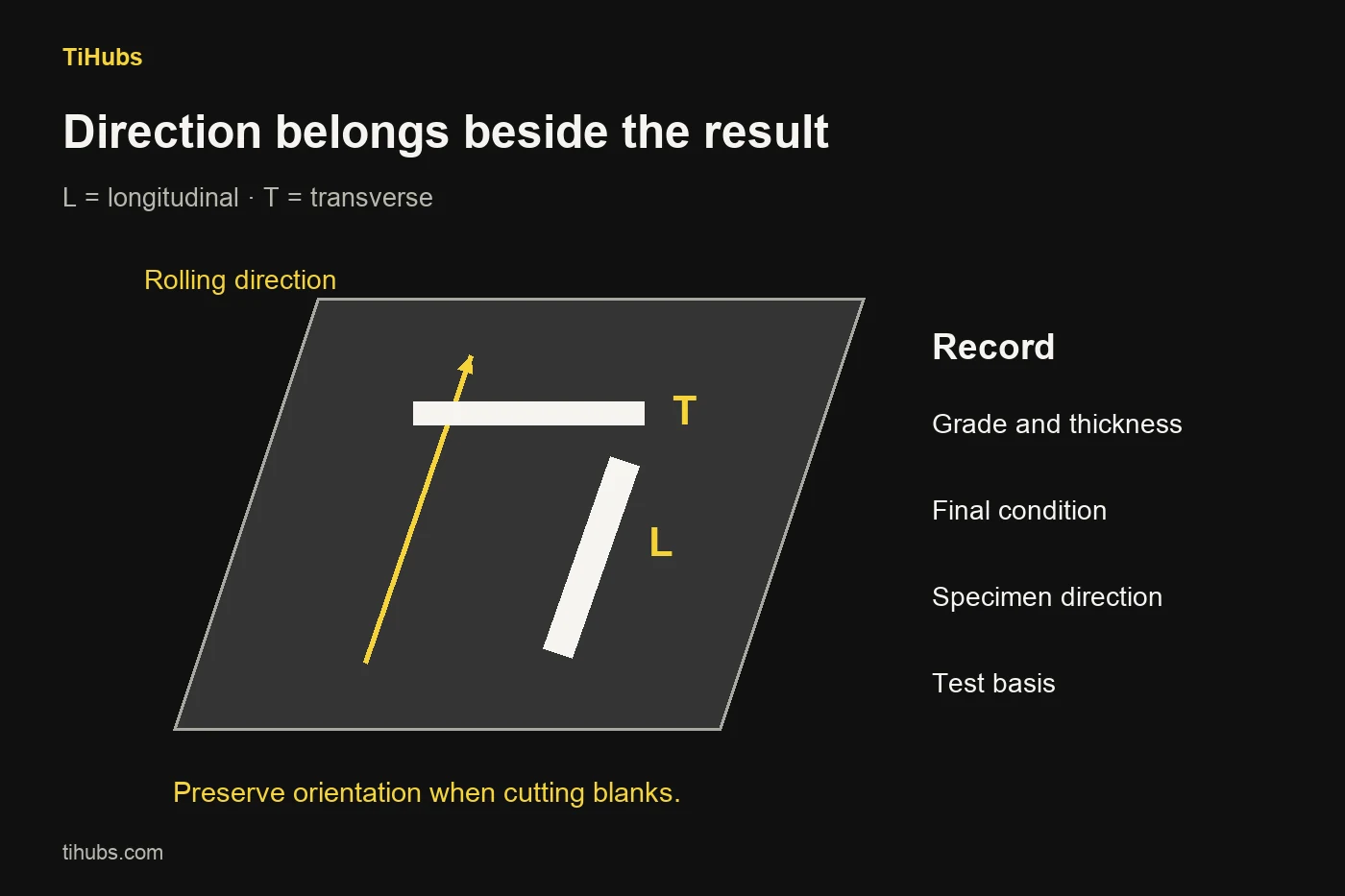
Longitudinal and transverse describe different test directions. Preserve their relationship to the blank and the finished feature.
03 / Forming and orientation
Make the stock choice fit the forming operation
A shallow cover, a deep-drawn cup and a corrugated heat-exchanger plate impose different deformation paths. Before asking which rolled product is easier to form, identify the operation and the feature that limits success. Relevant details may include a tight corner, a long flange, a drawn wall, a hole near a bend or a visible surface that cannot tolerate tool marking. A generic elongation value does not describe all of these conditions.
Mark the rolling direction on the proposed blank layout. Then relate each critical bend or drawn feature to that direction. If blanks are rotated during nesting, record which rotations are permitted. The procurement requirement should survive the transition from a full sheet to individual blanks; otherwise the certificate may remain correct while the workshop loses the orientation information that made the qualification meaningful.
For a new forming route, request a representative sample from the intended grade, thickness, final condition and surface route. A convenient offcut with a similar appearance can help check tool clearance, but it does not establish production formability. Keep those two sample purposes separate. The first is a geometric trial; the second is evidence about the proposed material and process combination.
Define what the trial must demonstrate
Specify the finished geometry, measurement locations and inspection stage before forming. Depending on the part, inspect thinning, cracks, wrinkles, springback, surface marks and dimensional fit. The drawing or approved trial plan supplies the acceptance limits. Do not invent a universal thinning allowance simply because the part is titanium. A pressure-retaining component and an architectural cover have different governing requirements.
Edge preparation matters when the cut edge enters a highly strained region. Record the cutting method, burr removal and any permitted edge blending. TIMET’s design and fabrication handbook discusses surface preparation and smooth edges before forming. That guidance supports reviewing the blank as a manufactured item; it does not supply a single bend radius suitable for every rolled condition.
Lubrication and cleaning also belong in the agreed route. The supplier and fabricator should identify which residues may remain before later welding, bonding or finishing. If the final assembly has a cleanliness requirement, a forming trial that stops immediately after pressing leaves an important part of the route untested. Inspect the part after the operations that could change its surface or dimensions.
When a trial fails, preserve the evidence before ordering a different material. Record where cracking started, its relation to rolling direction, the actual thickness, the blank edge and the tool setup. A crack at a damaged cut edge asks a different question from distributed wall thinning. This information helps distinguish a material change from a blank-preparation or tooling correction.
For repeat production, define which changes require renewed review: material source, grade, thickness, annealing route, blank orientation, tooling or a critical process parameter. A successful first sample establishes only the agreed scope. The separate titanium sheet bend-radius guide develops the bend-specific questions; use it when bending is the limiting operation rather than repeating those requirements on every rolling enquiry.
04 / Surface and geometry
Specify the surface that the part actually needs
A bright sheet can look more precise than a matte plate, but visual brightness does not establish thickness tolerance, flatness or roughness. Separate these properties in the enquiry. Thickness describes the local section. Flatness describes deviation from a reference plane under a defined assessment. Roughness describes surface texture under a stated measurement method. Appearance describes what a customer sees under agreed viewing conditions.
For thickness, state the required nominal value and applicable tolerance, including whether a minimum remaining wall controls the finished part. Identify the measurement locations and edge exclusions required by the governing specification or drawing. For a thin formed component, a measurement at one convenient corner is not necessarily representative of the region that experiences the highest deformation.
For flatness, identify the delivered condition: free sheet, supported sheet, clamped blank or finished component. A flatness requirement after machining is not the same deliverable as an incoming sheet requirement. If a workshop intends to remove material from one face, describe that plan. Stock acceptance should not silently promise dimensional stability after an unspecified downstream operation.
Agree roughness and appearance separately
If roughness affects sealing, coating or a functional contact, identify the parameter, measurement direction and evaluation method. A photograph cannot verify a numerical roughness requirement. Conversely, a satisfactory roughness measurement does not settle cosmetic uniformity across a large visible panel. For appearance-sensitive work, retain an approved sample and define the conditions under which it is compared with production.
Describe acceptable scratches, local blending and handling marks by the requirement they affect. A shallow mark on a machining allowance may be removable; the same mark on a final visible face may be unacceptable. The quotation should identify which face is critical and whether it is protected during cutting and transport. Specifying both faces as critical when only one remains visible can add unnecessary handling requirements.
Surface-treatment names should not be borrowed from another metal family without checking their meaning for the proposed titanium supply. Ask the supplier to explain the actual finishing sequence and the acceptance basis attached to its designation. Our titanium surface-finish comparison addresses pickled, polished and machined surfaces in more detail; rolling route does not replace that finish decision.
For coils, agree inside diameter, outside diameter or mass limits, winding direction, splice policy and packaging compatible with the receiving equipment. For cut sheets, agree dimensions, squareness, edge condition, interleaving and stack identification. These are different logistical interfaces. A low material price loses its advantage if the incoming coil cannot be handled by the buyer’s equipment or the sheet requires an unplanned trimming operation.
Keep protective film requirements tied to the next operation. Identify the protected face, removal stage and any residue limitations. A film that protects a visible surface during transport may be unsuitable to leave in place for a subsequent thermal operation. The order should make the removal responsibility clear, especially when material moves through a distributor, cutting service and separate forming workshop.
05 / Quotation and yield
Compare usable output rather than the route label
Two compliant offers can have different commercial results because they supply different usable areas. Compare the required blank layout against the offered sheet dimensions, permitted orientation, edge trimming and cutting allowance. A larger sheet is not automatically more economical, and a lower price per kilogram does not establish a lower cost per accepted blank. The relevant denominator is the output the buyer can actually use.
An explicit nesting example
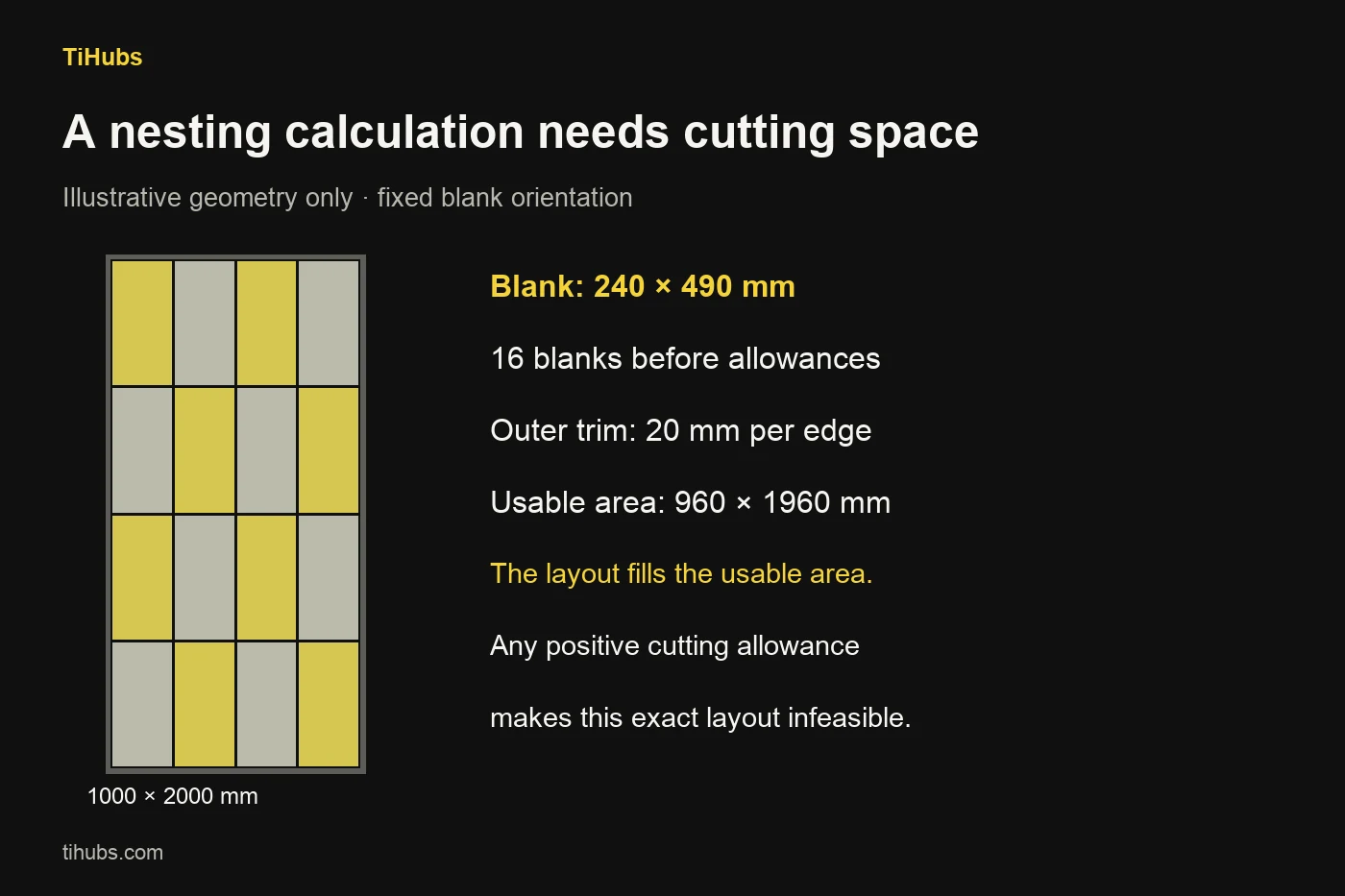
Consider an illustrative geometry calculation, not a production-yield claim. A buyer needs rectangular blanks measuring 240 × 490 mm with fixed orientation. On a 1000 × 2000 mm sheet, an ideal layout without margins or cutting allowance fits four blanks across and four along: 16 blanks. Their combined area is 1,881,600 mm², or 94.08% of the sheet’s 2,000,000 mm² area.
Now reserve 20 mm at every outer edge. The usable rectangle becomes 960 × 1960 mm. The same four-by-four arrangement exactly fills it before any allowance for the cutting process or spacing between blanks. Any positive allowance makes that particular layout infeasible. The arithmetic demonstrates why an attractive area-utilization percentage is not a production plan. A supplier must check the actual nesting geometry and permitted cutting route.
Ask for the number of accepted blanks delivered, not merely the number expected from an ideal drawing. State who owns offcuts, whether test pieces consume ordered material and whether rejected blanks are replaced. If the supplier quotes full sheets while the buyer quotes finished blanks internally, preserve that distinction in the cost model. Otherwise commercial teams can unknowingly compare different quantities of usable material.
Separate recurring and one-time work
Build the quotation from the material, cutting, leveling or finishing where specified, inspection, records, packing and delivery. Keep trial work and tooling separate from repeat production. Do not impose a fixed percentage premium for cold rolling: availability, quantity, dimensions, condition and the required finishing route can change the offer. Request a current quotation for the actual scope instead of treating a generic market statement as a purchasing rule.
For recurring orders, ask whether the producer can maintain the agreed condition and inspection basis between lots. If stock from several sources may be used, identify that possibility before qualification. A buyer may accept multiple sources after review, but should not discover the change only when forming behavior or surface appearance differs. The purchase agreement should define the review trigger rather than assume permanent identical mill supply.
Lead time should end at release of the complete accepted deliverable. Material in stock may still require cutting, document review, inspection or packing. Ask which steps remain and what information is needed to start them. For a new forming project, distinguish the sample schedule from the production schedule; a sample approval date cannot be treated as a guaranteed bulk shipment date without reviewing the remaining work.
When comparing titanium sheet and sheet or strip coil offers, include the receiving operation in the decision. The right supply form reduces unnecessary handling and processing at the buyer’s plant. TiHubs can review the requested dimensions, condition and destination; the available route and commercial terms should be confirmed for the specific enquiry.
Industrial buying guide / 05Area yield is not a cutting plan
Illustrative 240 × 490 mm blanks: a four-by-four layout exactly fills a 960 × 1960 mm usable area before cutting allowances.
06 / Receiving and release
Close the evidence chain before forming production
Receiving inspection should reconcile what was ordered, what was delivered and what the documents describe. Start with the material designation, specification edition, final condition, heat or lot identification and quantity. Then inspect the dimensional and surface requirements using the agreed methods. A certificate and a clean-looking package are useful inputs, but neither replaces checking the acceptance features assigned to the receiving stage.
Retain the link between each sheet or coil and its records after unpacking. When cutting begins, transfer identification to the blanks or their controlled containers using a method compatible with the part. Keep orientation information where it matters. Marking that disappears during the first operation needs a planned replacement; identification should not depend on somebody remembering which stack came from which certificate.
For a qualified forming route, record the production material against the approved trial baseline. Confirm grade, thickness range, final condition, surface route and permitted source. If a difference appears, determine whether it falls within the approved scope. A supplier’s statement that both products are “cold rolled” does not resolve a change in the variables that the trial actually controlled.
Agree how nonconformities are handled before a shipment arrives. Keep affected material identified, preserve the original measurements and request a disposition. Local polishing, releveling, additional heat treatment or replacement may change different aspects of the product. The proposed remedy should identify the resulting condition and any required reinspection, rather than merely promise to improve appearance.
For a material-only purchase, the supplier’s release applies to the supplied stock and its agreed requirements. For a formed-part purchase, acceptance also includes the finished drawing and any required process evidence. State which route TiHubs is being asked to quote. This prevents a stock certificate from being treated as a qualification of a forming operation that the supplier did not perform.
The final order should be readable without the quotation conversation. It should identify the product, grade, standard, condition, dimensions, critical face, orientation, testing, documentation, packing and permitted alternatives. Resolve contradictions between the drawing, purchase order and supplier acknowledgment before production. The plate thickness and flatness guide can support the dimensional portion where machining stock is involved.
Archive the approved sample scope and the incoming records together. On a repeat order, this lets the buyer ask whether the same requirements still apply instead of repeating an informal preference for “cold rolled.” The procurement decision then rests on a defined, repeatable deliverable: titanium stock that supports the intended manufacturing route and can be accepted against stated evidence.
07 / Build your RFQ
Request sheet for a defined manufacturing route
Send the part drawing or blank layout with the material requirement. Identify the final condition, critical surface and forming direction so that the proposed stock can be reviewed against usable output rather than a rolling label alone.
Information to include
Grade, product standard, edition and final condition
Thickness, width, length or coil handling limits
Blank orientation, forming operation and drawing revision
Critical surface, edge preparation and inspection requirements
Quantity, usable-output basis, destination and target date
Build your RFQ checklist
Choose the product and add the information you have. Copy the resulting brief or send your requirements to TiHubs. Submitting an enquiry does not place an order.
08 / FAQs
Questions buyers ask
Is cold-rolled titanium always stronger?
No. The final condition matters, including whether annealing follows reduction. Compare the same grade, thickness range, orientation and test basis. A route label does not replace the applicable specification or actual lot evidence.
Does cold-rolled sheet also pass through hot rolling?
It can. Kobe Steel’s published route shows hot rolling before subsequent cold reduction and annealing. Ask about the complete route and supplied condition instead of treating the two labels as mutually exclusive material histories.
Which route is better for a deep-drawn part?
Choose against the actual geometry and qualified forming process. Grade, delivered condition, thickness, orientation, surface and tooling all require consideration. A representative trial should include the operations and inspection features that limit the part, rather than rely on appearance or a single elongation value.
Can a bright surface prove the sheet is cold rolled?
Appearance alone cannot establish processing history or compliance. Request the supplier’s declared route and records required by the order. Specify roughness, visual acceptance and surface protection separately when they affect function or appearance.
Can the published yield-strength table be used for acceptance?
No. The values are selected research results for particular commercially pure titanium products with different thicknesses and processing. Use the controlled purchase specification and required lot results for acceptance; the table illustrates why direction and condition must be identified.
What should be sent for a useful quotation?
Provide the grade, standard, final condition, dimensions, quantity and destination, together with the blank layout or finished drawing. Add orientation, surface, forming and inspection requirements. Identify whether the quantity means full sheets, started blanks or accepted finished pieces.
09 / Key takeaways
Keep the purchase requirements connected.
Specify rolling route and final condition as separate fields.
Compare properties with grade, thickness, orientation and test basis visible.
Qualify forming with representative production stock and an explicit acceptance plan.
Check usable nesting, cutting allowance and receiving-equipment compatibility.
Preserve lot identity and rolling direction through cutting and release.
Technical references
Sources and data scope
References reviewed November 15, 2026. Public source summaries support the discussion; the controlled specification, agreed edition and approved project requirements govern acceptance.
TiHubs coordinates titanium material and custom supply enquiries from Baoji, China. Send the product, drawing revision and acceptance requirements so the proposed supply scope can be reviewed. Learn about our sourcing role.
Contents
TiHubs
Talk to TiHubs
Ask about titanium materials, grades or custom parts.
Enter your email to start chatting.
We use your email to respond to your enquiry. Your conversation is stored on this website.
Our team is away right now. Leave your enquiry and we will follow up by email.