Baoji High-tech Zone, ChinaTitanium sourcing · One contact


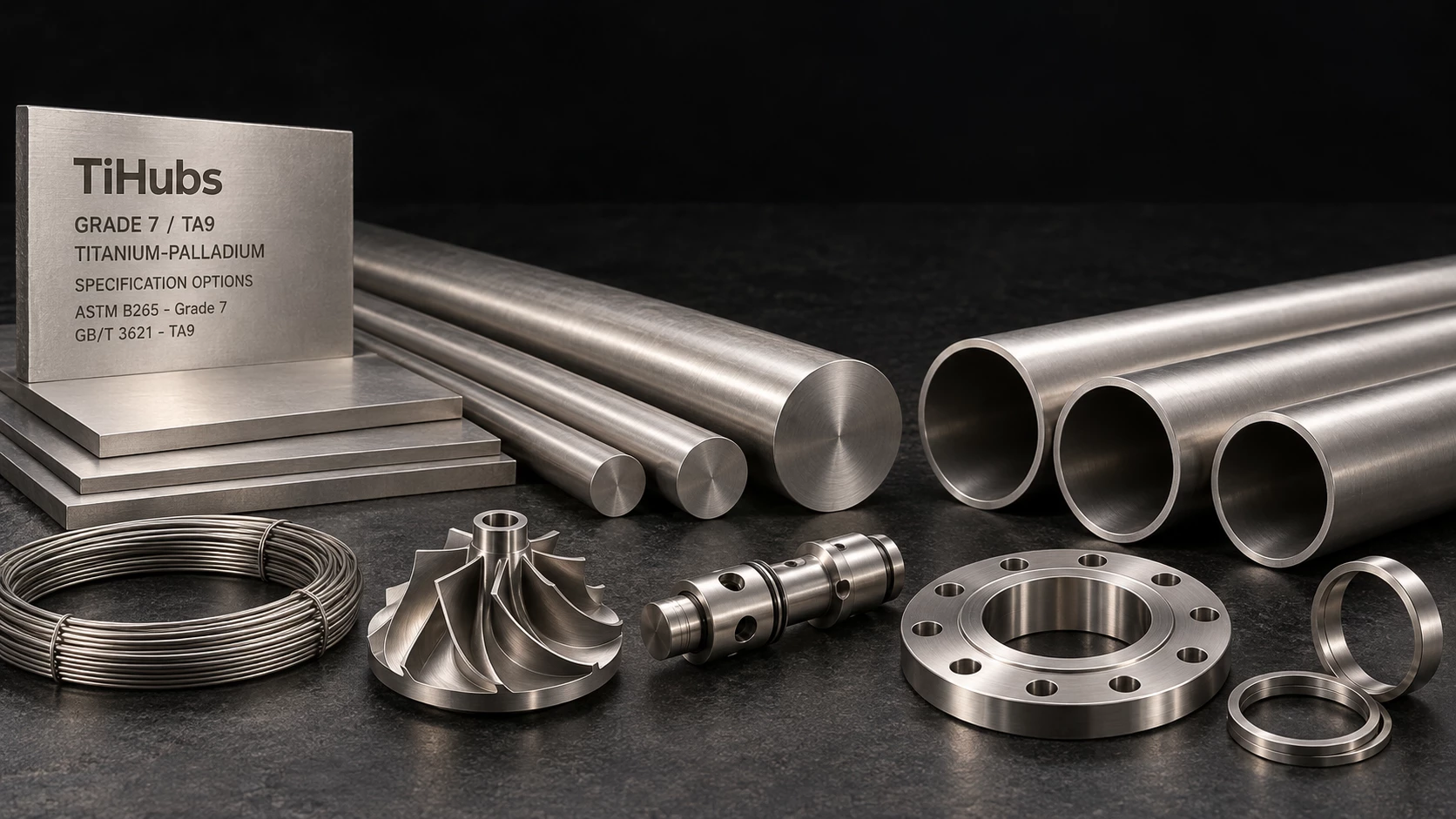
Titanium-palladium · Grade 7 / Gr7 / TA9
Grade 7 / TA9 titanium.For corrosive process duties.
Source Grade 7 titanium, also written Gr7, and Chinese TA9 titanium for chemical-process equipment. TiHubs coordinates plate, bar, seamless pipe, wire and drawing-based components through one technical and commercial contact in Baoji.
Start with a material specification, drawing or service conditions. We help define the supply scope, inspection and records needed for your quotation.
Material review. Supply coordination.
One contact in Baoji, China.
Ti–Pd alloyGrade 7 / Gr7 · Chinese TA9
Chemical-process dutiesMaterial, service and acceptance reviewed together
One contactRequirement review to delivery coordination
01 / Product forms
Grade 7 / TA9 products.
Matched to your process.
Choose the supplied form, then define the standard, condition, dimensions and acceptance. Six views connect Gr7 and TA9 material enquiries with chemical-equipment fabrication, machining and heat-transfer duties.
01 / 06
Grade 7 / TA9 · Fabrication stock
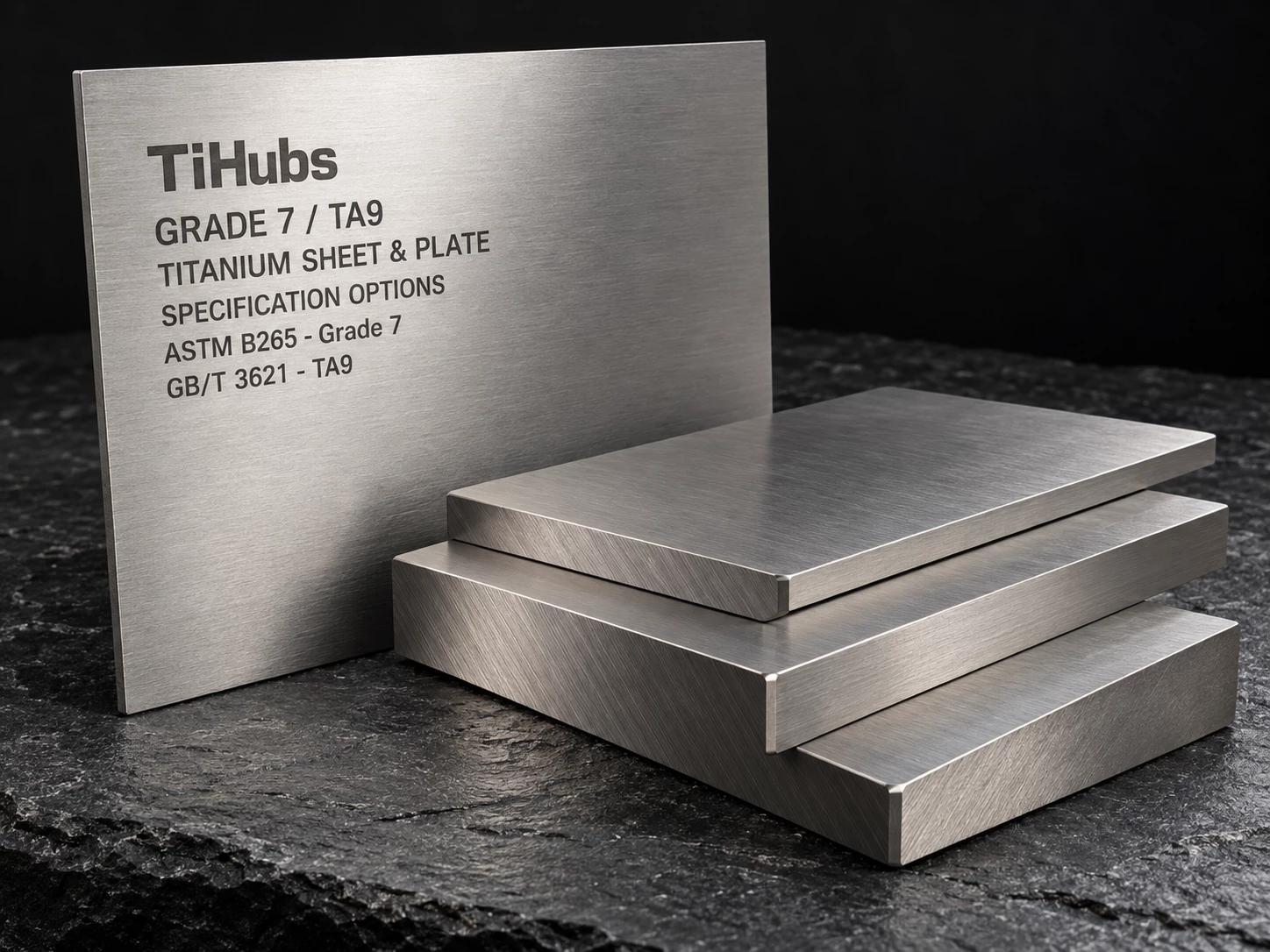
Grade 7 / TA9 titanium sheet & plate
For specified reactor internals, equipment linings, heat-transfer components and fabricated wetted parts. Include the finished geometry and any forming or welding that follows supply.
- Specification
- ASTM B265 Grade 7, or TA9 under GB/T 3621-2022. State the edition, product classification and agreed acceptance requirements.
- Dimensions
- Thickness × width × length; cut sizes, flatness, thickness tolerance, rolling direction and forming or machining allowance.
- Condition
- Annealed material to the specified route; agree surface condition, edge preparation and protection during fabrication.
- Acceptance
- Heat-linked chemistry including palladium, mechanical results, dimensions, surface checks and any additional inspection agreed for the order.
02 / 06
Gr7 / TA9 · Machining stock
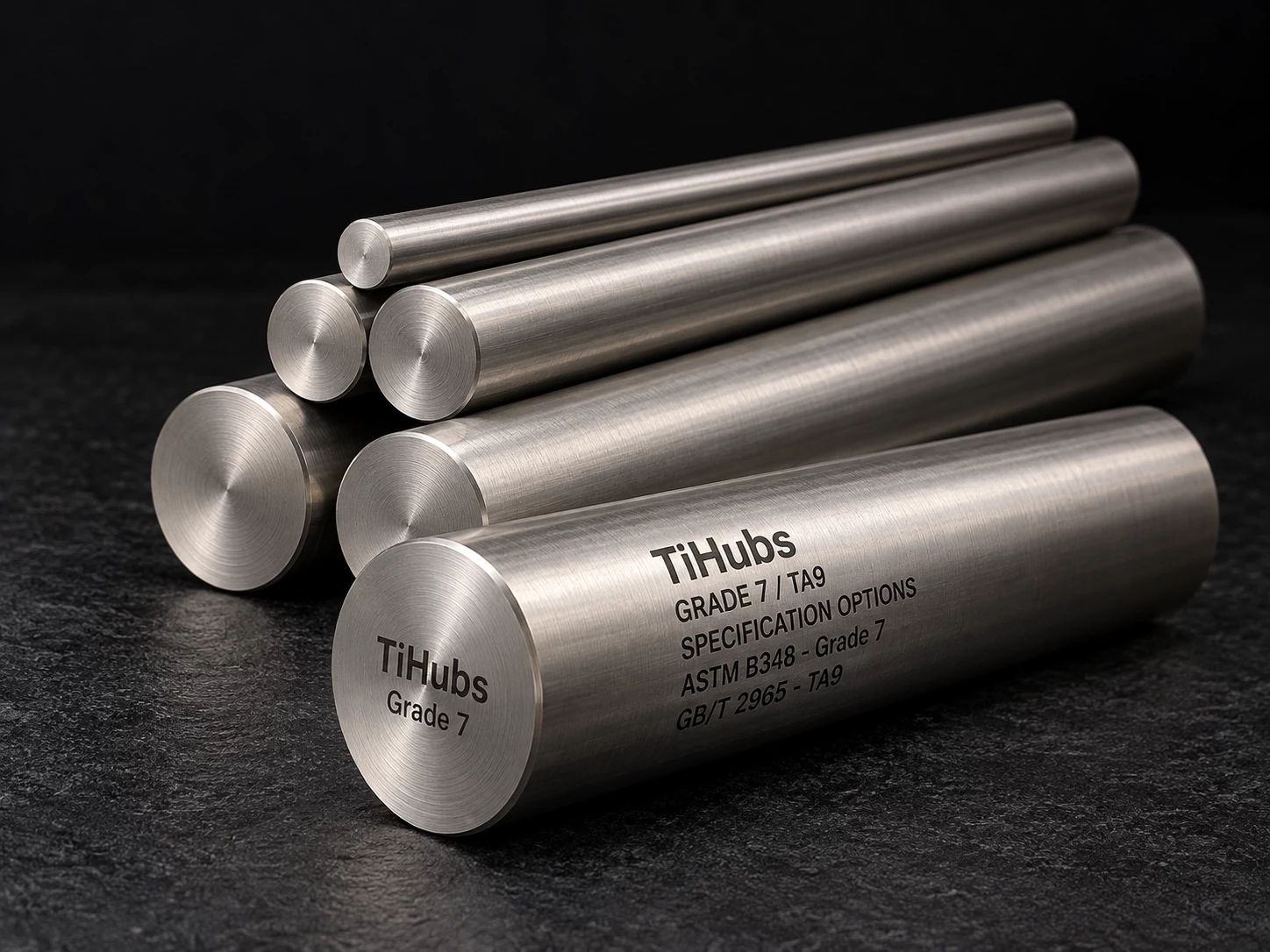
Gr7 / TA9 titanium bar & rod
Stock for valve internals, pump sleeves, seal carriers and other machined wetted components. Match the bar section and condition to the drawing, machining allowance and required inspection.
- Specification
- ASTM B348 Grade 7, or TA9 under GB/T 2965-2023. A shared alloy description does not replace product-specific mechanical requirements.
- Dimensions
- Diameter or section × length; tolerance, straightness, usable cut lengths, surface finish and quantity per size.
- Condition
- Specify the ordered material condition and turned, peeled or ground surface as appropriate to the machining process.
- Acceptance
- Material certificate, heat or lot identity, chemistry and mechanical results; ultrasonic or additional checks where specified.
03 / 06
Grade 7 pipe · TA9 seamless tube route
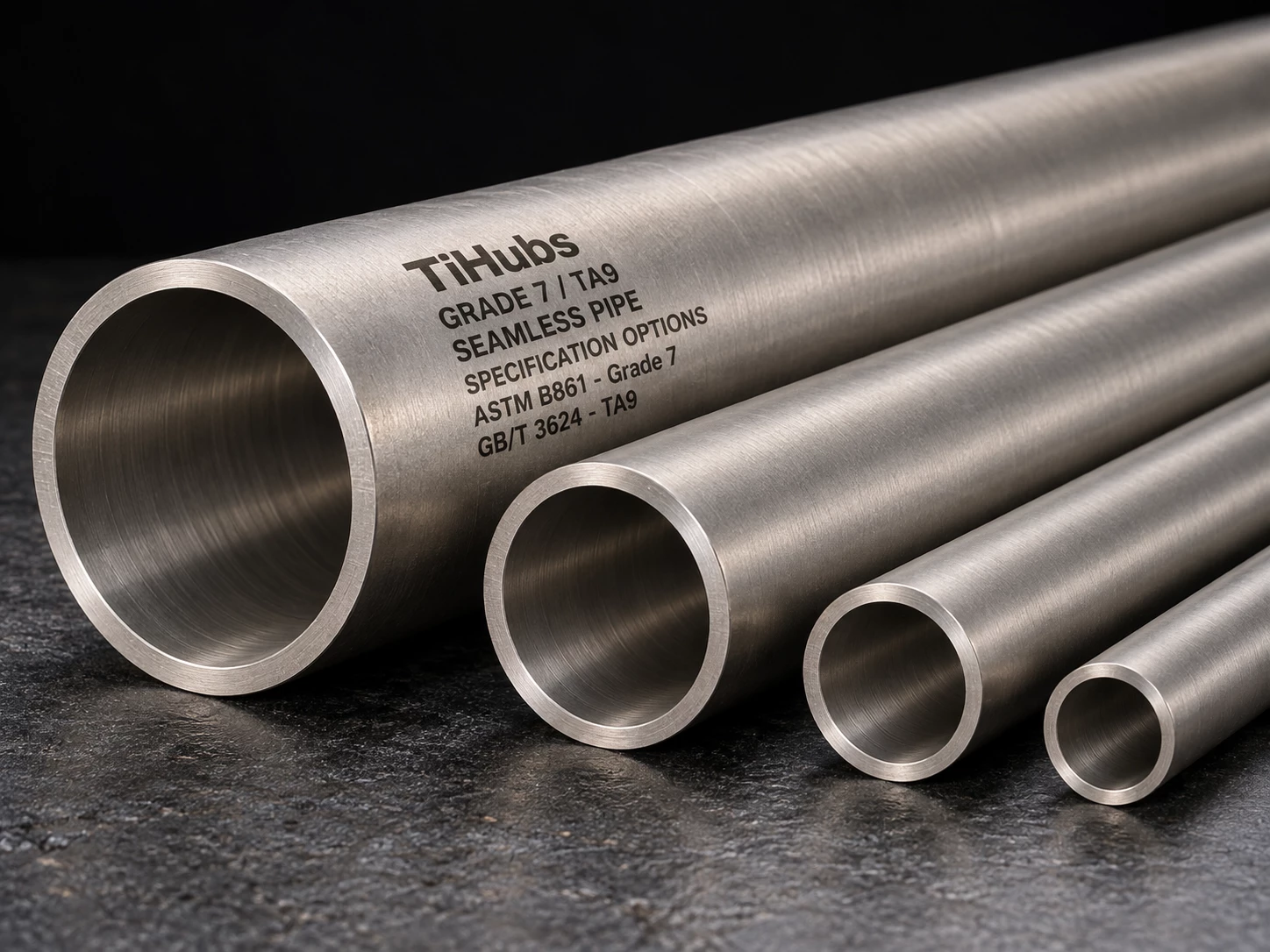
Grade 7 seamless pipe & TA9 tube
Seamless hollow stock for defined process-piping and equipment requirements. State whether you need an ASTM pipe size or a Chinese cold-rolled or cold-drawn tube size; their dimensional scopes differ.
- Specification
- ASTM B861-10 Grade 7 seamless pipe, or TA9 cold-rolled / cold-drawn seamless tube to GB/T 3624-2023 within its specified size scope.
- Dimensions
- NPS and schedule where applicable, or OD × wall × length; wall tolerance, straightness, ovality, end finish and permitted size combinations.
- Construction
- Seamless construction. Welded pipe and heat-exchanger tube are separate ordering routes; confirm condition and surface requirements.
- Acceptance
- Agree dimensional checks, required mechanical and process tests, applicable pressure or nondestructive testing, markings and heat traceability.
04 / 06
Grade 7 / TA9 · Wire and straight lengths
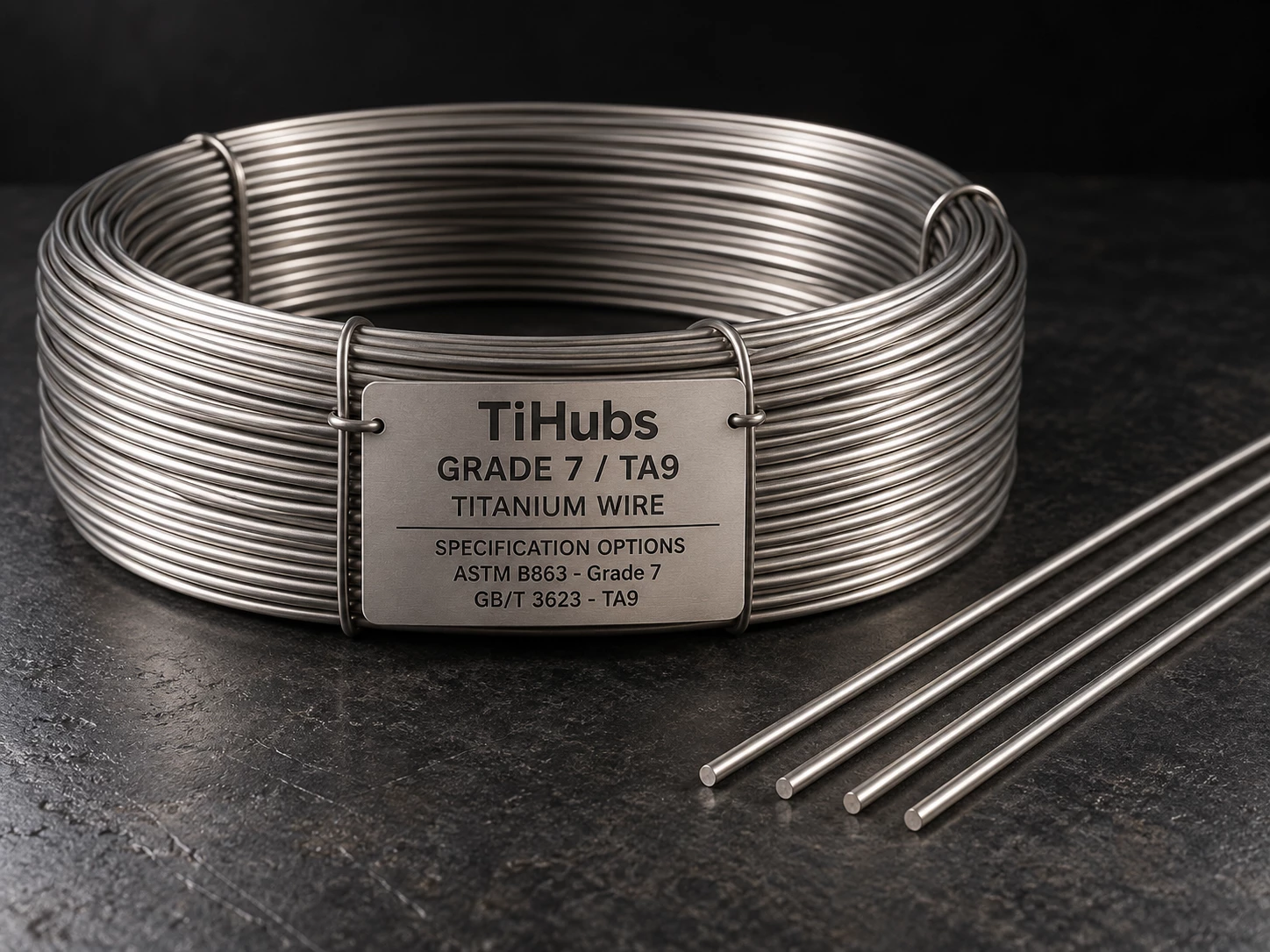
Grade 7 / TA9 titanium wire
For forming, weaving and specified component manufacture. Tell us the wire use before choosing a standard: general structural wire and welding consumables have different ordering requirements.
- Specification
- ASTM B863-19 Grade 7, or TA9 under GB/T 3623-2022 with the intended use stated. This Chinese standard distinguishes structural and welding wire requirements.
- Dimensions
- Diameter and tolerance, coil or straight-length format, cut length, coil weight and quantity.
- Condition
- Agree annealed or other permitted condition, surface cleanliness, straightness and compatibility with the next manufacturing operation.
- Acceptance
- Chemistry and test requirements for the selected use and condition, heat identity, dimensional records and packaging. Specify filler classification separately for welding.
05 / 06
Grade 7 / TA9 · Drawing-based components
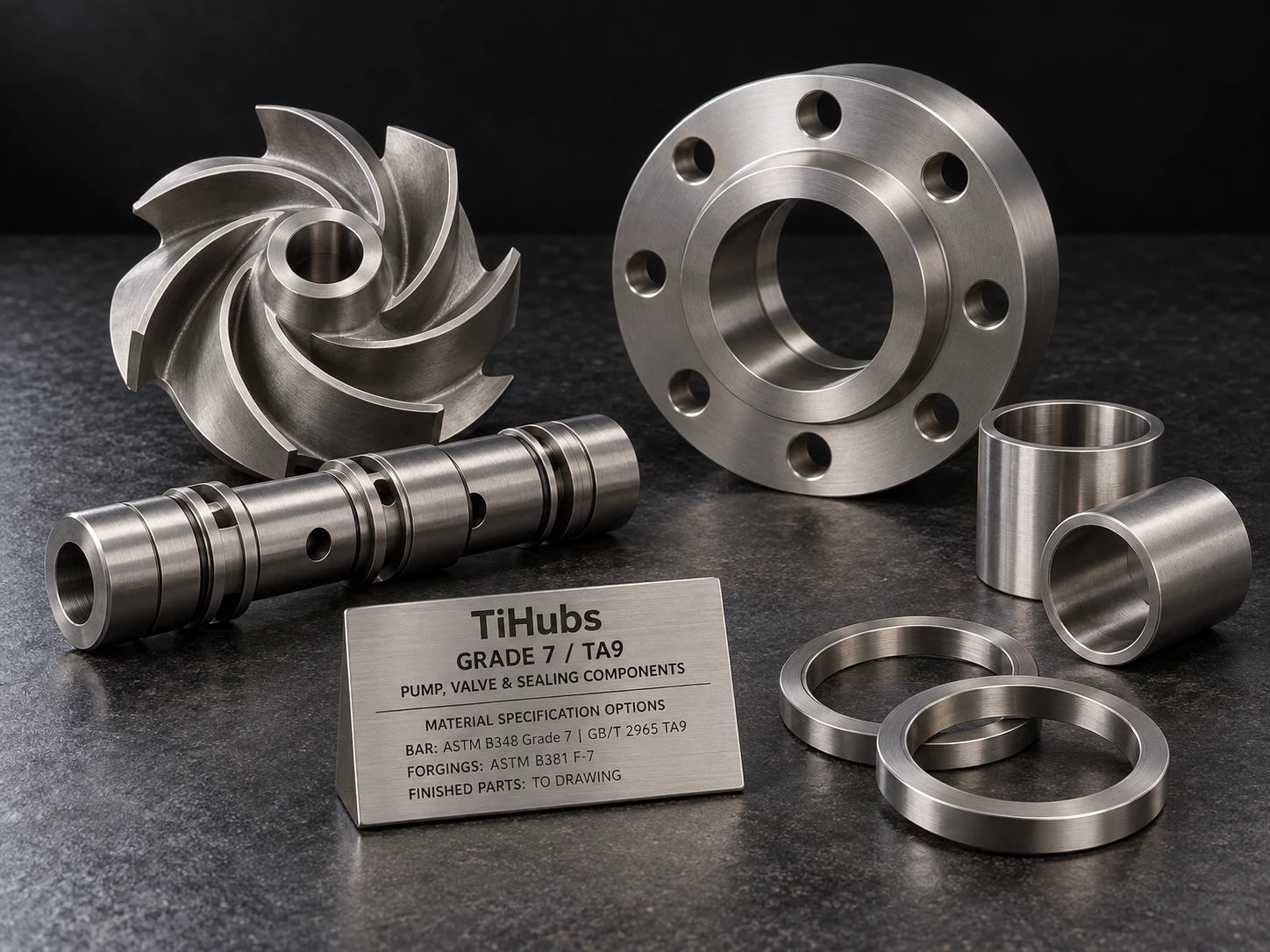
Pump, valve & sealing components
Discuss impellers, valve spools, sleeves, seal carriers, rings and flange blanks for specified chemical-service duties. Define the contact medium and finished-part requirements alongside the starting material.
- Material route
- ASTM B348 Grade 7 or GB/T 2965 TA9 bar; ASTM B381 F-7 forgings where specified. Confirm a separate Chinese forging route when required.
- Drawing
- Revision, critical fits, bore concentricity, sealing-face finish, machining allowance, mating materials and any balance requirement.
- Supply scope
- Raw blank, semi-finished or machined component. A bar or forging specification does not certify an assembled pump, valve or sealing system.
- Acceptance
- Heat traceability, critical-dimensional and surface records, applicable NDT and any drawing-specific checks. Agree sample approval before repeat production.
06 / 06
Grade 7 / TA9 · Heat-transfer components
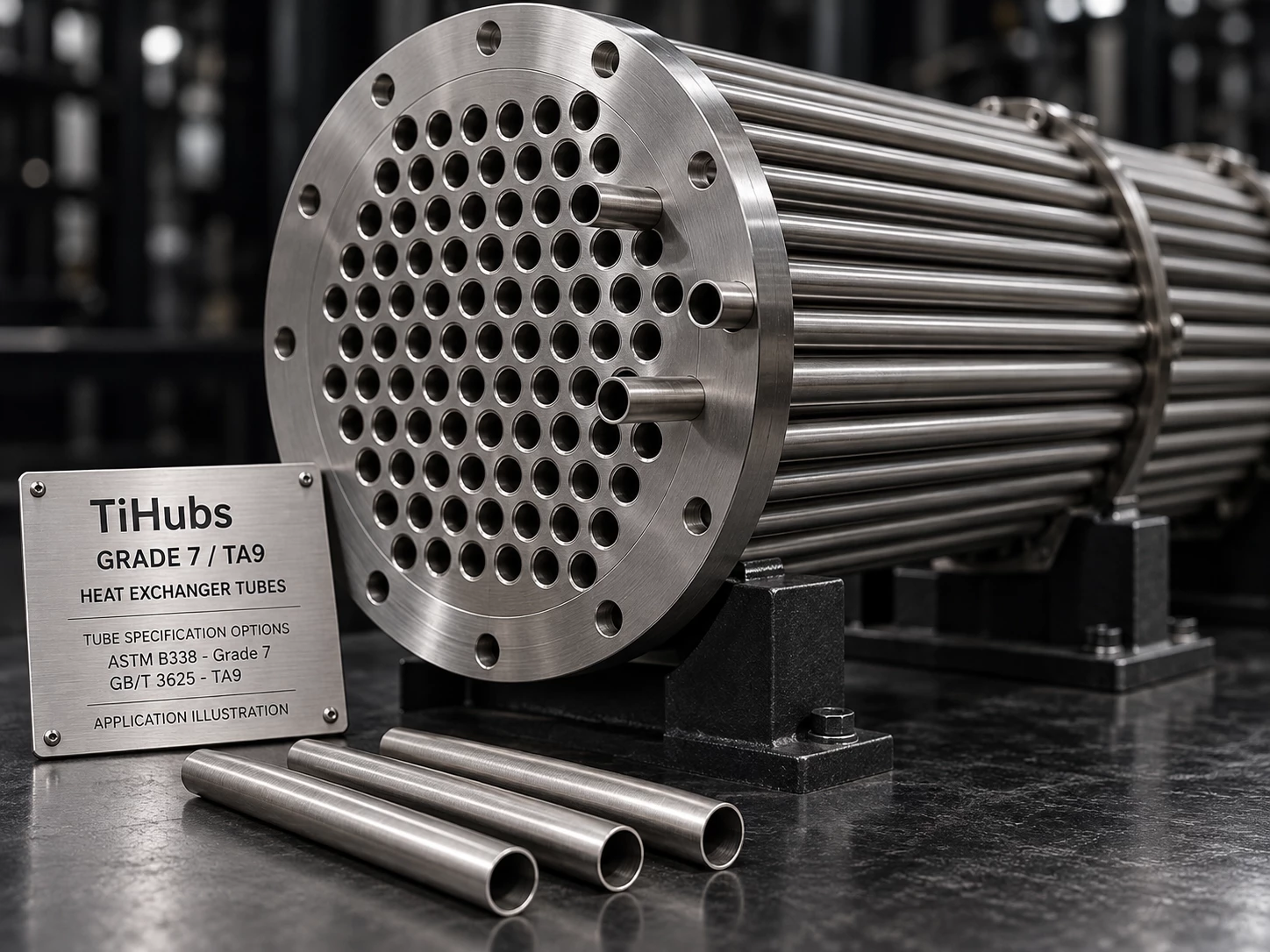
Grade 7 / TA9 heat-exchanger tubes
Material for defined condenser, cooler, heater and evaporator duties. Review both process streams and the tube-to-tubesheet connection, including wall temperature, deposits and cleaning conditions.
- Tube standard
- ASTM B338-08b Grade 7, or TA9 under GB/T 3625-2007. Specify seamless or welded construction and the applicable tube requirements.
- Dimensions
- OD × wall × length, straightness, end preparation and tube quantity. Bending, bundle layout and tubesheet work require their own drawing review.
- Service review
- Medium and concentration on both sides, normal and upset temperatures, design pressure, flow, fouling and cleaning regime.
- Acceptance
- Agree the specified tube testing, tube-end quality and material records. The illustration represents an application, not certification of a complete exchanger.
Images illustrate product forms, machining and specification options. Actual sizes, manufacturing routes and records are agreed for the order; the markings are not certificates or a promise of dual-standard compliance.
Need pipe fittings, blanks or a machined component?
Define the material, drawing and where our supply ends so the quotation covers the work you need.
01 / Custom requirement
Cut stock & machining blanks
Send the finished-part envelope, cutting plan, machining allowance and quantities. Agree how material identity will remain linked to each cut batch.
02 / Custom requirement
Welded pipe & fittings
Share pipe sizes and fitting geometry. Welded pipe, elbows, tees, reducers and stub ends need their own product standards, joint details and inspection scope.
03 / Custom requirement
Drawing-based components
Send the controlled drawing, critical tolerances, wetted surfaces and required records. We review manufacturing feasibility, samples and approval points before confirming the offer.
02 / Material identity
Grade 7, Gr7 & TA9.
Understand the material.
Grade 7 titanium (Gr7, UNS R52400) is a titanium-palladium alloy with 0.12–0.25% palladium. TA9 is the Chinese Ti-Pd designation commonly associated with this alloy family. Its main industrial value is improved corrosion resistance in selected chemical-process conditions.
Palladium improves resistance to certain reducing media and crevice corrosion compared with unalloyed titanium. The actual environment still determines suitability. Order Grade 7 or TA9 against the required product standard; matching principal chemistry does not establish automatic interchangeability.
345MPa
Minimum tensile strength
ASTM B265-08 Grade 7 reference
275–450MPa
0.2% offset yield range
ASTM B265-08 Grade 7 reference
20%
Minimum elongation in 50 mm
ASTM B265-08 Grade 7 reference
| Property or condition | Reference basis | Ordering implication |
|---|---|---|
| Reference condition | Annealed strip, sheet and plate | ASTM B265-08 Table 1 and its footnotes control the acceptance basis. Longitudinal and transverse requirements apply as specified. |
| Other conditions / thick plate | Separate agreement may apply | The edition permits agreed properties for conditions other than annealed or plate over 1 in (25 mm). Do not transfer headline values to every product. |
| Chinese TA9 product route | Use the ordered GB/T product requirements | Plate, bar, wire and tube requirements differ. Evaluate the specified condition, dimensions and test basis before accepting substitution. |
| Density | Approximately 4.51 g/cm³ | A preliminary mass-estimating reference; not a design allowable or shipment acceptance test. |
Selected values from the supplied ASTM B265-08, Table 1. These are material acceptance references, not pressure-design, fatigue or corrosion-service limits.
| Element | Symbol | Grade 7 · B265-08 · mass % | TA9 · GB/T 3620.1-2016 · mass % |
|---|---|---|---|
| Palladium | Pd | 0.12–0.25 | 0.12–0.25 |
| Iron | Fe | 0.30 max | 0.30 max |
| Oxygen | O | 0.25 max | 0.25 max |
| Carbon | C | 0.08 max | 0.08 max |
| Nitrogen | N | 0.03 max | 0.03 max |
| Hydrogen | H | 0.015 max | 0.015 max |
| Titanium | Ti | Balance | Balance |
Selected specified elements only. Apply all remaining-element limits, sampling and analysis rules in the controlling standard. These similar limits do not replace product-property, condition or inspection requirements.
ASTM B265-08View PDF ↗GB/T 3620.1-2016View PDF ↗
Wire requires an additional use check: GB/T 3623-2022 refers structural wire to GB/T 3620.1, while its welding-wire table sets separate limits. Do not apply this comparison as a welding-consumable specification.
Grade 7 versus Grade 2
Gr7 contains palladium. Consider it when corrosion data identify a benefit in the actual reducing or crevice-prone environment. Select using the process conditions and lifecycle requirements, rather than assuming the higher-alloyed option is necessary for every duty.
Grade 7 and Chinese TA9
Use either purchasing term on this page. Specify the complete product standard, edition and condition. If both routes are required, review chemistry, properties, tests and records for the same supplied lot before claiming dual conformity.
Grade 7 versus Grade 7H
The supplied B265 edition gives Grade 7H a higher minimum tensile requirement. Do not assume Grade 7 meets an H-grade order; keep the full designation and applicable pressure-equipment requirements explicit.
TA9 versus TA9-1
These are distinct designations. The supplied Chinese composition and product standards distinguish them; retain the suffix on the drawing and purchase order and review the corresponding chemistry and mechanical requirements.
Technical references: ATI CP Grade 7 ↗ · TIMET corrosion-resistance guide ↗. Confirm the actual service envelope with the responsible design or corrosion engineer.
03 / Chemical-process applications
Chemical-process equipment.
Start with the service duty.
Grade 7 / TA9 titanium is considered for wetted equipment exposed to selected reducing media, hot brines and crevice-prone conditions. Review the fluid chemistry, operating envelope and component design together before defining the material supply.
Application review / 01
Reactors, linings & wetted equipment
For chemical-processing or storage duties where the medium is mildly reducing or changes between oxidizing and reducing conditions, Grade 7 / TA9 can be considered for corrosion-sensitive wetted surfaces. Typical enquiries concern reactor internals, liners, baffles and fabricated parts; the vessel design determines where this alloy is appropriate.
Products to discuss
Plate and sheet for fabrication; bar or forgings for machined wetted connections, agitator hubs and drawing-based parts. Identify whether the request is for raw material, blanks or finished components.
What we need to review
List the medium and every significant impurity, concentration range, operating and upset temperatures, pressure or vacuum, liquid/vapour exposure, mixing conditions and cleaning chemicals. Include lining details, welds and drawing revisions.
Application review / 02
Heat exchangers, condensers & coolers
Heat-transfer service can expose the metal to a different temperature and chemistry from the bulk process fluid. Grade 7 / TA9 enquiries should address tube-to-tubesheet crevices, deposits, concentrated residues and cleaning cycles, as well as the resistance required in both process streams.
Products to discuss
B338 Grade 7 or GB/T 3625 TA9 tubes; separately specified plate, forging stock or machined parts for tubesheets and connections. Define straight tubes, bent tubes or a drawing-based component scope.
What we need to review
Provide both fluids and concentrations, inlet/outlet and expected wall temperatures, design pressure, flow conditions, tube OD/wall/length, joining method, fouling assumptions and inspection requirements.
Application review / 03
Hot-brine heaters, evaporators & concentrators
Heating and evaporation can concentrate salts and change the local pH while deposits create narrow stagnant spaces. Palladium-bearing titanium has improved crevice-corrosion resistance in selected hot chloride environments, making Gr7 / TA9 a material option to evaluate for brine heating and concentration equipment.
Products to discuss
Heat-exchanger tubes, seamless hollow stock, plate and selected fittings or machined connections. State the supplied form for each item rather than treating an evaporator as a single material specification.
What we need to review
Identify salt composition, chlorides and other ions, pH, concentration through the process, normal and upset temperatures, precipitation and scaling, vacuum conditions, cleaning and shutdown exposure.
Application review / 04
Process lines, welded pipe & fittings
In a corrosive process line, elbows, branches, welds and dead legs can experience conditions unlike a straight flowing section. Grade 7 or TA9 supply should follow the piping design and corrosion review, with seamless pipe, welded pipe and fittings identified separately on the bill of materials.
Products to discuss
ASTM B861 seamless pipe or B862 welded pipe; ASME SB-363 WPT7 fittings where specified. Chinese TA9 tube and fitting routes must match the dimensional and manufacturing scope of the selected GB/T standards.
What we need to review
Provide the line list, medium, concentration, pressure/temperature envelope, NPS/schedule or OD/wall, fitting dimensions, joint preparation, design code and required weld, pressure and nondestructive testing.
Application review / 05
Impellers, valve spools & pump sleeves
Wetted pump and valve parts require both corrosion resistance and an appropriate mechanical design. For Grade 7 / TA9 machining enquiries, distinguish the material requirement from the assembly’s flow, wear, sealing and performance requirements. The application image illustrates component types for discussion.
Products to discuss
Bar or forging blanks for impellers, valve spools, sleeves and other wetted parts; machining to a controlled drawing. Agree which surfaces contact the process fluid and where a different mating material is specified.
What we need to review
Send drawing revision, operating medium, solids content, temperature, flow or cavitation concerns, rotational speed where relevant, critical fits, surface finish and balancing or inspection criteria.
Application review / 06
Sealing interfaces & crevice-prone connections
A gasket, flange face, sleeve interface or deposit can create a locally depleted and more aggressive solution. Grade 7 / TA9 may be selected to improve resistance in such locations after service review. Material choice works together with connection geometry, surface condition and the selected seal system.
Products to discuss
F-7 forging stock where specified, TA9 or Grade 7 bar, machined rings, seal carriers, sleeves and flange blanks. A forging material standard does not determine the finished flange’s dimensions or pressure rating.
What we need to review
Specify mating materials, gasket or seal type, sealing-face geometry and finish, tolerances, fastening loads, relevant design standard, pressure/temperature rating and the component acceptance plan.
Application review / 07
Thermal desalination & heated saline-water duties
For thermal desalination and heated saline-water systems, evaluate Grade 7 / TA9 where temperature, deposits or tight crevices make additional corrosion resistance useful. Selection should be based on the specific heater, condenser or concentrated-brine duty and the engineering assessment.
Products to discuss
Heat-transfer tubes, selected plate, pipe and connection parts. Define the equipment stage and whether material is for new fabrication, a replacement tube batch or a drawing-based spare.
What we need to review
Provide salinity and other dissolved constituents, pH, temperature profile, concentration factor, oxygen conditions, scaling, chemical dosing, cleaning regime and any interaction with dissimilar metals.
Application review / 08
High-salt wastewater & recovery equipment
High-salt industrial wastewater can contain changing acids, chlorides, organics and impurities, so an industry label alone cannot determine alloy suitability. Grade 7 / TA9 can be reviewed for defined heat-transfer and evaporation duties when composition data and corrosion evidence support the choice.
Products to discuss
Tubes, plate, process-pipe items and drawing-based wetted components. Coordinate the required forms and records so replacement or fabrication work can proceed against the same agreed scope.
What we need to review
Send a representative analysis and expected variations, pH, temperature, solids, scaling and cleaning information. Identify fluoride-bearing or strongly reducing constituents and any need for representative corrosion testing.
Material selection is specific to the process. An application description or product image does not establish resistance to every acid, chloride solution or operating condition. Define raw material, fabricated parts and finished-equipment responsibilities separately.
Corrosion basis: TIMET — Corrosion Resistance of Titanium ↗ · ATI — Grade 7 material data ↗. The equipment examples organize supply enquiries; actual suitability requires the project’s engineering review.
Chemical-service review / Before quotation
What makes a chemical-service requirement complete?
The same alloy can behave differently as the process changes. Connect material selection, component geometry and the evidence needed for acceptance.
Define the complete medium
Include acids, chlorides, other salts, pH, water content, dissolved oxygen and relevant impurities. Certain reducing-acid conditions may benefit from Ti-Pd alloying, but acid name alone is insufficient: concentration and temperature matter. Fluoride-bearing and strongly reducing mixtures need particular review.
Define normal and upset conditions
State operating and maximum temperatures, pressure or vacuum, flow, solids, local wall temperatures, stagnant periods, deposits and cleaning cycles. Describe crevices at joints, gaskets and tube ends. Where service data are insufficient, discuss representative corrosion testing with the responsible engineer.
Define the supply and evidence
Identify Gr7 or TA9, each product standard and edition, dimensions, condition, quantity and drawing. List heat-linked chemistry including Pd, mechanical records, NDT or pressure tests, witness points and traceability. Agree what is included in the quotation before production.
Example: a useful Grade 7 / TA9 chemical-equipment enquiry
Material and product: Grade 7 seamless pipe to the specified ASTM B861 edition, or TA9 tube to GB/T 3624-2023 within that standard’s dimensional scope; required condition; NPS/schedule or OD × wall × length; tolerances and quantity.
Service and acceptance: process medium and analysis, concentration range, normal/upset temperature, design pressure, joining method, drawing revision, required material certificate, pressure/NDT scope, destination and target timing.
For plate, bar, heat-exchanger tube or machined parts, substitute the relevant product specification. If both ASTM and GB/T conformity are required, state both explicitly so the same lot and records can be evaluated.
04 / Standards & documentation
Grade 7 / TA9 standards.
Choose the product route.
Specify the material designation, product form, edition and acceptance requirements together. Gr7 and TA9 are useful enquiry terms; the ordered ASTM, ASME or GB/T specification defines the actual delivery scope.
| Material or product route | ASTM / ASME route | Chinese standard route | Clarify before quotation |
|---|---|---|---|
| Material identity | Grade 7 · UNS R52400
Gr7 is the short form used on this page. Apply chemistry and analysis rules from the ordered product standard. |
GB/T 3620.1-2016View PDF ↗
TA9 titanium-palladium alloy. Keep TA9 and TA9-1 distinct and apply the controlling product specification. |
Full designation, standard edition, chemical-analysis basis and any explicitly required dual conformity. |
| Sheet & plate | ASTM B265-08View PDF ↗
Grade 7 strip, sheet and plate; annealed or explicitly agreed condition. |
GB/T 3621-2022View PDF ↗
TA9 plate and sheet with product-specific mechanical requirements. |
Thickness, plate size, flatness, surface, rolling direction, cut edges and required inspection. |
| Bar & rod | ASTM B348-08aView PDF ↗
Grade 7 bars and billets. |
GB/T 2965-2023View PDF ↗
TA9 bars; confirm section, condition and dimensional class. |
Section size, straightness, surface, cut lengths, chemistry, mechanical records and any NDT. |
| Seamless pipe / tube | ASTM B861-10View PDF ↗
Grade 7 seamless process pipe. |
GB/T 3624-2023View PDF ↗
TA9 cold-rolled or cold-drawn seamless tubes. The supplied standard’s size matrix covers OD 3–110 mm and walls 0.2–5.5 mm; not every combination is permitted. |
Pipe or tube designation, actual permitted size combination, condition, end preparation and agreed testing. A standard range is not a stock list. |
| Heat-exchanger tubes | ASTM B338-08bView PDF ↗
Grade 7 seamless or welded tubes for condensers and heat exchangers. |
GB/T 3625-2007View PDF ↗
TA9 tubes under the supplied heat-exchanger/condenser edition. |
OD, wall, length, joining method, process side and utility side, tube testing and heat traceability. |
| Wire | ASTM B863-19View PDF ↗
Grade 7 wire; define the intended use and condition. |
GB/T 3623-2022View PDF ↗
TA9 wire: distinguish structural use from the standard’s separate welding-wire requirements. |
Diameter, tolerance, condition, coil or straight lengths, use-specific chemistry and required documentation. |
| Forgings & machined blanks | ASTM B381-08aView PDF ↗
F-7 annealed forgings. This material designation is distinct from the finished part’s drawing requirements. |
Chinese forging route by agreement
Specify TA9 and the applicable forging product standard, drawing and acceptance scope. A bar standard is not a blanket forging specification. |
Blank dimensions, allowance, finished-part drawing, heat treatment, test location, NDT and approval milestones. |
| Welded pipe / tube | ASTM B862-06bε1View PDF ↗
Grade 7 welded process pipe; keep it distinct from seamless pipe. |
GB/T 26057-2010View PDF ↗
TA9 welded tube. The supplied edition’s thin-wall size matrix is OD 10–38 mm and wall 0.5–2.1 mm, subject to permitted combinations. |
Construction, size scope, weld seam requirements, condition, testing, end finish and identification. |
| Seamless & welded fittings | ASME SB-363 · 2013View PDF ↗
WPT7 fittings. The supplied file is ASME SB-363 in the 2013 BPVC, Section II, Part B, based on ASTM B363-06a with mandatory certification. |
GB/T 27684-2011View PDF ↗
TA9 fitting route for specified elbows, tees, reducers and other covered fitting types. |
Fitting geometry, seamless/welded route, size and wall, end preparation, certification and the controlling piping design requirements. |
Specify the required edition on your order. The reference files retain the editions shown above. Confirm the product form, material designation, condition and acceptance requirements with your purchasing specification before quotation.
Review material and fitting specifications alongside the equipment design, applicable pressure code and project approval requirements. Request heat-linked material certificates for the actual supplied items; reference PDFs describe the standard itself.
05 / Order coordination
Know the scope
before ordering.
Our founder’s 20 years in titanium help us clarify the specification, review relevant manufacturing resources and coordinate the requirements your purchasing and quality teams need.
Chemical-equipment procurement / Clear supply scope
Know what arrives.
Know what supports it.
TiHubs connects material requirements, local manufacturing resources and order follow-up through one contact. Agree the Grade 7 or TA9 material route, processing and records as one defined supply scope.
- Material
- Standard and edition, product form, condition, size and quantity.
- Processing
- Raw stock, cut blanks or drawing-based work, with the required approval points.
- Evidence
- Heat/lot identity and the material, dimensional and inspection records agreed for the order.
A local network of 100+ titanium factories gives us supply options. Resources are reviewed for each requirement; network size is not a blanket qualification claim.
A quotation you can evaluate
Agree the grade, standard edition, dimensions, tolerance, condition and quantity before comparing prices.
- Identify whether inspection, samples and tooling are included.
- Confirm packaging, transport and delivery terms.
- Record items that still need technical confirmation.
Acceptance agreed before supply
Confirm the grade, palladium analysis, material condition, heat or batch identification, mechanical records and required dimensional or additional testing before supply starts.
Agree the scope, timing, acceptance criteria and cost of samples, pressure or NDT checks and independent inspection. Any service-specific corrosion testing needs its own method and acceptance basis.
Delivery with clear milestones
Review the proposed lead time, approvals, production sequence and dispatch requirements. For several product forms, coordinate document and packing readiness together.
Material substitutions and technical changes require written approval. A schedule deviation should identify the impact, decisions needed and next steps.
One contact when an issue arises
Contact TiHubs with the order reference, affected items and supporting photos or inspection records.
We record the issue, review it against the agreed requirements and coordinate the next steps with the relevant manufacturing parties.
01 / Material identity
Material records
Full Grade 7 / Gr7 or TA9 designation, standard edition, condition, chemistry including Pd, test results and heat or lot identity linked to the supplied items.
02 / Agreed acceptance
Inspection records
Records for the agreed inspection scope, including critical dimensions, metallurgical checks or additional testing where specified.
03 / Ready for dispatch
Dispatch records
Item identification, packing list, protective packaging and required shipment documents.
06 / Questions before sourcing
Before you source
Grade 7 / Gr7 / TA9.
Start with the material or component you need. A clear specification, service description and acceptance scope help your purchasing and engineering teams evaluate the same offer.
A useful first enquiry
- Product and specificationGrade 7 / Gr7 or TA9, product form, standard edition, condition, dimensions and drawing revision.
- Service and deliveryMedium, concentration, temperature, quantity, destination and required timing.
- Acceptance requirementsHeat traceability, Pd analysis, material records, critical dimensions and required testing or witnessing.
Not every detail is finalized? Send the information you have. We can help identify the questions to resolve before quotation.
What happens next: requirement review, technical clarification, then a supply proposal and quotation.
What is Grade 7 titanium, and does Gr7 mean the same grade?
Grade 7 titanium is a titanium-palladium alloy identified as UNS R52400, with 0.12–0.25% palladium in the referenced ASTM requirements. Gr7 and Gr.7 are common shortened ways to write Grade 7. On a purchase order, include the full product specification, edition, form, condition and dimensions.
Is TA9 the same as Grade 7 titanium?
TA9 is the Chinese titanium-palladium designation commonly associated with the Grade 7 alloy family. The selected principal chemical limits align in the supplied comparison, but product properties, conditions, dimensions, analysis rules and inspection requirements must still be reviewed. TiHubs handles both enquiries on this page; dual conformity requires supporting evidence for the supplied material.
What are the main chemical-equipment uses of Grade 7 / TA9?
Typical enquiries concern corrosion-sensitive reactor internals and linings, heat-exchanger tubes, hot-brine and evaporation equipment, process-piping items, pump or valve internals and sealing connections. The application must be assessed using the complete medium, concentration, temperature and component design; an equipment name alone does not establish suitability.
Why consider Grade 7 instead of Grade 2?
The palladium addition can improve resistance to selected reducing media and crevice corrosion. Compare the actual service conditions, available corrosion evidence, required life and material cost. Grade 7 is not automatically necessary for every duty already suitable for unalloyed titanium.
Does Gr7 titanium resist every acid or chemical mixture?
No. Concentration, temperature, water content, impurities and oxidizing or reducing conditions all matter. Fluoride-bearing and strongly reducing environments need specific review. Provide the full process analysis and any operating changes; the responsible engineer may require representative corrosion testing before selecting material.
How are seamless pipe and heat-exchanger tube different?
ASTM B861 covers seamless pipe, while ASTM B338 covers seamless and welded tubes for condensers and heat exchangers. Specify the intended use, dimensions and testing. Chinese GB/T 3624 and GB/T 3625 also have their own product scopes; they should not be treated as identical substitutes solely because the material is TA9.
Can you quote welded pipe, elbows and other fittings?
Send the pipe or fitting type, material, dimensions, wall thickness, construction, quantity and design requirements. Grade 7 welded pipe can be reviewed to ASTM B862; the supplied ASME SB-363 file includes WPT7 fittings. Chinese TA9 welded-tube and fitting routes require the relevant GB/T scope and size checks. Availability and manufacturing feasibility are confirmed with the quotation.
What does F-7 mean on a titanium forging requirement?
F-7 is the Grade 7-type titanium-palladium forging designation in ASTM B381. It describes the forging material route. The finished flange, pump part or seal component still needs its own drawing, dimensions, surface requirements, applicable design rules and inspection plan.
Can you supply pump, valve and sealing components to drawing?
We can review raw blanks, semi-finished parts and machining enquiries for items such as impellers, valve spools, sleeves, rings and seal carriers. Send the controlled drawing, wetted-service conditions, material specification, critical tolerances and inspection scope. We confirm the feasible manufacturing route and supply boundary before quotation.
Is Grade 7 wire automatically suitable as welding filler?
No. State the welding process, required filler classification and consumable specification. ASTM B863 material wire alone does not establish all welding-consumable requirements. GB/T 3623-2022 also distinguishes structural and welding-wire requirements, so the intended use must be explicit.
Can you provide material certificates, Pd analysis and third-party inspection?
Define the certificate and analysis requirements during quotation, including palladium, the other required elements, mechanical results and heat or lot identity. Dimensional records, NDT, pressure tests, samples and independent inspection can be discussed with their scope, timing, acceptance criteria and costs agreed for the order.
What are the MOQ, available sizes and delivery time?
These depend on product form, dimensions, condition, quantity, processing and inspection. Send your size list and destination for review. A photograph or a standard’s dimensional range does not mean every size is stocked; proposed supply quantities and lead time are confirmed in the quotation.
How do I send a useful Grade 7 / TA9 RFQ?
Include Grade 7 or TA9, the standard and edition, product form, dimensions and tolerances, condition, quantity and destination. For chemical service, add the medium, concentration, operating and upset temperatures, drawing and required records. You can start with incomplete information; TiHubs will identify the details still needed.
Who coordinates technical changes or an order issue?
TiHubs remains your technical and commercial contact. Material substitutions and changes affecting agreed requirements need written approval. If an issue arises, we record it, review the supplied evidence against the order requirements and coordinate the next steps with the relevant manufacturing parties.
07 / Your next step
Start with the
requirement you have.
Send your Grade 7, Gr7 or TA9 titanium requirement, drawing or service conditions. We review the information, clarify missing details and discuss the appropriate product and supply route before preparing a quotation.
- Requirement review
- Technical clarification
- Supply proposal and quotation
Bring the process conditions.
Include medium and concentration, normal and upset temperatures, pressure, deposits and cleaning. Identify the wetted part and your controlling material specification.
Bring the supply and acceptance scope.
List forms, sizes, quantities, drawing revisions, material records and inspection requirements. Include items that must arrive together, the destination and target timing.
Baoji, China · info@tihubs.com
Start your Grade 7 / TA9 enquiry
Tell us what you need. Details can be clarified after your first enquiry.