AI illustration; not a production or inspection record.
Quick answer
Ti-1023 is Ti-10V-2Fe-3Al, a near-beta forging alloy; Ti-6Al-4V is an alpha-beta alloy. Compare the approved product routes using the final condition, section and required property package. Historical Ti-1023 entries demonstrate that strength requirements vary within one alloy; they are not a current specification or a universal ranking against Ti-6Al-4V.
01 / Define the decision
A stronger alloy name is not a complete forging requirement
Ti-1023 vs Ti-6Al-4V is a meaningful comparison when a buyer is evaluating stock or forgings for a highly loaded structural component. Ti-1023 is the shorthand for Ti-10V-2Fe-3Al; Ti-6Al-4V is commonly associated with Grade 5. The purchasing decision needs to connect that identity to the final condition, geometry and acceptance requirements of the actual part.
TIMET identifies Ti-1023 as a near-beta forging alloy, while its Ti-6Al-4V datasheet describes an alpha-beta alloy. These classifications help explain why the processing discussion matters. They do not establish a universal winner or allow one stock item to replace another without reviewing the drawing, specification and evidence required for the component.
Begin by identifying the reason for comparison. Is the buyer trying to source an existing approved part, evaluate an engineering change, reduce machining from an oversized blank or understand a proposed alternative? Each task needs different information. A supplier’s availability proposal can start a technical review, but it cannot by itself approve a material substitution.
For an existing design, retain the complete approved callout and request quotations against it. If another alloy or condition is offered, record the change separately. For a new design, purchasing can help establish available forms and production constraints while engineering defines the performance and qualification basis. Avoid turning an exploratory price request into an implicit commitment to a new material route.
State what will actually be purchased: billet for subsequent forging, a forged blank, a rough-machined preform or a finished inspected component. A bar cut to length may be a useful starting product for some routes, but it is not automatically equivalent to a specified forging. Product form and delivered stage are part of the technical identity of the order.
The Ti-1023 and Grade 5 Ti-6Al-4V pages can be used to begin an enquiry. Provide the specification, condition, critical dimensions and intended next operation. Ask the supplier to identify the exact offered route and its limitations rather than simply confirming that the alloy name appears in a catalog.
A useful comparison ends in an order that can be inspected and accepted. It identifies which requirements are fixed, which alternatives are under review, what material is delivered and what evidence accompanies it. That outcome is more valuable than selecting a headline strength that does not correspond to the proposed product or final component state.
02 / Identity and condition
Read the alloy and the property context together
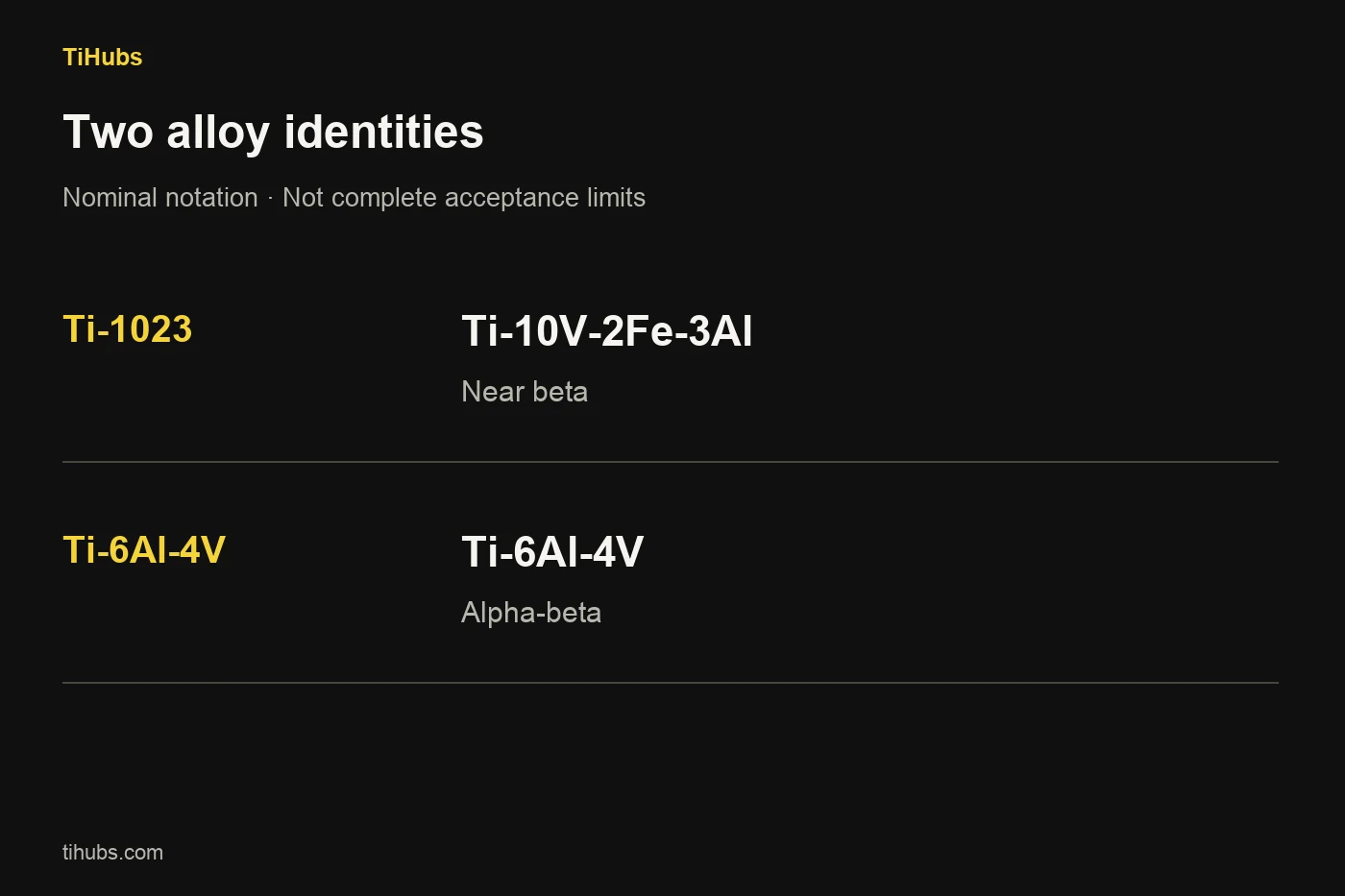
The identity table uses nominal alloy notation from TIMET’s manufacturer datasheets. Nominal percentages are a naming aid, not full chemistry acceptance limits or exact certificate targets. The governing product specification determines the actual permitted ranges and other controlled elements. Keep that distinction visible when reviewing a supplier’s material description.
Nominal identity, not complete chemical acceptance limits
Item
Ti-1023
Ti-6Al-4V
Alloy notation
Ti-10V-2Fe-3Al
Ti-6Al-4V
Named nominal additions, mass %
10 V; 2 Fe; 3 Al
6 Al; 4 V
Manufacturer classification
Near beta
Alpha-beta
Acceptance basis
Controlled product specification and condition
Controlled product specification and condition
Even within one alloy, a property requirement can change with the specified condition and section. TIMET’s historical Ti-1023 sheet illustrates this by listing different AMS-linked strength requirements and maximum sections. The following extract preserves those distinctions. It is not a comparison against Ti-6Al-4V, a current AMS reproduction or a recommendation to select a heat-treatment cycle.
The source presents solution-treated material subsequently aged for eight hours, with different aging-temperature bands for the three entries. It also reports other acceptance properties that are not reproduced here. Test temperature and specimen direction are not stated in that table; no assumption is added. Consult the current agreed specification for complete requirements, processing and applicability.
The point of the extract is that one alloy name does not mean one strength requirement. The rows cannot be treated as interchangeable grades, nor should their highest value be assigned to every Ti-1023 section. For Ti-6Al-4V, similarly distinguish annealed material from other thermal conditions and keep the relevant product and section limits attached to the evidence.
When a bid includes a mechanical table, ask whether it contains specification minima, typical results or actual tests of the offered lot. These answer different questions. A certificate result above a minimum may support that lot’s acceptance, but it does not establish a new design allowable or qualify a different material route.
Use a comparison sheet with separate fields for source, edition, product, size, condition, test temperature, direction and result type. An empty field signals a question to resolve, not permission to infer a convenient value. This method allows genuine numbers to remain useful without presenting unmatched tests as a direct ranking.
Nominal alloy notation identifies the family; full chemistry and condition requirements come from the controlled specification.
03 / Strength and toughness
Specify the property package the component actually needs
A high-strength structural component may need evidence beyond tensile and yield strength. Depending on the approved design basis, fracture toughness, fatigue, crack growth, bearing, shear or other properties may matter. The purchaser should identify which requirements are contractual and which remain engineering questions rather than requesting every available test without a defined purpose.
Strength and fracture resistance should be evaluated as a property package in the relevant condition. Do not assume that increasing a tensile requirement improves every other aspect of performance. Ask whether the proposed condition meets all required criteria together. Selecting one desirable maximum while ignoring the associated material state can lead to a specification that the quoted route does not actually satisfy.
For fracture-related evidence, retain the test method, specimen size, orientation, temperature and validity basis required by the project. A toughness number without those conditions may not answer the intended question. If a datasheet provides a typical trend, use it to guide the review; do not turn that trend into a guaranteed result for an arbitrary forging.
For fatigue, identify the relevant loading, environment, surface and geometric conditions. A smooth laboratory specimen and a production part containing features or transitions do not necessarily share the same evidence basis. A material tensile result cannot independently establish fatigue life. The responsible engineering process must determine what data or qualification supports the actual component.
Where a component has a critical lug, bore or other loaded feature, describe the applicable requirements through the drawing and specification. Avoid asking the supplier to infer the full structural assessment from the alloy name. The supplier can confirm material and processing capabilities, while the design authority identifies the performance criteria and approves proposed changes.
Keep uncertainty visible in the bid review. One offer may include the required tensile tests but leave a toughness requirement unaddressed; another may provide relevant evidence for a different section or condition. Record the missing item and the action needed. Neither a polished certificate nor an impressive property table removes the need to align the evidence with the order.
Use an illustrative comparison meeting to separate three decisions: whether the alloy is an approved candidate, whether the proposed route can achieve the required condition, and whether the supplied evidence demonstrates acceptance. These decisions are related but not identical. Resolving them in order avoids spending time comparing prices for a route that cannot yet be accepted.
For repeat production, retain the basis of the accepted property package. If a future quotation proposes a different strength level or thermal route, review the implications for all relevant requirements rather than only the property named in the change request. This keeps the material decision connected to the component’s original engineering purpose.
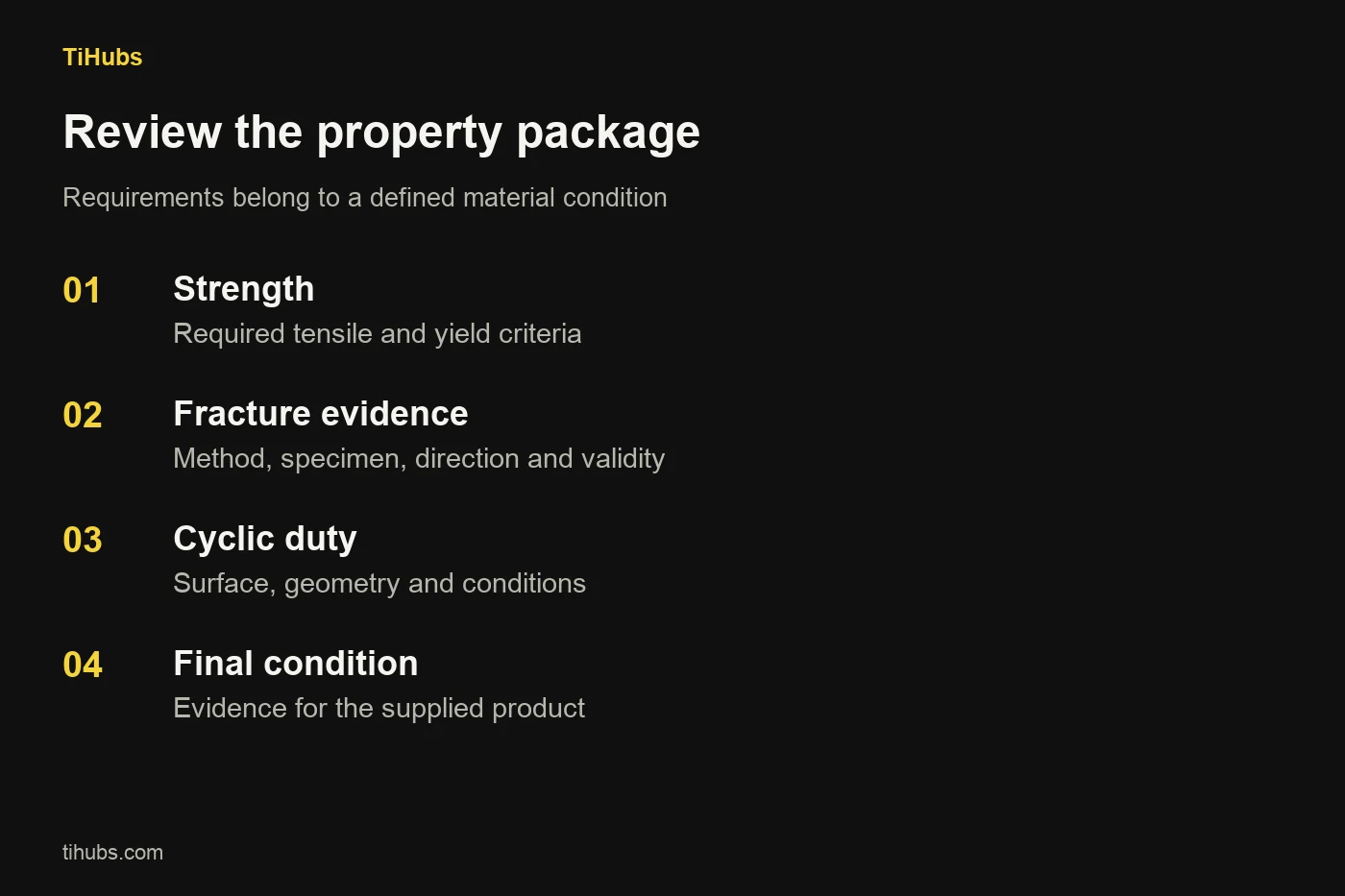
Industrial buying guide / 03Keep the property package together
Review the evidence required for the component, with each test attached to its conditions.
04 / Section and route
Specify the stock that can become the required forging
Section size is a central purchasing detail for a heat-treated forging route. Provide the dimensions and the relevant critical sections, not only the finished part’s overall envelope. The stock and intermediate geometry may differ from the final shape. Identify which stage is represented by each dimension and which section definition governs the applicable material requirement.
For billet or bar intended for further forging, specify the required starting condition and downstream route. For a forged blank, define the stage of thermal processing and inspection already completed. For a rough-machined item, state the remaining allowance and final operations. Each description establishes a different boundary between the stock supplier and the party completing the component.
A near-net-shape proposal can reduce material removal in a particular project, but the benefit must be established from the actual route. Review tooling, minimum production quantities, development work, test material and machining allowance. Do not assume a fixed material saving or cost reduction merely because the Ti-1023 manufacturer literature discusses near-net-shape forging opportunities.
Ask how required sampling will be provided. A test location or orientation may need a prolongation or another approved arrangement in the forging plan. The relationship between specimen and product should be defined before material is removed. An attractive near-net geometry can lose its practical advantage if it omits material needed for the agreed inspection and test package.
For the thermal route, request compliance with the controlled process and material requirements rather than a generic heat-treated label. The responsible processor should identify the delivered condition and retain the required records. Public datasheet cycles can explain terminology, but they should not be copied into a production instruction for a different geometry without the applicable approval.
Plan dimensional verification at the correct stage. A dimension checked before a later operation may not establish the final delivered geometry. Identify final tolerances, reference surfaces and any straightening or finishing requirements through the agreed route. This helps distinguish a stock offer suitable for further work from a product ready for final acceptance.
If the part is supplied through several processors, assign responsibility for maintaining material identification and records at each transfer. The final package should connect the original stock, forging, thermal processing and inspection. A series of individually plausible documents is insufficient if the reviewer cannot show that they relate to the same delivered product.
The titanium bar and rod enquiry route is suitable for describing starting-stock needs; identify forging requirements explicitly when they apply. Include the drawing and process boundary so the supplier can respond with a realistic supply scope. Do not assume that an alloy catalog entry establishes every size, condition or approved production route.
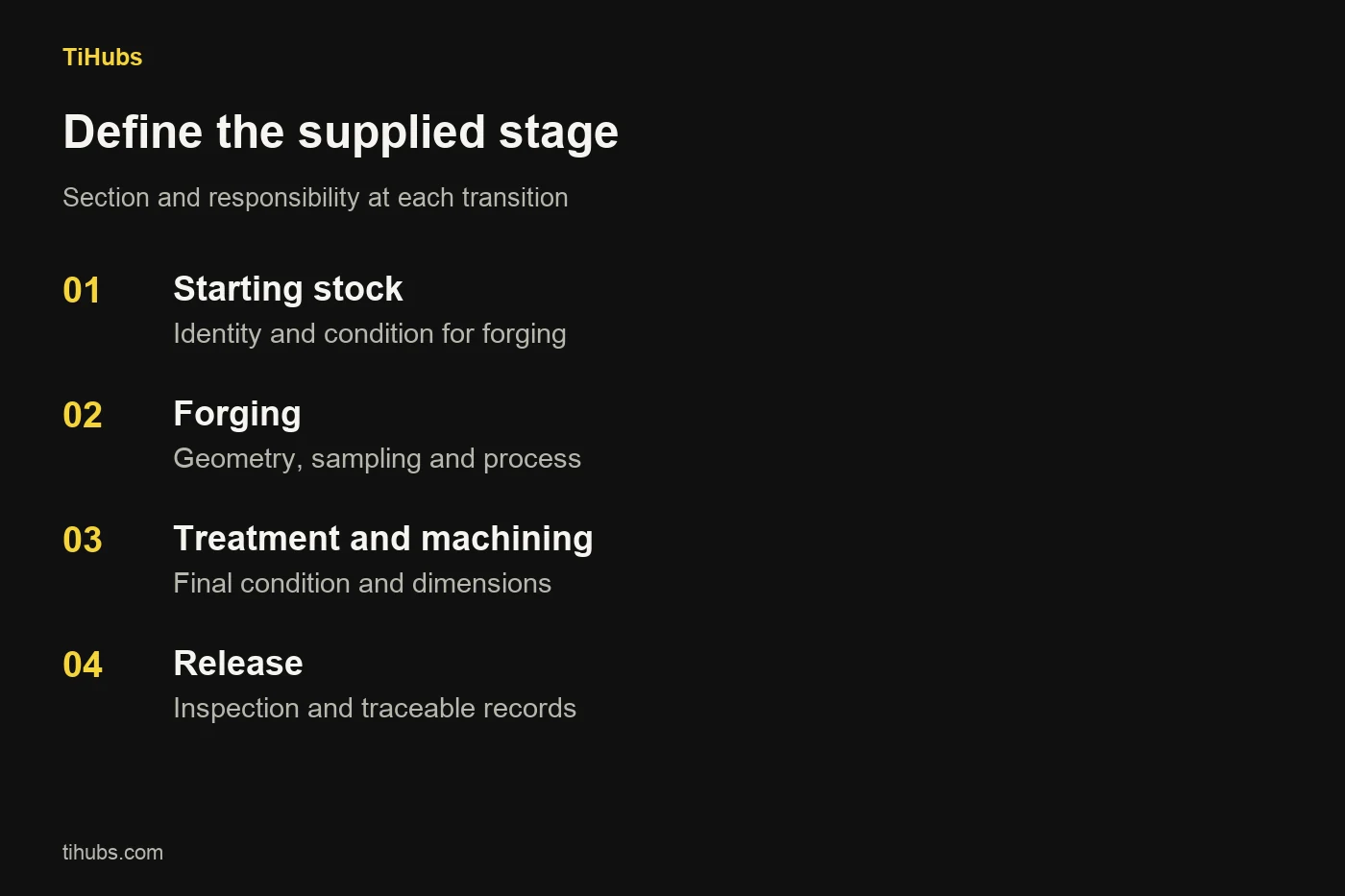
Industrial buying guide / 04Define the supplied production stage
Billet, forging and machined component describe different supply boundaries and verification responsibilities.
05 / Inspection and records
Make the acceptance evidence traceable to the product
Write the inspection package before comparing quotations. Include the required chemical and mechanical documentation, dimensional records, nondestructive examination and any customer-specific approvals. The applicable specification and drawing determine the details. A request for a certificate alone does not tell the supplier which tests, directions, sections or release statements the buyer expects.
Distinguish a sample certificate from the final certificate for the supplied lot. A sample can demonstrate document format or typical information, but it does not prove the properties of material not yet allocated. Ask the supplier to identify the offered heat or lot when relevant and confirm that final records will correspond to the actual delivered product.
Review chemical identity against the complete requirement. Nominal Ti-10V-2Fe-3Al or Ti-6Al-4V notation does not list every controlled element. Verify the agreed specification, edition and variant, including any special chemistry requirements. Do not accept an abbreviated commercial description as a substitute for the material designation required by the order.
For mechanical results, check units, test basis and condition before judging compliance. Keep a reported value separate from the acceptance threshold. If an elongation result uses a different gauge-length basis or a specimen direction is unclear, resolve that context rather than comparing only the numerical percentage. The same discipline applies to any fracture-related result.
For nondestructive examination, specify method, stage, coverage and acceptance basis as required. A generic inspected statement does not define what was examined or which indications were acceptable. The report should be connected to the product and the agreed procedure so the reviewer can understand the scope of the evidence.
Manage deviations explicitly. If a supplier cannot meet a required test arrangement, dimension or condition, identify the proposed alternative before order release. Record the responsible approval and any additional evidence required. A deviation accepted for one order should not silently become the standard for later purchases unless the controlled requirements are changed accordingly.
At receipt, match material identification, quantity, dimensions and documentation before release to production. Preserve the connection when stock is cut or parts move to subsequent processors. If information is missing, keep the affected material identifiable while the discrepancy is resolved. This makes the acceptance process practical without confusing administrative correction with technical approval.
When a quoted section differs from the drawing requirement, ask the supplier to identify the dimension used to establish compliance. A finished dimension, an intermediate heat-treatment section and the starting-stock diameter are not necessarily the same measure. Record the governing definition and supporting evidence in the review, especially when a published requirement includes a maximum section.
If a report lacks a required test condition, request the missing record or an explicit explanation of the applicable basis. Do not infer the condition from the report’s company logo, the usual practice of another supplier or a similar previous order. The evidence should answer the requirement for this material and this supply route.
For a proposed production trial, define what decision the trial is intended to support and how its material represents the planned order. State the acceptance criteria before testing and retain the result together with the tested geometry and processing history. A successful trial supports only the conclusions justified by that relationship.
Keep a concise decision register with the unresolved requirement, responsible reviewer, requested evidence and disposition. Once closed, link the decision to the revised quotation or order document. This prevents an important qualification from remaining only in meeting notes while production proceeds against an incomplete commercial description.
06 / Compare offers
Choose the accepted route, not a headline price per kilogram
Ask each supplier to quote the same delivery boundary and requirement set. Identify the alloy, form, dimensions, quantity, final condition, inspection and documentation. If one route is still awaiting engineering approval, label it as a conditional alternative. A price for an unapproved option should not be treated as a compliant competing bid.
Compare the total cost of usable delivered product. Include starting-stock quantity, machining allowance, tooling, development, thermal processing, tests and documentation where applicable. Separate one-time costs from recurring costs. The economic result depends on the actual part and order quantity, so a universal Ti-1023 versus Ti-6Al-4V price multiplier would be misleading.
Distinguish inventory availability from production feasibility. A supplier may have material in an alloy family but not the required size, condition or documentation. Ask which operations remain and whether the quoted schedule includes them. Stock availability is useful only when it can be connected to the complete requirement or a clearly reviewed alternative.
Include engineering and customer review in the schedule. A first-article package, process approval or document review may create a hold point before production or shipment. State who decides and what evidence is needed. Otherwise, a quoted manufacturing duration can be mistaken for a delivery commitment that includes approvals the supplier does not control.
Before placing the order, reconcile the quotation, drawing and purchase description. Confirm that proposed exceptions have been resolved and that the acknowledged specification and condition are correct. This is the point at which an informative alloy comparison becomes a clear commercial instruction. Leaving a critical condition only in an earlier discussion creates avoidable ambiguity.
After delivery, retain the accepted route and the reasons for selecting it. Future changes in supplier, geometry, material condition or test arrangement should be reviewed against that basis. An earlier successful Ti-1023 or Ti-6Al-4V order does not automatically qualify every later variation carrying the same alloy name.
The practical choice is the route that meets the approved structural requirements and can be supplied with coherent evidence at an acceptable total cost and schedule. Ti-1023 may warrant evaluation where its specific forging route addresses the project, while Ti-6Al-4V may remain the required or suitable basis elsewhere. The comparison should make that project-specific decision clearer, without claiming one alloy is universally superior.
Consider a bid comparison in which the first supplier offers approved Ti-6Al-4V stock for the buyer’s established forging route, while the second proposes a Ti-1023 near-net blank. The second offer may change several things at once: alloy, starting geometry, thermal responsibility and inspection stage. List those changes separately. A lower quoted mass does not establish a lower accepted-part cost until the additional qualification and processing scope is understood.
A different comparison may involve two Ti-1023 quotations using the same alloy but different delivery conditions. In that case, the material name is not the disputed point. Determine which supplier includes the final thermal operation, who verifies the resulting properties and whether the required section falls within the agreed scope. Aligning those responsibilities can reveal that the offers describe different products despite nearly identical commercial headings.
These are illustrative purchasing situations, not reported customer results. Their purpose is to make the next action concrete: identify the difference, assign the technical decision and request a revised offer on a common basis. Once that work is complete, price and delivery can be compared with substantially less ambiguity.
07 / Build your RFQ
Send the structural forging requirement
Include the exact alloy, specification, drawing, delivered stage and final condition. Identify critical sections, sampling, inspection and approval requirements so the offer can address the complete supply route rather than only the alloy name.
Information to include
Approved alloy and exact specification edition
Billet, forged blank or machined delivery stage
Critical sections, allowances and drawing revision
Property package, test directions and inspection
Quantity, approvals, destination and required date
Build your RFQ checklist
Choose the product and add the information you have. Copy the resulting brief or send your requirements to TiHubs. Submitting an enquiry does not place an order.
08 / FAQs
Questions buyers ask
Is Ti-1023 another name for Ti-6Al-4V?
No. Ti-1023 denotes Ti-10V-2Fe-3Al, while Ti-6Al-4V has a different nominal composition and alloy classification. Keep the exact designation in the drawing, quotation, purchase order and certificate. The shared titanium base does not make the materials interchangeable.
Is Ti-1023 always stronger than Grade 5?
A useful answer needs the product, section, condition and test basis. Even Ti-1023 has different published requirement contexts. Compare relevant specification minima or actual evidence under a defined scope, rather than selecting the highest datasheet value and applying it to every supplied form.
Why does toughness need a separate review?
Tensile strength does not establish every fracture-related requirement. The approved design may require a particular property package and test basis. Review toughness evidence with its method, specimen, orientation, temperature and condition, and do not convert a typical trend into a guaranteed value for a different forging.
Can a near-net forging automatically reduce purchase cost?
It can change material removal and processing needs, but the result depends on the actual geometry and production route. Compare tooling, development, quantities, allowances, test material and final machining. Use quotations for the complete accepted product rather than assuming a fixed saving from the alloy name.
Can a bar certificate replace final forging inspection?
It supports the bar within its stated scope. Later forging, thermal processing and machining need the verification required for the resulting component. Assign responsibility for each stage and maintain traceability so the final release package describes the supplied product and condition.
What information makes a supplier quotation actionable?
Provide alloy, specification edition, drawing revision, delivery stage, dimensions, section, condition, quantity, inspection and documentation. Identify approval hold points and any alternatives under review. The supplier should state compliance, deviations and remaining questions clearly enough for a technical and commercial decision.
09 / Key takeaways
Keep the purchase requirements connected.
Ti-1023 and Ti-6Al-4V are distinct alloy identities.
One alloy can have several condition-dependent property requirements.
Review strength together with the required toughness and fatigue evidence.
Define critical section, stock route, sampling and final condition.
Compare the total accepted supply package and document deviations.
Technical references
Sources and data scope
References reviewed November 14, 2026. Public source summaries support the discussion; the controlled specification, agreed edition and approved project requirements govern acceptance.
TIMET — TIMETAL 6-4 — Manufacturer source for nominal identity, alpha-beta classification and condition-dependent product data; no unmatched cross-alloy strength ranking is claimed.
Ti
About TiHubs
TiHubs coordinates titanium material and custom supply enquiries from Baoji, China. Send the product, drawing revision and acceptance requirements so the proposed supply scope can be reviewed. Learn about our sourcing role.
Contents
TiHubs
Talk to TiHubs
Ask about titanium materials, grades or custom parts.
Enter your email to start chatting.
We use your email to respond to your enquiry. Your conversation is stored on this website.
Our team is away right now. Leave your enquiry and we will follow up by email.