Alloy identityProduct and conditionAcceptance evidence
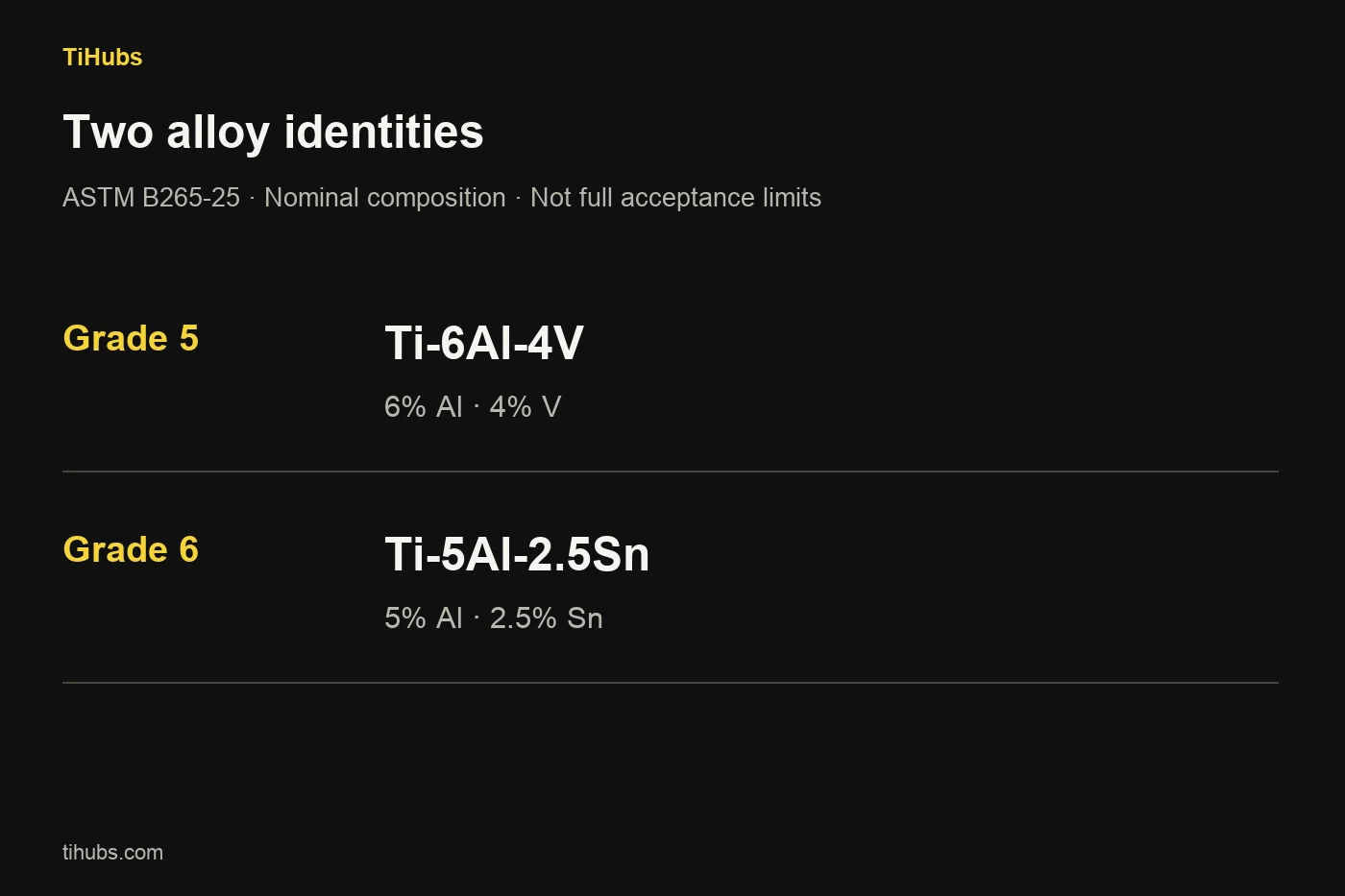
Grade 5Ti-6Al-4V
Grade 6Ti-5Al-2.5Sn
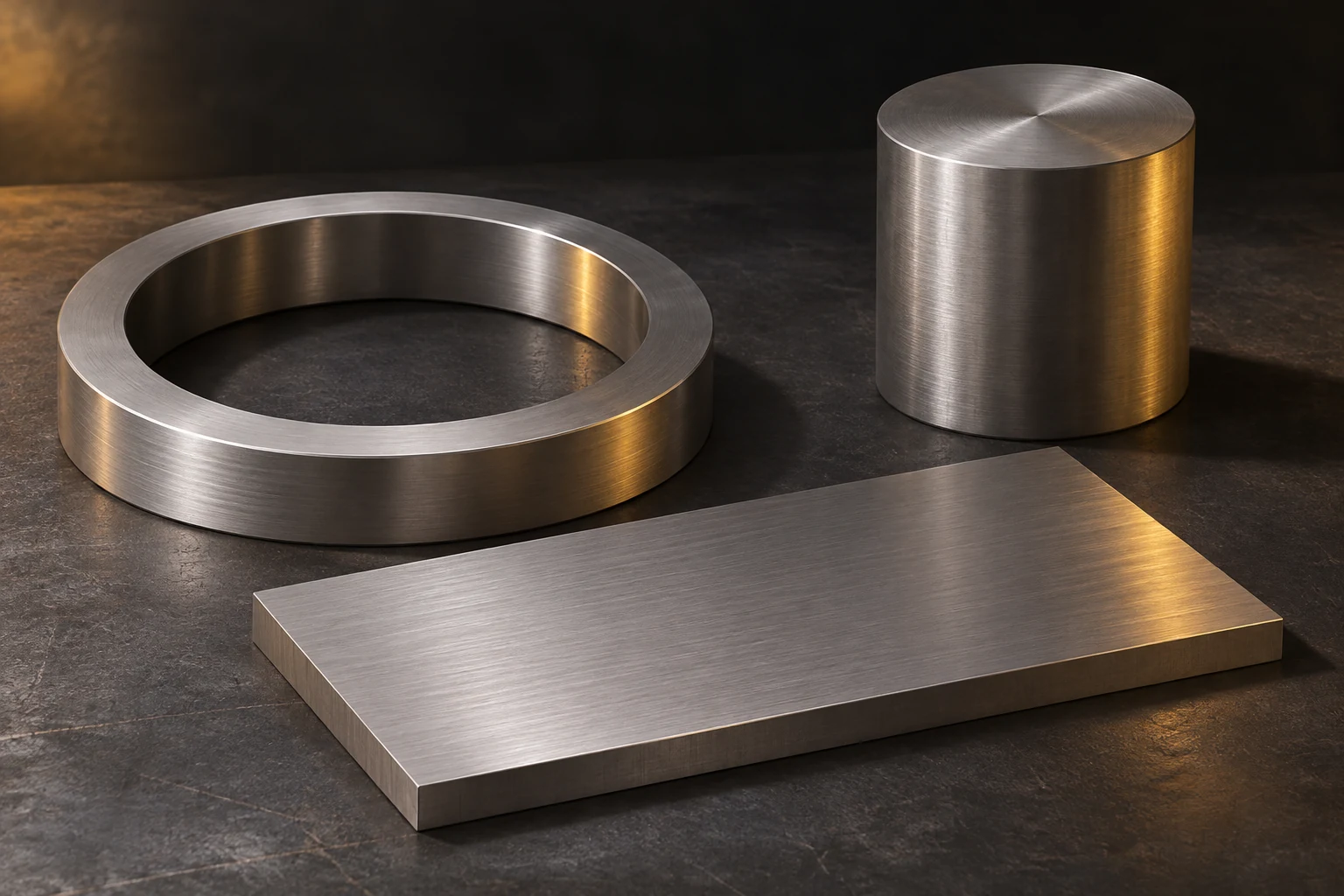
AI illustration; not a production or inspection record.
Quick answer
Grade 5 is Ti-6Al-4V, an alpha-beta alloy; Grade 6 is Ti-5Al-2.5Sn, an alpha alloy. Select between them using the approved product, condition and service requirements. Keep ordinary and ELI variants distinct, and compare mechanical data only when product form, section, test conditions and reporting basis are relevant and clear.
01 / The alloy choice
Choose the material route before comparing a headline strength
Grade 5 vs Grade 6 titanium is a comparison between Ti-6Al-4V and Ti-5Al-2.5Sn, not two adjacent steps on a single strength scale. A buyer evaluating plate, sheet, a ring or forging stock needs to understand the alloy identity, supplied condition and final component requirements. The grade number alone cannot determine which route is suitable or which quotation represents an acceptable product.
Ti-6Al-4V is an alpha-beta titanium alloy. Ti-5Al-2.5Sn is an alpha alloy. Those classifications provide useful metallurgical context, but purchasing still needs a complete product callout. A material description that omits form, condition, specification and dimensions leaves the supplier without the information needed to quote the relevant processing and inspection route.
Start with the component’s approved requirement. If a drawing already names one alloy, treat the other as a proposed alternative requiring review. If the design is new, identify which service and manufacturing questions remain open. The first case asks whether a change is acceptable; the second asks which material basis should be established. Mixing the two can turn an exploratory quotation into an unintended substitution.
Describe the duty rather than relying on a broad application label. A part used at an elevated temperature needs the actual temperature history and applicable property requirements. A cyclically loaded component needs a defined fatigue basis. A formed sheet component needs a viable manufacturing route. Merely calling the part aerospace or high performance does not identify the evidence that will support the purchase.
This guide focuses on sourcing and acceptance of material for engineered components. It does not approve an alloy for a particular aircraft part or replace a customer’s controlled design system. Where project-specific specifications and approved-source requirements apply, they determine the supply route. The purpose here is to help the buyer ask a sufficiently precise question and compare offers on the same basis.
Use the Grade 5 Ti-6Al-4V and Grade 6 Ti-5Al-2.5Sn pages to begin the material enquiry. Attach the product description and drawing context rather than asking only for the best titanium grade. A useful supplier response should identify the exact offered material, its documentation and any deviation requiring the buyer’s decision.
The selection should end with a route that can be purchased and verified: an alloy identity, a product specification, a condition at delivery, a defined final condition where further processing occurs, and an inspection package. Comparing those complete routes is more valuable than ranking isolated maximum strengths from unrelated datasheets.
02 / Identity and evidence
Keep nominal alloy names separate from acceptance limits
The public scope of ASTM B265-25 provides a clear starting point for the two grade identities in annealed strip, sheet and plate. The numbers in the familiar alloy names describe nominal alloying additions. They are not a complete chemical analysis and should not be used as exact target values for accepting a heat certificate.
Nominal alloy identities in ASTM B265-25 public scope
Item
Grade 5
Grade 6
UNS designation
R56400
R54520
Common alloy description
Ti-6Al-4V
Ti-5Al-2.5Sn
Nominal additions named in the scope
6% aluminium; 4% vanadium
5% aluminium; 2.5% tin
Product scope cited here
Annealed titanium alloy strip, sheet and plate
Source: ASTM B265-25, public scope. Percentages are by mass in the alloy description. Use the controlled product specification for element ranges, residual limits, testing and acceptance. The table does not imply that an element omitted from a nominal name is analytically zero.
The alpha-beta classification for Ti-6Al-4V is described in the TIMETAL 6-4 datasheet. The producer-sourced 1964 Alloy Digest abstract for Ti-5Al-2.5Sn identifies it as an all-alpha alloy developed primarily for sheet and strip. These sources establish background, not a common mechanical test condition for every purchasable product.
That distinction matters when reading strength tables. ATI’s public Grade 6 page presents wire data, while other frequently quoted values concern annealed Ti-6Al-4V bar or plate. A wire value with an unspecified thermal history should not be placed beside a heat-treated plate value and presented as a universal grade ranking. The numbers can each be genuine while the comparison is misleading.
For a numerical mechanical comparison, ask for matching product form, section, final condition, test temperature and specimen basis. Distinguish minimum specification requirements from typical manufacturer results and actual lot measurements. If one of those conditions is missing, keep it identified as missing. Do not fill the gap with a room-temperature or annealed assumption simply because it makes a table easier to complete.
The practical comparison can therefore begin with the verified identity table and proceed to project-specific evidence. This is preferable to inventing a single strength, hardness or maximum operating temperature for each alloy. The buyer can still make progress on dimensions, processing and commercial scope while the engineering basis for the final property comparison is established.
Industrial buying guide / 02Two different nominal alloys
ASTM B265-25 public scope. Nominal alloy names do not replace complete chemical acceptance limits.
03 / Condition and ELI
Specify what the material is when it arrives and when it is used
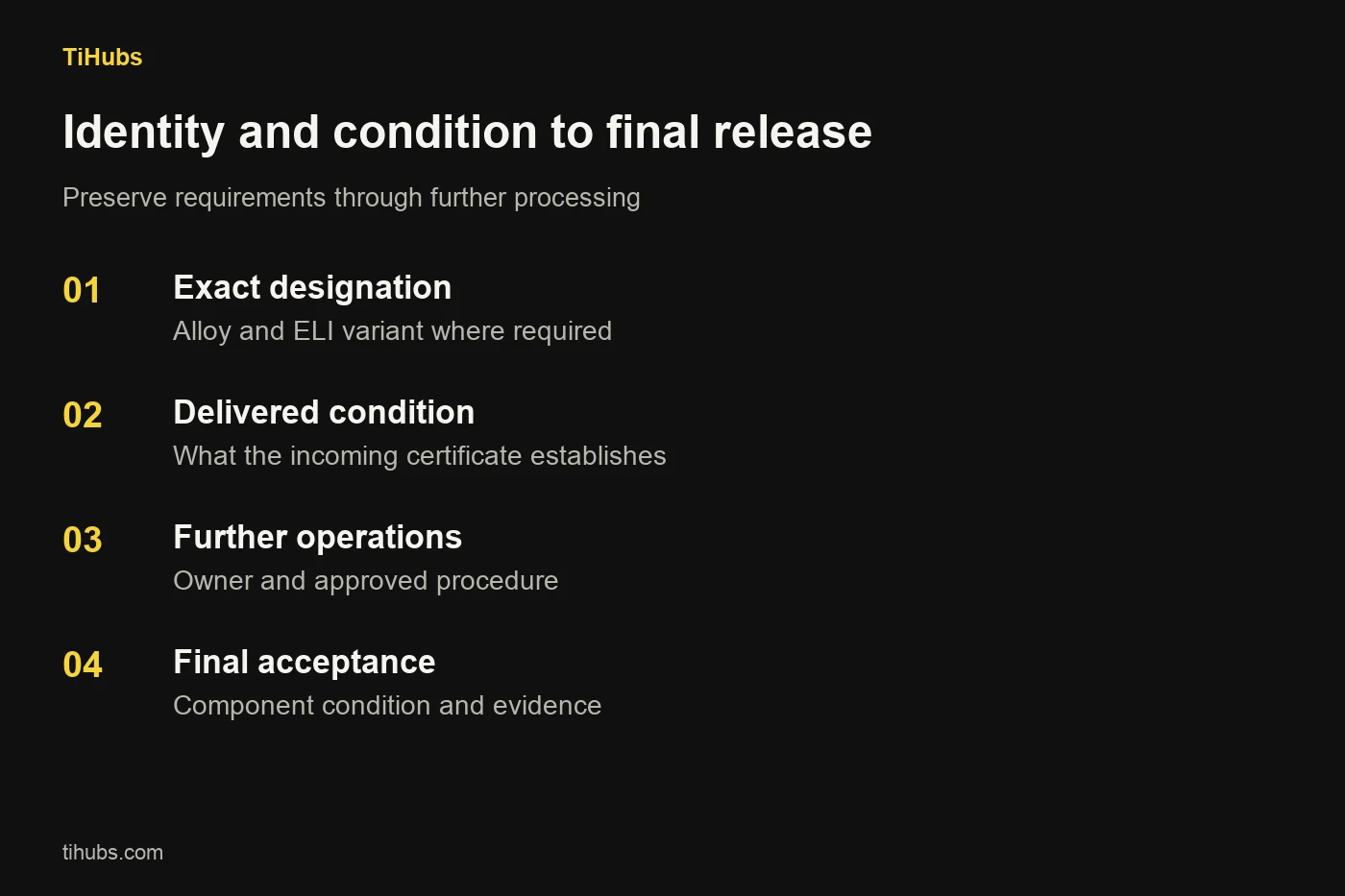
The supplied condition and the final component condition may differ. A buyer can order stock intended for later forming, forging or thermal processing, or order material already in the required final state. State that boundary explicitly. A certificate for incoming stock demonstrates its recorded condition; it does not automatically establish the properties after the buyer’s subsequent operations.
For Ti-6Al-4V, the TIMET datasheet distinguishes annealed and solution-treated-and-aged property contexts. Do not treat those as interchangeable labels on a quotation. If the design requires a particular condition, the supplier should identify the applicable process and acceptance basis. A proposed change in condition needs review just as a proposed change in alloy does.
For Ti-5Al-2.5Sn, avoid importing the Ti-6Al-4V processing route merely because both materials are titanium alloys. Use the specification and approved process for the actual alloy and product. Thermal processing can affect condition and microstructure, but a generic statement that the material is heat treated does not define the delivered requirements or demonstrate that the final component is qualified.
Keep ordinary Ti-5Al-2.5Sn and its extra-low-interstitial, or ELI, variant distinct. Historical low-temperature studies explicitly identify ELI material. Their results should not be assigned automatically to ordinary Grade 6 stock. If an enquiry calls for ELI, retain that designation and the applicable chemistry and product specification throughout the quotation and certification review.
A similar naming discipline is needed when Ti-6Al-4V ELI is discussed. An alloy-family name does not establish the exact ordered grade or its interstitial limits. Ask the supplier to identify the material against the controlled requirement rather than replacing a precise callout with a shorter commercial name. This prevents an apparently small wording change from concealing a different acceptance basis.
If low-temperature performance matters, define the relevant test temperature, property and acceptance requirement through the project. Do not infer toughness, ductility or compatibility from the ELI label alone. The label identifies a material variant; it does not establish every product condition, environment or manufacturing route needed by a particular component.
For further processing, assign responsibility for final verification. The purchasing package should say who performs the operation, who controls the procedure, what records are retained and which tests release the resulting material or part. Without that division, the stock supplier and fabricator can each assume that the other’s certificate covers a condition that neither has actually verified.
Industrial buying guide / 03Preserve identity through the process
Incoming condition, further processing and final acceptance should be connected in the purchasing package.
04 / Product route
Describe plate, ring or forging stock precisely
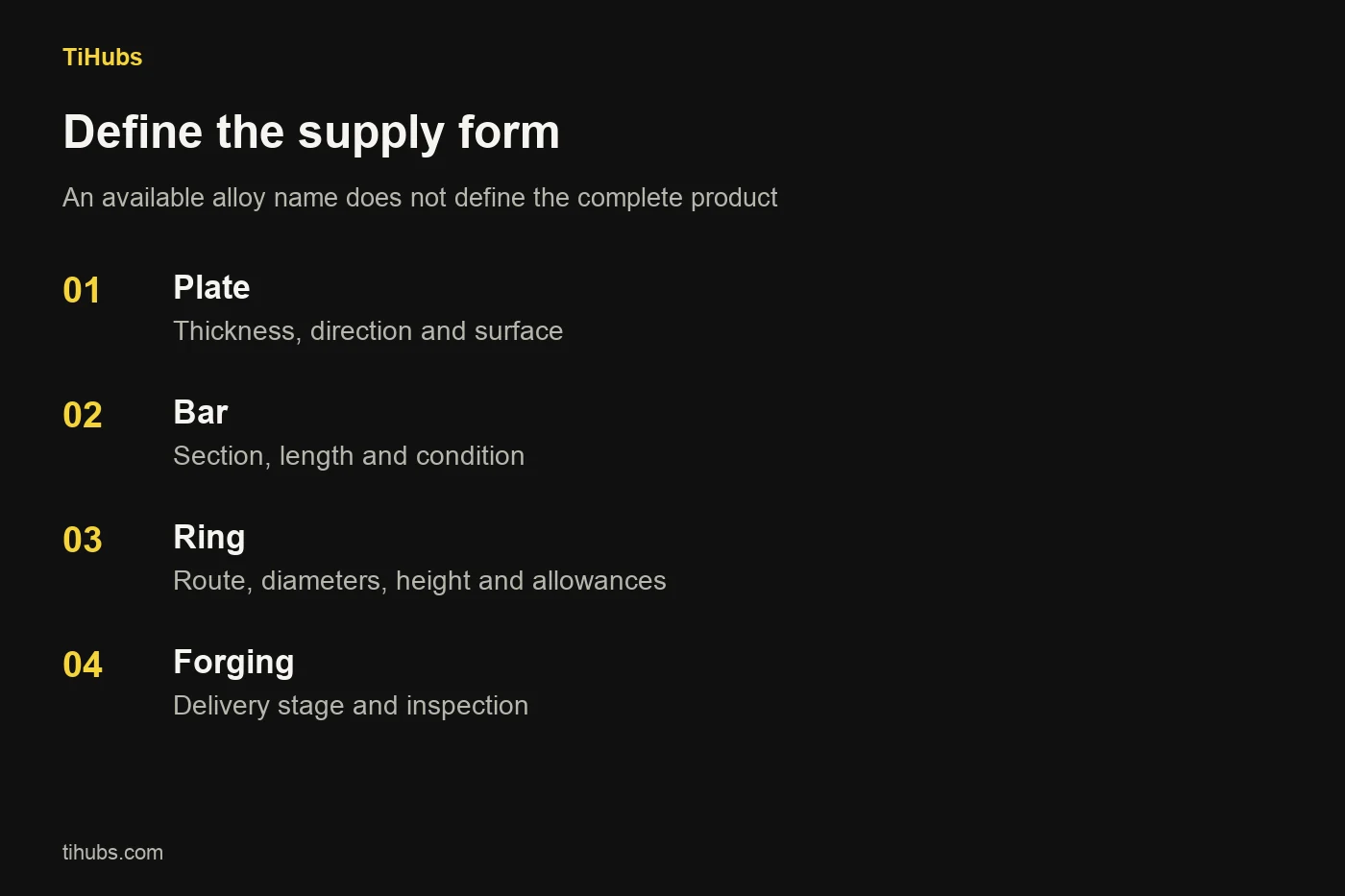
Choose the product route before using a specification number. Sheet and plate, bar, billet, a rolled ring and a forging are not interchangeable supply descriptions. Each can require a different specification, processing history and inspection plan. A list of several standards on a supplier’s website does not mean that every offered item is certified to all of them.
For sheet or plate, define thickness, width, length, tolerances, flatness and surface condition. Identify any direction relevant to forming or the final component. If blanks are cut from larger stock, state the required orientation and machining or trimming allowance. The usable blank requirement should reflect the actual part, not only the smallest rectangle that contains its outline.
For ring stock, provide outside diameter, inside diameter, height and the required allowance on each surface. State whether the purchase is a rolled ring, a rough-machined ring or a finished component. A ring cut from plate is a different stock route from a rolled ring; it should be reviewed as an alternative where the design or specification controls that distinction.
For forging stock, identify the delivery stage. A billet intended for further forging is not the same as a finished forging with established final properties. Include the relevant drawing, section sizes and required inspection condition. If the supplier proposes a near-net shape, record which dimensions remain unfinished and how the subsequent operations connect to final acceptance.
Discuss test locations and directions before production where the project requires them. The relationship between a specimen and the component can matter, particularly when section and processing vary. The buyer should know whether the evidence comes from the supplied product, an associated test piece or another approved basis. A result without that relationship may not answer the acceptance question.
For nondestructive examination, name the applicable method and acceptance requirement rather than requesting a generic inspected product. The method, stage of processing and accessible geometry affect what the examination can establish. If a particular surface condition or intermediate shape is needed for inspection, include it in the route and quotation.
Use the titanium plate or titanium bar and rod enquiry route for the relevant stock, and describe ring or forging requirements explicitly in the request. Ask the supplier to confirm the exact proposed product and certification scope. Availability of an alloy name alone does not establish availability of the complete engineered product.
Clarify how the supplied dimensions relate to the final machining envelope. A ring may need allowance on its bore, outside diameter and faces, while a plate blank may need stock for flatness correction and surface cleanup. Request a dimensioned supply sketch when the distinction is not obvious. This avoids accepting a nominally large enough piece that cannot yield the required component after the agreed preparation. It also prevents an oversized offer from appearing economical when the buyer must remove substantially more material.
Identify any test material that must remain attached or be reserved before cutting. If the approved inspection plan depends on a particular specimen location, removing that material too early can make the planned evidence unavailable. Agree the cutting and inspection sequence with the responsible parties. The purchase description should preserve the route needed to demonstrate conformity, rather than leaving test access to be solved after all blanks have been prepared.
Industrial buying guide / 04Define the product that will be delivered
Plate, bar, ring and forging routes need their own dimensions, condition and inspection basis.
05 / Performance evidence
Separate temperature, fatigue and manufacturing questions
A material comparison for an engineered component should identify the property that controls the decision. Room-temperature tensile strength, elevated-temperature tensile behavior, creep, fatigue and fracture resistance answer different questions. A high value in one category does not automatically establish a satisfactory result in another. The project must define which evidence is needed and under what conditions.
For elevated-temperature use, record the temperature range, exposure duration and loading history. Distinguish a short excursion from sustained operation. Ask whether the supporting data represents the proposed product and final condition. A broad historical statement about an alloy’s temperature capability should not be used as a universal design limit for a new component.
For fatigue-related requirements, identify the applicable test or approved design basis and the relevant manufacturing state. Surface finish, geometry, processing and loading conditions can affect the interpretation. Do not assign a fatigue life from a tensile-strength comparison. If the supplier provides a fatigue report, review its specimen, loading and acceptance context rather than only the largest cycle count.
For a formed sheet part, connect performance review to the forming condition and the final delivered state. A material selected for service must still be manufacturable within the approved geometry. Conversely, a material that forms easily is not automatically acceptable for the final load or temperature. The selection should follow the part through processing and into service.
For a machined ring or forging, review the effect of later operations on the accepted material condition and surface. Identify any process restrictions, final examination and dimensional requirements. If the component will be joined, include the relevant procedure and assembly evidence. A compliant starting-stock certificate cannot independently qualify every later manufacturing step.
Keep test evidence and design approval distinct. A supplier can provide material records and relevant technical data, while the responsible design authority determines whether those records support the component. This division does not prevent collaboration; it makes the unanswered questions visible. The enquiry can state which evidence the supplier must provide and which decision remains with the buyer’s engineering process.
Consider an illustrative sourcing situation in which Ti-5Al-2.5Sn plate is proposed for a part originally described only as titanium sheet. The first task is to establish the actual alloy, condition and service basis, not to compare a Grade 6 wire number with a Grade 5 bar number. Once the requirement is defined, the buyer can request the correct product-specific data and a meaningful quotation.
For a temperature-driven enquiry, prepare an evidence schedule with one line for each required property. Record the temperature, exposure or loading condition, product form and final state next to the supporting report. A room-temperature tensile certificate can satisfy its own requirement while leaving an elevated-temperature question unanswered. Mark that gap explicitly. This keeps the supplier’s valid material evidence useful without asking it to support a different claim.
Check the origin of a quoted value as well as its units. A report may describe a typical result, a minimum requirement, a design allowable or a calculation used in a historical study. These are different types of evidence. Ask for the relevant source page and conditions, and retain the distinction in the review. Do not transform an old illustrative calculation into a guaranteed property of current stock merely by copying it into a purchase comparison.
Finally, identify whether the proposed evidence covers the final component or only the starting product. If a plate becomes a formed and joined assembly, document the additional operations and the verification required afterward. The same applies when billet is converted into a forging. This gives the buyer a clear list of completed checks and unresolved decisions before choosing between the two alloy routes.
06 / Quote and release
Compare complete, documented supply routes
Request quotations against a common product and acceptance scope. Include quantity, dimensions, condition, specification edition, inspection, documentation and destination. Where two alloy routes are under consideration, identify the approval status of each. A technically unapproved alternative should remain a proposal rather than being counted as a compliant lower bid.
Separate existing-stock offers from new production. Ask which dimensions and conditions are available and which require additional processing. If the proposed route includes cutting, machining, thermal processing or examination, identify the sequence and delivery responsibility. A short stock lead time does not describe the time needed to deliver the final accepted package.
Include qualification work in the schedule. A first article, process trial or document review can be necessary before production release. State the hold points and responsible approver so that the supplier can plan them. If trial material differs from final production material, record the basis for transferring the result and any additional review needed.
Compare cost at the level of usable delivered product. Starting-stock mass, machining allowance, test material, inspection and documentation can affect the total. Do not assume a fixed Grade 5 versus Grade 6 price ratio. Use actual quotations and identify one-time costs separately from recurring material and processing costs.
Before order release, reconcile the alloy designation and condition across the drawing, purchase order, supplier acknowledgment and inspection plan. Preserve ELI where it is required and identify any accepted deviation explicitly. A shortened label on a commercial document should not erase a technically significant distinction from the approved requirement.
At receipt, review identity and the complete material records. Match the delivered heat or lot to the product and required tests. Confirm that the condition and product form correspond to the order. Maintain that relationship through cutting and further processing so that the final components remain connected to their evidence.
For repeat purchases, retain the approved route and the reasons for its selection. If a later supplier proposes another form, condition or processing sequence, review the change against that basis. This is the practical outcome of comparing Grade 5 and Grade 6: a clearly specified material route that supports the component, rather than a general claim that one titanium alloy is superior.
Use a deviation schedule when several offers propose different solutions. Record each change in alloy, condition, product route, dimension or inspection scope on its own line, with its approval status. A supplier may offer the right alloy but a different state, or the right dimensions but a different certification basis. These are distinct questions and should not be hidden in a general statement of equivalence. Once the accepted offer is selected, incorporate the agreed deviations into the final documents so that receiving inspection can apply one clear requirement instead of reconstructing a chain of quotation emails.
07 / Build your RFQ
Send the complete alloy and product requirement
For a Grade 5 or Grade 6 enquiry, identify the exact alloy designation, product form, delivered condition and final processing route. Include the specification, drawing and approval status so the offer can address the required evidence and delivery scope. Keep the final approved drawing revision clearly identified.
Information to include
Exact alloy and ordinary or ELI designation where required
Sheet, plate, bar, ring or forging delivery stage
Dimensions, section, orientation and machining allowance
Specification, condition, tests and inspection scope
Quantity, approval hold points and delivery destination
Build your RFQ checklist
Choose the product and add the information you have. Copy the resulting brief or send your requirements to TiHubs. Submitting an enquiry does not place an order.
08 / FAQs
Questions buyers ask
What is the main identity difference between Grade 5 and Grade 6?
Grade 5 is nominal Ti-6Al-4V, while Grade 6 is nominal Ti-5Al-2.5Sn. Their alloy families and product requirements differ. The nominal percentages identify the alloy; complete chemical limits and acceptance come from the controlled specification for the ordered product.
Which grade is stronger?
There is no useful universal answer without the product and condition. Compare the relevant specification minima or test results for matching form, section, temperature and specimen basis. A Grade 6 wire result and a heat-treated Grade 5 plate result do not establish a general ranking.
Is ordinary Grade 6 the same as Ti-5Al-2.5Sn ELI?
Do not treat them as the same purchasing identity. ELI denotes an extra-low-interstitial variant with its own controlled requirements. Historical ELI performance should not be assigned automatically to ordinary Grade 6 stock. Retain the exact designation and specification in the order and certificate review.
Can an annealed certificate support the final heat-treated component?
It supports the incoming material within its stated scope. Later processing needs the procedure and verification required for the final condition. Define responsibility for those operations and records so that the final part is not accepted using evidence for a different state.
Can a plate-cut ring replace a rolled ring?
Only after review against the applicable drawing and product requirements. The stock route and associated material evidence can differ. Describe the proposed alternative explicitly, including allowances, orientation, inspection and final condition, rather than treating the change as only a price decision.
What makes the quotations comparable?
Use the same delivery boundary, dimensions, quantity, condition, specification, inspection and documentation. Include qualification and further processing where needed. Keep any technically unapproved alternative separate from conforming offers, and compare actual usable product rather than a universal alloy price ratio.
09 / Key takeaways
Keep the purchase requirements connected.
Grade 5 and Grade 6 are different alloy routes, not adjacent levels on a universal scale.
Use nominal chemistry for identity and controlled limits for acceptance.
Keep ordinary and ELI material distinctions visible.
Compare properties with the product, section and final condition attached.
Release the order against a complete and documented supply requirement.
Technical references
Sources and data scope
References reviewed November 14, 2026. Public source summaries support the discussion; the controlled specification, agreed edition and approved project requirements govern acceptance.
ASTM — B265-25 — Public scope identifies Grade 5 and Grade 6 UNS designations and nominal alloys for annealed flat products.
TIMET — TIMETAL 6-4 — Manufacturer background for the alpha-beta alloy and its distinct condition-dependent property contexts.
Alloy Digest — Ti-5Al-2.5Sn — Producer-sourced abstract, 1 December 1964, Titanium Metals Corporation of America; identifies the all-alpha sheet/strip alloy. Full paid datasheet not used.
ATI — Grade 6 — Public wire product context illustrates why product-form data should not be transferred to unrelated plate or forging purchases.
NASA / Aerojet — Report CR-54855 (1966) — Parametric Study of Glass-Filament-Reinforced Metal Pressure Vessels, April 1966; explicitly identifies annealed Ti-5Al-2.5Sn ELI. Used only to distinguish historical material identity, not to qualify current stock.
Ti
About TiHubs
TiHubs coordinates titanium material and custom supply enquiries from Baoji, China. Send the product, drawing revision and acceptance requirements so the proposed supply scope can be reviewed. Learn about our sourcing role.
Contents
TiHubs
Talk to TiHubs
Ask about titanium materials, grades or custom parts.
Enter your email to start chatting.
We use your email to respond to your enquiry. Your conversation is stored on this website.
Our team is away right now. Leave your enquiry and we will follow up by email.