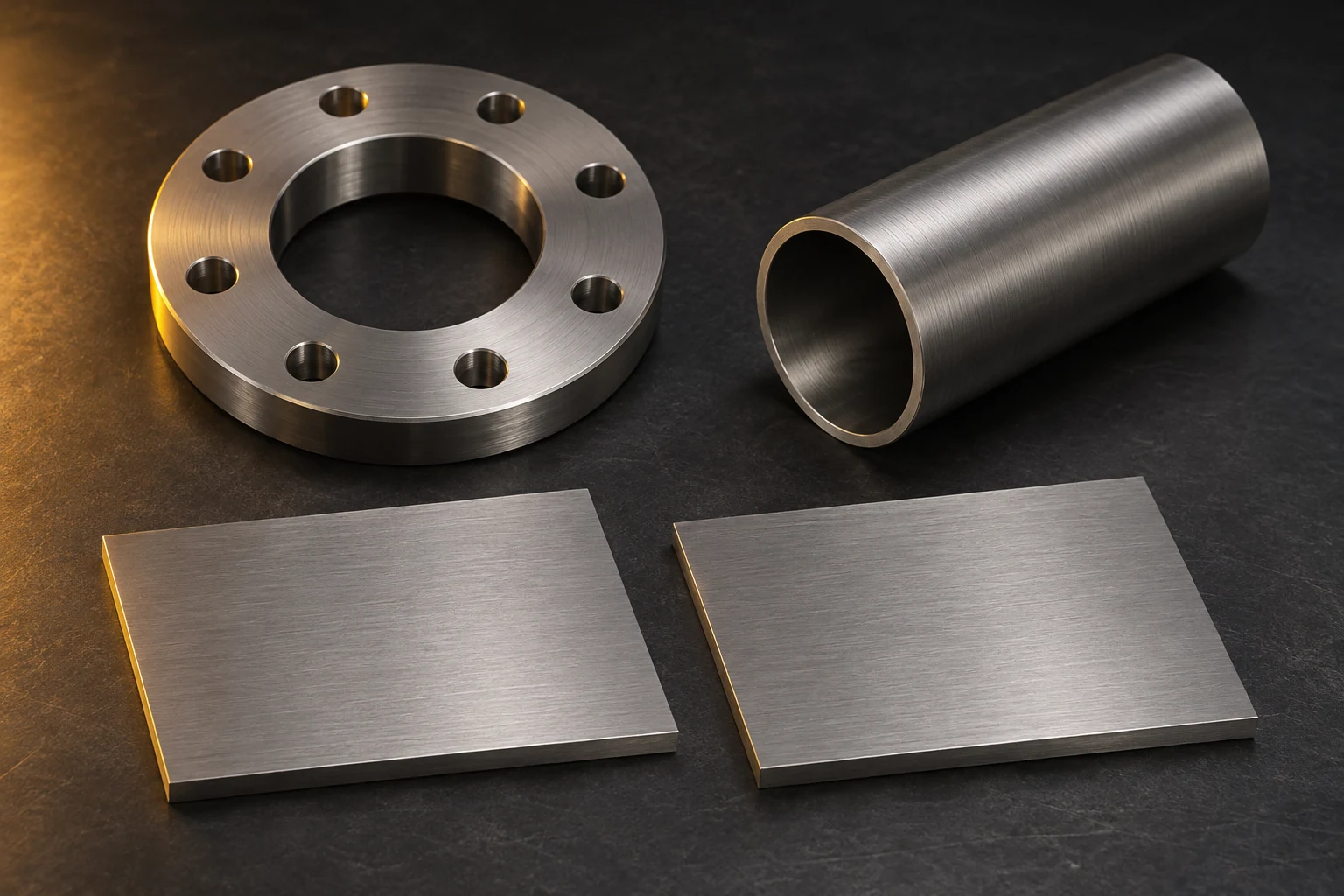
AI illustration; not a production or inspection record.
Quick answer
Grade 7 and Grade 16 are palladium-bearing titanium grades with different specified palladium ranges. Their matching tensile-property entries in a published reference do not prove identical corrosion performance. Evaluate the actual service, product specification, material analysis and complete quotation before approving a Grade 16 alternative to Grade 7.
01 / The purchase question
What should a lower-palladium route demonstrate?
Grade 7 vs Grade 16 titanium is primarily a purchasing comparison between two palladium-bearing titanium routes. A buyer may be looking for a lower-cost alternative to an established Grade 7 component, or evaluating palladium-bearing material for a new corrosive duty. The useful question is not simply which grade contains more palladium. It is whether the proposed product can meet the approved service, fabrication and acceptance requirements at a justified total cost.
Grade 16 has a lower specified palladium range than Grade 7 in the cited product scope. That difference is real and measurable. It does not, by itself, establish an equipment-life ratio, a fixed price saving or automatic interchangeability. The service environment and the complete delivered product must remain part of the decision. A reduction in one alloying addition is a starting point for review, not the final purchasing conclusion.
Begin with the status of the existing material. If the drawing or equipment specification requires Grade 7, ask for a conforming offer and a separately identified Grade 16 proposal. If the material choice is still open, state the duty and the evidence needed for selection. This prevents a supplier’s commercial alternative from being mistaken for a design-approved substitution.
Describe why Grade 7 was selected in the first place. The basis may be documented service experience, a corrosion assessment, a customer specification or an established equipment design. Locate that evidence before comparing alternatives. A material requirement inherited through several purchase orders can be difficult to interpret, but removing it without understanding its purpose introduces an avoidable gap in the review.
The comparison is especially useful for plate, sheet, tubing and fabricated equipment parts where both alloy identity and processing matter. The product form determines the relevant specification, while the component geometry determines the local service conditions. A flat plate coupon, a gasketed flange and a welded tube joint are not identical corrosion situations simply because they are made from the same titanium grade.
Use the Grade 7 titanium and Grade 16 titanium pages for the initial material enquiry. Then identify whether the supplier is being asked to provide stock, a formed blank or a finished assembly. That boundary helps determine which party must supply material records, fabrication evidence and the final acceptance package.
The final choice should explain what was compared and why it was accepted. A useful decision record names the product, service envelope, supporting evidence, inspection scope and commercial assumptions. It should allow a later buyer to repeat the approved route without turning a carefully reviewed alternative into a universal rule for every Grade 7 application.
02 / Palladium and properties
Separate alloy identity from mechanical equivalence
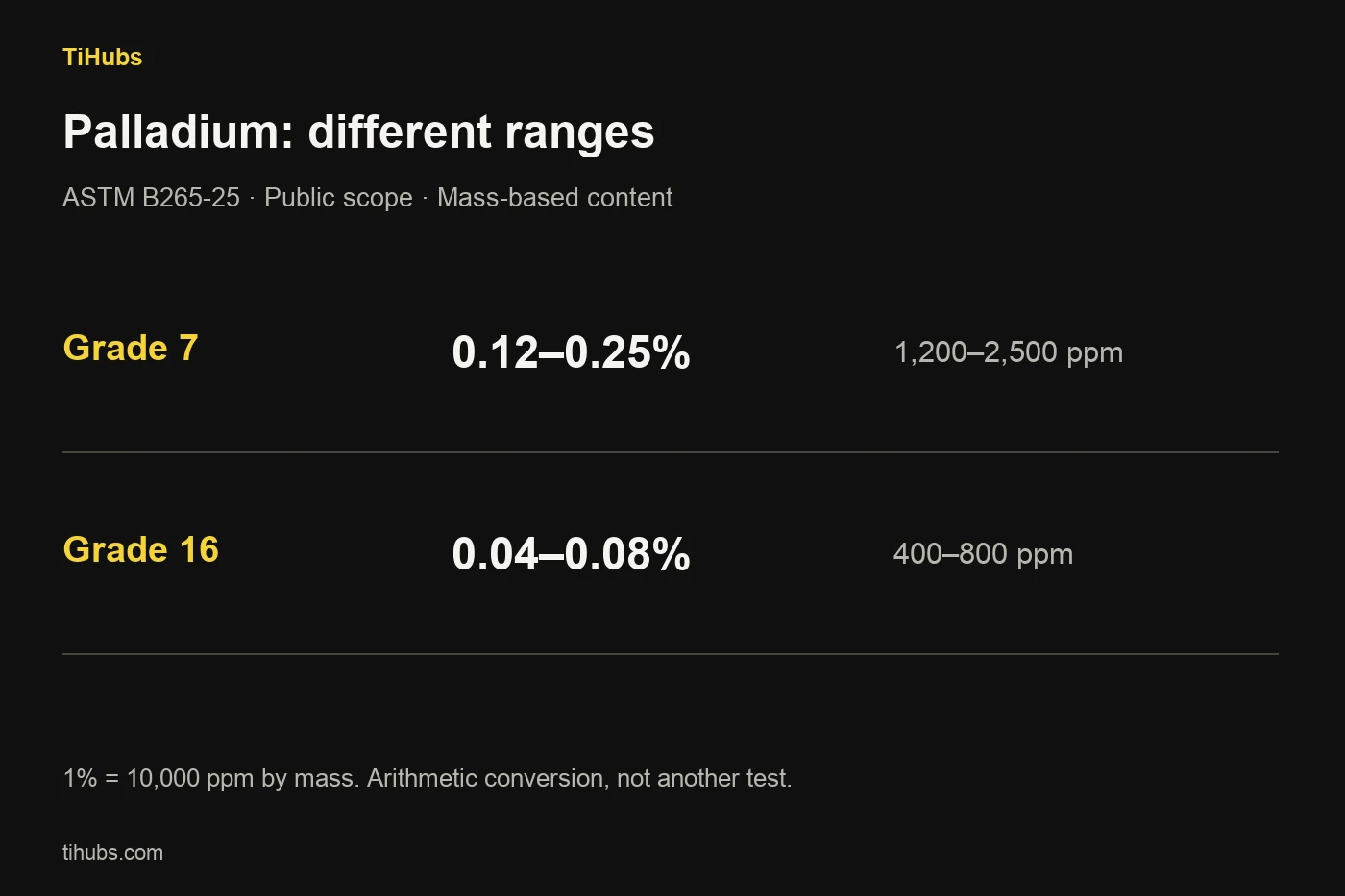
The public scope of ASTM B265-25 identifies both grades for annealed titanium strip, sheet and plate. It gives different palladium ranges and UNS designations. The first table retains those ranges and adds a transparent unit conversion to parts per million by mass. The conversion helps when comparing reports written in different units; it is not a second test result or a separate material specification.
Grade identity in ASTM B265-25 public scope; palladium by mass
Item
Grade 7
Grade 16
UNS designation
R52400
R52402
Palladium range
0.12–0.25%
0.04–0.08%
Same range converted to ppm by mass
1,200–2,500 ppm
400–800 ppm
Source: ASTM B265-25, public scope. Conversion: one mass percent equals 10,000 ppm by mass. These grade-identifying entries do not reproduce the full chemistry or acceptance requirements. The controlled standard and purchase order must define the complete product basis, including the distinction between the ordinary grade and any separately specified H variant.
ATI 2013 mill-annealed reference figures for plate, sheet and strip context
Property and source label
Grade 7
Grade 16
Tensile strength, listed minimum
345 MPa
345 MPa
Yield strength, listed minimum / maximum
275 / 450 MPa
275 / 450 MPa
Elongation in 2 inches, listed minimum
20%
20%
Source: ATI, Corrosion-Resistant Titanium, version 2, 26 February 2013, page 4. The table identifies mill annealing but does not specify thickness, orientation or test temperature. ATI also describes the document as informational rather than a specification or final-design basis. These historical reference figures are therefore not current contractual acceptance limits.
The matching mechanical entries do not make the grades chemically identical. Nor do they prove equivalent corrosion behavior for a specific process stream. They answer a narrower question: the cited manufacturer reference places the two grades at the same listed tensile-property level. A substitution review still needs the environmental evidence and the complete ordered product requirements.
Do not compare only the midpoint of each palladium range. A midpoint can describe an arithmetic example, but the accepted material is controlled by the specified range and actual analysis. The supplier should report the heat’s measured result with appropriate units and traceability. A purchase decision based on an assumed exact palladium content can misrepresent both the material and its commercial basis.
ASTM B265-25 public scope. ppm values are mass-based arithmetic conversions, not additional test results.
03 / Service evidence
Require evidence for the actual environment
ATI groups palladium-bearing titanium grades together in its discussion of improved crevice-corrosion resistance relative to unalloyed CP grades in salt environments. That is useful background for why these materials are considered. It is not a paired Grade 7 versus Grade 16 qualification for every temperature, fluid or geometry. The scope of a general statement should remain visible when it is used to support a purchase proposal.
Start the service review with fluid composition, concentration range, temperature and relevant impurities. For heat-transfer equipment, distinguish bulk-fluid temperature from local metal conditions. Describe deposits, stagnant regions, gasketed joints and other crevices where they occur. If the proposed material will see more than one stream or operating mode, identify those exposures separately rather than combining them into an average condition.
Include startup, shutdown and cleaning. A material that has satisfactory evidence for normal operation may encounter a different environment during maintenance or an upset. Record the approved cleaning procedure and any intended change. The material review should address the exposure that the component will actually see, not only the normal process label used on a simplified flow diagram.
Ask what evidence directly compares the proposed routes. Relevant plant history, a well-documented published test or a representative qualification program can each contribute, but their limitations differ. A report for another palladium-bearing grade should not be silently relabeled as Grade 16 evidence. Similarly, a result for an open specimen does not automatically qualify a gasketed or welded region.
If testing is needed, define the question before ordering the specimens. Identify material condition, specimen preparation, representative geometry, medium, temperature, duration, measurement method and acceptance criteria. Specify who reviews the result. This does not require inventing a universal test program; it requires making the chosen evidence relevant to the component and the reason for considering the alternative.
Review localized attack separately from an average corrosion rate where the service requires it. A low average loss can hide damage concentrated at a small feature. The equipment’s integrity requirements determine what must be assessed and what constitutes an acceptable result. The buying guide should not supply a made-up allowable rate or convert an incomplete test into a guaranteed number of service years.
When evidence remains incomplete, keep the material selection provisional while other procurement work continues. Dimensions, manufacturing options and quotations can be investigated without declaring the alternative service-qualified. Release the production route only after the responsible review has accepted the relevant evidence and recorded the remaining restrictions. That distinction allows useful progress without overstating certainty.
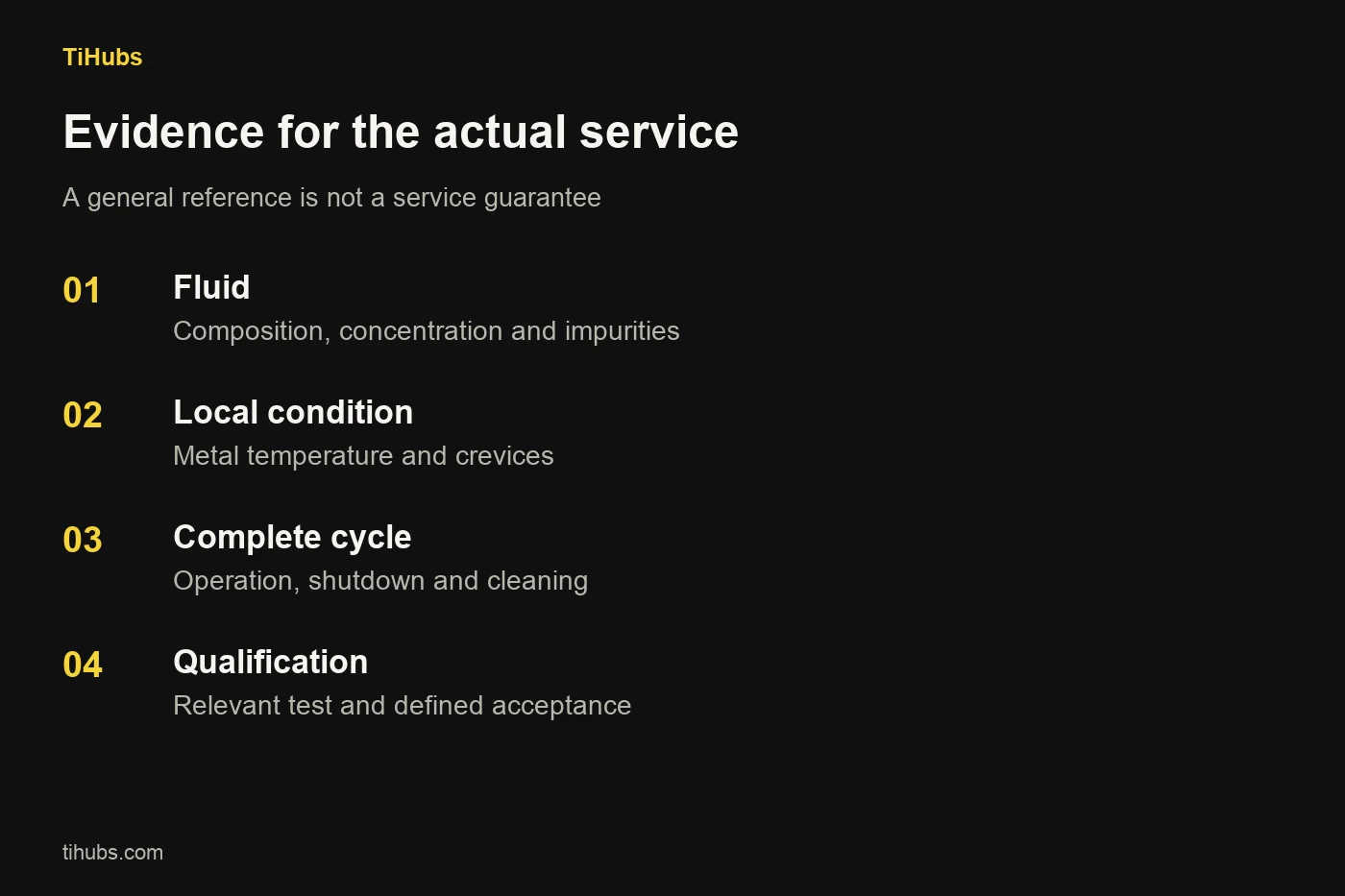
Industrial buying guide / 03Match evidence to the service
Fluid, local geometry and the complete operating cycle belong in the material review.
04 / Material verification
Make the palladium result traceable
The palladium range is small in percentage terms, so the enquiry should ask how the required chemistry will be established and reported. This is a question about the capability of the chosen method and the traceability of the result. Do not assume that any instrument showing a titanium alloy name has verified every element needed for grade acceptance.
Request the actual heat analysis associated with the offered product. Check units before comparing the result with a limit. A value expressed in ppm by mass must be converted consistently if the requirement is written in mass percent. Keep the original report available and record any conversion used during review. A misplaced decimal can change the interpretation even when the underlying laboratory result is correct.
If positive material identification is required, define its purpose. It may support segregation, confirm selected elements or investigate an identity concern, depending on the method and approved procedure. Ask which elements and concentration ranges the procedure can assess, how calibration and reference materials are handled, and how results are linked to the tested items. A generic PMI statement does not answer those questions.
Distinguish a screening result from the full acceptance analysis. A field check can be useful within its validated scope, but it should not silently replace the chemical or mechanical evidence required by the product specification. If a measurement is near an acceptance boundary or its reporting capability is insufficient, agree on the appropriate review or confirmation method rather than rounding the result into compliance.
Traceability should continue after the mill certificate is issued. When plate is cut into blanks or tubing is divided into lengths, preserve the relationship to the heat or lot. If Grade 7 and Grade 16 are handled together, identify the materials clearly throughout storage, cutting and fabrication. Their similar appearance is not a reliable identification method, and a convenient offcut should not lose its material identity.
For a fabricated assembly, map the relevant components to their material records. The body, liner, tube, flange and any added material may have different procurement records or requirements. Define the permitted combination in the approved drawing and fabrication documents. A certificate for one plate does not establish the identity of every part in a completed assembly.
Resolve document discrepancies before release. If an offer says Grade 16 but a certificate or label says something else, obtain a documented explanation and valid evidence. Do not infer that the difference is harmless because the tensile values look similar. The very reason for this comparison is that a small composition difference can be commercially and technically meaningful.
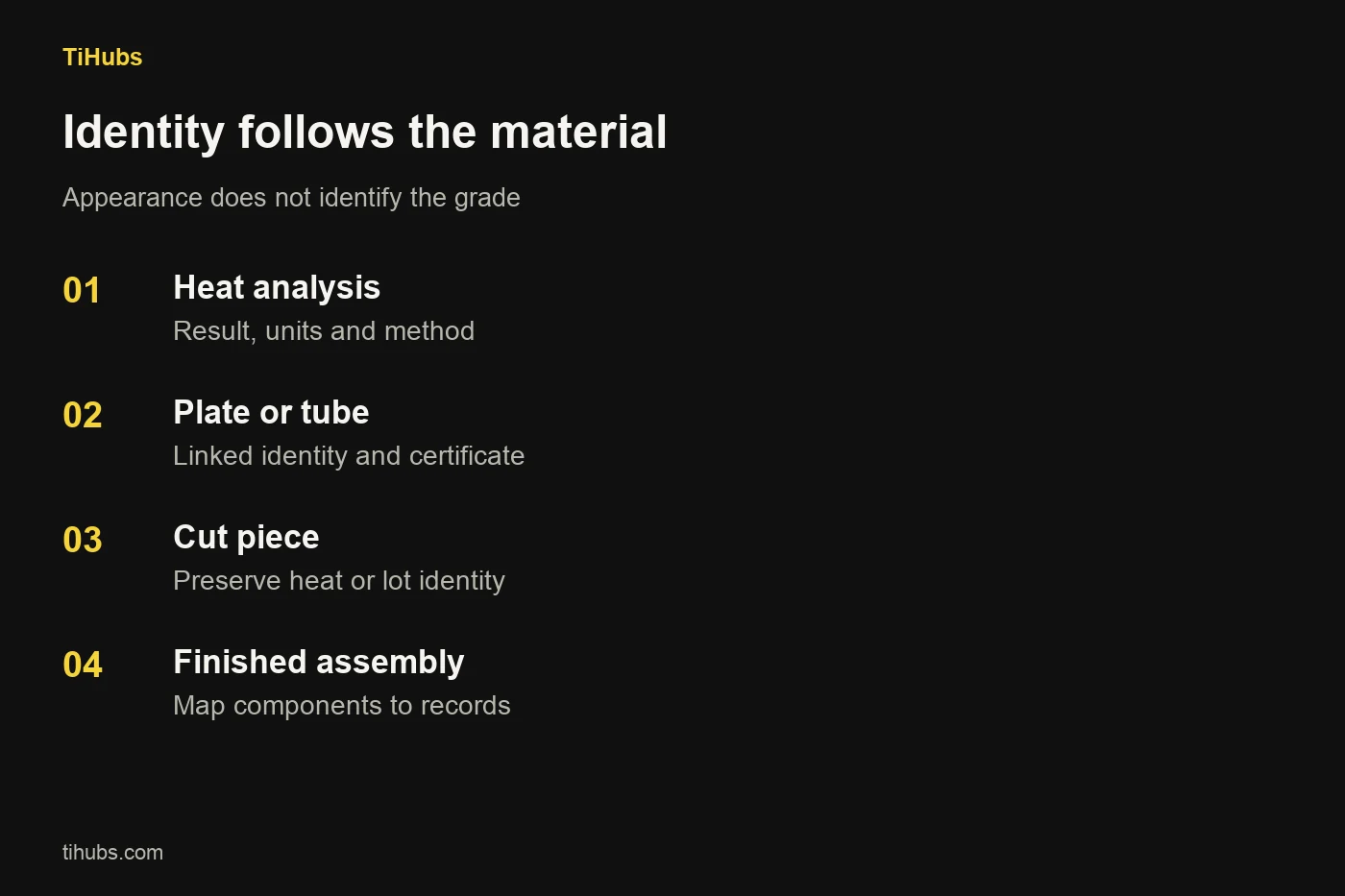
Industrial buying guide / 04Keep identity through fabrication
Analysis, stock identification and component records should remain connected.
05 / Price and delivery
Compare the delivered scope, not palladium alone
Lower palladium content can be relevant to an alloy’s cost basis, but a finished material quotation contains much more than the palladium addition. Product dimensions, production quantity, yield, processing, testing, documentation and delivery all matter. A buyer should compare real offers for the same scope rather than multiplying a metal-content difference by a market price and treating the result as a guaranteed purchasing saving.
Ask whether the quoted route uses identified stock or new production. An available Grade 7 plate may have a different commercial outcome from a Grade 16 production order with a larger minimum quantity. The opposite may also occur. These are supply-specific circumstances, not permanent rankings of the grades. Obtain the exact stock description, quantity basis and delivery assumptions for each proposal.
Keep technical compliance as the first filter. A lower-priced alternative that has not been accepted for the service is not a compliant saving. Once the routes are technically acceptable, compare delivered usable quantity, fabrication scope, inspection and document requirements. If one proposal includes forming or testing that the other excludes, add those differences explicitly rather than comparing headline prices.
Separate the cost of qualifying an alternative from recurring purchase cost. A corrosion review, representative trial or procedure update may occur once, while material price, inspection and processing recur. Identify who pays for each activity and when it must be completed. This makes the commercial decision understandable for both an urgent replacement and a longer-term supply program.
Evaluate life-cycle cost only with relevant assumptions. Define the service interval, inspection plan and replacement scenario used by the buyer, and distinguish documented experience from an estimate. Do not claim that either grade lasts a fixed multiple of the other without applicable evidence. When life is uncertain, show the uncertainty in the decision instead of hiding it inside an optimistic saving.
For example, an existing Grade 7 component may have satisfactory operating history while a Grade 16 option offers a lower material quote but needs qualification. The buyer can compare the qualification effort and schedule with the expected purchasing benefit. The same conclusion may not apply to a new component with a different environment. This is an illustrative decision scenario, not a TiHubs customer performance claim.
Align the purchase schedule with the approval process. Reserve time for material review, testing where required, certificate approval and fabrication. An offer that ships before technical release can create storage and commitment without shortening the path to accepted equipment. State the point at which the alternative may enter production and the documents required to release it.
Clarify how the quotation treats excess material and remnants. A plate purchase may require more incoming mass than appears in the final component because of blank layout, edge allowance and machining. If a supplier discusses alloying cost on incoming mass while the buyer calculates it on finished-part mass, the two estimates are not comparable. Use a consistent quantity basis and state whether usable remnants are returned, retained or included in the supplied stock.
Also define the validity period and conditions of each offer. An older Grade 7 quotation and a new Grade 16 quotation may reflect different delivery assumptions or commercial timing. Request comparable current offers rather than attributing the entire difference to palladium. If the supplier includes a variable surcharge or an adjustment mechanism, ask how it applies to the order and when the final price is fixed. Keep these commercial terms visible beside the technical scope so that the purchase comparison can be reproduced.
06 / Order and acceptance
Write the accepted route into the order
The final order should identify grade, product form, standard, edition, delivered condition, dimensions and quantity. For plate and sheet, define thickness, tolerances, flatness, edges and surface as needed for the component. For tubing, define outside diameter, wall basis, length, route and end condition. A grade choice is only one field in the complete supply requirement.
Choose the appropriate product scope. ASTM B265 concerns strip, sheet and plate, while ASTM B338-17(2026) concerns condenser and heat-exchanger tubing. A material offered under one scope should not be accepted for another product merely because the same grade appears. Review the full controlled requirements and any equipment-specific inspection plan.
Identify fabrication responsibilities. If the supplier delivers a formed liner, welded component or tube assembly, include the approved drawings and required procedure or inspection evidence. If the buyer performs those operations, define the incoming material requirements that support them. The acceptance package should reflect the actual boundary between stock supply and finished-component supply.
Use the titanium plate, titanium sheet or titanium tube enquiry route with the relevant dimensions and service information. State whether Grade 7 is mandatory, Grade 16 is already approved or both options remain under review. This allows commercial work to proceed with the correct approval status visible.
At receipt, match physical identification, certificate and purchase requirements. Verify the complete required chemistry and product tests, not only palladium. Check that the delivered condition and dimensions correspond to the accepted offer. If the order includes special inspection, keep its evidence linked to the material or assembly that was actually delivered.
Retain an approved substitution record where Grade 16 replaces Grade 7. It should identify the affected part, service envelope and evidence supporting acceptance, together with any restrictions. A future change in cleaning, temperature, geometry or manufacturing route may require reassessment. The original approval should not be interpreted as unrestricted permission to substitute throughout a plant.
After installation, preserve the material record with the equipment history and planned inspection observations. Relevant service experience can strengthen future decisions, provided the conditions remain comparable. This closes the purchasing task: the selected grade is not only named on an invoice but connected to a defined product, accepted evidence and an equipment record that can support the next order.
07 / Build your RFQ
Describe the material, duty and approval status
Send the product dimensions, service envelope and certificate requirements for the Grade 7 or Grade 16 enquiry. Identify whether the lower-palladium route is approved or proposed, and separate stock supply from any forming, welding or assembly work.
Information to include
Grade, product standard, edition and delivered condition
Plate or tube dimensions, quantity and tolerances
Fluid, temperature, crevices and cleaning exposure
Heat analysis, traceability and inspection requirements
Alternative approval status, destination and delivery date
Build your RFQ checklist
Choose the product and add the information you have. Copy the resulting brief or send your requirements to TiHubs. Submitting an enquiry does not place an order.
08 / FAQs
Questions buyers ask
Does Grade 16 contain less palladium than Grade 7?
Yes. The cited ASTM B265-25 public scope lists 0.04–0.08% palladium for Grade 16 and 0.12–0.25% for Grade 7, by mass. These ranges identify the grades; complete acceptance still requires the applicable chemistry, product tests and certification.
Do matching tensile values make the grades interchangeable?
No. The cited historical ATI reference gives matching tensile-property entries, but the grades have different palladium ranges. Service suitability, product requirements and approved fabrication still need review. Mechanical similarity alone does not demonstrate corrosion equivalence in a particular environment.
Is Grade 16 always cheaper to buy?
No universal price ranking can be guaranteed. Palladium content is one cost factor, while stock availability, dimensions, order quantity, processing and inspection affect the actual offer. Compare technically acceptable quotations for the same delivered scope and include any qualification cost.
Can a PMI label replace the material certificate?
A screening or identification result has only the scope supported by its method and procedure. It does not automatically replace the complete analysis and product evidence required by the order. Define which elements and ranges are verified and link the results to the tested material.
How do I compare palladium results in percent and ppm?
For mass-based units, one percent equals 10,000 ppm. Grade 16 at 0.04–0.08% corresponds to 400–800 ppm, and Grade 7 at 0.12–0.25% corresponds to 1,200–2,500 ppm. Keep the original report and confirm the unit basis before evaluating compliance.
What supports a Grade 16 substitution proposal?
Provide the existing Grade 7 requirement, the exact proposed product and relevant service evidence. Include material analysis, fabrication and inspection plans, any required trial and the responsible approval. Record the accepted scope so the decision is not extended to unrelated equipment.
09 / Key takeaways
Keep the purchase requirements connected.
Compare the specified palladium ranges and actual heat analysis separately.
Matching mechanical references do not establish universal corrosion equivalence.
Tie the material review to the actual fluid, local geometry and cleaning cycle.
Compare complete acceptable quotations, including qualification and delivery.
Preserve the approved substitution scope and material traceability.
Technical references
Sources and data scope
References reviewed November 14, 2026. Public source summaries support the discussion; the controlled specification, agreed edition and approved project requirements govern acceptance.
ASTM — B265-25 — Public scope identifies Grade 7 and Grade 16 UNS designations and palladium ranges for annealed flat products.
ATI — Corrosion-Resistant Titanium — Version 2, 26 February 2013; page 4 historical mill-annealed mechanical reference and page 3 general corrosion discussion. Not a paired service qualification.
ASTM — B338-17(2026) — Public product scope for condenser and heat-exchanger tubing; complete acceptance requires the controlled specification.
Ti
About TiHubs
TiHubs coordinates titanium material and custom supply enquiries from Baoji, China. Send the product, drawing revision and acceptance requirements so the proposed supply scope can be reviewed. Learn about our sourcing role.
Contents
TiHubs
Talk to TiHubs
Ask about titanium materials, grades or custom parts.
Enter your email to start chatting.
We use your email to respond to your enquiry. Your conversation is stored on this website.
Our team is away right now. Leave your enquiry and we will follow up by email.