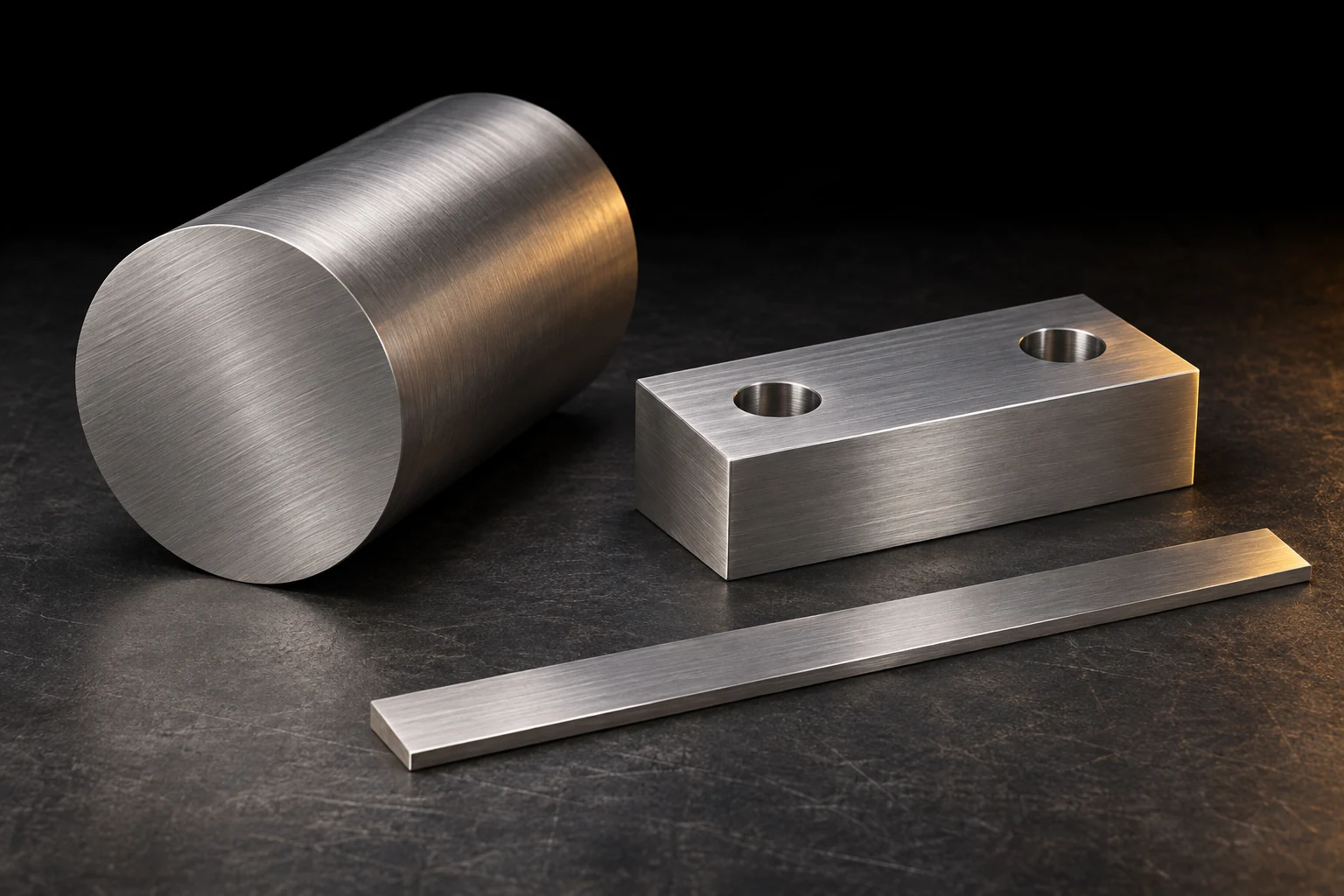
AI illustration; not a production or inspection record.
Quick answer
Grade 4 has higher published strength minima than Grade 3, but it is not an automatic substitute for a Grade 3 drawing. Compare the actual product and condition, review the features and fabrication steps affected by the change, and obtain documented acceptance before releasing the alternative for production.
01 / The substitution request
Separate a stronger material from an approved change
A Grade 3 vs Grade 4 titanium enquiry often begins with a practical supply problem: the drawing specifies Grade 3, but a supplier offers Grade 4 in a useful size or delivery window. Another trigger is a request for more strength in an existing commercially pure titanium component. In both cases, the buyer needs a substitution review, not simply a statement that the higher grade is better.
Both materials belong to the commercially pure titanium family. Grade 4 has a higher published strength level, but a drawing can control more than minimum strength. It may depend on forming behavior, the selected product standard, a qualified fabrication procedure or the exact material designation. A stronger offered material can therefore remain a nonconforming substitute until the responsible authority accepts it.
Begin by preserving the original requirement. Record the drawing revision, material callout, product form, condition and applicable specification. Then describe the proposed change on a separate line. This makes it possible to compare the approved Grade 3 route with the offered Grade 4 route without losing the baseline. Do not overwrite the material field while the review is still in progress.
Identify the reason for the proposal. If the issue is availability, the review asks whether the alternative can meet the existing design and manufacturing requirements in time. If the issue is permanent deformation or an insufficient strength margin, the review asks whether the design basis needs changing. The same material pair can appear in both enquiries, but the evidence and approval process are different.
This guide concentrates on industrial stock and component purchasing, including machined bar or plate blanks and parts that undergo forming. It does not establish implant or flight-critical qualification. Where a project uses a regulated or customer-controlled material system, its specific authorization and qualification requirements govern the change. A general industrial comparison cannot replace those project requirements.
Use the Grade 3 and Grade 4 material pages to start the enquiry, then provide the original requirement and the proposed deviation. Ask the supplier to identify what is available, what is documented and what still requires approval. This is more useful than asking whether the two grades are interchangeable in the abstract.
A successful review can end in several legitimate outcomes: retain Grade 3, approve Grade 4 without a geometry change, approve a revised part and process, or reject the alternative. The objective is not to force an upgrade. It is to obtain a conforming component through a supply route that the buyer, fabricator and responsible engineer understand.
02 / Matched reference data
Compare the same product and condition
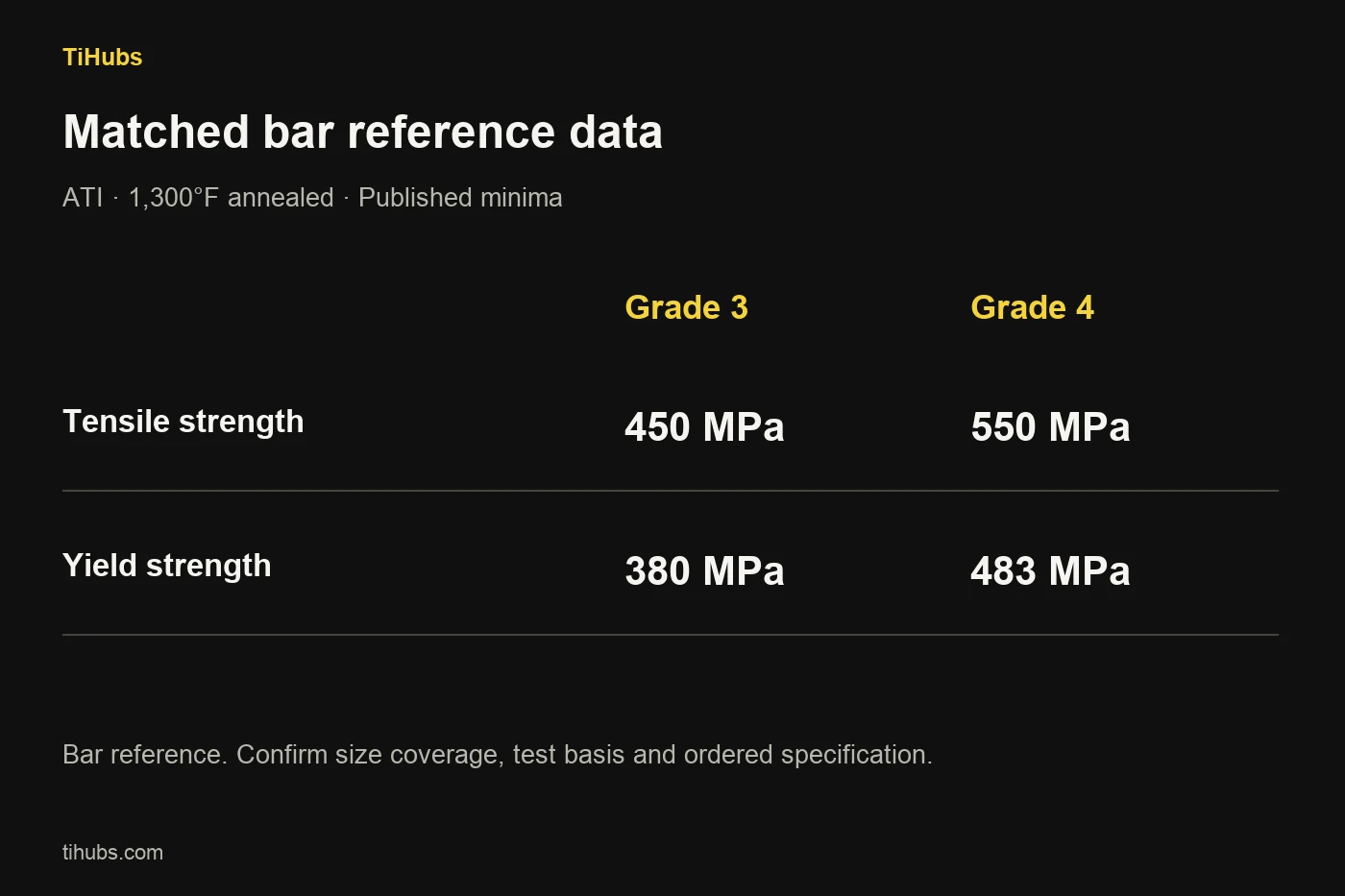
ATI publishes separate product-form sections for CP Grade 3 and CP Grade 4. The selected values below come from the bar sections, which identify a 1,300°F annealed condition. This keeps the comparison within one manufacturer’s published product context. It does not establish acceptance for every bar diameter, plate thickness or wire condition, and it does not replace the specification named in an order.
ATI published bar reference: 1,300°F annealed condition
Reported property
Grade 3
Grade 4
Tensile strength, minimum
450 MPa
550 MPa
Yield strength, minimum
380 MPa
483 MPa
Elongation, minimum
18%
15%
Hardness, maximum
90 HRB
100 HRB
Sources: ATI CP Grade 3 and ATI CP Grade 4, bar sections, reviewed 14 November 2026. The selected sections do not state test temperature, specimen orientation or elongation gauge length. The table therefore does not assign those conditions. Confirm size coverage, test definitions and ordered limits in the controlled product specification and material certificate.
Selected composition maxima from the same ATI bar sections, mass percent
Element
Grade 3
Grade 4
Oxygen
0.35%
0.40%
Iron
0.30%
0.50%
These selected chemistry limits help identify a material difference; they are not a complete acceptance table. They also are not measured contents of a particular heat. Ask for the full chemical analysis and all required test results for the offered stock. A Grade 4 certificate cannot be converted into a Grade 3 certificate simply because one or two reported elements fall within a narrower limit.
The mechanical comparison shows higher listed strength minima and a lower listed elongation minimum for Grade 4. It does not establish the exact machining time, tool life, bending radius or fatigue life of a component. Those outcomes depend on additional material and process conditions. Avoid turning a few tensile entries into a universal productivity or durability ranking.
Do not combine the bar hardness values with a sheet or wire offer as though the product forms were identical. A cold-worked wire or a differently processed plate may require another property basis. The supplier should identify the actual product route and condition before technical comparison. A clearly scoped table is more reliable than a larger table assembled from unrelated sources.
Industrial buying guide / 02The published bar comparison
ATI bar entries in a 1,300°F annealed condition. Listed minima; confirm the complete product specification for an order.
03 / Component review
Check the features that the change affects
Review the part’s function before selecting tests. For a machined spacer, pin or mounting block, important questions may include the load case, local bearing surfaces, threads, fits and section transitions. For a formed clip or bracket, the review also includes the forming sequence and the geometry after unloading. The same grade change can affect different features depending on how the component is made and used.
A higher strength minimum does not authorize a reduction in diameter or wall thickness. If the supplier proposes a smaller blank or a lighter finished section, treat that as a design change. Check stiffness, contact geometry, stability, fatigue requirements and the relevant load cases through the approved engineering process. The purchasing comparison should retain the original dimensions until a revised drawing is released.
Threads and fits need their own acceptance requirements. State the thread designation, class or tolerance, inspection method and any relevant surface requirement. Do not assume that a stronger bulk material automatically provides the desired behavior at a threaded interface. The mating part, engagement, finish and assembly procedure remain part of the component design. Where the interface is critical, obtain project-specific evidence.
For parts with thin webs or deep pockets, discuss dimensional stability during machining. Record the stock condition and the proposed sequence of roughing, intermediate operations and finishing where these affect the drawing. A finished dimension measured immediately after one setup may not describe the part after release from the fixture. Agree on the inspection state rather than attributing every dimensional issue to the grade.
When forming is involved, review the existing qualification against the alternative. The lower published elongation minimum for Grade 4 is a reason to examine the process, not a formula for predicting a crack. Representative trials should use the actual thickness or section, orientation, edge preparation and tooling. If the change requires a revised radius, route that revision through the drawing approval process.
If welding or another joining operation follows machining or forming, establish who reviews the material change for that operation. The original material certificate supports identification of the stock; it does not independently qualify a joint. Include any procedure review, representative assembly or inspection required by the project. Purchasing should know whether those activities occur before stock release or after fabrication.
Corrosion suitability also remains a separate question. The higher grade number and strength entries do not prove a corrosion improvement in a particular fluid. Preserve the approved service conditions and review any material change against the relevant environmental evidence. If the existing failure was caused by the environment rather than load, a mechanical-property comparison alone does not address the cause.
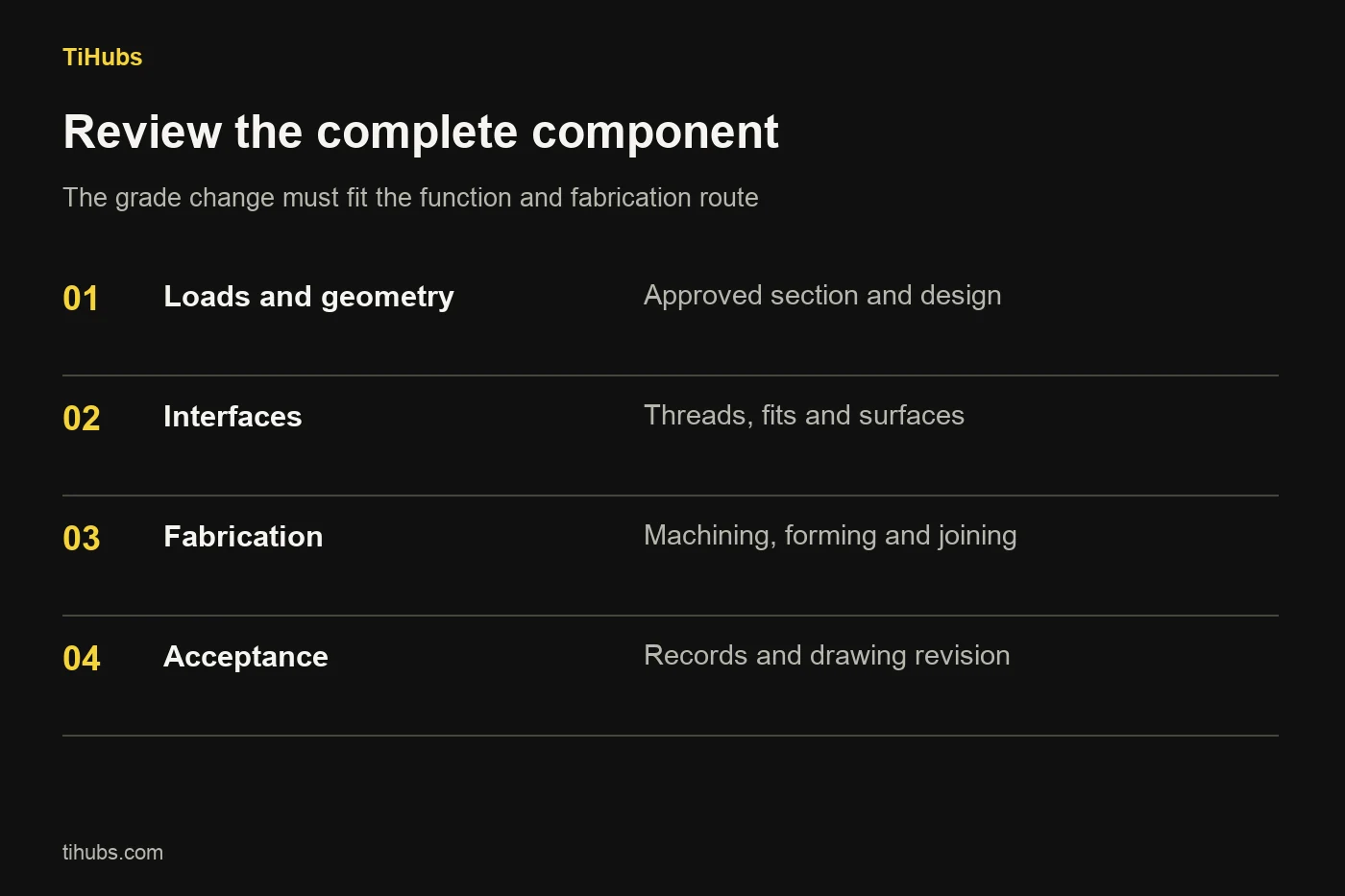
Industrial buying guide / 03Review the part before changing the grade
Material, geometry and fabrication changes require their own supporting evidence.
04 / Stock and processing
Keep stock selection tied to fabrication
Specify whether the purchase is bar, a plate blank, wire or a finished part. ASTM B348/B348M-25 addresses titanium and titanium alloy bars and billets, while ASTM B265-25 addresses strip, sheet and plate. Their product scopes differ. The order should name the appropriate standard and edition, together with any additional drawing or customer requirements.
For bar, state diameter or cross-section, tolerance, straightness, length and surface condition. Explain whether the stock feeds an automatic machine, is cut into individual blanks or undergoes another operation before machining. These details affect the usable stock requirement. A bar that can produce the final diameter in principle may still be unsuitable for the planned feeder or insufficient after straightening and surface cleanup.
For a plate blank, include thickness, width, length, flatness and required machining allowance. If the final part is orientation-sensitive, identify the required relationship between the blank and the rolling direction. Do not assume that changing from round bar to a plate-cut blank is merely a commercial choice. It changes the stock route and may alter the material evidence needed for the part.
For wire, define diameter, delivered condition, straight lengths or coil, surface and intended downstream operation. A drawn condition should not be described using the annealed bar table in this article. Ask for the applicable wire requirements and the actual condition proposed. If the wire will be bent, headed or otherwise formed, provide the operation and acceptance criteria so the supplier can review the correct route.
Agree on the condition at the point of delivery. If the buyer performs later heat treatment or other processing, identify what evidence accompanies the incoming stock and what must be established after that operation. If the supplier delivers a finished part, the quotation should include the required final condition and inspection. An unclear division of responsibility can leave both parties assuming the other will provide the missing evidence.
A machining trial should answer a defined question. It may establish whether the proposed stock can meet a difficult tolerance, whether the planned finishing sequence is stable or whether the existing process needs adjustment. Record the material identity and relevant conditions. Do not extrapolate a universal Grade 4 machining penalty from one trial or promise equal tool life without supporting production evidence.
Use the titanium bar and rod, titanium plate or machined titanium parts route according to the delivery boundary. The enquiry should say which operations are included and which remain with the buyer. This allows the supplier to price a specific responsibility rather than an ambiguous material name.
05 / Approval and cost
Price the change as a separate option
Request a compliant Grade 3 offer where possible and a separately identified Grade 4 alternative. Use the same quantity, drawing revision, delivery destination and inspection scope. If the alternative is available sooner, identify the evidence behind that date and the time required for approval. A faster stock shipment is not automatically a faster delivery of accepted components.
Calculate the commercial effect around usable parts. Include stock allowance, cutting, machining or forming trials, inspection and any required engineering review. The figures should come from actual quotations and project estimates. There is no sound basis for assigning a fixed percentage saving or premium to Grade 4 across all products. A small order cut from available stock can behave differently from a new production run.
Keep one-time qualification costs separate from recurring production costs. A representative trial or revised fixture may affect the first order but not every later batch. Conversely, a continuing inspection or reduced material yield can recur. This distinction helps the buyer understand whether a proposed change solves a single urgent shortage or creates a sustainable long-term supply route.
Consider an illustrative case in which a machine shop has an approved Grade 3 drawing and receives an offer for Grade 4 bar. The correct first step is to record the deviation and collect the offered material documents. Engineering then evaluates the part requirements, while production reviews the machining and any later operations. Only after acceptance should the order release the alternative. This is a process example, not a claimed TiHubs customer case.
Set a clear approval boundary. A conditional quotation can reserve commercial discussion without declaring the material acceptable. If the buyer authorizes purchase of trial stock, distinguish that authorization from permission to produce and ship finished parts. If a hold point is used, name who releases it and which records are required. The supplier should not have to infer approval from silence.
Review continuity if the Grade 4 route will become standard. Ask whether future orders can use the same product condition and documented source route, and what happens if those change. The purpose is not to promise permanent availability. It is to identify the conditions that made the approved alternative workable and to preserve a method for reviewing future deviations.
At order acknowledgment, reconcile the final technical and commercial documents. The grade named in the purchase order, drawing, supplier acknowledgment and inspection plan should agree, or the accepted deviation should be explicitly referenced. A verbal understanding that Grade 4 is stronger is not a sufficiently precise record for receiving inspection or the next production order.
Check whether trial material and production material will come from the same identified lot. If the supplier proposes a different lot for the final order, document the basis for transferring the trial result. This does not necessarily require repeating every test, but the responsible review should address any relevant difference in condition, dimensions or processing history. Also specify how unused trial stock will be identified and stored. Clear lot boundaries help prevent material purchased for evaluation from entering routine production before the alternative has been accepted, and they preserve useful evidence if the production route later changes.
If several drawing revisions exist, identify the revision that governs the quotation and withdraw superseded requirements from the active purchase package.
06 / Final acceptance
Release against the approved material route
Receiving inspection should verify that the delivered identity matches the approved decision. Check grade, heat or lot, product form, condition, dimensions and the applicable specification. Review the full certificate rather than only the title or the largest strength number. Where the order requires an additional report or purchaser review, keep the material on the agreed hold until that requirement is satisfied.
Check that units and property definitions match the acceptance basis. Hardness in HRB is not interchangeable with another hardness scale without a valid, applicable method. Elongation needs its specimen basis, and tensile or yield results need the test context required by the specification. The shortened comparison table above is not a substitute for those details in a real material release.
Maintain traceability when stock is cut into blanks. Record how each production lot relates to the supplied heat or lot and the accepted deviation. If remnants will be stored for future use, identify their grade and condition accurately. A leftover Grade 4 bar from an approved one-time substitution must not later be treated as unrestricted Grade 3 inventory.
For finished parts, review the required dimensional and process evidence as well as the material certificate. The certificate proves only its stated material scope. It does not demonstrate that a thread, pocket, bend or joint meets the drawing. The release package should connect those separate records to the delivered quantity and approved revision.
If a nonconformity appears, assess it against the final approved requirements. Do not use the original Grade 3 requirement for one property and the Grade 4 offer for another simply to obtain a passing result. Establish the agreed material and product basis, then document the disposition. Any further change must be reviewed for its effect on the component and its supporting evidence.
Retain the decision for repeat procurement. Record why the alternative was accepted, which dimensions and processes were unchanged, what validation was performed and what restrictions remain. This prevents a controlled exception from becoming a blanket interchangeability rule. It also gives purchasing a clear route when the same supply question returns.
The final answer to whether Grade 4 is worth specifying is therefore conditional on the part. It can be a useful higher-strength CP option when its product, processing and acceptance requirements fit the application. It is not justified solely by availability or a higher tensile entry. A defined requirement and a documented review turn that option into an order the supplier can fulfill.
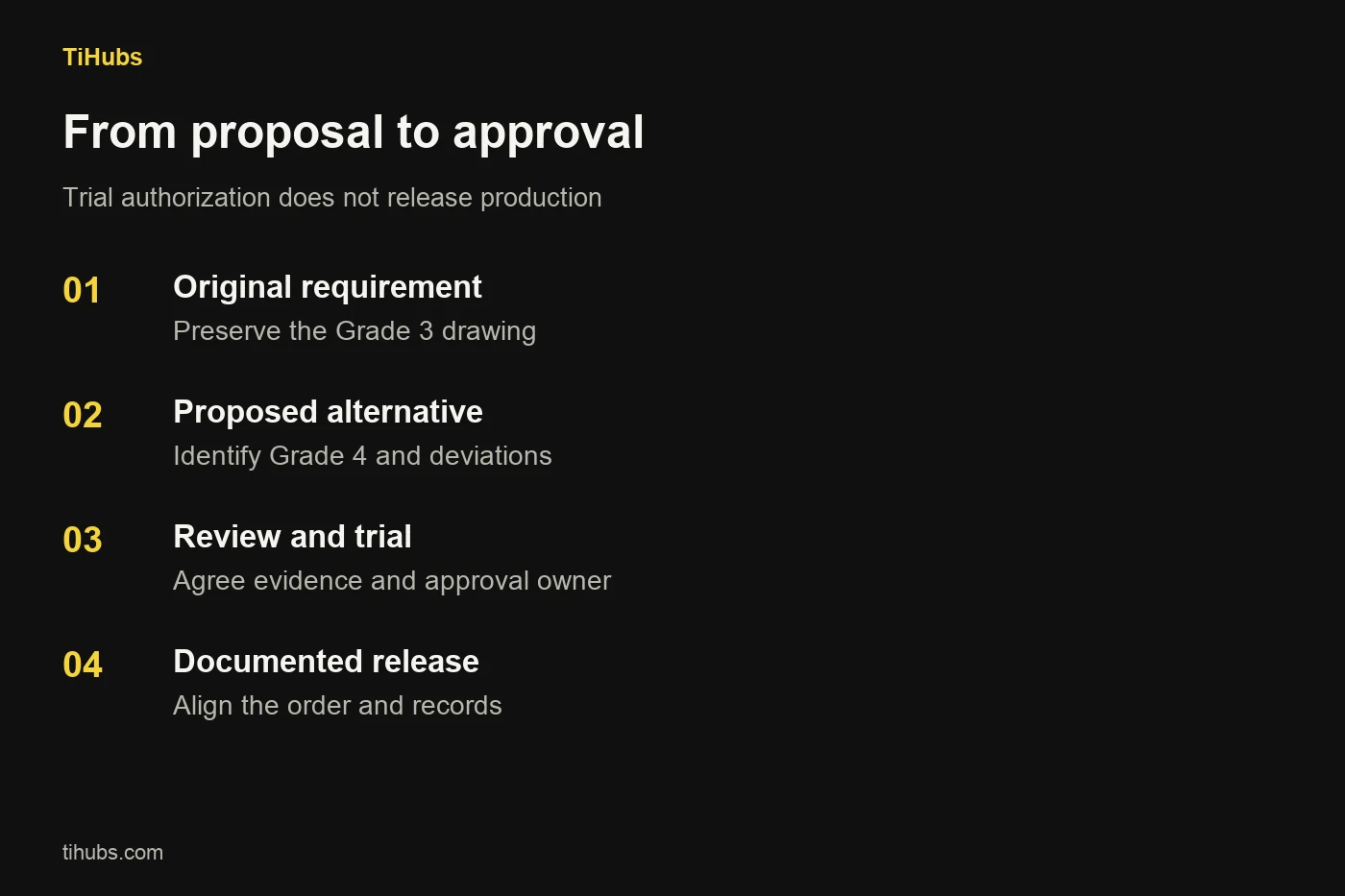
Industrial buying guide / 06Keep the alternative visible until approval
A trial authorization and a production release are separate decisions.
07 / Build your RFQ
Define the original requirement and alternative
Send the Grade 3 requirement and the proposed Grade 4 stock or component separately. Include the drawing, processing route and approval status so the quotation can distinguish a compliant supply from an alternative that still needs review.
Information to include
Original grade, drawing revision and applicable standard
Proposed grade, stock form, condition and dimensions
Machining, forming or joining operations included
Material records, trials and final inspection required
Quantity, delivery date and authority for change approval
Build your RFQ checklist
Choose the product and add the information you have. Copy the resulting brief or send your requirements to TiHubs. Submitting an enquiry does not place an order.
08 / FAQs
Questions buyers ask
Can a supplier replace Grade 3 with Grade 4 because it is stronger?
Only when the responsible approval process accepts the change. The original drawing may control grade identity, condition, fabrication or qualification in addition to strength. The supplier should identify the deviation and supporting evidence before production, not silently change the material on the order.
Are the published bar values valid for every plate or wire order?
No. The comparison uses the ATI bar sections and their stated annealed condition. Plate and wire can have different product requirements or processing states. Obtain the applicable specification and actual proposed condition before using data to accept another product form.
Does Grade 4 always cost more to machine?
The comparison table does not establish machining cost or tool life. Stock dimensions, machine setup, tooling, finishing and inspection all affect cost. Ask for a quotation or a defined representative trial rather than applying a universal percentage to the grade change.
Can the stronger grade use a smaller section?
A smaller section requires approved engineering review. Strength is only one part of the design; stiffness, interfaces, stability, fatigue and manufacturing requirements may also control dimensions. Keep the original geometry in the quotation unless a revised drawing authorizes the change.
Can a Grade 4 heat be accepted as Grade 3 if its chemistry looks suitable?
A few chemistry results are insufficient. Full chemistry, mechanical properties, product requirements, testing and valid certification must support the claimed conformity. Do not relabel stock by selecting individual favorable values. Use a documented alternative approval where that is the actual supply route.
What should the supplier receive with a substitution enquiry?
Provide the original material callout, drawing, product form, dimensions, condition and quantity. Describe the proposed alternative, relevant manufacturing steps and required inspection. State the approval status and delivery need so the supplier can quote the correct scope without assuming permission to substitute.
09 / Key takeaways
Keep the purchase requirements connected.
Preserve the original Grade 3 requirement while reviewing Grade 4.
Compare data for the same product form and stated condition.
Higher strength does not automatically authorize a smaller section or a material substitution.
Price trials, processing and approval time with the actual stock offer.
Keep accepted deviations and material traceability visible on repeat orders.
Technical references
Sources and data scope
References reviewed November 14, 2026. Public source summaries support the discussion; the controlled specification, agreed edition and approved project requirements govern acceptance.
ATI — CP Grade 3 — Bar section: 1,300°F annealed condition, published mechanical entries and selected chemistry maxima; reviewed 14 November 2026.
ATI — CP Grade 4 — Matching bar section and stated condition; test temperature, specimen orientation and elongation gauge length are not given in the selected entries.
ASTM — B348/B348M-25 — Public scope for titanium and titanium alloy bars and billets; complete order requirements require the controlled specification.
ASTM — B265-25 — Public scope for strip, sheet and plate; a separate product basis from bar.
Ti
About TiHubs
TiHubs coordinates titanium material and custom supply enquiries from Baoji, China. Send the product, drawing revision and acceptance requirements so the proposed supply scope can be reviewed. Learn about our sourcing role.
Contents
TiHubs
Talk to TiHubs
Ask about titanium materials, grades or custom parts.
Enter your email to start chatting.
We use your email to respond to your enquiry. Your conversation is stored on this website.
Our team is away right now. Leave your enquiry and we will follow up by email.