Buying strip for stamping? Specify the complete coil.
The right grade and gauge are only the beginning. Connect the strip, coil package and acceptance evidence to the feeding line and the part you need to make.
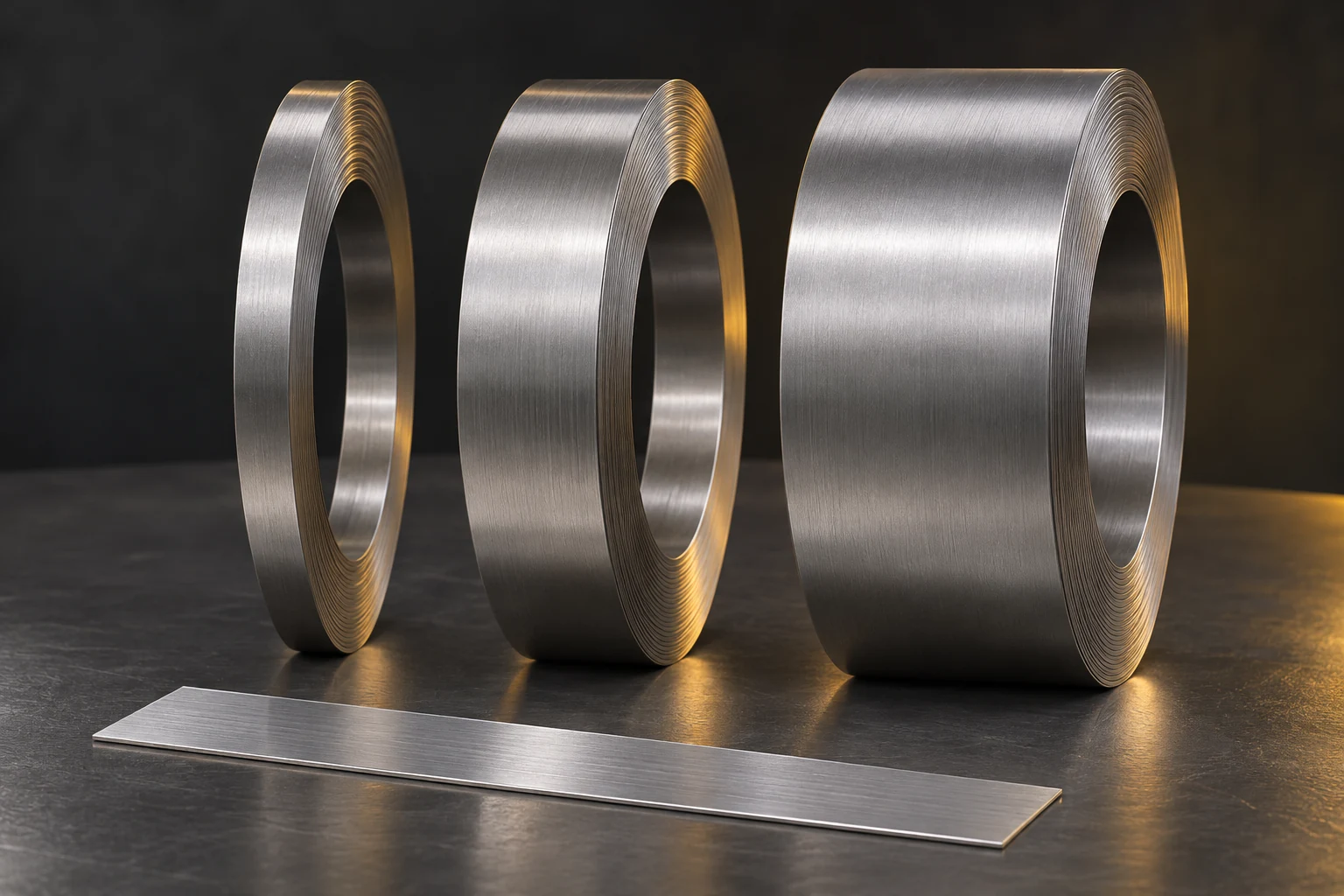
AI illustration; not a production or inspection record.
Quick answer
A stamping-strip enquiry should define grade and condition, thickness and width limits, edge requirements, shape acceptance and coil dimensions. Match those requirements to the approved feeding and tooling process. A conforming strip certificate does not by itself prove feeding performance, part yield or successful forming on your equipment.
01 / Process baseline
Describe the stamping task before selecting a coil
A supplier can quote titanium strip to a grade, thickness and width while leaving the buyer with a coil that does not suit the production line. The missing information often concerns the delivered condition: edge direction, shape, coil dimensions, continuous length or surface protection. A useful enquiry starts with the part and approved manufacturing route, then works back to the material and package that the route can accept.
State whether the strip will be blanked, pierced, bent, drawn or processed through several operations. Identify whether the proposed material is for a development trial, a replacement production lot or an alternative to an already qualified supply. These cases have different evidence needs. A development sample may answer an open forming question; a repeat order should preserve the established requirements and clearly disclose any proposed change.
Connect the specification to the approved process
ASTM B265’s public scope covers annealed titanium and titanium-alloy strip, sheet and plate. Identify the agreed grade, edition, condition and any additional project requirements. The specification reference should be connected to the actual product and required records. It does not replace the part drawing, tooling requirements or line-capacity review, and it should not be used as a generic promise that every titanium strip can run on every stamping line.
Provide the material properties that the responsible process team needs to assess the route. Do not describe a strip as suitable for stamping solely because it is commercially pure titanium or because another buyer formed a different part from the same nominal grade. The required deformation, material condition, orientation and process constraints matter. Where a mechanical-property range is required beyond the basic product specification, state it explicitly and agree the test basis.
Preserve the difference between material supply and process development
Identify who approves the material, who owns the tooling and who validates the completed part. A strip supplier can confirm the proposed material and processing scope without necessarily taking responsibility for the buyer’s entire stamping operation. If application support or a performance commitment is required, define it in the enquiry. Avoid discovering after delivery that one party expected a material order while the other expected a production-process guarantee.
Use a compact baseline package: part or strip drawing, material schedule, coil-delivery limits and acceptance plan. Mark confidential or provisional information clearly. An approved drawing revision is more useful than several informal dimensions distributed across messages. Once the production route is qualified, keep later quotations tied to that baseline so a seemingly small change in condition, edge treatment or coil size receives the review it needs.
02 / Width and edges
Specify the usable strip at its maximum and minimum dimensions
A nominal strip width is insufficient when the feeding guides, carrier layout or final blank have limited clearance. State width limits and the measurement basis, together with thickness limits. Identify whether the width applies before or after a particular edge treatment. If a rounded or otherwise processed edge is required, its geometry and effect on usable width should be part of the drawing rather than an undefined finishing preference.
A width that fits nominally may fail the clearance budget
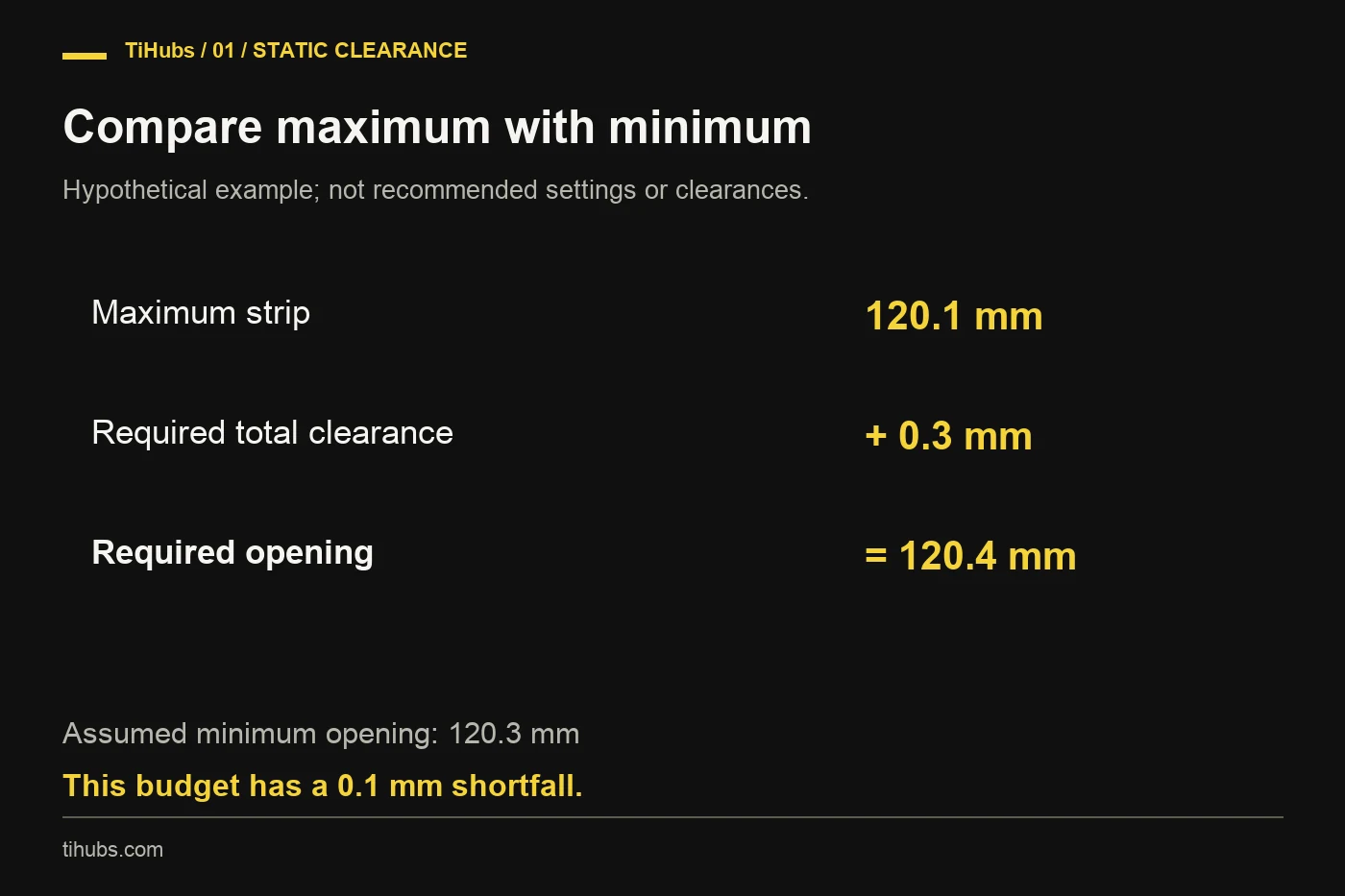
Consider a hypothetical strip specified as 120.0 ±0.1 mm. Its maximum width is 120.1 mm. Assume a hypothetical minimum guide opening of 120.3 mm and a required total lateral clearance of 0.3 mm under a simplified static comparison. The maximum strip would require 120.1 + 0.3 = 120.4 mm, leaving a 0.1 mm shortfall against that opening. These numbers are invented to explain a purchasing check; they are not machine settings or recommended clearances.
The calculation is only a static dimensional budget. It does not establish dynamic feeding behaviour or account for every shape and alignment effect. The line owner must confirm the actual operating requirements. The buyer’s task is to obtain a strip specification consistent with those requirements, rather than accepting a nominal width because it appears smaller than a nominal guide dimension.
Make the edge requirement observable
Specify the delivered edge condition and any required limit or inspection method for burrs, damage or edge defects. If burr direction matters to the process, define it relative to the identified strip face and unwind direction. Avoid an unqualified “burr-free” statement when the buyer and supplier use different methods or thresholds. Agree the criterion and how the actual delivery will be checked.
Surface and edge acceptance should be linked to the functional area of the finished part. A defect in a scrap carrier may have a different consequence from one entering a formed edge, but the permissible distinction belongs in the approved requirements. If edge removal is part of the buyer’s route, include the required allowance and identify the resulting usable width. Do not assume that a downstream operation will remove a defect that the current layout carries into the part.
Titanium Industries describes coil slitting as a way to supply custom strip widths from wider material. That service context does not define a universal width tolerance or edge quality. For the actual enquiry, ask the supplier to confirm the proposed slitting and finishing scope, measurement results and any restrictions that affect the order. A narrower strip is a different delivered product, not simply a proportional share of a wider coil’s certificate.
Keep identification meaningful after slitting. Several narrow coils can originate from one parent coil but occupy different width positions and carry different piece identifiers. Preserve the relationship where required by the traceability plan. If a local issue is later found, that relationship helps identify the affected material without automatically treating every strip from the same heat as either satisfactory or defective.
Industrial buying guide / 02Check maximum strip width against minimum available opening
Hypothetical static budget: 120.1 mm maximum strip plus 0.3 mm required total clearance equals 120.4 mm, exceeding an assumed 120.3 mm opening. Not a machine-setting recommendation.
03 / Shape and condition
Distinguish camber, coil set and local flatness
Strip shape cannot be represented by one general request for flat material. Camber concerns sideways curvature along the strip in its plane. Coil set describes curvature associated with the wound shape. Local waviness or other deviations can introduce additional questions. A purchase specification should identify the shape characteristic relevant to the process and the condition in which it is assessed.
Use a defined measurement length and restraint
A camber value without its reference length and measurement method is incomplete. State the sample length, support and restraint conditions, reference line and acceptance criterion selected by the technical team. A short coupon can look straight while a longer length reveals a relevant deviation. Conversely, forcing a sample into position can hide the free-state shape that the agreed inspection intended to assess.
For coil set or flatness, identify whether acceptance applies to material as unwound, after an agreed preparation or after the buyer’s leveling process. These are different conditions. Do not ask the supplier to certify an undefined flatness while the receiving team evaluates a sample prepared in a different way. Record the procedure and any exclusions so both parties can reproduce a meaningful comparison.
Relate condition to the line without inventing a machine setting
The feeding and straightening equipment must be reviewed for the actual material and section. COE’s public descriptions of coil lines identify thickness, width, yield strength and coil weight as relevant capacity variables. Its listed machine ranges are not a qualification for titanium on the buyer’s equipment. Use the installed machine documentation and the responsible equipment or process team to confirm the appropriate operating scope.
This article does not prescribe roll settings, press speed or tooling clearances. Those belong to the approved process and equipment instructions. The procurement requirement should instead capture the material characteristics and delivery condition that the validated process expects. If a proposed strip requires a different leveling route or handling arrangement, treat that as a reviewed change rather than assuming the production team can compensate for it later.
Material condition and surface protection also belong in that review. State whether processing oils, protective films or other residues are permitted and who removes them before the next operation. If both faces have different surface requirements, identify them consistently on the drawing and coil label. A change made to protect shipping appearance should not introduce an unapproved cleaning step or interfere with an established joining or coating process.
For an initial trial, retain enough information to connect the observed behaviour to the supplied material: coil identity, grade, condition, measured dimensions, edge orientation and relevant shape results. A statement that the strip ran well is much more useful when the next order can reproduce the conditions that were evaluated. Without that link, the trial can become an isolated demonstration rather than a dependable basis for purchasing production material.
04 / Coil package
Check the coil against the entire handling and feeding route
Coil inside diameter, outside diameter, width and mass are separate requirements. A coil can meet the weight capacity of a reel and still fail another dimensional constraint. State the permitted ranges and whether the limits apply to bare material, a core-supported coil or the complete shipping package. The supply enquiry should use the installed equipment’s reviewed requirements, not a generic coil size taken from another facility.
Separate net metal from the package
Identify the maximum individual coil mass and the commercial quantity tolerance. Specify whether the quoted mass includes the core, protective materials or packaging. For handling and logistics, the gross package dimensions and mass may also be needed. The relevant equipment and site procedures govern lifting and unloading; this guide does not authorize a handling method or a capacity assumption.
State the required winding and unwind orientation in an unambiguous drawing or sketch. Connect it to the identified material face, edge condition and feed direction. Specify core requirements where applicable and how the strip ends will be secured and identified. A photograph of a coil can support the discussion but may not establish its orientation clearly enough for a production order.
Use ideal coil arithmetic only as a planning check
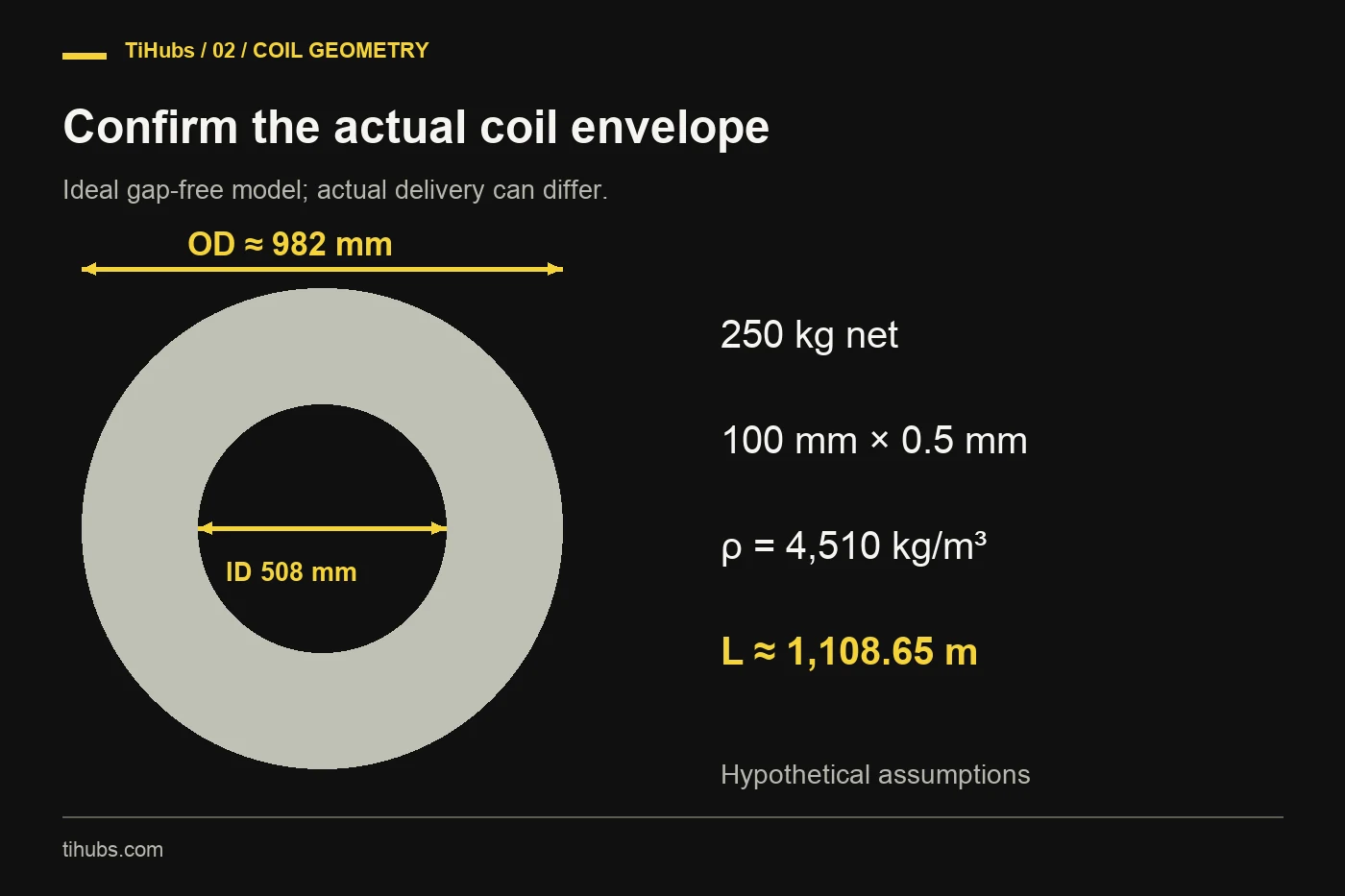
For a hypothetical coil containing 250 kg of net titanium, assume a width of 100 mm, thickness of 0.5 mm and rounded density of 4,510 kg/m³. The ideal length is mass divided by density, width and thickness: 250 ÷ (4,510 × 0.100 × 0.0005), approximately 1,108.65 m. This excludes tolerances, coatings, splices and any nonmetal mass. It is not a measured or guaranteed delivery length.
If that ideal strip is tightly wound without gaps around a 508 mm inside diameter, the geometric relationship is outside diameter squared equals inside diameter squared plus 4 × length × thickness ÷ π, using consistent units. It gives an outside diameter of approximately 982 mm. Real winding, core construction and dimensional variation can change the delivered envelope. Confirm the supplier’s actual coil dimensions rather than using the estimate to approve machine clearance.
These calculations reveal why mass, length and outside diameter cannot be treated as independent promises without a consistent basis. A requirement for a smaller outside diameter may change the maximum length per coil and the number of coil changes. A preferred large coil may exceed a handling constraint. Resolve those tradeoffs through the reviewed line requirements and the supplier’s proposed coil schedule before placing the order.
Define packaging that protects the edges, faces and coil shape throughout the delivery route. State storage or surface-protection requirements relevant to the next operation. If orientation on the pallet matters for receiving equipment, include the agreed arrangement. The packaging should also preserve identification so the receiving team can distinguish individual coils without opening every protective layer unnecessarily.
Industrial buying guide / 04Mass, length and diameter need a consistent basis
Idealized example: 250 kg net titanium, 100 mm width, 0.5 mm thickness and assumed density 4,510 kg/m³ give about 1,108.65 m. Tight winding at 508 mm ID gives about 982 mm OD. Actual delivery must be confirmed.
05 / Yield and trial
Compare usable production length and validate a representative coil
Total kilograms and total metres are useful commercial measures, but they do not directly equal accepted stamped parts. A production estimate must include strip layout, feed pitch, end losses, permitted interruptions and process yield. Distinguish an arithmetic estimate from the output guaranteed under an agreed production scope. A material supplier does not automatically own every loss in the buyer’s tooling and process.
Count coil-end losses on the same basis
Using the hypothetical 1,108.65 m ideal coil from the previous section, assume a 25 mm feed pitch, one part per pitch and 8 m of combined leading and trailing losses. The remaining length is approximately 1,100.65 m. Dividing by 0.025 m gives about 44,025 complete pitches when the fractional remainder is discarded. This idealized count excludes defects, process rejects, setup trials and all other losses.
Splitting the same total material into more coils can increase repeated end losses if each coil requires its own lead-in and tail-out length. That does not mean the largest possible coil is always the best purchase: machine capacity, handling, scheduling and traceability may justify smaller coils. Ask for an individual coil schedule so production planning can evaluate both the practical constraints and the repeated losses.
Review the slit-width layout without assuming a universal yield
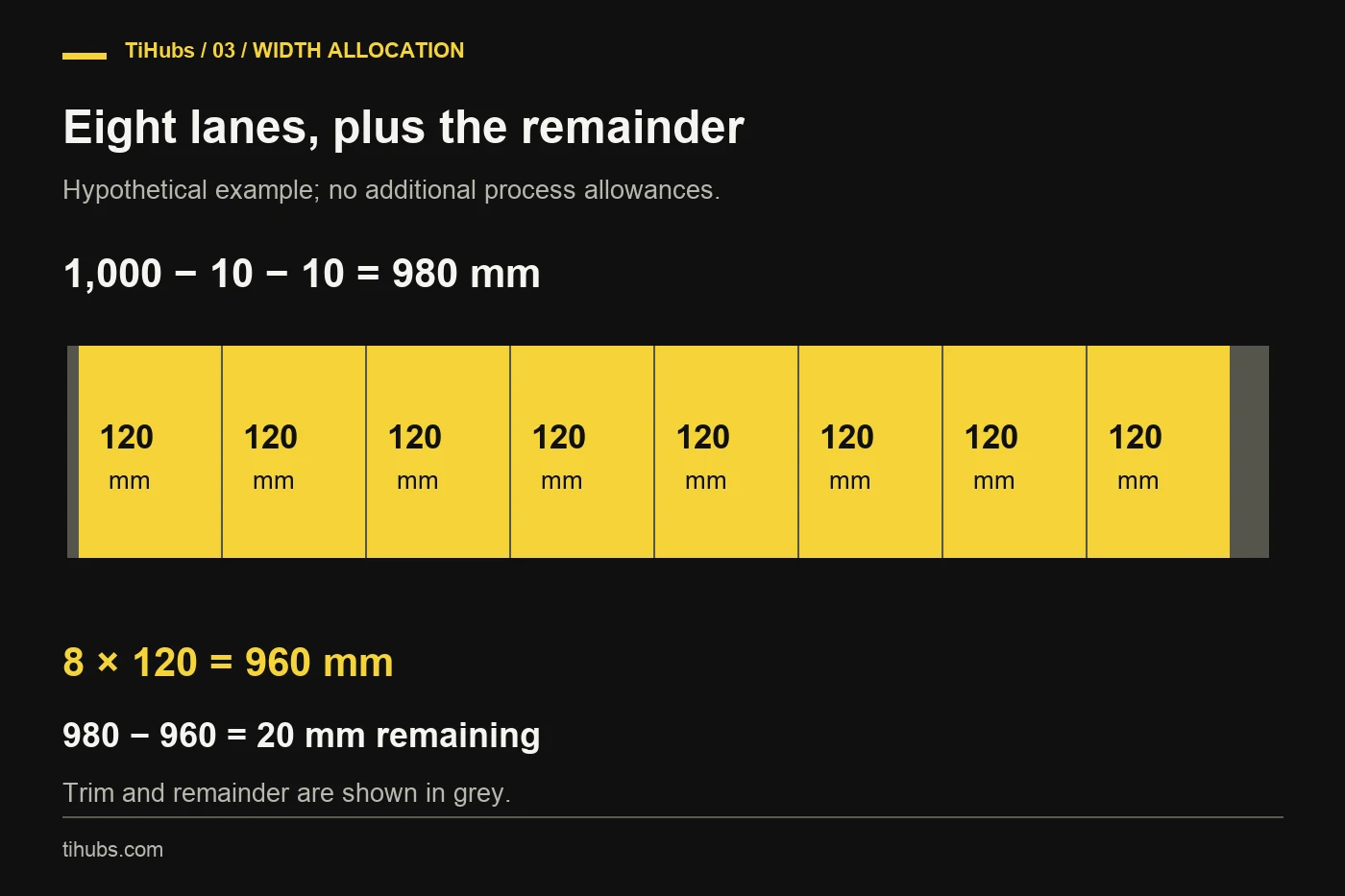
For another hypothetical example, start with a 1,000 mm wide parent strip and assume 10 mm of edge trim on each side. The simplified remaining width is 980 mm. Eight 120 mm lanes use 960 mm, leaving 20 mm before any additional process-specific allowances. Nine lanes would require 1,080 mm and do not fit. This is a width allocation example, not a slitting-tool setup or a guarantee of saleable yield.
Actual width tolerances, edge treatment, permitted parent-coil variation and the chosen process can affect that allocation. Ask how trim and residual width are treated commercially and whether alternatives are permitted. The cheapest nominal lane width may not be the lowest cost per approved part if it forces a different layout or reduces the process margin. Evaluate the proposed width against the approved component and carrier requirements.
A trial should represent the intended delivery
Agree the trial coil’s material condition, width, thickness interval, edge state and winding arrangement. A short hand-fed coupon may answer a forming question while leaving continuous feeding untested. Define what the trial must demonstrate and record the actual material and process conditions. Keep equipment operation within the approved instructions and the responsible team’s control.
For a repeatable qualification, retain the part inspection results and the relationship to the trial coil. Identify which changes trigger another review: grade, condition, dimensional range, edge treatment, source or coil configuration as relevant. Do not turn one successful run into unrestricted permission for later substitutions. A documented change process protects both the buyer’s production assumptions and the supplier’s agreed scope.
Compare two proposed coil schedules
Suppose a hypothetical order contains 2,000 kg of the same strip. One offer divides it into eight 250 kg coils; another offers ten 200 kg coils. If the approved process loses the same assumed 8 m at the ends of every coil, the first schedule consumes 64 m in end losses and the second consumes 80 m. The difference is 16 m, equivalent to 640 pitches at the hypothetical 25 mm pitch. This comparison ignores every other loss and does not guarantee that either schedule produces more accepted parts.
The smaller coils could still be the correct choice if they match a reviewed handling limit or production schedule that the larger coils cannot meet. The buyer should therefore record the reason for the selected schedule, not optimize the arithmetic in isolation. Ask the supplier to identify the expected number of coils, the permitted individual mass range and whether final quantity tolerances can change that distribution. If the delivery later arrives as additional short coils, the receiving and planning teams can then compare it with an explicit agreement instead of debating what a total-weight order was supposed to mean.
Industrial buying guide / 05Check the width allocation before comparing strip prices
Hypothetical 1,000 mm parent width minus two 10 mm trims leaves 980 mm. Eight 120 mm lanes use 960 mm, leaving 20 mm before additional process allowances.
06 / RFQ and acceptance
Release the order with a coil-level acceptance plan
The final enquiry should allow the supplier to confirm the strip and its delivery format together. Include the material designation, drawing revision, dimensions, condition, edge requirements and shape inspection basis. Add the individual coil limits, continuous-length requirement, permitted splices or marked exclusions, and the expected quantity schedule. Avoid defining only total weight when production depends on a particular distribution of coil sizes.
Make the records follow each coil
Agree the identification linking heat or material lot, parent coil where required, finished slit coil and inspection documents. The report should clearly state which results apply to the lot and which are measured on individual coils or samples. Chemistry, mechanical properties, strip dimensions and delivered coil dimensions are different records; a single certificate title does not establish that every requirement was checked.
Plan receiving checks for identification, shipping condition, coil envelope and the agreed dimensional or surface samples. Keep unverified material distinct until the required review is complete. If a result differs from the order, follow the agreed disposition process and preserve traceability. The production team should not compensate for an unapproved deviation simply because a machine adjustment appears to make the first few parts possible.
Compare commercial scope after technical alignment
Ask whether slitting, edge finishing, special winding, testing and protective packaging are included. Separate a supply lead time from the time needed for sample approval or a new manufacturing route. If the supplier proposes another coil size, ask for its effect on count, length, handling and delivery schedule. This makes alternatives comparable without treating every change as either automatically acceptable or automatically undesirable.
Start a titanium strip enquiry with the approved baseline and any open questions. The material certificate guide can help organize the required traceability. TiHubs can review the proposed material, processing and delivery scope. Exact capability, tolerances, coil dimensions, documentation, availability and lead time must be confirmed for the actual purchase.
07 / Build your RFQ
Build a titanium stamping-strip enquiry
Connect the strip drawing to the coil package and the validated production route. Identify the limits the supplier must meet and the checks the receiving and trial teams will use.
Information to include
Grade, specification, condition and required material properties.
Thickness and width limits, edge condition and identified faces.
Camber, coil set or flatness method and acceptance state.
Coil ID, maximum OD, individual mass, continuous length and winding.
Trial scope, traceability, inspection, packaging, quantity and delivery.
Build your RFQ checklist
Choose the product and add the information you have. Copy the resulting brief or send your requirements to TiHubs. Submitting an enquiry does not place an order.
08 / FAQs
Questions buyers ask
Is grade and thickness enough to buy titanium strip for stamping?
No. Width limits, material condition, edges, shape, surface and the coil package can all affect the approved process. Include the relevant line and tooling requirements in the enquiry. A product certificate alone does not demonstrate successful feeding or completed-part acceptance on the buyer’s equipment.
Are camber and coil set the same requirement?
No. Camber is sideways curvature in the strip plane, while coil set relates to curvature from winding. Define the relevant characteristic, measurement length, restraint and acceptance state. An undefined request for flat strip does not establish a reproducible check for either condition.
Can a coil meet the mass limit and still be unsuitable?
Yes. Inside diameter, outside diameter, width, winding and core arrangement also need to match the reviewed equipment requirements. Distinguish net metal mass from gross package mass. Confirm actual delivered dimensions rather than relying on a theoretical length or diameter calculation.
Does a larger coil always reduce the cost per part?
It may reduce repeated end losses in some processes, but handling capacity, line limits, scheduling and traceability can favour smaller coils. Compare a proposed individual coil schedule against the validated production route. Total kilograms alone do not establish accepted-part yield.
Can a short coupon qualify continuous coil feeding?
A coupon can answer a limited material or forming question, but it may not reproduce winding, coil set, continuous feeding or end behaviour. Define the trial objective and use representative material and delivery conditions. Retain the records needed to reproduce the accepted production baseline.
What should a supplier disclose when offering an alternative?
Identify changes in material condition, dimensions, edges, shape, coil size, winding, inspection and delivery scope. Explain their commercial effect separately. The responsible buyer or process team should approve relevant changes before the alternative is treated as equivalent to the established order.
09 / Key takeaways
Keep the purchase requirements connected.
Tie the material requirement to an approved part and process baseline.
Check width limits and edge condition against usable geometry.
Define shape by method, length and restraint condition.
Specify coil ID, OD, mass and continuous length separately.
Use representative trials and preserve coil-level traceability.
Technical references
Sources and data scope
References reviewed November 14, 2026. Public source summaries support the discussion; the controlled specification, agreed edition and approved project requirements govern acceptance.
TiHubs coordinates titanium material and custom supply enquiries from Baoji, China. Send the product, drawing revision and acceptance requirements so the proposed supply scope can be reviewed. Learn about our sourcing role.
Contents
TiHubs
Talk to TiHubs
Ask about titanium materials, grades or custom parts.
Enter your email to start chatting.
We use your email to respond to your enquiry. Your conversation is stored on this website.
Our team is away right now. Leave your enquiry and we will follow up by email.