Grade 7 or Grade 11? Same palladium. Different base.
Both grades specify the identical palladium addition and deliver the same corrosion resistance. The decision is made by design stress, forming severity and supply reality — not by the corrosion table.
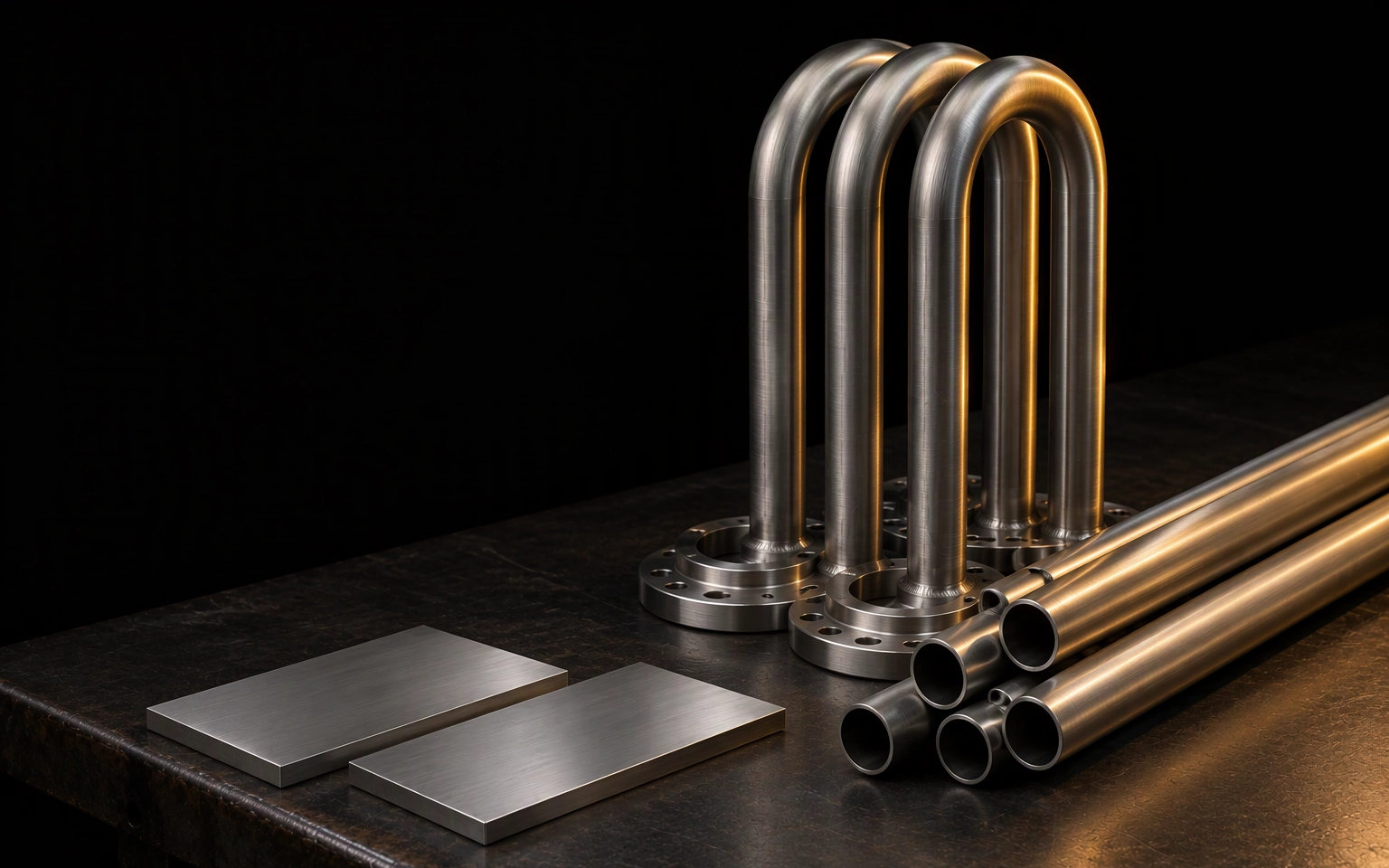
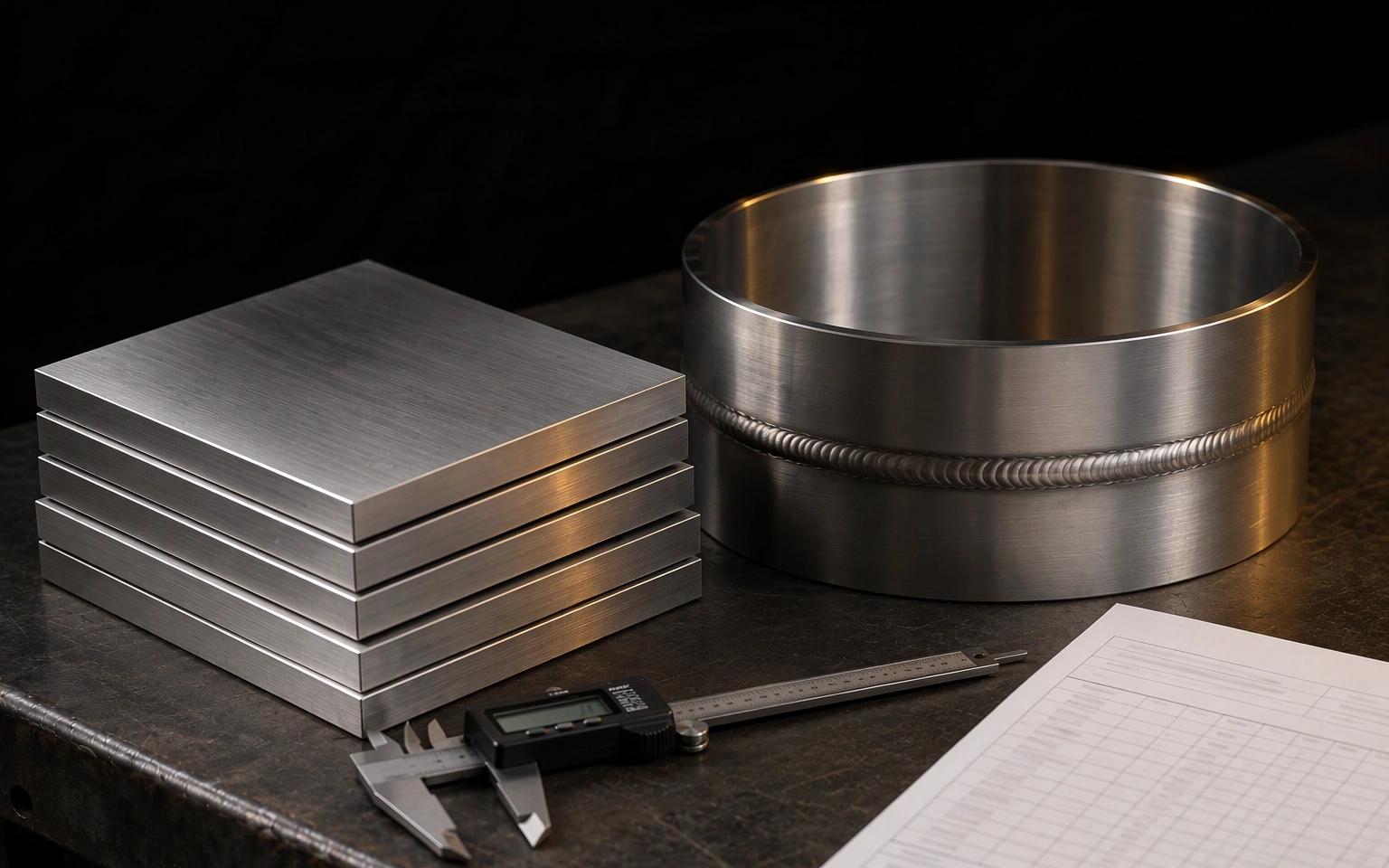
AI illustration. Appearance and labels do not verify material compliance.
Quick answer: corrosion resistance does not decide this comparison
Grade 7 and Grade 11 titanium specify the same 0.12–0.25% palladium addition, so corrosion resistance is identical. Grade 7 uses the stronger Grade 2 base (275 MPa yield); Grade 11 uses the softer Grade 1 base (172 MPa yield). Choose Grade 7 when design stress governs; choose Grade 11 when tight bending or deep drawing governs.
01 / Grade comparison
What the shared palladium addition actually does
Unalloyed titanium protects itself with a self-repairing TiO₂ passive film. In reducing conditions — dilute hydrochloric acid, warm dilute sulfuric acid, hot concentrated brines and tight crevices — there is not enough oxidizing species to keep that film stable, and commercially pure titanium can shift into active corrosion. Palladium changes that balance. Even at 0.12–0.25%, palladium at the surface acts as a preferential site for hydrogen evolution, pulling the corrosion potential back into the passive region where the TiO₂ film remains stable. TIMET’s corrosion manual describes this benefit for palladium-bearing grades in selected reducing and crevice conditions, and identifies the limits that still require specialist review. [2]
The critical purchasing point: Grade 7 and Grade 11 carry the identical palladium range, so this mechanism works identically in both. Manufacturer datasheets describe the same reducing-acid and crevice service window for each. [1] A buyer should therefore never pay a premium for one grade over the other “for better corrosion resistance” — the premium must buy a mechanical, fabrication or availability benefit. Those are examined in the next sections.
Comparison item
Grade 7
Grade 11
Material identity
Palladium-added titanium on a Grade 2 CP base
Palladium-added titanium on a Grade 1 CP base
Palladium content
0.12–0.25%
0.12–0.25% — identical
Corrosion resistance
Excellent in the Pd-grade envelope
Identical to Grade 7 — not a differentiator
Purchasing question
Does the design allowable reward the higher yield?
Does the forming severity require the softer base?
Cost driver
Pd premium plus plate/vessel volume
Pd premium plus mill-order availability and lead time
The useful comparison is not “good palladium titanium versus better palladium titanium.” It is one corrosion solution offered on two different mechanical bases, each with a clear boundary of suitability and a documented release process.
02 / Composition & standards
Two base materials under one palladium range
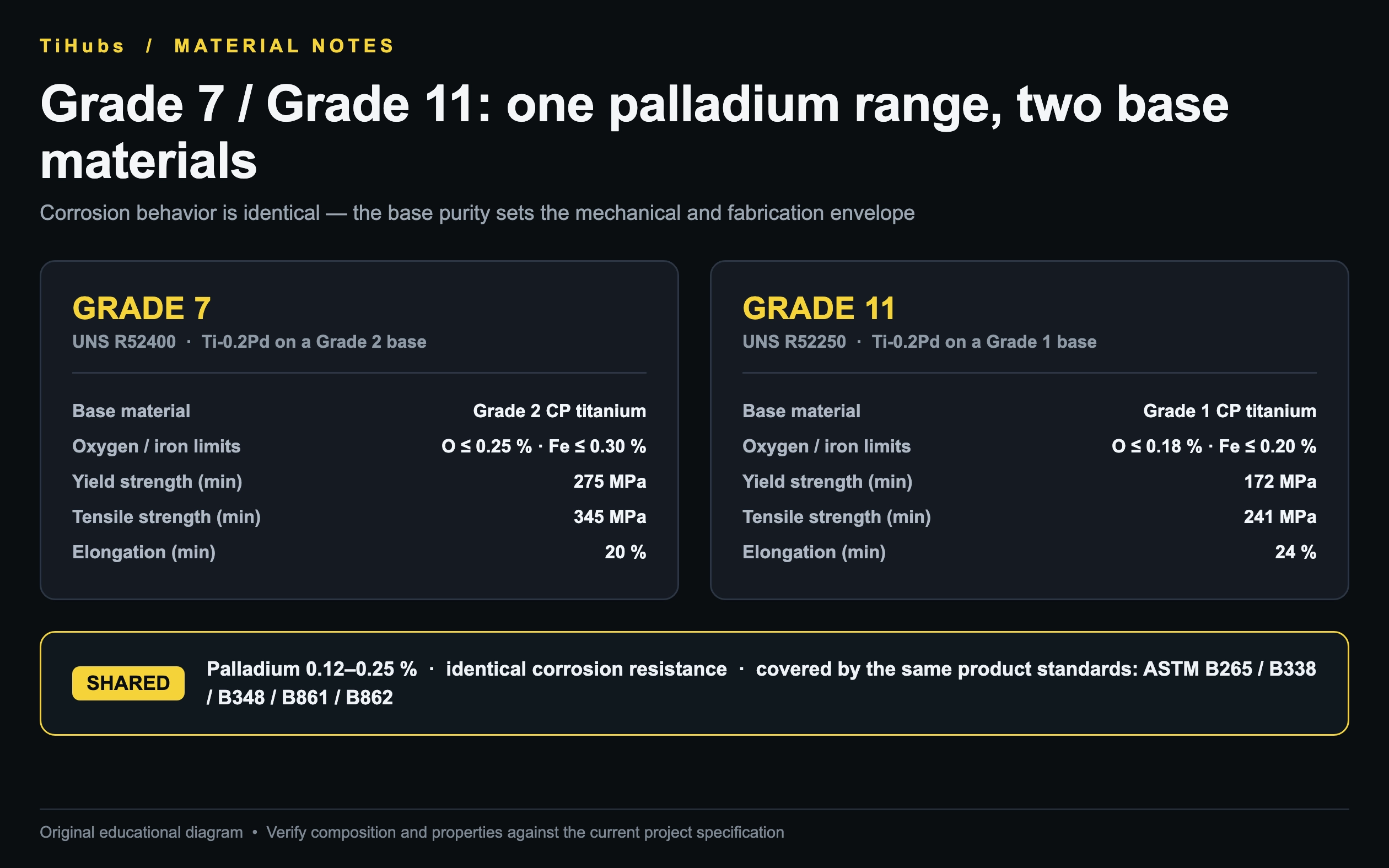
Strip the designations back to the specification and the whole story is the interstitial ceiling. Grade 7, UNS R52400, keeps the Grade 2 base limits — oxygen to 0.25% and iron to 0.30%. Grade 11, UNS R52250, keeps the tighter Grade 1 base limits — oxygen to 0.18% and iron to 0.20%. Oxygen and iron are the strength dial in commercially pure titanium: lower interstitials mean lower strength and higher ductility. ASTM B265 lists the composition and the mechanical minimums for both grades, and those values must be verified against the current edition for the ordered product form. [3]
Element / designation
Grade 7
Grade 11
UNS number
R52400
R52250
Palladium
0.12–0.25%
0.12–0.25%
Oxygen, max
0.25%
0.18%
Iron, max
0.30%
0.20%
Base equivalent
Grade 2 CP titanium
Grade 1 CP titanium
Common equivalents
GB TA9 · JIS Class 12 · W.Nr. 3.7235
GB TA9-1 · JIS Class 11 · W.Nr. 3.7225
Two relatives appear in enquiries and should not be confused with these grades. Grade 7H shares Grade 7’s chemistry but carries a higher minimum tensile floor of 400 MPa; it is a separate designation that must be ordered explicitly. Grades 16 and 17 use a reduced palladium range of 0.04–0.08% on Grade 2 and Grade 1 bases — a narrower corrosion window at lower cost, not a substitute where full Pd content is specified.
Both grades are covered by the same product standards: ASTM B265 for strip, sheet and plate, B338 for heat-exchanger tube, B348 for bar, B861 and B862 for pipe, and B381 for forgings, with ASME SB counterparts for code work. Where a supplier offers a Chinese GB designation such as TA9 or TA9-1 against an ASTM callout, request a clause-by-clause comparison of the complete specifications — chemistry, mechanical properties, testing and documentation. A cross-reference table is a starting point, not an automatic substitution instruction.
Material identityOne palladium range, two bases
Corrosion behavior is identical; the base purity sets the mechanical and fabrication envelope. Educational diagram — verify against the current specification.
03 / Mechanical properties
What the yield gap changes in a design
The 103 MPa gap in minimum yield strength is the entire commercial difference between these grades. It decides wall thickness in pressure design, forming load and springback in fabrication, and the margin available in cyclic service.
Property (annealed, room temperature)
Grade 7
Grade 11
Yield strength, min
275 MPa (40 ksi)
172 MPa (25 ksi)
Tensile strength, min
345 MPa (50 ksi)
241 MPa (35 ksi)
Elongation, min
20%
24%
Elastic modulus
≈ 108 GPa
≈ 103 GPa
Density
4.51 g/cm³
4.51 g/cm³ — identical
In pressure equipment, the comparison runs on the allowable stress from the applicable design code at the service temperature — not on the room-temperature minimums alone. Industry guidance commonly finds that a vessel wall designed to Grade 7 allowables comes out roughly 20–25% thinner than the same vessel designed to Grade 11. Thinner walls mean fewer kilograms, less weld volume, lower freight weight and, in some layouts, a more compact vessel. Those savings can offset a meaningful share of the palladium premium both grades carry.
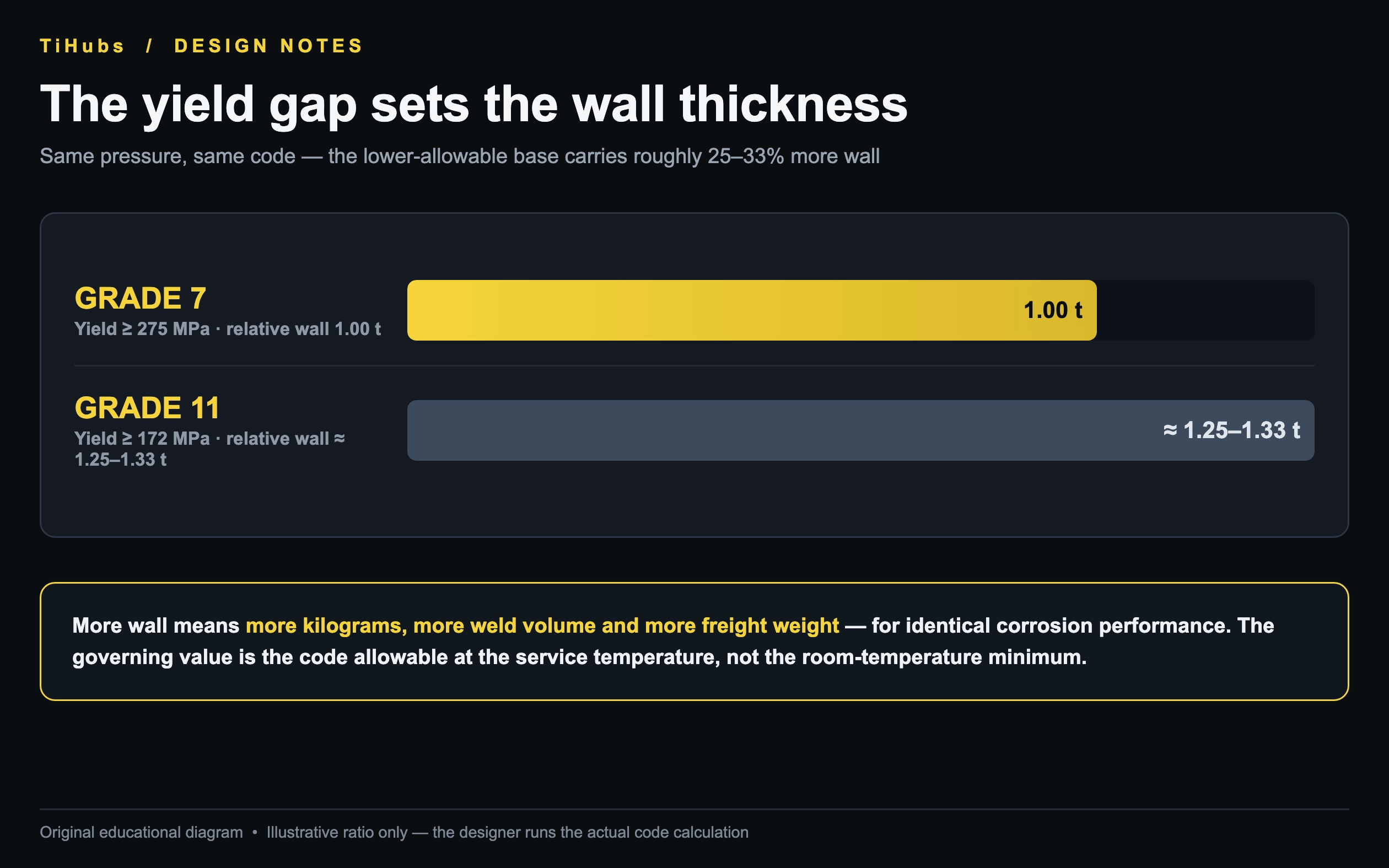
A worked illustration keeps the scale concrete. Take a vessel shell course whose required wall is governed by membrane stress: at representative allowable-stress ratios, the Grade 11 design lands at roughly 1.25–1.33 times the Grade 7 thickness. On a shell that needs 10 mm in Grade 7, that means 12.5–13.3 mm in Grade 11 — about 25–33% more titanium by weight for identical corrosion performance, plus proportionally more weld volume at every seam. The designer must run the actual code numbers; the procurement point is that the grade bought for easier forming can become the heavier, costlier choice once the design is thickness-governed.
Design impactSame duty, different wall
Illustrative thickness ratio at representative allowable stresses. Educational diagram — the designer runs the actual code calculation.
Two cautions keep this comparison honest. First, the governing allowable value changes with the code edition and temperature; the design engineer must run the actual numbers rather than scale from a data sheet. Second, service with severe pressure cycling usually favors the higher-strength grade, while severe thermal cycling can reward the more ductile weld zones of Grade 11. Ask the designer which mechanism governs before the material is released — the answer is design-specific, and a generic rule of thumb is not a design basis.
04 / Fabrication & forming
When forming decides the grade
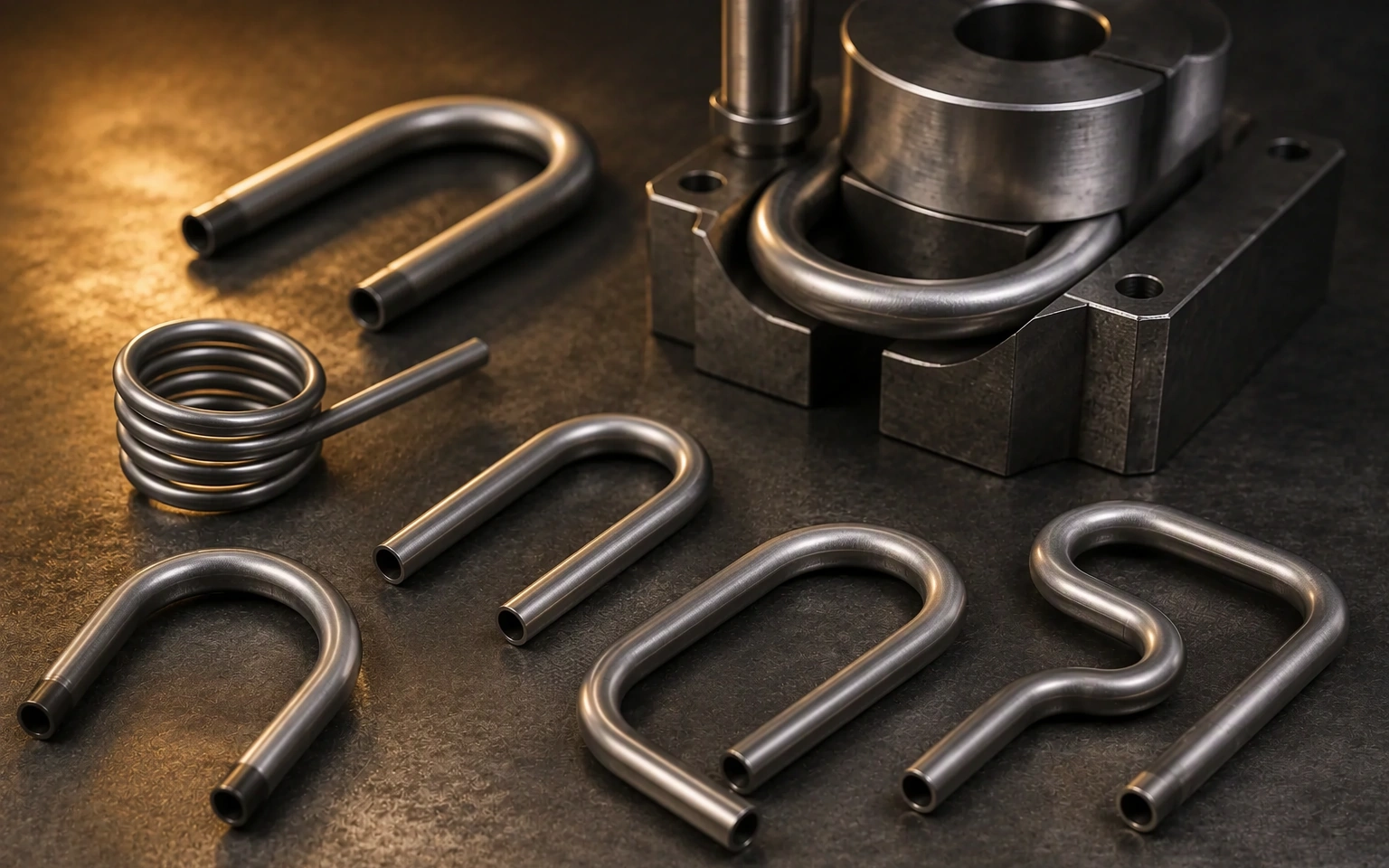
Grade 11 exists for the fabrication shop. Its lower yield strength and higher elongation mean lower forming loads, less springback and more margin before cracking in severe operations: tight-radius U-bends in heat-exchanger retubes, deep-drawn end closures, expansion joints, corrugated or thin-wall formed components. A practical signal: when the drawing shows tube bend radii below roughly 3× outside diameter in thin wall, or any deep draw, put Grade 11 into the quotation comparison even if the pressure design would accept Grade 7.
The economics are unforgiving in the wrong direction. One cracked bend trial, one split draw or a batch of out-of-tolerance springback can scrap more value than the entire per-kilogram difference between the two grades. If the fabrication route is aggressive, the “stronger” grade is the expensive grade.
Fabrication detailSevere forming favors the softer base
Confirm bend radii, springback and trial results before releasing the grade. AI illustration; not production or inspection evidence.
Welding follows standard titanium discipline for both grades: GTAW or GMAW with inert shielding on the face, back-purge on the root, and protection until the weld zone cools below the oxidation threshold. For corrosion service, specify matching palladium-bearing filler — ERTi-7 with Grade 7, ERTi-11 with Grade 11 — so the weld metal keeps the same reducing-acid protection as the base. Lower-Pd or unalloyed filler quietly downgrades the joint. Grade 11’s weld zones carry slightly lower residual stress and higher ductility, which is one reason it is preferred where formed and welded parts see thermal cycling.
05 / Service envelope
Define the duty before comparing grades
Identical corrosion resistance does not remove the corrosion review — it simply means the review compares the palladium-grade family against the duty, rather than the two grades against each other. The classic Pd-grade territory covers dilute hydrochloric acid at moderate temperatures, warm dilute sulfuric acid, phosphoric acid service, hot concentrated brines and crevice-prone chloride geometries, and wet chlorine or hypochlorite streams such as bleach-plant and water-treatment duty.
Crevice geometry deserves its own line in the enquiry. The highest-risk locations in chemical equipment are rarely the open surfaces — they are tube-to-tubesheet joints, gasket faces, lap welds and deposit-covered areas, where the local chemistry diverges from the bulk. Palladium raises the critical crevice-corrosion temperature in hot brines, which is why these grades appear in desalination brine heaters and evaporator tubing. State the joint geometry and deposit history in the enquiry; open-surface corrosion data does not qualify the crevice.
There are also firm boundaries where neither grade is the answer, and recognizing them early saves a wasted evaluation cycle:
Environment
Both grades
Purchasing action
Dilute HCl / warm dilute H₂SO₄, moderate temperature
Within the Pd envelope
Verify against project-specific evidence and coupon history
Hot concentrated brines, tight crevices
Extended window versus CP grades
Review crevice geometry and temperature with the designer
Concentrated HCl above ~20%, boiling H₂SO₄
Active corrosion risk
Specialist review; consider C-276, zirconium or tantalum
Anhydrous HF, strong fluoride media
Not resistant
Exclude titanium; escalate the material review
Strong alkali above ~pH 12 at temperature
Corrosion risk
Specialist review with the process owner
Dry chlorine gas, red fuming nitric acid
Ignition / pyrophoric risk
Prohibited; do not approve from a compatibility table
Collect the complete exposure envelope — all media and impurities with concentration ranges, bulk and wall temperatures, crevices and deposits, cleaning chemistry, startup and shutdown states. A short description such as “acid service” is not enough to approve either grade, and no palladium content compensates for an undefined process.
06 / Availability & cost
Stock position and lead time are decision inputs
Because the palladium premium applies equally to both grades, the price gap between Grade 7 and Grade 11 is driven by supply, not chemistry. Grade 7 is routinely stocked by mills and service centers in plate, sheet, tube and bar. Grade 11 is a lower-volume product: many offers are mill orders with a minimum quantity and an extended lead time, and thin-wall tube or strip can be the hardest forms to source quickly.
Quote both grades on an identical scope — product form, standard and edition, condition, dimensions, quantity — and ask for the lead time and minimum order quantity explicitly in the offer. A Grade 11 price that looks competitive per kilogram can carry a delivery schedule the project cannot accept; a Grade 7 price can hide forming scrap that only appears in fabrication.
Quotation alignment item
Why it matters for this comparison
Product form, standard and edition
B265, B338 and B348 scopes and test requirements differ; a mixed-scope quote cannot be compared
Condition and dimensional schedule
Annealed condition and exact dimensions drive both the price and the forming behavior
Quantity basis and minimum order
Grade 11 mill orders often carry minimums that inflate a small project
Lead time and melt schedule
A delayed Grade 11 melt can cost more than an approved Grade 7 redesign
Price validity window
Palladium is a traded precious metal; long validity requests can carry a premium
Forming responsibility
State who owns bend trials, springback allowance and scrap risk
Evaluate total project cost, not the kilogram rate. In pressure-retaining parts, Grade 7’s thinner design wall reduces material volume and weld metal, and can offset much of the palladium premium on heavy equipment. In forming-heavy parts, Grade 11 can pay for itself in trial yield alone. If lead time blocks Grade 11, the controlled alternative is an engineering-approved Grade 7 route with adjusted forming parameters — larger bend radii, hot forming or intermediate anneals — never a silent substitution. Palladium is a traded precious metal, so confirm price-validity windows on both grades before the order is released.
07 / Selection review
A practical selection review with four outcomes
Use the following matrix to organize the review. It is a purchasing workflow, not a corrosion-resistance chart or a list of approved operating limits.
Review outcome
Next purchasing action
Design governed by allowable stress
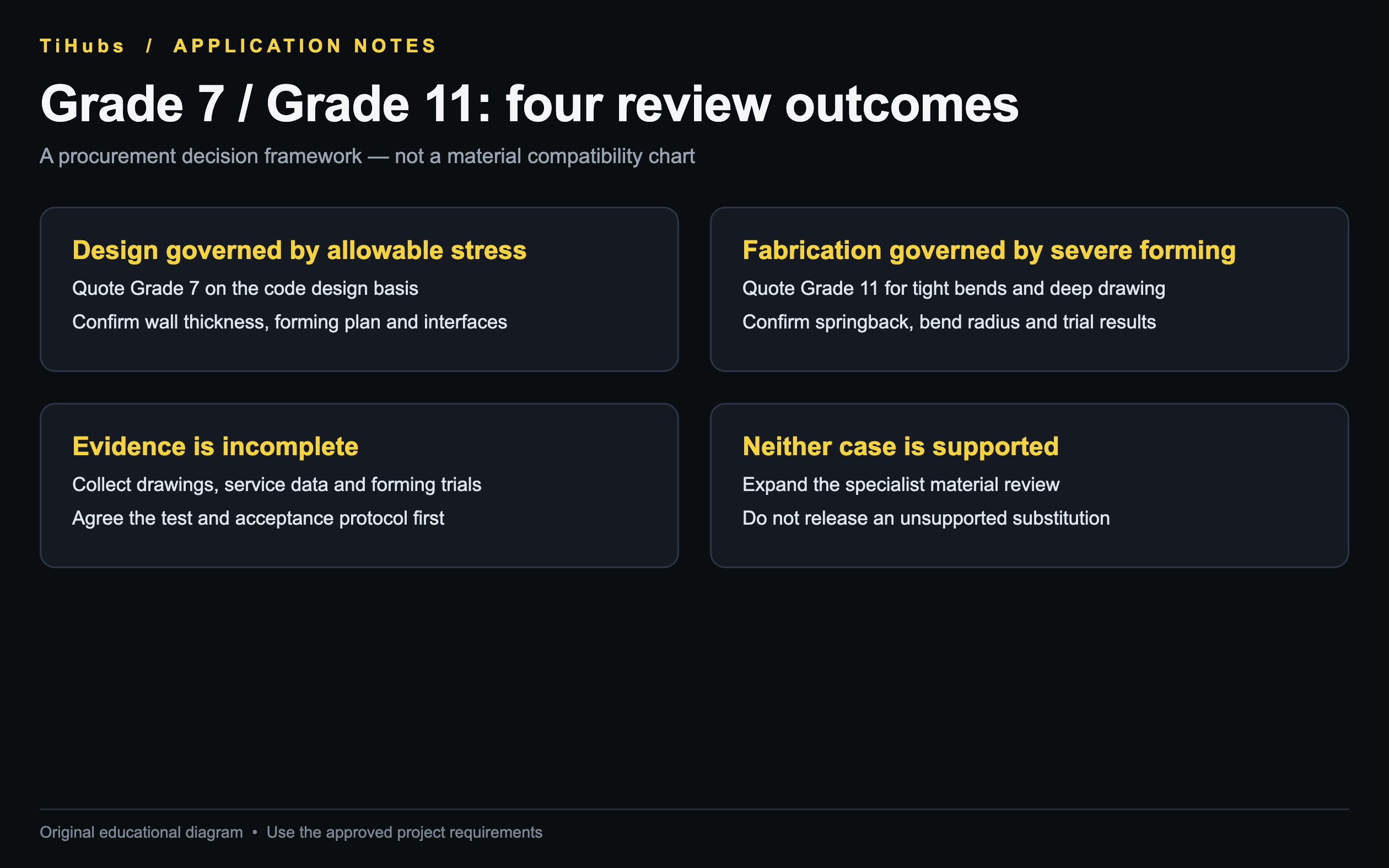
Quote Grade 7 on the code design basis; confirm wall thickness, forming plan and interfaces
Fabrication governed by severe forming
Quote Grade 11 for tight bends and deep drawing; confirm springback, bend radius and trial results
Information is incomplete
Collect drawings, service data and forming trials; agree the test and acceptance protocol first
Neither case is supported
Expand the specialist material review; do not release an unsupported substitution
Example: a heat-exchanger retube with tight U-bends
The operating team requested Grade 7 “because it is stronger.” The tube bundle drawing showed bend radii close to the forming limit for the specified wall. Bend trials on Grade 7 produced springback outside tolerance and two cracked samples. The released package used Grade 11 for the tube bundle while the tubesheet remained Grade 7 — one corrosion system, two mechanical bases, each where it belongs. The trial cost was trivial next to a scrapped bundle.
Example: a new pressure vessel on a code design
A new vessel in dilute-acid service was designed on code allowables. Grade 7 met the design with a meaningfully thinner wall than Grade 11, and the total fabricated cost — material, welding, freight — came out lower even though both grades solved the corrosion problem identically. The buyer’s checklist documented the governing requirement so the next reviewer can trace why the stronger base was chosen.
Selection workflowFour possible review outcomes
A procurement decision framework, not a corrosion-resistance chart.
08 / Product requirements
Carry the grade decision into the product order
Once a grade is selected, specify the product form and applicable standard — plate and sheet to ASTM B265, heat-exchanger tube to B338, bar to B348, pipe to B861/B862, forgings to B381, or the ASME SB equivalents for code work. State the edition, the delivery condition (annealed is standard for both grades), dimensions, tolerances and the inspection scope. “Grade 7 titanium” alone does not define a finished product requirement.
For fabricated equipment, connect the mill certificate to the cut pieces and the weld map. Require the fabrication plan to identify the material, the joining procedures, the palladium-bearing filler designation, the inspection stages and the final surface condition. Any proposed substitution — including between Grade 7 and Grade 11 — must be evaluated against both the material and the fabrication requirements and approved in writing.
Order controlMeasure against the approved requirement
Record the standard, condition and heat identity of the supplied material. AI illustration; not production or inspection evidence.
Where a Chinese designation is offered against an ASTM callout — TA9 for Grade 7, TA9-1 for Grade 11 — request a clause-by-clause comparison of chemistry, mechanical properties, testing and documentation, and approve any differences explicitly. Traceability must survive fabrication: the heat and lot identity should follow the material through cutting, bending and welding into the final release package.
09 / Release documents
Build a release package, not a collection of certificates
An effective release package links the approved design basis to the supplied product, its heat and lot, its forming and welding records, and any accepted deviations. The final review should be able to answer: which requirement governed the grade choice, what was supplied, how it was checked, and who accepted any difference.
Documented selection basis — the governing requirement: allowable stress or forming severity.
Product standard and edition, exact grade, condition and dimensional schedule.
Mill test certificate with heat/lot identity and the measured palladium result.
Bend or forming trial records where severe fabrication is specified.
Welding procedure and filler-metal certificates — ERTi-7 or ERTi-11 as applicable.
Inspection plan, reports and any witness or hold-point release.
Deviation register and written approvals linked to the correct revision.
Packing list and marking that preserve the certificate-to-product connection.
When a document is missing, keep the item open. A general company quality certificate is not a replacement for a heat-specific test report, and a valid raw-material certificate does not resolve an unapproved change in the equipment drawing.
The package leans on different evidence for each grade. A Grade 7 release rests on the design basis — the code allowable and the thickness calculation behind the stronger base. A Grade 11 release rests on fabrication evidence — bend-trial results, forming parameters and weld-procedure qualification behind the softer base. Whichever requirement justified the choice is the evidence the file must keep.
10 / RFQ checklist
Build your Grade 7 / Grade 11 enquiry checklist
Complete all known conditions and mark uncertainties. The brief below helps TiHubs coordinate the supply enquiry and identify questions that need the buyer’s designer or corrosion specialist before an order is released.
Build your operating-condition checklist
Choose the product and add the information you have. Copy the resulting brief or send your requirements to TiHubs. Submitting an enquiry does not place an order.
11 / FAQs
Frequently asked questions
Is Grade 11 more corrosion resistant than Grade 7?
No. Both grades specify the same 0.12–0.25% palladium range, and their corrosion behavior is treated as identical in published data. The difference between them is mechanical — strength, ductility and forming behavior — not chemical.
Can Grade 11 directly replace Grade 7 in a pressure vessel?
Not without a design review. Grade 11’s lower yield strength changes the code allowable and normally increases the required wall thickness. Treat the change as a formal substitution with the designer’s written approval.
Why is Grade 11 harder to source?
Demand is much lower than for Grade 7, so many suppliers produce it to mill order with a minimum quantity and extended lead time. Confirm stock position and schedule in the offer, not after release.
What is Grade 7H?
Grade 7H shares Grade 7’s chemistry but carries a higher minimum tensile strength of 400 MPa. It is a separate designation for designs that need the higher strength floor; it is not interchangeable with Grade 7 without approval.
Which filler metal should the welding procedure specify?
For corrosion service, specify the matching palladium-bearing filler — ERTi-7 with Grade 7 and ERTi-11 with Grade 11 — with full inert-gas shielding discipline. Unalloyed or lower-Pd filler downgrades the weld joint.
Are TA9 and TA9-1 the same as Grade 7 and Grade 11?
They are the nominal GB/T chemistry equivalents. Equivalence of a designation is not equivalence of the delivered product — compare the complete specifications clause by clause and approve any differences before substitution.
When is neither grade suitable?
Concentrated hydrochloric acid above roughly 20%, boiling sulfuric acid, anhydrous HF, strong alkali at temperature, dry chlorine gas and red fuming nitric acid are outside the envelope. Escalate to a specialist review of other alloy families.
Does Grade 11 cost more because of its palladium?
No. The palladium premium applies identically to both grades. Any price gap between them comes from availability, order volume and lead time, which is why both should be quoted on the same scope.
12 / Key takeaways
The palladium-grade decision in five checks
Treat corrosion resistance as identical; select on mechanics, fabrication and supply.
Let the design code’s allowable stress — not a datasheet minimum — set the wall-thickness comparison.
Score forming severity honestly before defaulting to the stronger grade.
Price availability, minimum order quantity and lead time, not just the kilogram rate.
Carry the decision into standards, filler metals, forming trials and a traceable release package.
TIMET — Corrosion Resistance of Titanium. Technical background on titanium corrosion, the palladium mechanism and alloy selection. Confirm current, project-specific evidence before design release.
The review matrices and examples are original purchasing guidance. No universal chemical concentration or temperature limit is established here. Photographs and diagrams are educational illustrations, not corrosion-test, fabrication or inspection evidence. References checked November 11, 2026.
Ti
About TiHubs
TiHubs coordinates titanium materials and custom supply from Baoji, China. Our founder’s 20 years in titanium inform a specification-led sourcing approach: clarify the product, manufacturing and acceptance requirements before quotation. Learn about our sourcing role.
Contents
TiHubs
Talk to TiHubs
Ask about titanium materials, grades or custom parts.
Enter your email to start chatting.
We use your email to respond to your enquiry. Your conversation is stored on this website.
Our team is away right now. Leave your enquiry and we will follow up by email.