Grade 5 vs Grade 23 titanium: buy the right ELI scope.
Similar alloy names can hide different purchase requirements. Compare chemistry, product standards and acceptance evidence before treating ELI as a replacement.
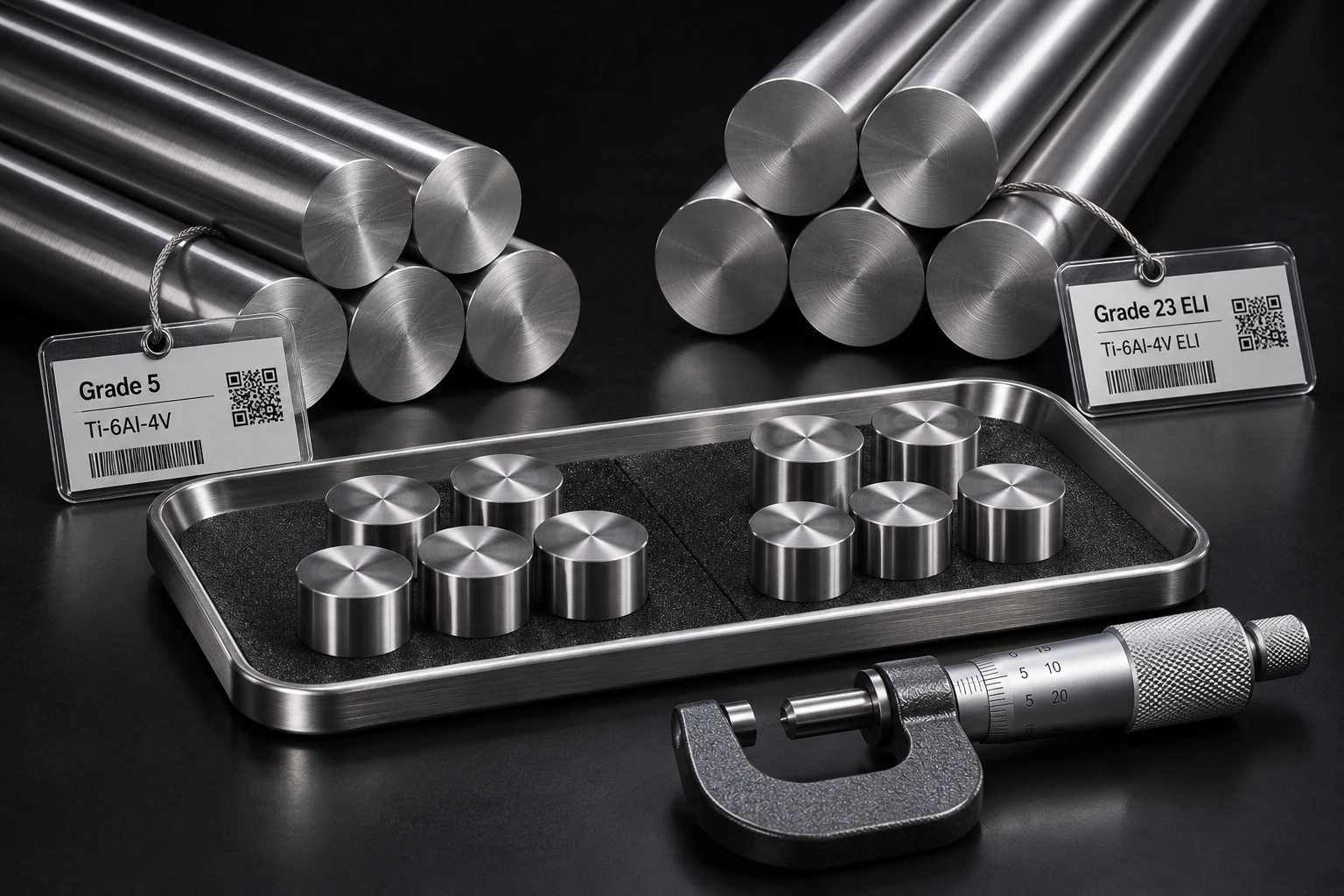
AI illustration. Appearance and labels do not verify material compliance.
Quick Answer
Grade 23 is the extra-low-interstitial (ELI) variant of Ti-6Al-4V; Grade 5 is the conventional Ti-6Al-4V grade. Lower permitted interstitial content can matter to the required property balance, but “ELI” is not a complete purchase specification. Confirm the product standard and edition, condition, chemistry, mechanical and metallurgical requirements, traceability and certificate scope. Neither grade should replace the other on a controlled drawing without a documented review and the required approval.
01 / The purchasing question
ELI changes the material requirement, not just the label.
A useful grade 5 vs grade 23 titanium comparison starts with the purchase specification. Two quotations may both say Ti-6Al-4V and show similar-looking bar stock, while only one addresses the required ELI chemistry, processing and acceptance records. The buyer’s task is to identify the exact deliverable rather than select the more impressive alloy description.
TIMET identifies Grade 23 as the ELI variant of Ti-6Al-4V and discusses its use where fracture-related properties are important. Its historical comparison shows tighter limits for oxygen, nitrogen, iron and hydrogen in the ELI material than in the conventional grade. The precise requirements must be taken from the ordered product standard and edition. [1]
This distinction does not mean Grade 23 is automatically the right choice for every stronger, more precise or more expensive component. The relevant question is whether the material, condition and manufacturing route satisfy the approved design. A buyer may need conventional Grade 5, a specified ELI product, or a particular implant-material specification; these are different order descriptions.
Product definitionStart with the product.
Define the form, condition and manufacturing requirements before comparing grades.
Acceptance evidenceConnect the records.
Dimensions, material identity and the agreed inspection scope belong together.
AI-generated editorial illustrations show product and inspection concepts. They are not production records or evidence of a particular material grade.
A purchasing comparison
Factor
Grade 5 / Ti-6Al-4V
Grade 23 / Ti-6Al-4V ELI
Alloy family
Conventional Ti-6Al-4V
ELI variant of the same nominal alloy family
Composition review
Apply the specified product-standard limits
Apply ELI limits and all other specified requirements
Property decision
Verify condition and product-specific requirements
Verify the required property balance; do not assume higher strength
Product specification
Exact industrial, aerospace or other specified document
Exact ELI product specification, including implant scope where required
Certificate review
Heat-specific evidence against the order
Heat-specific evidence that establishes the required ELI scope
Substitution
Requires review when the drawing calls for ELI
Requires review when the drawing calls for conventional Grade 5
Cost comparison
Quote actual dimensions, condition and records
Quote the same scope; do not assume a universal premium
What the chemistry comparison can show
As a screening example, TIMET’s published comparison lists maximum oxygen of 0.20% for Grade 5 and 0.13% for Grade 23, nitrogen of 0.05% and 0.03%, and iron of 0.40% and 0.25%, respectively. Those historical manufacturer values illustrate the distinction; they are not a substitute for checking the current, ordered standard or the actual heat analysis. [1]
The word “interstitial” should not lead the buyer to inspect oxygen alone. Review every required element, its reporting basis and the applicable limits. A heat with a low oxygen result does not automatically become certified ELI stock. The remaining chemistry, processing, tests and documents still need to meet the specified requirements. Likewise, the absence of an ELI suffix on a generic sales sheet should trigger clarification, not an assumption about the actual batch.
Similar appearance cannot identify the grade
Titanium bar, plate and machined blanks can look very similar across these grades. Surface finish, colour and machining marks do not establish an ELI designation. Use the product identification and linked records to determine what is offered. Illustrations in this article communicate product forms and inspection concepts; they are not evidence that a photographed item meets any particular specification.
02 / Requirements
Choose the specification before comparing the certificates.
Separate industrial grade designations from application-specific material specifications. ASTM B348/B348M covers titanium bars and billets, while ASTM B265 covers strip, sheet and plate. A purchase for a particular application may require another specification with its own scope. Record the exact document and edition rather than asking for “medical titanium,” “aerospace titanium” or “ELI quality” as a stand-alone requirement. [2][3]
Grade 23 and ASTM F136 are related, but not interchangeable labels
ASTM F136 addresses wrought Ti-6Al-4V ELI material for surgical implant manufacture, identified as UNS R56401, and covers chemical, mechanical and metallurgical requirements. An offer stating only “Grade 23 bar” does not by itself demonstrate conformity with F136. Ask whether the actual product is certified to the specified edition and whether the required supporting records are available. [4]
ASTM F1472 separately addresses wrought Ti-6Al-4V for surgical implant manufacture, identified as UNS R56400. Its existence is a useful reminder that “for implants” and “ELI” are not synonyms. The material requirement comes from the approved device design and specification, not from a general preference for one marketing label. [5]
Material-standard compliance also does not certify a finished medical device. This article concerns procurement of material and records. Finished-device design, manufacturing validation and applicable regulatory responsibilities must be addressed by the responsible organization. Do not describe a raw bar as an approved implant simply because a certificate cites a material specification.
Match the product form and condition
If the drawing requires annealed bar, confirm that the offered condition and test records correspond to that requirement. If a later operation changes the condition, identify who owns the resulting verification. A certificate for starting stock and an inspection report for the finished component answer different questions. Keep both in the document plan where the order requires them.
For sheet, review thickness, surface, flatness and relevant test direction. For bar, review section size, straightness, surface and machining allowance. For wire or forging stock, review the applicable product requirements instead of importing values from a plate comparison. A published tensile strength for a particular product is not automatically the requirement for all Ti-6Al-4V forms.
Build an acceptance-document matrix
Requirement
Evidence to request
Review question
Exact grade and standard
Certificate with full designation and edition
Does it state the actual ordered specification?
Chemistry
Heat analysis and any required additional analysis
Are all specified elements reported on the correct basis?
Delivery condition
Certificate statement and supporting records where required
Does the condition match the drawing and test results?
Mechanical properties
Required results with specimen and lot identity
Do size, direction, sampling and method fit the order?
Metallurgical requirements
Reports required by the selected specification
Are the required examinations actually included?
Manufacturing route
Required process information and approvals
Are there restrictions the quotation has not addressed?
Traceability
Piece, heat/lot and document linkage
Can the delivered stock be tied to the reported results?
Additional examination
Agreed procedure, coverage and acceptance criteria
Is the extra inspection defined well enough to accept?
Request a sample format before the batch is made
A sample certificate helps the buyer see whether the supplier’s normal document package contains the needed fields. It is not evidence for the future production batch. Ask which records are issued by the mill, which by the processor and which by an independent laboratory. Define the language, review stage and document identifiers so that the final package can be checked without reconstructing the supply history.
If a result is missing, identify whether the required evidence can still be obtained under the specification. Some gaps may be resolvable with an agreed additional test; others involve processing or traceability that a later test cannot recreate. Avoid assuming that any material can be converted into fully compliant ELI stock by adding a test after delivery.
03 / Acceptance and cost
Substitution needs a defined technical decision.
The substitution question works in both directions. Conventional Grade 5 is not an automatic replacement for a specified ELI material. Grade 23 is not an automatic replacement for every Grade 5 order either. A tighter chemistry limit in one area does not prove that all other requirements, property assumptions, approved sources and documentation obligations are satisfied.
Use a five-step substitution review
Freeze the original requirement. Record the drawing, specification editions, product form, size, condition and application-specific controls.
Describe the offered alternative. Obtain the exact designation and specification, proposed batch records and a separate deviation list.
Compare every controlling requirement. Include chemistry, properties, processing, inspection, traceability and any source restrictions.
Obtain the required approval. Record the approving party, decision, limitations and document revision before production or shipment.
Carry the decision through delivery. Ensure the order, labels, certificates and incoming inspection criteria reflect the approved scope.
An illustrative ELI quotation problem
A buyer requests bar to a specified F136 edition. One quotation says “Grade 23 ELI” and provides a generic chemistry table; another identifies the requested specification, condition, inspection package and heat traceability. The first offer may still be viable, but it is incomplete. Ask the supplier to close the missing requirements before comparing it commercially with the second offer.
If the supplier proposes standard Grade 5 because it is available sooner, that is a material alternative, not a delivery adjustment. The technical owner must decide whether it is permissible. If the drawing does not allow the alternative, procurement should seek a compliant supply route rather than treating a lower price or shorter lead time as approval to substitute.
Compare cost without assuming a fixed ELI premium
ELI supply can involve a different stock position and specification scope, but a single percentage premium is not useful for every size and order. Compare quotations for the same product form, condition, usable dimensions, quantity, tests, documents, packing and delivery terms. Ask whether the quoted material is available as identified stock or requires a new production route.
Separate material price from the cost of qualification, additional examination, machining allowance and document review. For a small order, minimum order quantity or usable stock size may matter more than price per kilogram. For a repeat order, consistency of the approved supply and document package may be commercially important. Ask for the conditions that could change price or lead time before placing the order.
Protect identity through machining and finishing
Once material is cut into blanks, traceability should continue through the operations required by the order. Agree how parts or containers are identified and how mixed heats are controlled. If the same workshop processes Grade 5 and Grade 23, the buyer should understand the identity controls for the relevant order. Visual similarity makes this a documentation and handling issue, not an appearance check.
Before shipment, reconcile the final quantities, heat/lot identities and certificate references with the packing list. For finished parts, review the material records separately from dimensional acceptance. If an approved deviation applies only to a particular batch or drawing revision, make that limitation visible. Do not carry a one-time approval into later orders without checking its scope.
Keep the claims proportionate to the evidence
Avoid claims such as “Grade 23 is always safer,” “ELI is always stronger” or “all Grade 5 is unsuitable for medical use.” Those statements erase the role of the product specification, design and processing history. A useful supplier response identifies the material it can provide, the requirements it can demonstrate and any remaining questions. That is more valuable than a broad superiority claim.
04 / Build your RFQ
Ask for the exact ELI supply scope.
TiHubs coordinates titanium material and custom supply from Baoji. For an ELI enquiry, send the product specification and edition, full designation, size, condition, quantity, destination and required document package. Identify whether an alternative is permitted and who must approve it. We can coordinate clarification with the proposed supply route before the commercial scope is finalized.
Use the checklist to distinguish the grade name from the application-specific specification. If you are buying for an implant-related supply chain, include the material requirements already approved by your technical team. Do not leave the supplier to infer the required standard from a general application description.
Build your RFQ checklist
Choose the product and add the information you have. Copy the resulting brief or send your requirements to TiHubs. Submitting an enquiry does not place an order.
“Please quote the exact material specification and edition listed in the enquiry. Confirm the full ELI designation, product form, delivered condition, chemistry, required mechanical and metallurgical results, and heat/lot traceability. List the certificates and inspection reports included. Quote any alternative separately and do not substitute without written approval.”
05 / FAQ
Questions about Grade 5, Grade 23 and ELI.
What does ELI mean?
ELI means extra low interstitial. In Ti-6Al-4V purchasing, it identifies a controlled variant with tighter composition limits in relevant elements. The exact limits and remaining requirements depend on the ordered specification and edition.
Is Grade 23 stronger than Grade 5?
Do not assume that. ELI is about a different controlled composition and property balance, not a universal increase in tensile strength. Compare the required product and condition using the applicable specification and actual test records.
Does Grade 23 automatically mean ASTM F136?
No. F136 is a specific material specification with chemical, mechanical and metallurgical requirements. A Grade 23 label alone does not establish complete conformity with the specified F136 edition.
Is ASTM F1472 an ELI specification?
F1472 addresses wrought Ti-6Al-4V identified as UNS R56400. F136 addresses the ELI alloy identified as UNS R56401. Use the exact specification required by the approved design rather than treating the two references as interchangeable.
Can low-oxygen Grade 5 stock be accepted as ELI?
A low oxygen result alone is insufficient. The complete chemistry and all other required product, processing, test and document requirements must be established. Any proposed acceptance route needs the appropriate technical review.
Can Grade 23 replace Grade 5 without approval?
Not on the assumption that lower interstitial limits make every requirement equivalent. Compare the entire order and obtain the required approval for the proposed substitution.
Which documents should accompany an ELI order?
Agree the material certificate, heat/lot identity, required chemistry and property results, applicable metallurgical or supplementary examination reports, and finished dimensional reports where relevant. The exact package depends on the ordered specification and contract.
Does a material certificate approve the finished implant?
No. A raw-material certificate addresses its stated material scope. It does not replace the separate design, manufacturing, validation and regulatory responsibilities for a finished device.
06 / Key takeaways
Buy a defined specification, not an ELI slogan.
Grade 23 is the ELI variant. Verify the full chemistry and product requirements.
Choose the application-specific standard. Grade names alone do not establish F136 or another specification.
Review condition and records together. A generic datasheet cannot certify the offered heat.
Control substitutions in both directions. Better availability or one tighter limit is not automatic approval.
Compare equal commercial scopes. Include inspection, documentation, usable stock and delivery terms.
Technical references
Sources and data scope
Technical references checked November 7, 2026. The chemistry examples are historical manufacturer reference data and must not be used in place of the controlled order specification. This article addresses material procurement; it does not establish finished-device suitability or approval.
ASTM B265 — titanium strip, sheet and plate scope.
ASTM F136 — wrought Ti-6Al-4V ELI for surgical implant manufacture, UNS R56401.
ASTM F1472 — wrought Ti-6Al-4V for surgical implant manufacture, UNS R56400.
Ti
About TiHubs
TiHubs coordinates titanium materials and custom supply from Baoji, China. Our founder’s 20 years in titanium inform a specification-led sourcing approach: clarify the product, manufacturing and acceptance requirements before quotation. Learn about our sourcing role.
Contents
TiHubs
Talk to TiHubs
Ask about titanium materials, grades or custom parts.
Enter your email to start chatting.
We use your email to respond to your enquiry. Your conversation is stored on this website.
Our team is away right now. Leave your enquiry and we will follow up by email.